

On 8th November 2026, the day Hindus all over the world celebrated their most sacred festival of Diwali, a proposed 30-foot idol of Goddess Saraswati at Dhaka University’s Jagannath Hall became another flashpoint in the continuing persecution of Hindus in Bangladesh. The opposition to the initiative once again brought into focus the hostility Hindu religious expression faces, even within the Islamic Republic’s educational institutions.
This controversy was not isolated. At the same university, Hindu student leader Dipjoy Sarkar Dipta faced death threats, online harassment and doxxing after he publicly defended Hindu religious rights and protested the insult of Lord Shri Ram. The targeting of a student for speaking up against the desecration of Hindu religious sentiments raised further concerns about the intimidation faced by those who stand up for the community.
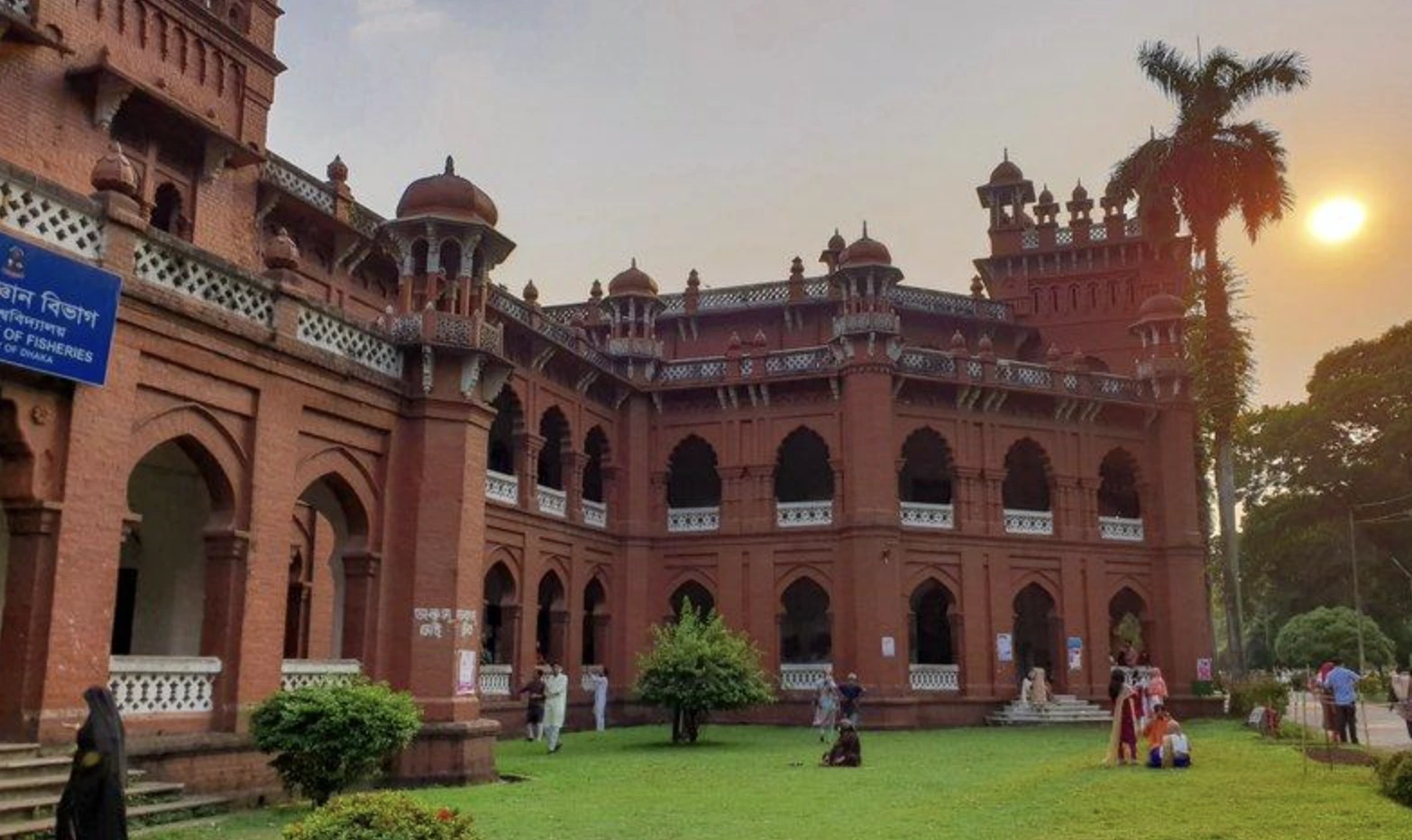
For Bangladesh’s Hindu minority, such controversies are part of a much larger struggle to preserve their religious identity, protect their places of worship and exercise their fundamental right to practise their faith without intimidation or discrimination. From attacks on temples and religious symbols to threats, exclusion and opposition to Hindu religious observances, the challenges confronting the community extend far beyond isolated incidents.
The developments at Dhaka University in November also draw renewed attention to another institution in the capital: Jagannath University, with a history rooted in Bengal’s Hindu educational and cultural heritage. This institution has also witnessed a series of controversies involving its Hindu students, their right to worship and their ability to observe religious festivals without interference.
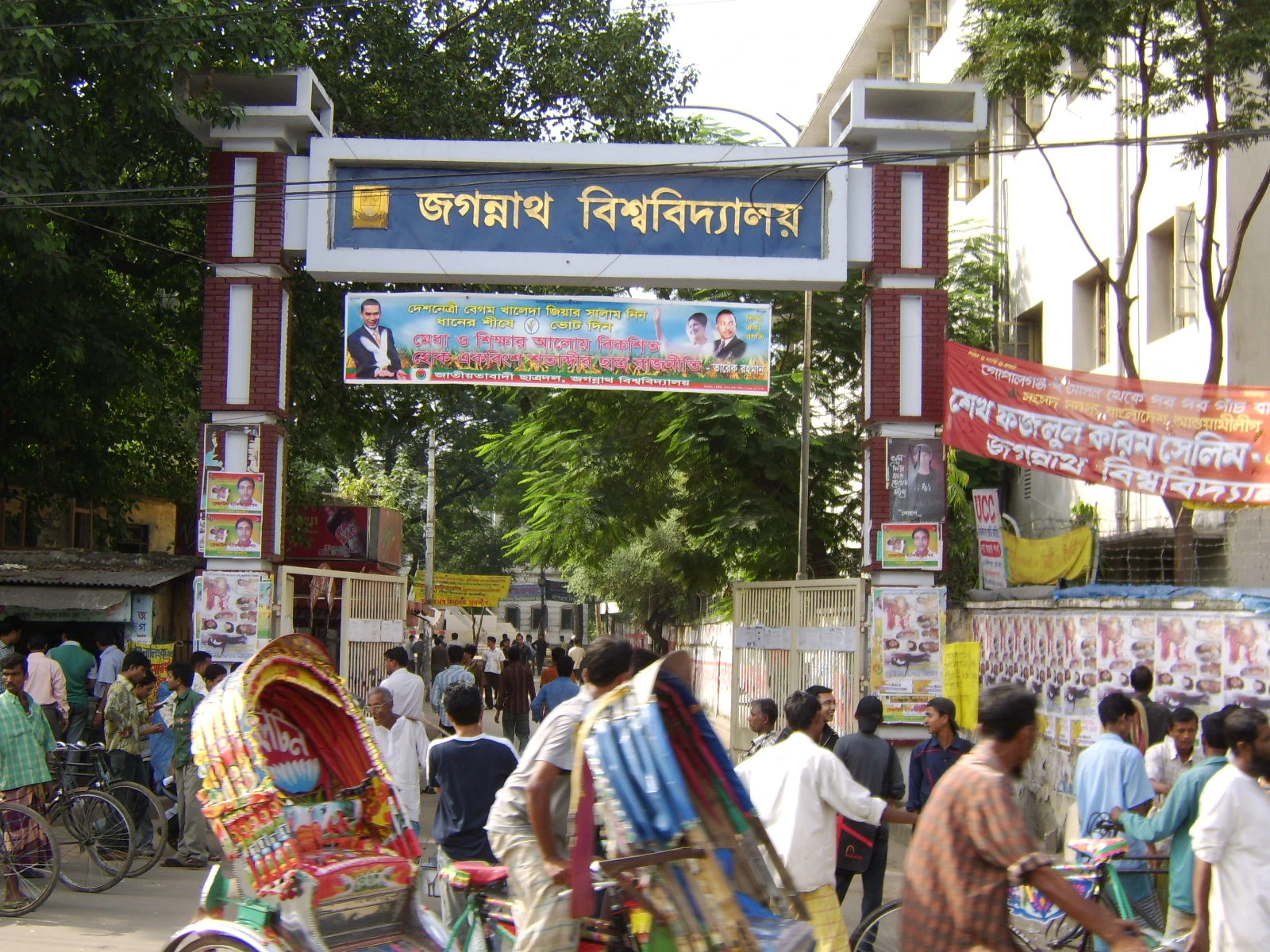
The Hinduphobia Tracker has documented eleven incidents connected to Jagannath University. These include disputes over Hindu religious observances, the treatment of Hindu students, religious intimidation, threats of conversion, anti-Hindu slogans and acts that directly offended Hindu religious sentiments.
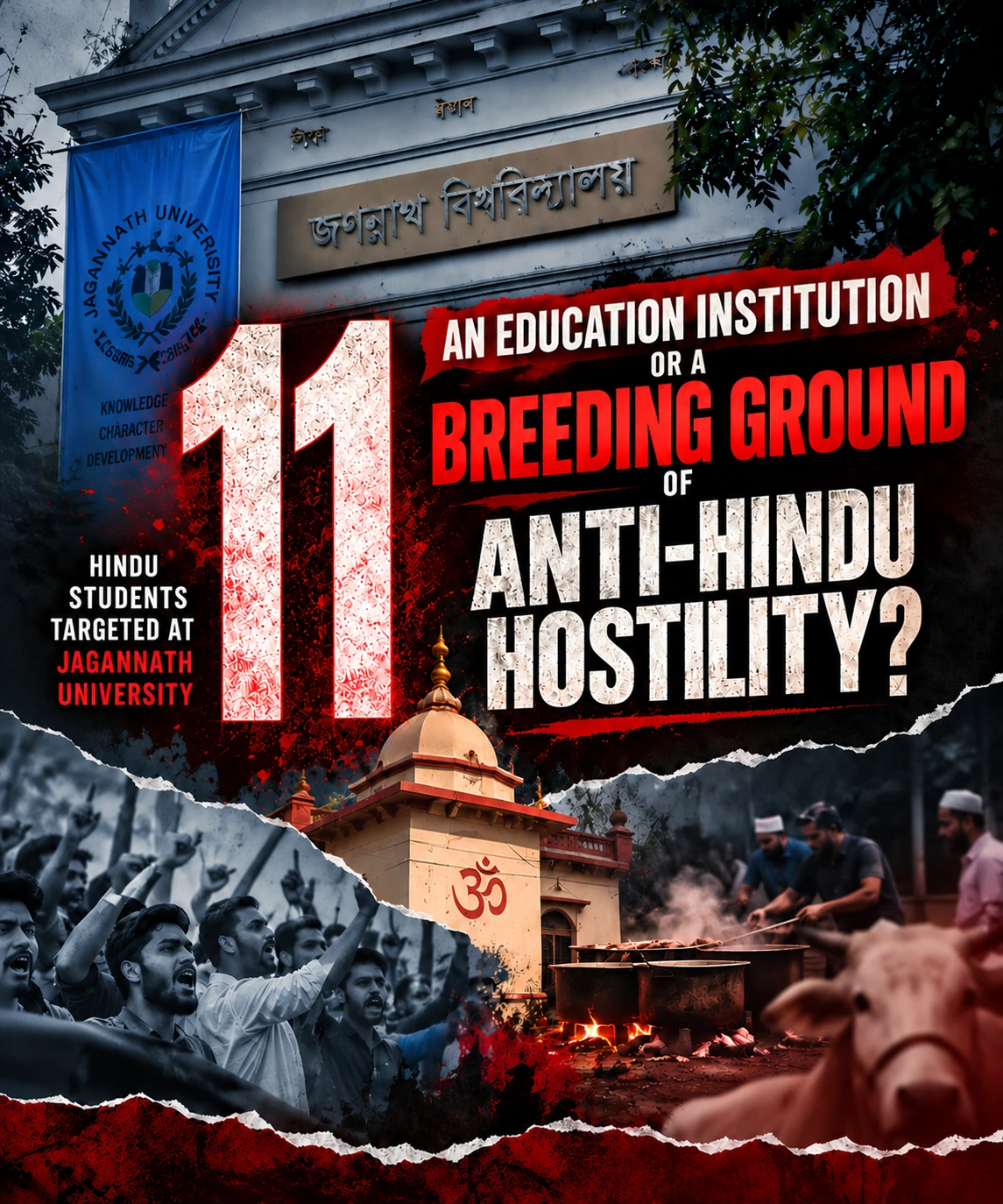
The controversy that erupted in October 2026 over beef khichuri being prepared near the university’s Central Hindu Temple brought these attacks into sharp focus. What began as an objection by Hindu students to the location of a beef-cooking arrangement escalated into anti-Hindu slogans, threats, calls for conversion and public cow slaughter during Durga Puja. The subsequent developments exposed the extent to which Hindu religious sentiments could be dismissed, challenged and openly provoked on a university campus.
Interestingly, both the University of Dhaka and Jagannath University, institutions that have increasingly become sites of hostility towards Hindus, share deep historical connections to the Hindu educational and cultural heritage of the region now known as Bangladesh. Though their institutional histories differ, both bear the imprint of Hindu philanthropists, educators, and students who contributed significantly to the development of higher education in this part of the subcontinent.
Against this historical backdrop, the growing hostility towards Hindu religious expression at these institutions is particularly concerning. Educational institutions should provide a safe and inclusive environment for all students. Yet, in Bangladesh, campuses have become spaces where Hindus face the same hostility, discrimination and intimidation that they encounter elsewhere in society. The persecution of Bangladesh’s Hindu minority has not spared educational spaces. It follows Hindu students into their classrooms, hostels and campuses, threatening their freedom to practise their faith, celebrate their festivals and stand up for their religious identity without fear.
Dhaka University: Its founding history and the Hindu connection
The University of Dhaka, one of Bangladesh’s oldest and most prominent institutions of higher education, began its journey on 1 July 1921. Its establishment followed a political campaign that gathered momentum after the annulment of the 1905 Partition of Bengal in 1911. Some Muslim leaders in East Bengal viewed the decision to reverse the partition as a setback to the region’s educational and political advancement. In response, a delegation led by Nawab Sir Salimullah, Nawab Syed Nawab Ali Chowdhury and A.K. Fazlul Huq met Viceroy Lord Hardinge in Dhaka on 31 January 1912 and pressed for the establishment of a university in the city. The Government of India subsequently announced its decision to recommend a university at Dhaka.
The British Government then appointed a committee under Sir Robert Nathan on 27 May 1912 to prepare a detailed plan for the proposed institution. Known as the Nathan Committee, it included prominent members from different backgrounds. Historical records name Hindu representatives such as Dr Rash Behari Ghosh, Ananda Chandra Ray, Satis Chandra Acharji, and Lalit Mohan Chatterjee. Their participation is an important part of the university’s formative history. The Dacca University Act was passed in 1920, and the university formally opened the following year with three faculties, twelve departments and three residential halls: Salimullah Muslim Hall, Dacca Hall and Jagannath Hall. Sir Philip Joseph Hartog served as its first Vice-Chancellor.
The Hindu connection, however, goes beyond individuals’ participation in the university’s planning. It is particularly visible in the history of Jagannath Hall, one of the three original residential halls established when the university opened. The hall was named after Jagannath Roy, the father of Kishorilal Roy, a zamindar and philanthropist from Baliati in Manikganj. Its establishment was closely linked to Jagannath College’s educational contributions, whose students, teachers, and library resources helped the newly established university get started. The college’s contribution was significant enough that the university recognised it by naming Jagannath Hall.
Jagannath Hall also had a distinguished Hindu academic presence from its earliest years. Professor Naresh Chandra Sen-Gupta of the Law Department was its first provost. In subsequent decades, several eminent Hindu scholars served as its provost, including physicist Satyendra Nath Bose, educationist Gyan Chandra Ghosh, philosopher Govinda Chandra Dev and professor Jyotirmoy Guhathakurta. The latter two were among those killed by the Pakistani Army during the 1971 Liberation War. The hall also became an important centre of academic, cultural, and political activity, with its students participating in major movements in the region’s history.
Therefore, it is important to understand that although Muslim political leaders drove Dhaka University’s establishment and British-era legislation formalised it, its early history was not exclusively Muslim. Hindu educators, academics, philanthropists and students contributed to its development, while Jagannath Hall became a lasting institutional symbol of that connection. Its name, origins and academic legacy are part of the university’s own history.
This historical background is particularly significant in light of the controversies surrounding Hindu students and their right to uphold their faith and religious identity at the University of Dhaka. The demand for a Hindu religious symbol on a campus with such a long association with Hindu students and scholars cannot be dismissed as an attempt to impose a religious identity on the university. At its core, it is about whether Hindu students can have their faith, cultural heritage and religious observances recognised and respected within an institution whose history is also closely linked to their community. The two incidents discussed below bring this question into sharp focus.
Dhaka University: When defending Hindu faith becomes a target for intimidation
On 8 November 2026, Dhaka University laid the foundation stone for a proposed 30-foot permanent idol of Goddess Saraswati at Jagannath Hall, a prominent residential hall with a significant Hindu student population. Muslim students and Islamic organisations, however, opposed the proposed construction on religious grounds. The protesters described the university as an ‘Islamic institution’, invoked Islamic theology to justify their opposition and accused Hindu organisations of pursuing a ‘Hindutva agenda’. They also denigrated Hinduism, Hindu deities and the Hindu community, hurled communal slurs such as ‘Malaun’ (a derogatory slur against non-Muslims, most notably against Hindus in Bangladesh) against Hindus and issued threats over the proposed construction.
The initiative responds to a long-standing student demand for a permanent representation of the goddess on campus. Upon completion, the proposed structure is expected to house the world’s largest Saraswati idol. The foundation-laying ceremony was attended by Vice-Chancellor Professor A B M Obaidul Islam, Jagannath Hall Provost Professor Debashish Pal, university officials, students and representatives of Hindu organisations. Addressing the gathering, the Vice-Chancellor emphasised that Bangladesh belonged to people of all religions and communities, and that everyone should be able to express themselves and enjoy equal rights. The university administration presented the initiative as an expression of religious inclusion and recognition of the students’ aspirations.
However, the announcement soon attracted opposition from Muslim organisations.
On 11 November, Hefazat-e-Islam Bangladesh issued a statement opposing the construction of the permanent idol. The organisation described Dhaka University as an Islamic university and questioned how an idol or temple associated with Hindu worship could be established within its premises. They also demanded to know who had initiated the project, who was funding it and whose interests were behind the construction.
Hefazat-e-Islam described the proposed idol as part of a ‘Hindutva agenda’ and accused Hindu organisations of attempting to expand their influence in Bangladesh through the initiative. The organisation also demanded a government investigation into the project’s motives.
On 14 and 15 November, Muslim students and organisations began mobilising against the proposed construction, demanding that the project be cancelled. During the protests, several Muslim students and demonstrators made derogatory remarks against Hinduism, the Hindu community and Hindu deities. In a media interview, a protester identified as Mohammad Hamidul Islam described Hinduism as a ‘wrong religion’ that had failed to flourish. He questioned the belief in the 33 crore Hindu deities and asserted that, according to Islamic scholars, no religion other than Islam could survive on earth. He also mocked Hindu religious figures and deities, referring to them as ‘Ram-Bam’ and making disparaging references to Hindu saints dressed in red and orange robes. He declared that the people of Bangladesh would never accept Hindu religious figures, including sadhus and saints.
The protester further used the derogatory communal slur ‘Malaun’, commonly directed at Hindus in Bangladesh, while declaring that the country would never accept them. He said Hindu students and teachers had gained the confidence to initiate the idol’s construction because the Indian High Commission had funded the temple. He warned that if an idol were installed at Dhaka University, the institution would no longer remain a university.
Referring to an earlier October incident in which Hindu students had raised slogans against the protesters, he used it to further justify the opposition. He also issued a direct threat, stating that if such activities continued, the protesters would deliver a ‘befitting reply’.
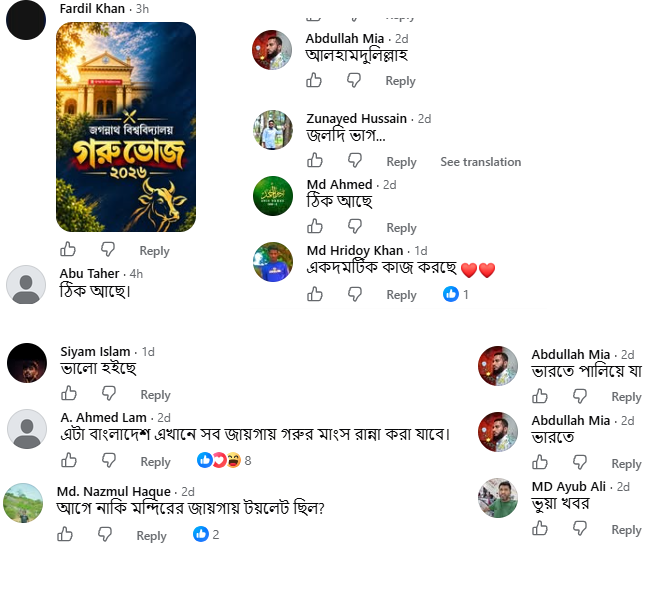
Another Muslim protester, while addressing the gathering, described Dhaka University as an Islamic university and questioned how a Hindu temple or idol could be established on its premises. Drawing comparisons with Jagannath University, he pointed out that even a proposal to build a public toilet had been applauded, whereas the proposed installation of a Hindu idol at Dhaka University had drawn opposition. He also referred to other universities, describing them as Islamic universities despite their institutional names, and questioned why Hindu religious structures or idols should be permitted on their campuses. Invoking the Quran and Islamic religious teachings, he argued that Muslims had the right to oppose idol worship and the proposed installation.
Such remarks went beyond an objection to the proposed construction. They expressed contempt towards an entire faith and its followers.
Hindu idols hold immense religious and cultural significance as representations of the divine and serve as focal points of worship and devotion. Goddess Saraswati is revered as the Hindu goddess of knowledge, education, wisdom, music and the arts. Her worship is particularly associated with educational institutions, where students and teachers seek her blessings for learning and academic pursuits. Across the Indian subcontinent, including Bangladesh and Pakistan, Goddess Saraswati is recognised as an important religious and cultural figure. Her idols and images are consequently found in schools, colleges and universities, where they symbolise the pursuit of knowledge and learning.
In this instance, the proposed installation at Dhaka University was an institutional initiative that reflected respect for Hindu religious sentiments and the cultural significance of Goddess Saraswati. However, the initiative was met with organised opposition from Muslim students and Islamic organisations, who questioned how a Hindu idol could be installed at what they described as an ‘Islamic university’. They invoked their religious objections to idol worship to justify preventing its construction. Despite Dhaka University being a secular institution, they sought to impose an Islamic religious identity upon the campus and treated the presence of a Hindu deity as unacceptable. The vehement opposition to even a peaceful installation representing knowledge and learning, simply because it was associated with Hinduism, exposed deep-seated anti-Hindu intolerance. It demonstrated an unwillingness to accommodate Hindu religious expression within a secular educational institution and reflected an attempt to deny Hindus the freedom to publicly express their faith. Such opposition also conveyed that Hindu religious symbols and sentiments were unwelcome on the campus, creating an atmosphere of intimidation for Hindu students, teachers and other members of the university.
The right to practise one’s religion cannot depend on whether another religious group approves of its symbols or traditions. A public university that accommodates students from different faiths must recognise their equal right to religious expression. The opposition to the Saraswati idol, therefore, sent a direct message to Hindu students that their faith, deities and traditions were unwelcome on campus. It reflected an exclusivist mindset rooted in the notion of Islamic supremacy, which regards non-Islamic faiths, particularly idol-worshipping traditions like Hinduism, as inferior or unacceptable. In Islam, idol worship, or shirk, is regarded as a grave sin. When this theological belief translates into contempt for those who worship Hindu deities, it fuels hostility towards Hindu traditions and their followers. Hindu gods and goddesses become targets of mockery, religious rituals are disrespected, and the right of Hindus to practise their faith is challenged. The opposition to the Saraswati idol was therefore not merely an objection to a religious installation. It reflected a deeper hostility towards Hinduism, driven by an ideology that seeks to demean, delegitimise and exclude Hindu beliefs from public spaces. The attempt to deny Hindu students the right to honour Goddess Saraswati exposed the religious intolerance underlying the opposition.
Hindu student leader faces death threats and online harassment for defending Lord Shri Ram
In another incident at the University of Dhaka, Dipjoy Sarkar Dipta, a Hindu student leader and Assistant General Secretary (AGS) of the Jagannath Hall Students’ Union, faced death threats, online harassment and the circulation of his personal information after publicly defending Hindu religious rights and protesting the insult of Lord Shri Ram.
The campaign against Dipta began shortly after he addressed a protest organised by Hindu students of Jagannath Hall. The students had gathered to condemn the public insult of Lord Shri Ram and demand protection for Hindu religious rights and sentiments. According to Dipta, the harassment began on the night following the protest and soon developed into a sustained online campaign intended to intimidate him and silence his advocacy.
Dipta named a Muslim student identified as Jamshed as the person who initiated the campaign. According to Dipta, his personal mobile number was circulated across social media platforms, exposing him to repeated harassment. He also stated that Jamshed, identified as the Acting President of the Bangladesh Jatiyatabadi Olama Dal, publicly portrayed him as a terrorist by associating him with the term ‘Bhagwa Love’, without establishing the facts.
The campaign also extended to Dipta’s personal life. Content concerning his longtime classmate and female friend was circulated on social media to malign their relationship. Dipta maintained that the university community had always regarded their relationship as akin to that of siblings, and that attempts to portray it otherwise began only after he spoke out in defence of Hindu religious rights.
The targeting of Dipta raised serious concerns about the freedom of Hindu students to speak up against insults to their faith. His religious identity, coupled with his public defence of Hindu religious rights, became the backdrop to a campaign involving threats, personal attacks and attempts to discredit him. The circulation of his private information and the intimidation directed at him sent a chilling message to other Hindu students who might wish to challenge anti-Hindu hostility on campus.
When a student faces threats and intimidation for protesting the insult of a revered Hindu deity, the issue is no longer simply a disagreement over religious expression. It concerns a religious minority’s freedom to defend its faith without becoming a target itself.
Jagannath University: Its origins and the Hindu connection
Like the University of Dhaka, Jagannath University also has deep historical connections with the Hindu educational and social reform movements of nineteenth-century Bengal. Its roots trace back to the efforts of Bengali reformers and philanthropists who sought to expand access to education in Dhaka. Its history began in 1858 with the establishment of Dhaka Brahma School by Dinanath Sen, Prabhaticharan Roy, Anathbandhu Mallik and Brajasundar Kaitra. The founders were associated with the Brahmo Samaj, a socio-religious reform movement that emerged within the broader Hindu reform tradition and played an important role in the Bengal Renaissance.
The institution received its present historical identity through the contribution of Kishorilal Roy Chowdhury, a prominent zamindar and philanthropist from Baliati in Manikganj. In 1872, he took over the school’s management, moved it to its present location, and renamed it Jagannath School in honour of his father, Jagannath Roy Chowdhury. His intervention came at a critical time, when the school faced financial difficulties. Kishorilal’s support helped secure its future and laid the foundation for what would eventually become one of Dhaka’s most prominent educational institutions.
Kishorilal Roy Chowdhury’s contribution did not end with the school’s revival. In 1884, he upgraded it into a second-grade college, with assistance from individuals including Anath Mallick, Advocate Trailokyanath Basu and Justice Sarda Charan Maitra. Law was among the first courses introduced. The college gradually expanded its academic offerings, introducing honours courses in subjects such as English, Philosophy, and Sanskrit. It also developed a reputation as one of the leading non-government colleges in Dhaka, attracting students from different parts of the region.
The institution continued to evolve through the twentieth century. After Dhaka University was established in 1921, Jagannath College had to discontinue its degree courses and was renamed Jagannath Intermediate College. It resumed degree programmes in 1949, was taken over by the government in 1968, and was subsequently upgraded to a postgraduate college. On 20 October 2005, it formally began its journey as a full-fledged public university under the Jagannath University Act, 2005.
Thus, although Jagannath University attained university status only in 2005, its institutional legacy stretches back nearly a century and a half. Its origins lie in a school established by followers of the Brahmo Samaj, while its name and subsequent growth are inseparable from the philanthropy of Kishorilal Roy Chowdhury and the legacy of his father, Jagannath Roy Chowdhury. In this sense, the institution is an important part of the region’s Hindu educational and cultural heritage.
This legacy becomes particularly significant when examined alongside the treatment of Hindu students at the present-day university. Despite the institution’s deep historical connections with Hindu educational and cultural heritage, Hindu students at Jagannath University have repeatedly faced threats, intimidation and hostility for asserting their religious identity and defending their right to practise their faith. The total 12 incidents (11 under the Hate Crime database and 1 under the Undecided database) documented by the Hinduphobia Tracker provide concrete examples of this pattern.
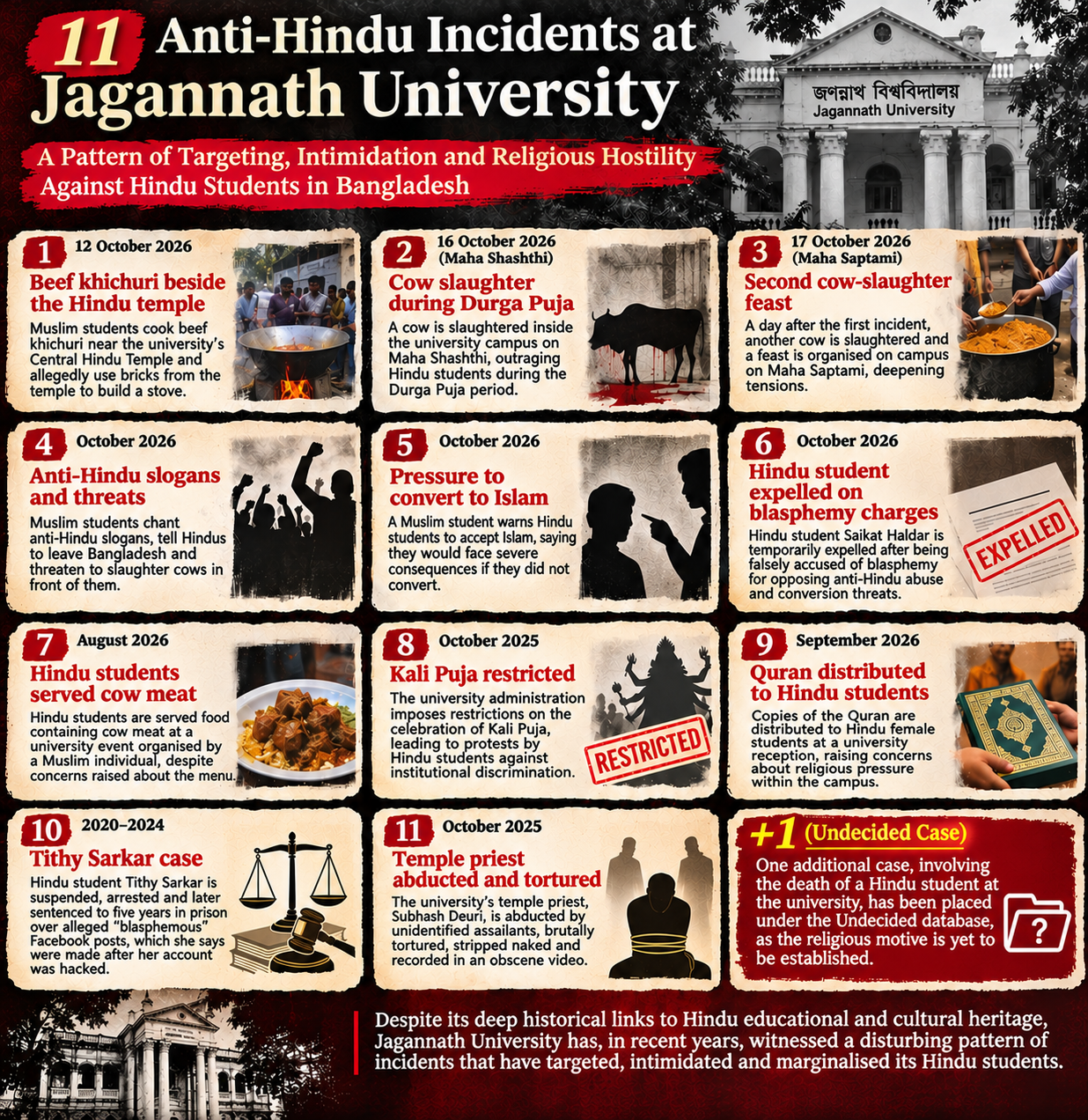
Beef Khichuri beside a Hindu Temple: The incident that sparked outrage at Jagannath University
The latest controversy at Jagannath University began on Monday evening (October 12th, 2026), when students from the 17th batch of the Department of Islamic History and Culture organised a beef khichuri feast near Muktamancha, an open-air space on campus. The university’s Central Hindu Temple is situated nearby. For the Hindu community, the location was a matter of deep religious concern. Cooking beef so close to a Hindu place of worship was seen as a disregard for the sanctity of the temple and the sentiments of those who worship there.
Around 8 pm, Joy Saha, member secretary of the university’s Central Temple Management Committee, approached the organisers along with other students. Speaking to BBC Bangla, Joy said they initially asked what meat was being cooked before learning it was beef. Saha said the proximity to the temple caused considerable distress and that they requested the organisers to move the cooking arrangements elsewhere.
What should have been a straightforward appeal to consider a religious space soon turned into a heated exchange. Saha confirmed that some organisers responded provocatively and questioned the temple’s boundaries. The university proctor eventually intervened, and the cooking arrangements were moved slightly away, though the cooking did not stop.
The organisers claimed that they had no intention of hurting anyone’s religious sentiments. But for Hindus, the question extended beyond the organisers’ stated intentions. A place of worship deserves respect, and students should not have to argue to have their religious concerns taken seriously. The episode had already left Hindu students feeling that the organisers treated the sanctity of their temple as an afterthought.
The dispute deepened when concerns emerged that the organisers used bricks from the temple to build a makeshift stove for the feast. Reports claimed the organisers initially planned to cook in the university cafeteria but moved outdoors because of low gas pressure. They claimed they used nearby bricks without knowing they belonged to the temple. They also claimed that after objections were raised, they removed the bricks, brought an iron stove from the cafeteria and apologised.
Their explanation addressed how they used the bricks, but it did not erase the distress the incident caused. From the Hindu community’s perspective, the concern was not merely about whether the organisers had knowingly taken temple property. It was also about the care and respect owed to a religious site. The use of the bricks became a point of contention, with some students arguing that the dispute was primarily about temple property rather than the cooking of beef itself.
Saha disputed that interpretation in his account to BBC Bangla, explaining that the proximity of the cooking arrangements to the temple was the principal concern and that the bricks were a secondary issue. That distinction is important. Reducing the entire controversy to a misunderstanding over construction material risks overlooking the original objection raised by Hindu students: they did not want beef, a prohibited meat for Hindus, to be cooked so close to their temple.
Following the confrontation, Hindu students held a procession on campus. The dispute soon spread across social media, drawing wider attention and triggering arguments among students. What began as a request to move a cooking arrangement had become a larger confrontation over how the university treated Hindu religious sentiments.
According to the university administration, the proctor’s intervention resolved the initial disagreement, and further discussions the following day helped settle the matter. Yet the controversy continued to gather momentum online. Some students portrayed the Hindu students’ objections as an attempt to restrict the freedom to eat beef on campus. But this framing sidestepped the concerns that prompted the protest, that was the location of the cooking arrangements, the temple’s proximity, and the use of its bricks.
The issue was not simply whether students could eat a particular food. It was whether the university would acknowledge Hindu students’ religious concerns with the same seriousness it gave to others’ religious sensitivities. An apology may address an immediate misunderstanding, but it cannot, by itself, settle a wider dispute if those who raised the concern feel their objections were dismissed or misrepresented.
The controversy took a more disturbing turn when plans began circulating for a larger beef feast involving the slaughter of cows on campus. For Hindus, the cow holds profound religious significance. The prospect of public slaughter in the wake of a dispute centred on a Hindu temple therefore carried a meaning that went far beyond an ordinary campus meal. Against this backdrop, the university administration intervened once again.
The University bans cow slaughter then cracks under pressure
On Wednesday, 14 October 2026, the Jagannath University administration stepped into the controversy by issuing a notice through the proctor’s office, asking students and staff to refrain from slaughtering animals on campus. The notice cited ‘public health’, ‘cleanliness’, and the need to ‘maintain a hygienic environment’ as the reason, not the religious sentiments of the several Hindu students studying there. It also warned that violations could invite action under a public notice issued by Dhaka South City Corporation.
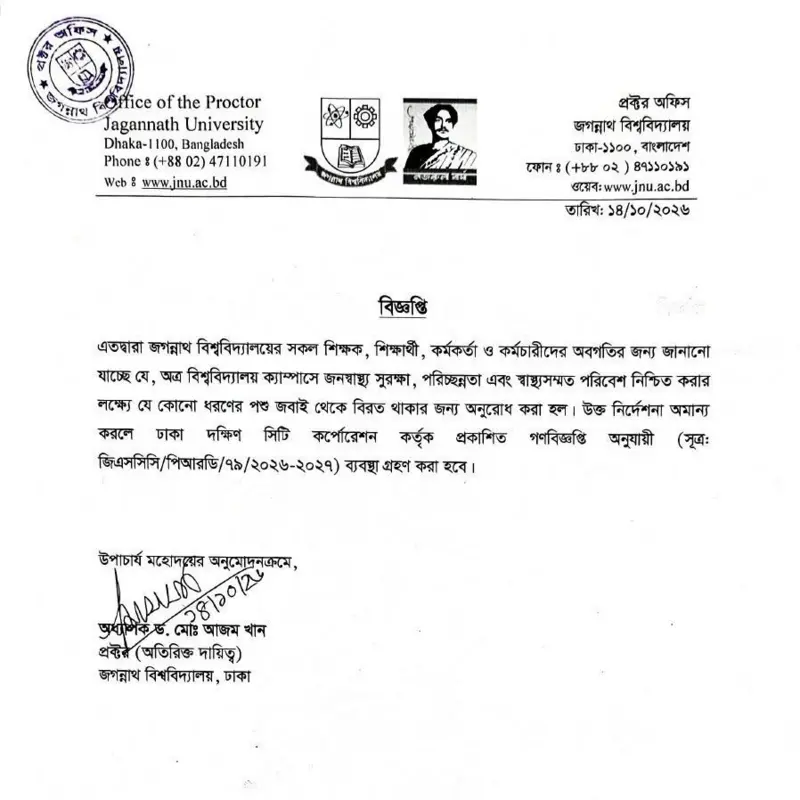
But the directive triggered another round of protests. The Jagannath University Central Students’ Union (JnUCSU) strongly opposed the notice, organising a protest march and rally that same night. The union put forward a four-point charter of demands.
The administration subsequently issued a ‘clarification’ stating that everyone had the right to slaughter animals and organise events on campus. It claimed that the proctor’s earlier request was intended only to prevent further tension following the controversy. In what appeared to be an attempt to appease protesting Muslim students, the university backtracked on its earlier position and expressed regret over the notice, suggesting that it had caused a misunderstanding.
The reversal raises an important question. The original notice had been issued against the backdrop of a dispute involving a Hindu temple and objections from Hindu students who said their religious sentiments had been hurt. Yet the administration’s subsequent clarification shifted the emphasis to the right to organise events and slaughter animals on campus. For Hindu students, the concern remained whether their religious sensitivities and the sanctity of their place of worship would receive meaningful protection, rather than being reduced to a dispute over dietary freedom.
The sequence of events also revealed how quickly the original issue could be reframed. What began with Hindu students objecting to beef being cooked near their temple had expanded into a confrontation over the university’s authority to regulate campus activities. The administration cited the need to prevent tension, but its retreat from the initial directive did little to address the deeper concern. In a dispute that began with Hindu students asking for their temple and religious sentiments to be respected, the loudest counter-response became a show of defiance that risked turning their faith itself into a target.
From campus dispute to open anti-Hindu hostility
The controversy soon took a more disturbing turn when videos circulated showing students at Jagannath University raising aggressive slogans against Hindus during the Durga Puja period. The chants went far beyond defending the right to eat beef. They included calls for Hindus to leave Bangladesh, declarations that Hindus were not their brothers, and statements that cows would be slaughtered on campus and in front of Hindu students. A dispute that had begun near a Hindu temple was now accompanied by rhetoric targeting Hindus as a community.
In one widely circulated video, students were heard chanting “Goru Khaowar Adhikar” (the right to eat beef), alongside “Shah Jalal er Bangla” (this is Shah Jalal’s country), “Hindu aamader bhai naye” (Hindus are not our brothers) and “Hindu aamader chai naye” (we do not want Hindus here). The contrast between these slogans is telling. While the first invoked a right to consume beef, the others questioned whether Hindus belonged in the country at all. The declarations about slaughtering cows in front of Hindu students added another layer of religious provocation to an already volatile situation.
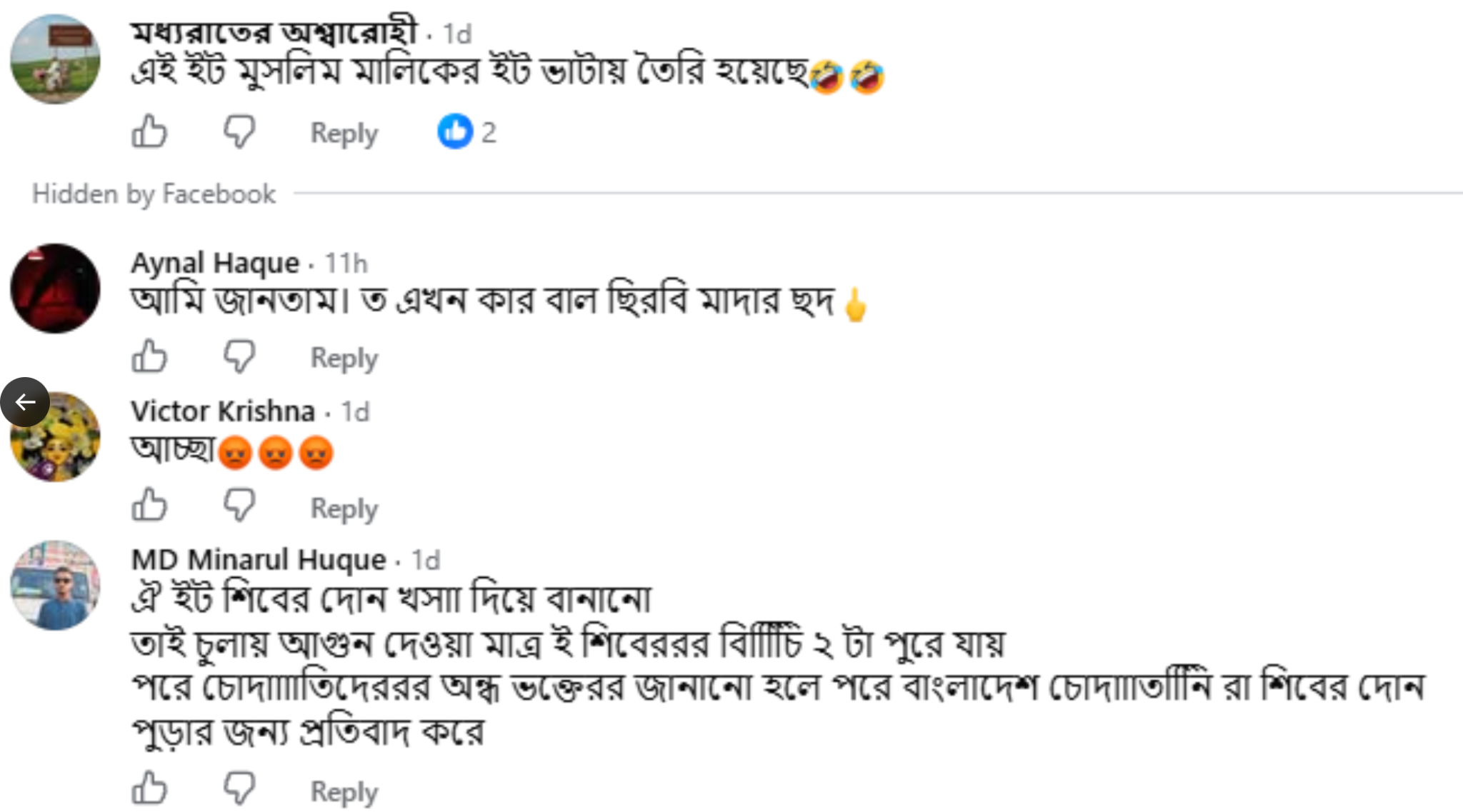
Several other inflammatory posts, ridiculing Hindus and their faith, were also posted online. One user mocked objections over the temple bricks by stating that the bricks had been made in a Muslim-owned brick kiln, while another comment used highly obscene and sexually degrading language against Lord Shiva and Hindu devotees. Other posts contained vulgar remarks concerning Hindu deities, Hinduism and the university temple.
Hindus subjected to religious intimidation and pressured to convert to Islam by Muslim student
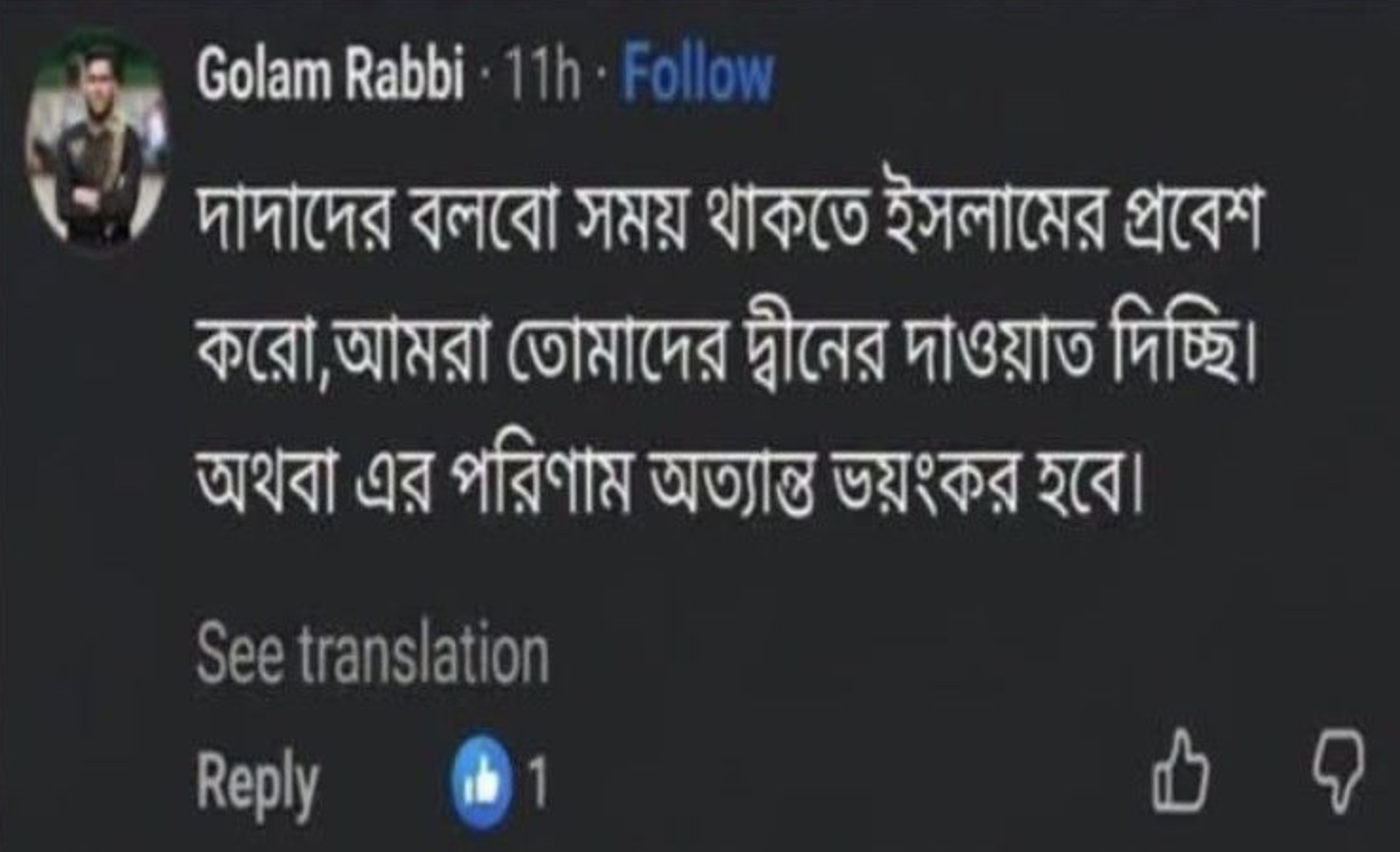
As the dispute spread online, Golam Rabbi, identified as a History student of Jagannath University, issued a religious warning directed at Hindus. He wrote: “I will tell the brothers/Hindus to accept the invitation to Islam while there is still time. We are inviting you to the faith, or else the consequences will be extremely terrible.” The statement linked an invitation to convert to Islam with a warning of severe consequences for those who did not accept it. The Hinduphobia Tracker had documented this incident.
Another Muslim student declared that Bangladesh was not the land of Rabindranath Tagore but the land of Kazi Nazrul Islam and Shah Alam, and said that it was “not the land of cows and Gobind.” He further warned that if Hindus or Hindu organisations attempted to assert their religious beliefs, “18 crore Muslims” would cause bloodshed, walk over their blood and bodies and establish Islam, before declaring that Bangladesh was not a Hindu country. During the agitation, a university student leader was also quoted as saying that “Bangladesh does not belong to Rabindranath.” Social-media posts calling for Hindus to leave Bangladesh also circulated during the controversy.
Muslim students slaughter a cow on Maha Shashthi: A provocation that mocked Hindu sentiments
Amidst all the protests and the vile anti-Hindu campaign, the Muslim students of Jagannath University went on to publicly slaughter a cow on the campus on October 16, 2026, the day that marked Maha Shashthi, the beginning of Durga Puja.
Hinduphobia Tracker reported that Muslim students brought a cow onto the campus and slaughtered it on the road between the Vice-Chancellor’s building and the Mathematics Department. They then cooked the meat with khichuri and distributed it among students. Organisers collected Tk 70 from participants and said they had purchased the cow through registration fees and donations. Event accounts also said participants chanted “La ilaha illallah” during the programme.
This incident takes on particular significance against the backdrop of the events that preceded it. Just days earlier, Hindu students had objected to beef being prepared near their temple, and the controversy had been accompanied by anti-Hindu slogans and threats of cow slaughter. The organisers were therefore aware of the religious sensitivities at stake. Yet, on 16 October, as Hindus celebrated Maha Shashthi, marking the beginning of Durga Puja, a cow was publicly slaughtered on campus.
For Hindus, the cow is revered as Gau Mata, a symbol of motherhood, nourishment and sacredness. Choosing to slaughter a cow on such an important day, so soon after a dispute involving a Hindu temple, made the act particularly offensive. The chanting of “La ilaha illallah” during the slaughter added to the religious overtones of an already charged situation. This was not simply a disagreement over food or campus regulations. In the context in which it occurred, the public slaughter was to make a spectacle of the very religious sentiments they had asked others to respect.
Second consecutive day of cow slaughter: Another ‘feast’ during Durga Puja
On 17 October 2026, as Hindus observed Maha Saptami, the second day of Durga Puja, another cow was slaughtered on the campus of Jagannath University in Dhaka, followed by a feast featuring cow-meat tehari. The university unit of Bangladesh Khelafat Chhatra Majlis, affiliated with the Islamist organisation Bangladesh Khelafat Majlis, organised the programme. Coming just a day after a similar event on Maha Shashthi, the second consecutive cow slaughter deepened the controversy and intensified concerns among Hindu students about the disregard for their religious sentiments.
The cow was slaughtered on the road between the Vice-Chancellor’s residence and the Department of Mathematics in the morning. According to reports, the organisers purchased the animal for Tk 85,000 and collected Tk 40 from each registered participant. Organisers prepared food for more than 600 people and distributed it near the Central Shaheed Minar between approximately 3:30 pm and 5:30 pm. The organisers also arranged an evening Qawwali programme.
The event followed the cow-slaughter feast held on 16 October under the banner of the Jagannath University Central Students’ Union (JnUCSU), when cow meat and khichuri were distributed among students. That first slaughter had already taken place amid a controversy over beef being prepared near the university’s Central Hindu Temple and on Maha Shashthi, the opening day of Durga Puja. The decision to organise another cow slaughter on Maha Saptami, the very next day, went beyond a campus food event. It was a deliberate act of defiance and a pointed mockery of Hindu religious sentiments during one of the community’s most sacred festivals.
The institutional affiliations of those involved also merit attention. The JnUCSU organised the 16 October feast under its banner, and its elected committee included several members identified as leaders of Islami Chhatra Shibir, including its vice-president and general secretary. The following day’s event was organised by Bangladesh Khelafat Chhatra Majlis, affiliated with Bangladesh Khelafat Majlis. In the context of the preceding anti-Hindu slogans, threats and objections raised by Hindu students, the repetition of these events on consecutive days during Durga Puja made it increasingly difficult to dismiss the episode as an ordinary campus food gathering. For Hindu students who had asked for their temple and religious sentiments to be respected, a second public cow slaughter during the same festival was bound to deepen the feeling that their faith was deliberately being mocked and their concerns being purposely disregarded.
Hindu students served cow meat at event organised by Muslim man
Hindu students were deliberately served food containing cow meat during an event organised for meritorious library students on 14 August 2026. A Muslim man named Riasal Rakib, the Library and Seminar Secretary of the university’s Central Students’ Union and a leader of the Chhatra Dal, organised the event.
Several Hindu students said they asked the organisers before eating whether the food contained cow meat but did not receive a clear answer. During the food distribution, organisers handed boxes containing Beef Bhuna Khichuri to Hindu students. After consuming the food, several students learned that the meal contained cow meat and expressed distress and anger over the incident, as cow meat is prohibited for them on religious grounds.
The Hindu students subsequently raised the matter publicly and demanded that organisers respect their religious beliefs and dietary restrictions, particularly since they had expressly sought clarification about the meal’s contents before eating it. They also demanded an investigation and measures to prevent Hindu students from being placed in a similar situation in future.
Riasal Rakib, however, claimed that the incident was not intentional and described it as a ‘mix-up’ caused by delayed food delivery.
Hindu student temporarily expelled over ‘blasphemy’ after speaking out against anti-Hindu abuse
As the controversy over the treatment of Hindu students at Jagannath University escalated, another troubling development emerged. On 13 October 2026, Hindu student Saikat Haldar was temporarily expelled from the university following accusations that he had made derogatory remarks about Islam and Prophet Muhammad. However, the action raised serious concerns because Haldar had reportedly spoken out against vulgar and hateful comments targeting Hindus and Hinduism.
The sequence of events raises an uncomfortable question. What happens when a Hindu student challenges abuse directed at his faith? Instead of his concerns about anti-Hindu hostility receiving attention, Haldar found himself facing disciplinary action over unsubstantiated blasphemy accusations.
Viewed alongside the controversy over beef being prepared near the Central Hindu Temple, the anti-Hindu slogans and threats that followed, Haldar’s case adds another dimension to the atmosphere confronting Hindu students at Jagannath University. While public acts and campus gatherings became flashpoints over Hindu religious sentiments, a Hindu student who reportedly challenged hateful remarks about his faith faced temporary expulsion. The contrast raises serious concerns about whether Hindu students can speak up against hostility towards their religion without risking disciplinary consequences themselves.
Hindu student sentenced to 5 years in jail over accusation of ‘blasphemy’
Tithy Sarkar, a former student of Jagannath University and the convenor of World Hindu Struggle Council, was arrested after Muslims accused her of making derogatory remarks against Islam and the Prophet Muhammad. Sarkar told Pallabi police that her Facebook account was hacked and that an unidentified hacker made the blasphemous comments. After filing the complaint, she went missing, and her phone was untraceable. On October 23, 2020, the university temporarily suspended her amid protests. The CID later claimed Sarkar had faked her abduction and gone into hiding with her boyfriend, Shiplu Mallik. Police arrested her on November 11, 2020. In May 2021, the CID filed charges against Sarkar and Mallik. On November 4, 2021, the Dhaka Cyber Tribunal charged her under the Digital Security Act (DSA). Another Hindu man, Niranjan Baral, was also arrested for spreading rumours about her disappearance. Four years after the accusations, on May 13, 2024, Justice AM Zulfikar Hayat of the Dhaka Cyber Tribunal sentenced Sarkar to five years in prison, plus one year of probation under strict conditions. Despite Bangladesh’s secular claims, its blasphemy laws are frequently used by Islamists to target religious minorities, including Hindus.
A university with a mosque but no Hindu Temple; proposed temple site used for public toilet
For years, Hindu students at Jagannath University sought a permanent temple on campus where they could perform religious rituals. They pointed out that a mosque already existed on campus, while Hindu students had no comparable dedicated place of worship. The Hindu students had repeatedly submitted memorandums and staged peaceful protests. Their frustration peaked in February 2026, when they stated that the site they had identified for a central temple was instead being earmarked for a public toilet. On 3 February 2026, after years of administrative inaction, the students held a sit-in, performed the foundation ritual and installed images of Hindu deities at the proposed site. The university disputed that the land had formally been allocated for a temple. Nevertheless, the episode highlighted Hindu students’ prolonged struggle to secure a dedicated place of worship on campus and their demand for equal recognition of their religious needs.
For a university named after Jagannath, the prolonged struggle to establish a Hindu temple is particularly striking. The issue went beyond building a structure. It concerned whether Hindu students could practise their faith on campus without having to repeatedly protest for institutional recognition of their religious needs.
Kali Puja restricted, Hindu students take to the streets
In October 2025, Hindu students at Jagannath University protested for the right to celebrate Kali Puja on campus. They said the university administration denied permission for the festival, leaving them questioning why it was preventing an important Hindu religious observance.
According to the students, the proctor had initially given verbal approval but later refused formal permission, citing security concerns.
The controversy deepened after the university’s proctor reportedly remarked that “Kali Puja is part of North Indian culture,” while the vice-chancellor reportedly said the university would not allow any new religious traditions on campus. The statement was denounced as historically false, culturally offensive, and reflective of the growing intolerance towards Hindu traditions in Bangladesh.
The students responded by taking their protest to the university’s administrative building and submitting a memorandum to the vice-chancellor’s office. Their demand was simple. They wanted to celebrate their festival without fighting the administration for permission.
Students and alumni expressed anguish, noting that an institution built by Hindu benefactors now denies the right to worship Goddess Kali, the central deity symbolising Bengal’s spiritual strength and feminine divinity. The outrage gained momentum on social media under hashtags such as #JagannathUniversity, #KaliPuja, #SanatanDharma, and #ReligiousFreedom. Many demanded the authorities immediately withdraw the ban and issue a public apology for the proctor’s “arrogant and culturally insulting” remarks.
Following the protest, the university administration claimed the episode was a misunderstanding. The proctor claimed the administration was concerned about possible unrest because University Day and the student union election were approaching. He also claimed that the students had initially agreed not to hold the celebration that year.
But the controversy had already raised a larger question about how the university treated Hindu religious practices. Hindu students had been protesting for the right to observe their own festival, and the reported description of Kali Puja as a “North Indian festival” only deepened their concerns. For the students, the issue was not simply about holding one religious event. It was about whether the university genuinely recognised their faith and traditions as part of campus life, or treated them as something it could exclude.
Jagannath University’s temple priest brutally attacked
The challenges surrounding Hindu religious life at Jagannath University extend beyond disputes over worship and religious expression to concerns about community members’ physical safety. Subhash Deuri, a Hindu priest connected to the university’s central temple, was reportedly attacked and left seriously injured in Dhaka. Reports described severe wounds to his head, hands and legs. His wallet and two mobile phones were also reportedly stolen, and the assailants allegedly used one of the stolen phones to contact his sister and demand money.
The attack was particularly disturbing because Deuri was not merely a student at Jagannath University. He was also a priest serving the campus’s Hindu community, making his safety a matter of concern for those who depend on the temple as a place of worship. The severity of his injuries and the reported attempt to extort money from his family added to the gravity of the incident.
For Hindu students and members of the Hindu community, an attack on someone associated with their place of worship can deepen fears about their safety and security. At a university where Hindu students have already raised concerns over their religious rights and access to a place of worship, the violent assault on a temple priest adds another troubling dimension to their experience.
Hindu student found dead in college; police dismiss as suicide
The body of a Hindu student named Akash Sarkar of Jagannath University was recovered on 18 January from a mess in the Bhatikhana area. Police identified the deceased as Akash Sarkar, a student in the Department of Theatre at Jagannath University. He belonged to the department’s 10th batch. His home district was Faridpur. According to media reports, Ishtiaq, a housemate, said that around 9:00 p.m., Akash’s girlfriend phoned him, saying she could not reach Akash. “After the call, I found Akash’s room locked from the inside. As I did not get any response despite repeated calls, I broke the door open and saw his body hanging from the ceiling. Then, I immediately called the police,” he said. Nazmul Hasan, an investigation officer of Gandaria Police Station, said, “We arrived at the scene around 9:30 pm after receiving the information. The body was recovered in a hanging condition and later sent to Mitford Hospital for an autopsy.”
Akash Sarkar’s death was placed under the Undecided Database because the strict parameters of the Hinduphobia Tracker do not permit the case to be classified as a hate crime without evidence establishing a religious motive. However, this classification should not be mistaken for an absence of concern. The repeated instances of anti-Hindu hostility, intimidation and religious targeting documented at Jagannath University create a deeply troubling context in which the death of a Hindu student cannot simply be viewed in isolation.
Quran distributed to Hindu students within the campus
In September 2026, videos circulated online showing copies of the Quran being distributed to students at Jagannath University during a reception for newly admitted students. The distribution reportedly involved members of Islami Chhatra Shibir, the student wing of Jamaat-e-Islami, who were seen handing out Qurans and other items. Videos showed that the Qurans were specifically being handed to Hindu female students.
This incident was not included in the Hinduphobia Tracker because the available information does not establish that the distribution involved coercion, threats or pressure to convert. However, the circumstances remain concerning. Copies of the Quran were reportedly distributed specifically to Hindu female students during a university reception, bringing the question of religious targeting into an institutional setting. When students belonging to a religious minority are singled out for the distribution of another religion’s scripture, it raises questions about the intent behind the exercise, whether students felt free to decline, and whether the activity was an attempt at religious outreach directed specifically at them. The concern is not the voluntary distribution of religious literature itself, but the reported selective focus on Hindu students and the possibility of religious influence in a setting where students should feel free to practise their own faith without pressure. While the available evidence did not establish a hate crime, the incident warrants scrutiny.
For Hindu students living as a religious minority in Bangladesh, situations like these can be difficult to navigate. Refusing a religious text handed to them by members of an organised student group may not be as simple as it sounds. Students may worry about offending those offering it, attracting unwanted attention or being singled out for refusing. For young women in particular, the pressure to avoid confrontation can make it harder to express discomfort openly. What might seem like a simple act of religious outreach can therefore become an uncomfortable experience for someone who does not share that faith.
The concern is not that people should be prevented from sharing their religious beliefs. The concern is whether those beliefs are shared in a way that respects others’ freedom to accept or decline. When students from a minority community are approached with religious material, their ability to make that choice freely matters. Religious conviction cannot excuse disregarding another person’s beliefs or personal boundaries. Students also should not feel that refusing another religion’s scripture could make them a target of disapproval or hostility.
The incident also raises a broader question about the attitude behind religious outreach when it targets people of another faith. Sharing one’s beliefs is one thing; treating people from a different religious background as people who need to be brought into one’s own faith is quite another. When that approach leaves little room for an unpressured refusal, it risks turning outreach into an exercise of religious influence over others.
For Hindu students at Jagannath University, this episode comes against a wider backdrop of hostility and exclusion. The distribution of Quran copies does not, on its own, prove that the students were forced to accept them. But the incident adds to the concerns surrounding how Hindu students experience campus life as a religious minority. They should be able to practise their faith, hold on to their beliefs and decline religious material from another faith without feeling intimidated, pressured or treated as outsiders.
Conclusion: A disturbing pattern of anti-Hindu hostility
Conclusion: Anti-Hindu Hostility in Bangladesh’s Universities Reflects a Wider Pattern of Persecution
The incidents documented at the University of Dhaka and Jagannath University point to a disturbing reality: anti-Hindu hostility in Bangladesh is not confined to attacks on temples, homes or individuals. It is also entering spaces meant to provide education, security, and equal opportunities to young people. Hindu students have faced religious intimidation, threats of conversion, hostility towards their festivals and religious practices, discriminatory treatment and physical violence. Their right to study, worship and express their religious identity without fear is increasingly being challenged within institutions that should protect those freedoms.
These are not merely disagreements between students or routine campus disputes. When Hindu religious practices are singled out, when students are threatened for asserting their identity, and when university authorities fail to provide consistent protection, the message extends beyond the individuals directly affected. It creates an environment in which Hindu students are made to feel that their faith, traditions and very presence are unwelcome. The incidents at Jagannath University are particularly striking given the institution’s historical roots in Hindu educational and cultural movements.
These campuses cannot be viewed in isolation from the wider persecution of Hindus in Bangladesh. Across the country, Hindus have faced attacks on religious places, intimidation, vandalism, violence, threats and pressure to abandon their faith. The Hinduphobia Tracker has documented a total of 713 cases in Bangladesh in which Hindus have been targeted for their faith.
The scale of these documented cases makes it impossible to treat anti-Hindu targeting as a concern confined to two campuses. Each case represents an incident that must be examined in its own context, but together, the records provide a wider picture of the threats, discrimination, intimidation and violence faced by Hindus because of their religious identity.
The 680 cases documented by the Hinduphobia Tracker are more than a number. They record Hindu lives, religious freedoms, and dignity affected by hostility directed at their faith. The systematic documentation of these cases helps reveal the patterns of anti-Hindu hostility in Bangladesh and brings greater visibility to the scale and nature of the targeting faced by the Hindu community. The incidents at Jagannath University must therefore be seen not in isolation, but against the wider record of anti-Hindu hostility in Bangladesh.