Saraswati idol construction at Dhaka University opposed by Muslim students and organisations; protesters hurl derogatory remarks against Hindus and their faith
 Dhaka, Dhaka District, Bangladesh
 14 November, 2026
Case Summary
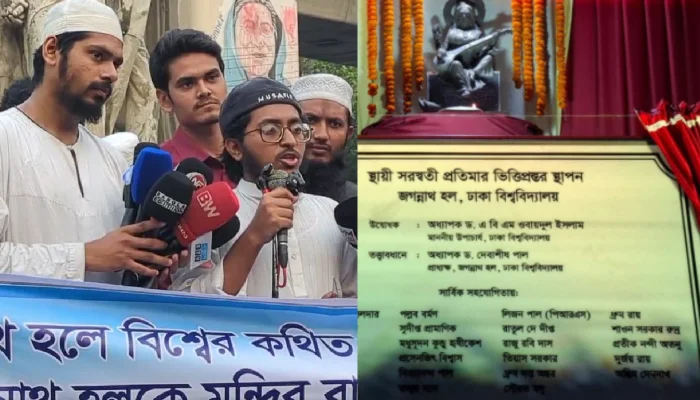
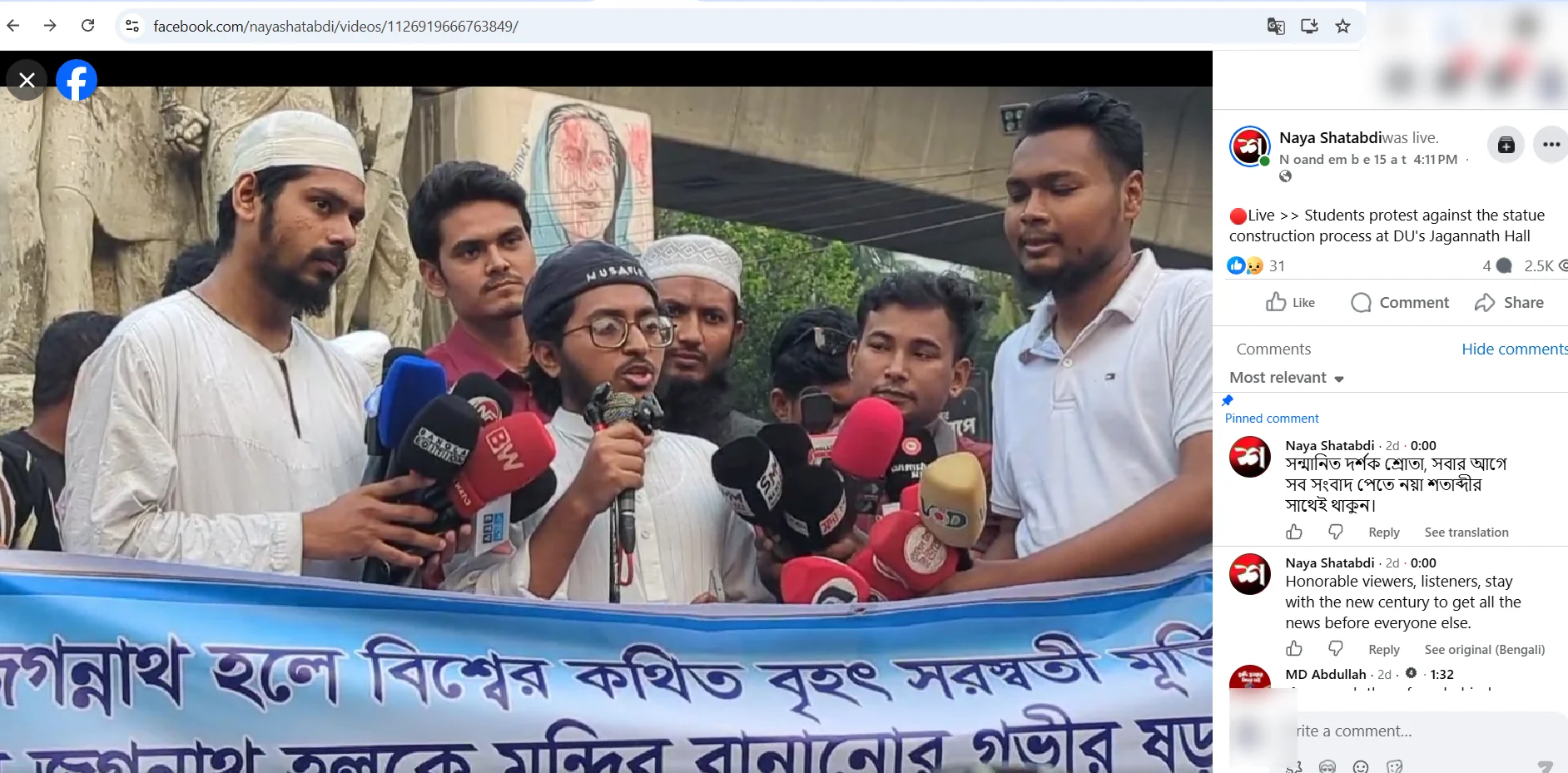
At Dhaka University in Bangladesh, the proposed construction of a 30-foot-tall Saraswati idol was opposed by Muslim students and Islamic organisations on religious grounds. The protesters described the university as an 'Islamic institution', invoked Islamic theology to justify their opposition and accused Hindu organisations of pursuing a 'Hindutva agenda'. They also denigrated Hinduism, Hindu deities and the Hindu community, hurled communal slurs such as 'Malaun' against Hindus and issued threats over the proposed construction. According to media reports, on 8 November 2026, the authorities of Dhaka University laid the foundation stone for a proposed 30-foot-tall idol of Goddess Saraswati at Jagannath Hall, which was expected to become the world's largest Saraswati idol upon completion. The ceremony was held on the premises of Rabindra Bhavan and was inaugurated by Dhaka University Vice-Chancellor Professor ABM Obaidul Islam. Speaking at the event, the Vice-Chancellor stated that Bangladesh belonged to people of all religions and communities, not merely Muslims or Hindus. He emphasised the need to build a country where everyone could enjoy equal rights and live without communal conflict. Jagannath Hall Provost Debashish Pal subsequently confirmed that the proposed idol would stand approximately 30 feet tall, surpassing the existing 19-foot Saraswati idol, which was made in Indonesia and located in the United States. On 15 November 2026, Muslim students and Islamic organisations, including Hefazat-e-Islam, began organising protests against the proposed construction and demanded the cancellation of the project. The protesters objected to the installation of a Hindu deity on the university campus on religious grounds. They described Dhaka University as an Islamic university and questioned how an idol or temple associated with Hindu worship could be established within its premises. They also demanded to know who had initiated the project, who was funding it and whose interests were behind the construction. Hefazat-e-Islam described the proposed idol as part of a 'Hindutva agenda' and accused Hindu organisations of attempting to expand their influence in Bangladesh through the initiative. The organisation also demanded a government investigation into the motives behind the project. During the protests, several Muslim students and demonstrators made derogatory remarks against Hinduism, the Hindu community and Hindu deities. In a media interview, a protester identified as Mohammad Hamidul Islam described Hinduism as a 'wrong religion' that had failed to flourish. He questioned the belief in the 33 crore Hindu deities and asserted that, according to Islamic scholars, no religion other than Islam could survive on earth. He also mocked Hindu religious figures and deities, referring to them as 'Ram-Bam' and making disparaging references to Hindu saints dressed in red and orange robes. He declared that the people of Bangladesh would never accept Hindu religious figures, including sadhus and saints. The protester further used the derogatory communal slur 'Malaun', commonly directed at Hindus in Bangladesh, while declaring that the country would never accept them. He stated that Hindu students and teachers had gained the confidence to initiate the idol's construction because the Indian High Commission had provided funding for temple construction. He warned that if an idol were installed at Dhaka University, the institution would no longer remain a university. Referring to an earlier October incident in which Hindu students had raised slogans against the protesters, he used it to further justify the opposition. He also issued a direct threat, stating that if such activities continued, the protesters would deliver a 'befitting reply'. Another Muslim protester, while addressing the gathering, described Dhaka University as an Islamic university and questioned how a Hindu temple or idol could be established on its premises. Drawing comparisons with Jagannath University, he pointed out that even a proposal for constructing a public toilet had been applauded, whereas the proposed installation of a Hindu idol at Dhaka University had attracted opposition. He also referred to other universities, describing them as Islamic universities despite their institutional names, and questioned why Hindu religious structures or idols should be permitted on their campuses. Invoking the Quran and Islamic religious teachings, he argued that Muslims had the right to oppose idol worship and the proposed installation. This was not the first instance of opposition to the construction of Hindu idols in Bangladesh. The Hinduphobia Tracker had previously documented many incidents in which initiatives to construct idols of Lord Shri Ram faced organised opposition, intimidation and communal hostility from Muslims in Bangladesh. For instance, in June 2026, in Ramchandrapur (Bedan Para), under Haridaspur Union of Palashbari Upazila in Bangladesh's Rangpur Division, the construction of an idol of Bhagwan Shri Ram within the historic Shri Shri Radhagobinda and Kali Temple faced sustained threats and intimidation from Muslim groups and radical preachers. Social media posts portrayed the idol as a symbol of Hindutva, called for its demolition and even incited Muslims to vandalise it. A radical Islamic preacher associated with the Islamic organisation Insaf Kayemkari Chhatra Sramik Janata openly called for the demolition of the idol and temple, while Muslim groups organised street protests against the project. Following the sustained hostility and threats of violence, the Hindu temple committee was forced to suspend the construction. In a separate incident in June 2026, in Palashbari, Bangladesh, the historic Shri Shri Radhagobinda and Kali Temple became the target of a campaign of communal hate speech, incitement and misinformation over the construction of a large idol of Bhagwan Shri Ram. Inflammatory social media posts targeted the temple and portrayed the construction of the Hindu deity's idol as unacceptable within a Muslim-majority locality, directing hostility towards the Hindu religious institution and its practices. In another incident in July 2026, a Muslim organisation organised a coordinated campaign against the proposed construction of an 82-foot-tall idol of Bhagwan Shri Ram within the historic Shri Shri Radha Govinda and Kali Temple complex in Palashbari Upazila, Gaibandha district. The organisation held a human chain, protest rally and procession, demanding government intervention against the Hindu religious project and opposing the installation of the idol within the temple premises. This incident occurred against the broader backdrop of the longstanding persecution of Hindus in Bangladesh. The Hindu minority has faced discrimination, targeted violence and religious hostility over decades, with attacks intensifying during periods of political and social instability. The latest major escalation began after the ouster of Sheikh Hasina’s government in August 2024, continued after the death of Sharif Osman Bin Hadi in December 2025, and resurfaced immediately after Bangladesh’s 13th National Parliamentary Election in 2026. Following Sheikh Hasina’s ouster, attacks on Hindu homes, temples and religious institutions were reported alongside intimidation, arson and mob violence targeting Hindu localities. The Hinduphobia Tracker recorded 336 incidents involving the Hindu minority during this period, reflecting the scale of the escalation and the vulnerability of Hindus amid the political upheaval. Another spurt of violence followed the death of Sharif Osman Bin Hadi, a Muslim political activist and student leader known for his anti-Hindu and anti-India rhetoric, in December 2025. In the aftermath, Hindu communities faced retaliatory violence, with Hindu homes and properties selectively attacked and several families reportedly forced to flee. Among the victims was Dipu Chandra Das, who was lynched and whose body was subsequently set ablaze by a Muslim mob over false blasphemy allegations. The Hinduphobia Tracker documented 51 incidents of anti-Hindu violence in the period following Hadi’s death alone, illustrating how hostility towards the Hindu minority intensified amid communal mobilisation. During this period, posters and written material calling for the extermination of Hindus were also displayed in public spaces. Viewed alongside reports of arson, vandalism, assault and targeted intimidation, such rhetoric pointed to a recurring pattern in which hostility towards Hindus intensified during periods of unrest. The most recent escalation followed the 13th National Parliamentary Election in 2026. In the immediate aftermath of the election results, Hindu families in districts including Noakhali, Rangpur, Nilphamari, Sylhet, Thakurgaon and Dinajpur faced attacks involving arson, looting, assault and vandalism of Hindu homes and temples. In several instances, Hindu properties were reportedly singled out, and families faced threats of displacement.
Case Images
Why it is Hate Crime ?
The first primary category selected is: Restriction/ban on Hindu practices. The subcategory selected is: Restriction on expression of Hindu identity. An example of the state-affected prejudicial and targeted orders against the Hindu community would be a government denying the right of a Hindu or a group of Hindus to hold a religious procession owing to the animosity of non-Hindu groups. Denial of the religious right of the Hindus to assuage the non-Hindu group which harbours animosity to a point where it could lead to violence against Hindus is not only a failure of law and order but is a prejudicial order against Hindus, denying them their fundamental rights to express their religious identity. An example of a hate crime against Hindus by a non-Hindu would be a non-Hindu institution forcing its Hindu employees to abandon religious symbols that a Hindu would wear as an expression of faith owing to inherent prejudice against the faith professed by the victim or a non-Hindu group of people restricting a Hindu group from constructing a place of worship simply because the demography of the area in which the temple is being built is dominated by non-Hindus. Such actions are driven by religious animosity and/or prejudice against Hindus and their faith and would therefore be categorized as a hate crime. The second primary category selected is: Hate Speech against Hindus. The subcategory selected is: Anti-Hindu slurs, mocking faith. Anti-Hindu slurs and the deliberate mocking of the Hindu faith owing to religious animosity involve the usage of derogatory terms, stereotypes, or offensive references to religious practices, symbols, or figures. One of the common anti-Hindu slurs used against Hindus is “cow-worshipper” and “cow piss drinker”. The intention of using this term is to demean and mock Hindus as a group and their religious beliefs since Hindus consider the cow holy. Additionally, some symbols and the slurs attached to them have a historical context that exacerbates the insult, hate, stereotyping, dehumanisation and oppression against Hindus. Cow worship has been used for centuries to denigrate Hindus, insult their faith and oppress Hindus specifically as a religious group. There has been overwhelming documentation about how cow slaughter has been used to persecute Hindus with cow meat being thrown in temples and places of worship. There has also been overwhelming documentation where cow meat (beef) has been force-fed to Hindus to either forcefully convert them to Islam or denigrate their faith. Apart from cow worship, the Swastika – which holds deep religious significance for the Hindus – has also been misinterpreted and distorted to use as a slur against Hindus. Similarly, the worship of the Shivling has been used by supremacist ideologies and religions to denigrate Hindus owing to religious animosity. Such slurs and denigration stem out of inherent animosity and hate towards Hindus and their faith, therefore, it is categorised as hate speech targeted at Hindus specifically owing to their religious identity. This incident exemplified anti-Hindu religious hostility, as Muslim students and Islamic organisations opposed the proposed Saraswati idol at Dhaka University on religious grounds, denigrated Hinduism and its deities, hurled communal slurs against Hindus and issued threats over the construction. Their actions targeted not merely the project but the public expression of Hindu religious identity. Hindu idols hold immense religious and cultural significance as representations of the divine and serve as focal points of worship and devotion. Goddess Saraswati is revered as the Hindu goddess of knowledge, education, wisdom, music and the arts. Her worship is particularly associated with educational institutions, where students and teachers seek her blessings for learning and academic pursuits. Across the Indian subcontinent, including Bangladesh and Pakistan, Goddess Saraswati is recognised as an important religious and cultural figure. Her idols and images are consequently found in schools, colleges and universities, where they symbolise the pursuit of knowledge and learning. In this instance, the proposed installation at Dhaka University was an institutional initiative that reflected respect for Hindu religious sentiments and the cultural significance of Goddess Saraswati. However, the initiative was met with organised opposition from Muslim students and Islamic organisations, who questioned how a Hindu idol could be installed at what they described as an 'Islamic university'. They invoked their religious objections to idol worship to justify preventing its construction. Despite Dhaka University being a secular institution, they sought to impose an Islamic religious identity upon the campus and treated the presence of a Hindu deity as unacceptable. The vehement opposition to even a peaceful installation representing knowledge and learning, simply because it was associated with Hinduism, exposed deep-seated anti-Hindu intolerance. It demonstrated an unwillingness to accommodate Hindu religious expression within a secular educational institution and reflected an attempt to deny Hindus the freedom to publicly express their faith. Such opposition also conveyed that Hindu religious symbols and sentiments were unwelcome on the campus, creating an atmosphere of intimidation for Hindu students, teachers and other members of the university. The protesters further demonstrated their religious hostility through derogatory remarks against Hinduism and its theological traditions. A protester described Hinduism as a 'wrong religion' that had failed to flourish and mocked the Hindu belief in 33 crore deities. Hinduism is one of the world's oldest living religious traditions, with a rich philosophical and spiritual heritage encompassing diverse schools of thought, forms of worship and traditions of devotion. The belief in 33 crore deities is an important aspect of Hindu religious and cultural understanding of the divine. Dismissing Hinduism as a 'wrong religion', ridiculing its beliefs and suggesting that it had failed to flourish went beyond expressing disagreement with particular religious practices. The mocking tone was directed at the faith itself and sought to portray Hindu religious beliefs as inferior and undeserving of respect. Such remarks amounted to the denigration of an entire religious tradition and its followers, exposing the anti-Hindu hostility underlying the protests. The protester further justified his remarks by asserting that, according to Islamic scholars, no religion other than Islam could survive on earth. This reflected an exclusivist and religiously supremacist outlook that denied the legitimacy and continued existence of other faiths. By presenting Islam as the only religion entitled to survive, the protesters displayed contempt for religious pluralism and the equal dignity of Hinduism and its followers. Such rhetoric reinforced the hostility towards Hindu religious expression and suggested that Hindu beliefs and practices did not deserve recognition or respect. The protesters also mocked revered Hindu religious figures, including Bhagwan Shri Ram, referring to him as 'Ram-Bam', and made disparaging remarks about Hindu saints dressed in red and orange robes. Bhagwan Shri Ram is one of the most revered deities in Hinduism and is worshipped as an incarnation of Bhagwan Vishnu. He holds immense religious significance as an embodiment of righteousness, duty and dharma. Hindu saints and sadhus, meanwhile, occupy an important position in Hindu religious life as spiritual practitioners, teachers and custodians of religious traditions. Mocking Bhagwan Shri Ram and ridiculing Hindu saints therefore amounted to a direct denigration of deities and religious figures held sacred by Hindus. These remarks further demonstrated the religious contempt underlying the protests. The protesters repeatedly described Dhaka University as an 'Islamic university' and questioned how a Hindu temple or idol could be established on its premises. They invoked the Quran and Islamic religious teachings to justify their opposition, arguing that Muslims had the right to oppose idol worship and the proposed installation. The hostility towards the Saraswati idol must also be understood in this religious context. In Islamic theology, idol worship is regarded as shirk, a grave religious transgression. The protesters explicitly relied on this religious prohibition to oppose the installation of a Hindu deity, effectively seeking to make their own religious beliefs the basis for restricting the religious expression of the Hindu community. Their actions demonstrated that they were unwilling to respect the secular character of the university or accommodate Hindu religious practices that did not conform to their own beliefs. The participation of Islamic organisations, including Hefazat-e-Islam, alongside Muslim students further demonstrated the extent of the organised mobilisation against Hindu religious expression. This was therefore not merely a disagreement over the administration or funding of the project but an attempt to suppress a Hindu religious representation because of the faith it represented. The use of the word 'Malaun' further exposed the communal hostility directed at Hindus. 'Malaun' is a derogatory communal slur used in Bangladesh to demean and stigmatise members of the Hindu community on the basis of their religious identity. The protesters' declaration that Bangladesh would never accept Hindus, accompanied by this slur, directly targeted the community's right to belong and practise its faith without intimidation. They also threatened a 'befitting reply' if the construction continued. Such threats, coupled with the rejection of Hindus as members of Bangladeshi society, demonstrated that the hostility extended beyond the proposed idol to the Hindu community itself. The protesters sought to intimidate Hindu students and religious representatives into abandoning an expression of their faith, reinforcing the message that Hindu religious identity and its public expression would not be tolerated. The protesters’ portrayal of the proposed Saraswati idol construction as a “Hindutva agenda” further exposed their deep-seated hostility towards Hindu religious and civilisational identity. The term “Hindutva” is frequently used to discredit Hindu cultural assertion and movements advocating the preservation of Hindu identity, while also serving as a pretext to portray Hindu religious expressions as threatening or illegitimate. In this instance, the protesters invoked the term to vilify the proposed installation of a Hindu deity, framing a religious and cultural initiative as an attempt to advance Hindu influence. Such rhetoric reflects how the targeting of Hindutva can extend beyond opposition to a political ideology and become a means of disparaging Hinduism, Hindu religious symbols and the broader assertion of Hindu identity. By portraying even the installation of Goddess Saraswati at a university as a Hindutva agenda, the protesters sought to delegitimise Hindu religious expression and present it as something that warranted opposition, further exposing the anti-Hindu animosity underlying their protests. This was not an isolated instance of opposition to Hindu religious expression in Bangladesh. The Hinduphobia Tracker had previously documented similar incidents in June and July 2026, when the construction of Bhagwan Shri Ram idols at Hindu temples in Palashbari faced organised opposition, protests, threats and intimidation from several Muslim organisations. In one instance, sustained threats and incitement forced a Hindu temple committee to suspend the idol construction. The recurrence of such opposition to Hindu religious representations demonstrated a pattern of targeted hostility towards Hinduism and its public expression in Bangladesh. The opposition to the Saraswati idol at Dhaka University was another manifestation of this pattern, reinforcing how Hindu religious symbols, beliefs and practices were repeatedly subjected to organised resistance and intimidation. Overall, since this case meets the parameters of a hate crime, it is being added to the hate crime database of the Hinduphobia Tracker. Disclaimer: The total number of perpetrators was not specified in media reports. However, videos of media interviews with the protesters showed more than ten Muslim men participating in the demonstrations. Hence, a perpetrator range of 10–100 has been selected for documentation purposes only.


Case Status
Unknown


Perpetrators Details
Perpetrators
Muslim Extremists
Perpetrators Range
From 10 to 100
Perpetrators Gender
male
 Sources



