

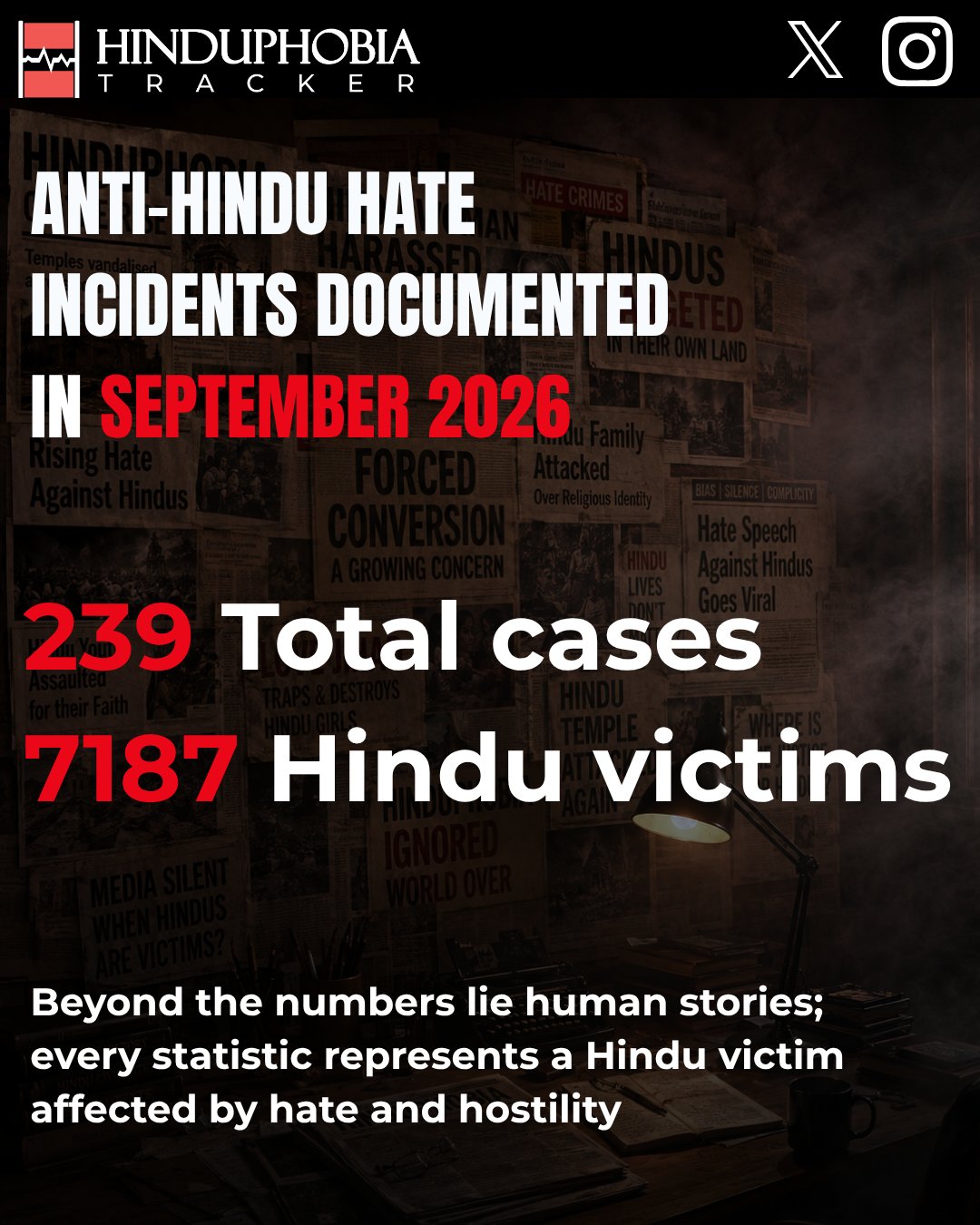
Another month has passed, and the numbers tell a troubling story: incidents continue, and the scale of harm can be staggering. In September 2026, the Hinduphobia Tracker documented 239 cases involving 7,187 victims. From hate speech and attacks on Hindu religious representations to predatory proselytisation and other forms of religious targeting, the cases spanned multiple categories. While the number of incidents fell slightly from August, the victim count soared. Eight mass conversion cases alone accounted for 6,735 victims, nearly 94 per cent of everyone recorded in September. These figures reveal both the persistence of religious targeting across different categories and the scale some incidents can reach, affecting thousands of people in a single event.
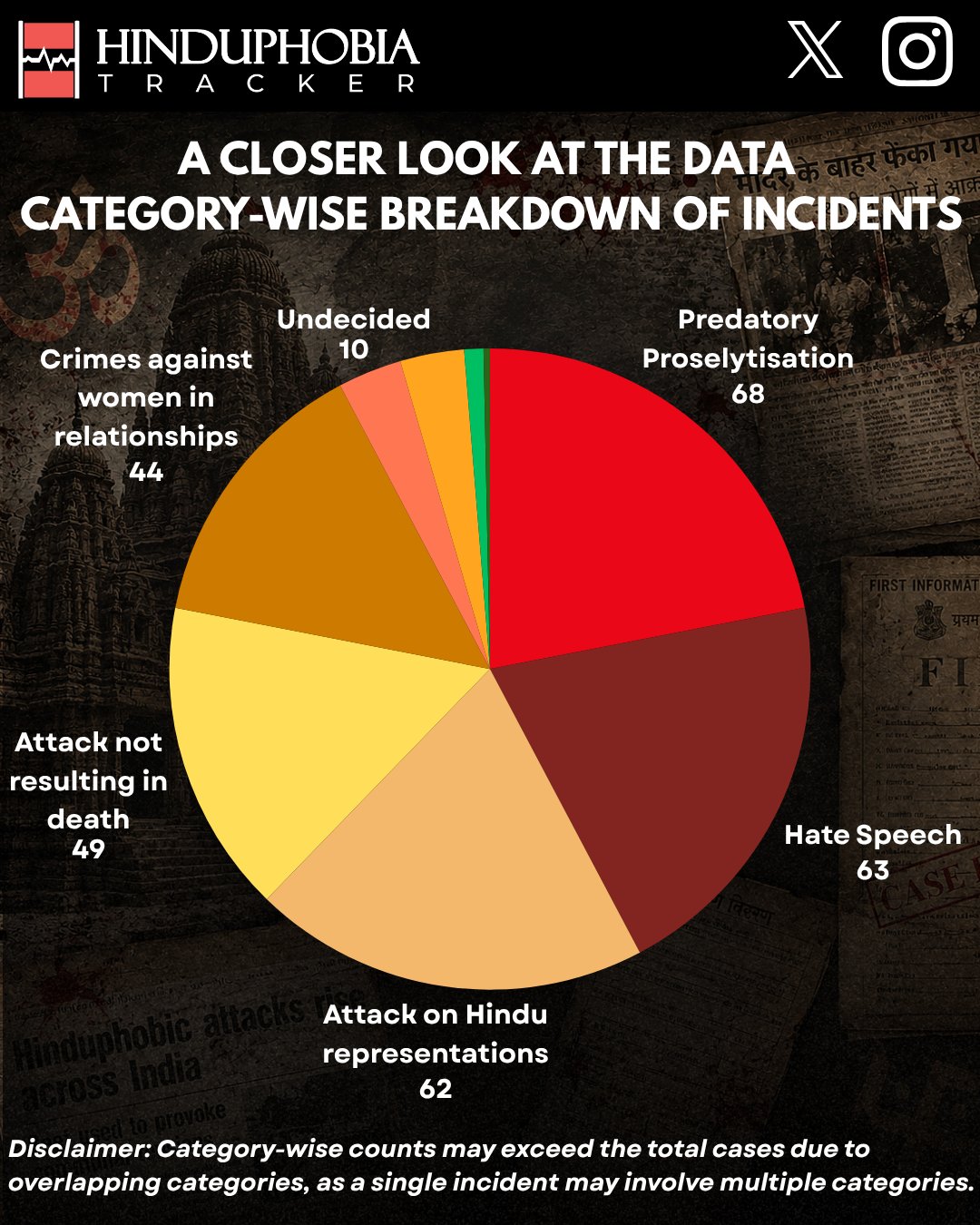
The numbers also point to several other patterns. Predatory proselytisation was recorded in 68 cases, hate speech in 63, attacks on Hindu religious representations in 62, and attacks not resulting in death in 49. Crimes against women in relationships accounted for another 44 cases. These categories overlap, meaning that a single incident may be recorded under more than one category. Therefore, the category-wise figures should not be added to arrive at the total number of incidents.
Geographically, India accounted for 194 of the 239 cases, while 45 cases were recorded outside the country. Within India, Uttar Pradesh and Madhya Pradesh featured prominently in the state-wise data supplied for September. The database also recorded incidents in Bangladesh and Pakistan, underlining that the documented cases were not confined to India.
September’s figures require an important distinction. The number of victims was heavily influenced by a small number of large-scale conversion cases. This does not diminish the significance of the other incidents, but it does mean that the total victim count reflects both individual cases of religious targeting and events involving hundreds or thousands of people.
This report examines September’s figures, the distribution of cases across categories and locations, the victim profile, and the patterns visible in the predatory proselytisation data. The month-on-month comparison with August appears towards the end, after the September findings have been examined on their own terms.
September 2026 at a Glance
- 239 cases documented during September.
- 7,187 victims recorded across the dataset.
- 194 cases in India and 45 outside India.
- Eight mass conversion cases involving 6,735 victims.
- 68 cases of predatory proselytisation.
- 63 cases involving hate speech.
- 62 cases involving attacks on Hindu religious representations.
- 49 attacks not resulting in death.
- 44 cases involving crimes against women in relationships.
Geographic distribution: India and beyond
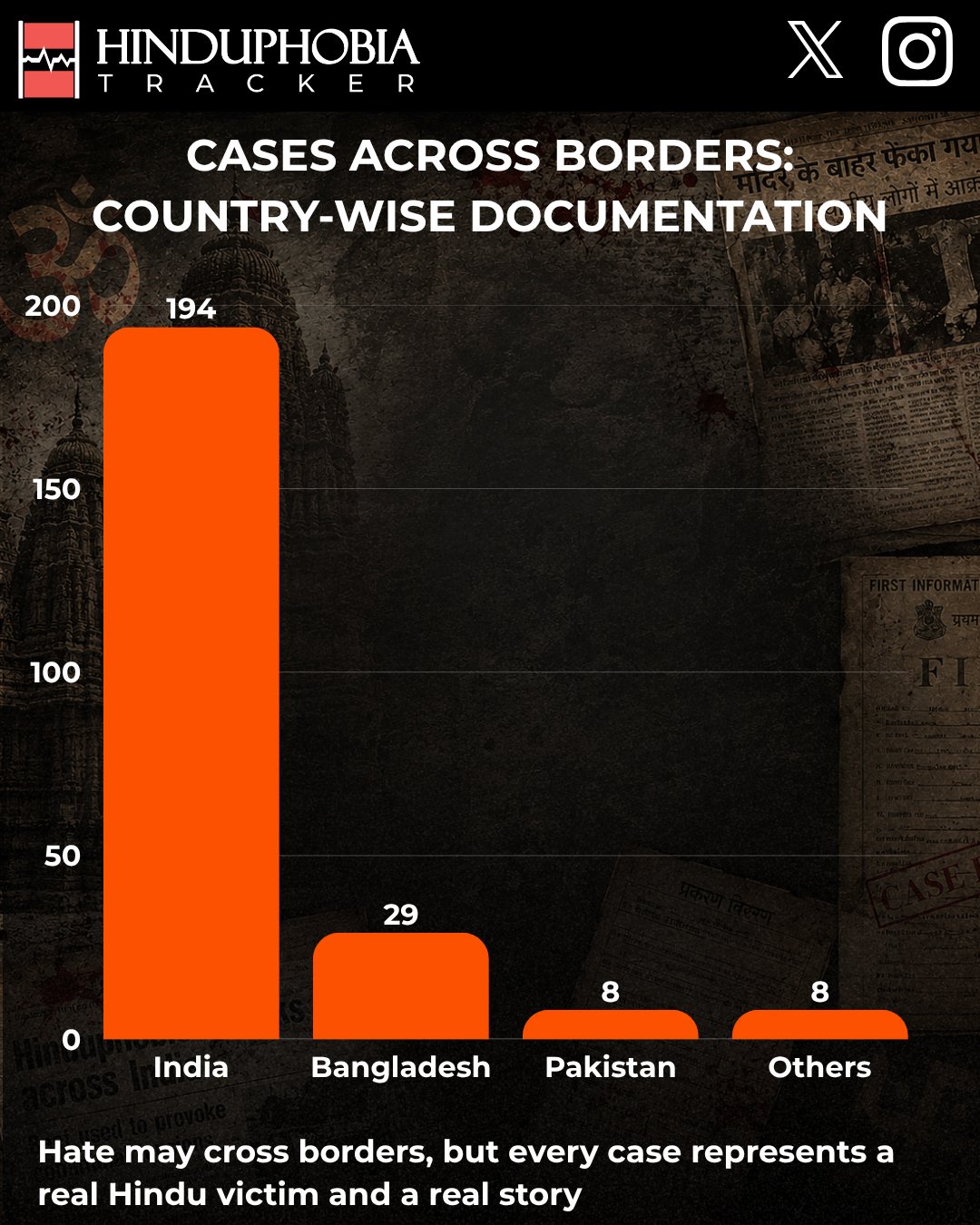
India accounted for 194 of the 239 cases recorded in September, representing approximately 81.2 per cent of the total. The remaining 45 cases, or 18.8 per cent, were recorded outside India.
Bangladesh accounted for 29 cases, Pakistan for 8, and other countries for another 8. The figures show that the database’s September coverage extended beyond India, with Bangladesh accounting for the largest share of cases recorded outside the country.
State-wise distribution within India
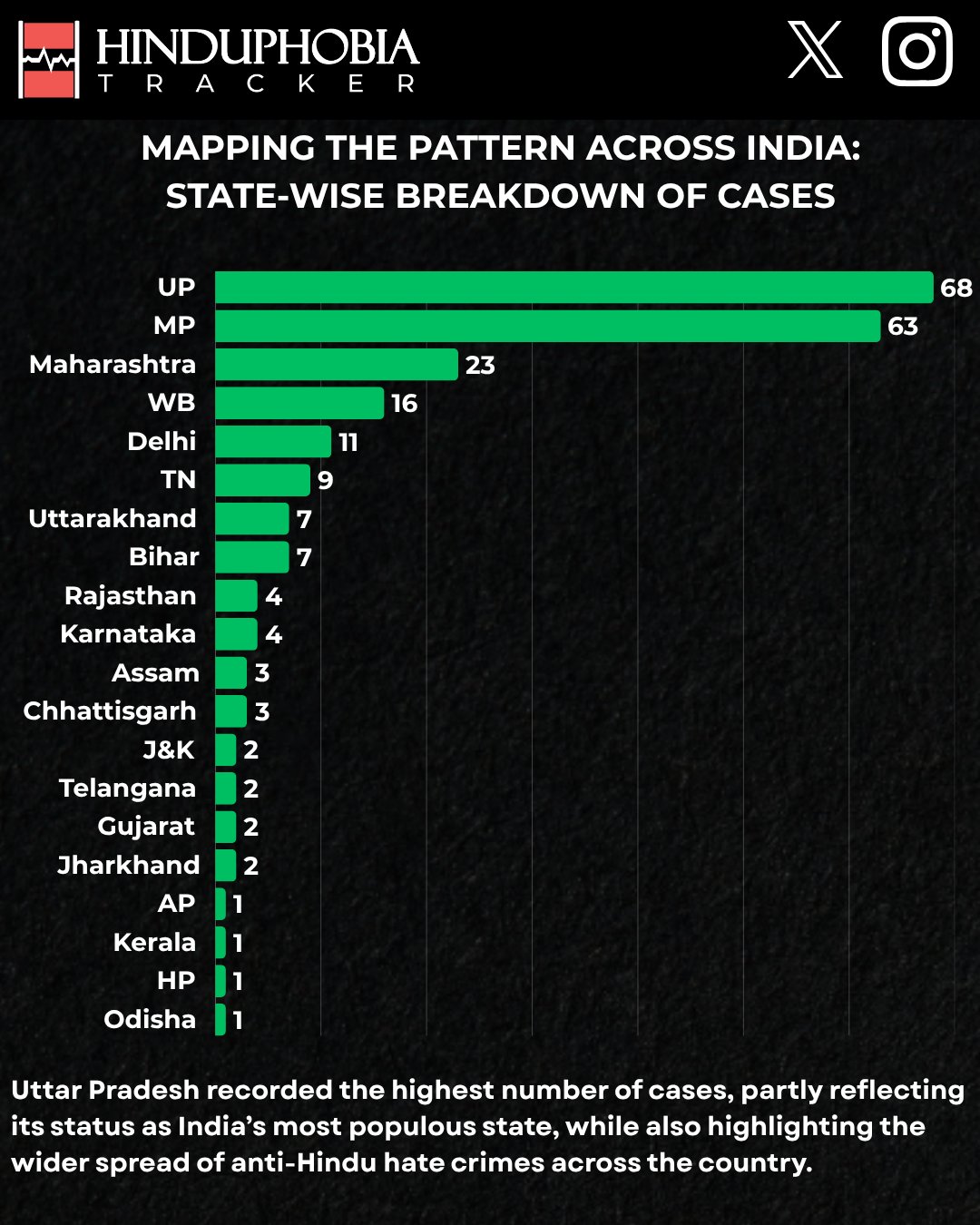
The state-wise chart shows Uttar Pradesh and Madhya Pradesh at the top, with 68 and 63 cases, respectively. Maharashtra followed with 23 cases, while West Bengal recorded 16 and Delhi 11.
Other states and Union Territories represented in the chart included Tamil Nadu, Uttarakhand, Bihar, Rajasthan, Karnataka, Assam, Chhattisgarh, Jammu and Kashmir, Telangana, Gujarat, Jharkhand, Andhra Pradesh, Kerala, Himachal Pradesh and Odisha.
Uttar Pradesh and Madhya Pradesh together account for 131 entries in the state-wise chart. Their prominence is a notable feature of the supplied geographical data. Maharashtra, with 23 entries, forms the next substantial cluster, followed by West Bengal and Delhi.
The scale of mass conversion incidents
The most consequential number in September’s dataset is the concentration of victims in eight mass conversion cases. Together, these incidents accounted for 6,735 victims, approximately 93.7 per cent of the month’s total of 7,187.
The eight locations and victim counts shown in the data are:
- Saran, Bihar: 5,000 victims.
- Delhi: 800 victims.
- Palghar, Maharashtra: 530 victims.
- Dhamtari, Chhattisgarh: 190 victims.
- Agra, Uttar Pradesh: 60 victims.
- Anuppur, Madhya Pradesh: 55 victims.
- Sant Kabir Nagar, Uttar Pradesh: 50 victims.
- Azamgarh, Uttar Pradesh: 50 victims.
The Saran incident alone accounts for 5,000 victims, making it the largest of the eight recorded events. Delhi and Palghar follow at a considerable distance. The remaining five entries range from 50 to 190 victims each.
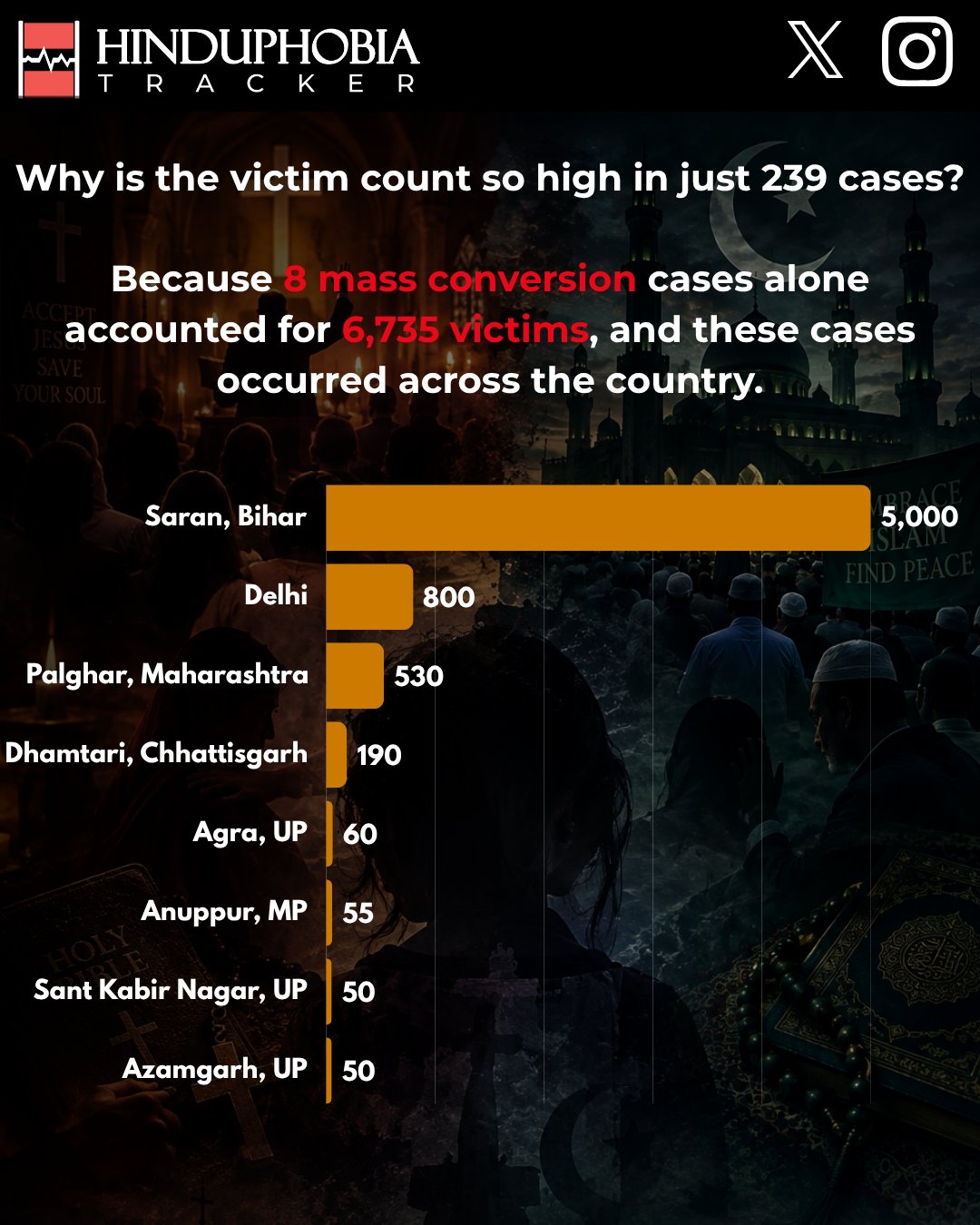
These figures explain why September’s total victim count was so much higher than the previous month’s, even though relatively fewer cases were recorded overall. Mass events can dramatically affect the aggregate victim count, while individual incidents may involve far fewer people. Both dimensions matter, but they measure different aspects of the documented pattern.
The eight mass conversion cases accounted for 6,735 of September’s 7,187 recorded victims. The remaining 231 cases involved 452 victims. This sharp difference shows how a few large-scale incidents can drive up the monthly victim count. However, fewer victims in an individual case do not make the incident any less serious. The nature of the harm matters just as much as the number of people affected.
Who was affected? The September victim profile
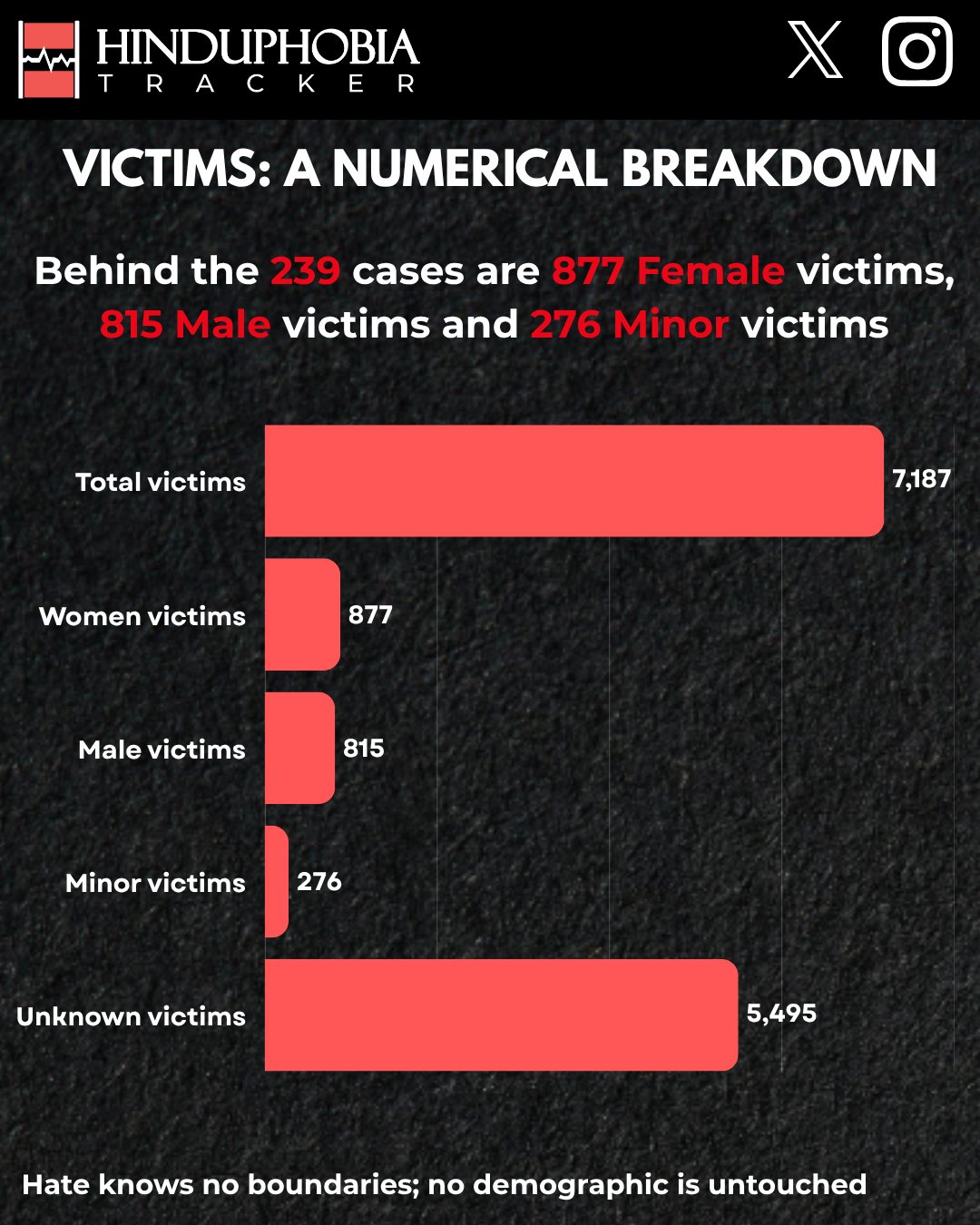
The victim-profile data records 7,187 victims in September. Of these, women accounted for approximately 12.2 per cent of the total recorded victim count, while men accounted for approximately 11.3 per cent. The 276 minors represented approximately 3.8 per cent of the total.
Predatory proselytisation: Targets, tactics and vulnerability
Predatory proselytisation was the most frequently recorded category in September, with 68 cases. The breakdown identifies attempts to convert Hindus to Christianity in 36 cases and attempts to convert Hindus to Islam in 30 cases.
The same dataset records 43 cases involving grooming, brainwashing or manipulative tactics, 29 involving harassment and coercion to facilitate conversion, and 27 involving inducements. It also identifies 35 cases involving women victims and 24 involving minor victims.
The figures show not just the religions targeted for conversion, but also the methods used and the people affected, including women and minors. These numbers overlap because a single case may involve more than one of these factors, so they should not be added together.
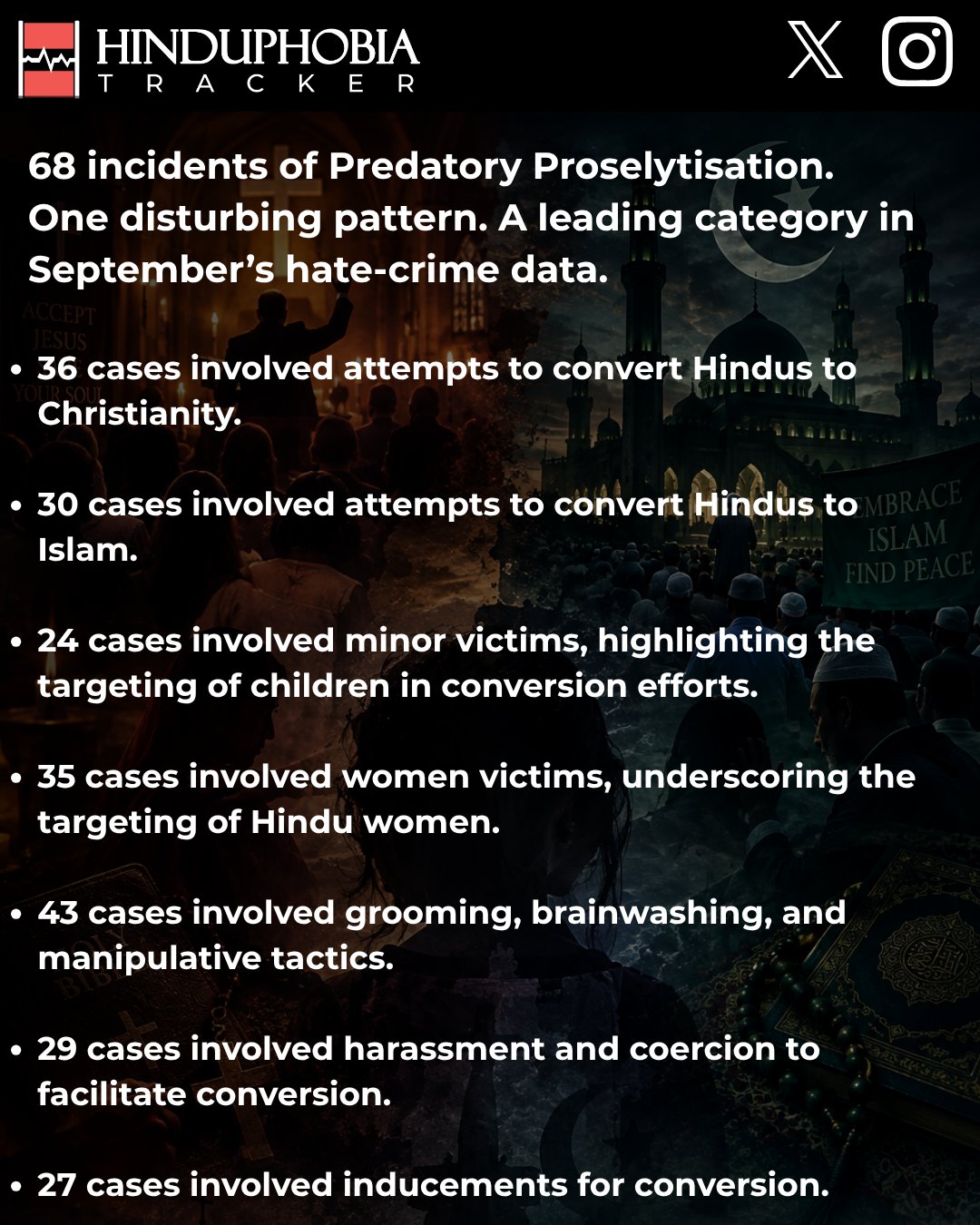
The method-related figures are particularly important to the analysis. A conversion-related incident may involve more than a direct appeal to adopt another religion. The supplied classifications also cover cases in which the reported conduct involved manipulation, pressure, harassment or inducements. These distinctions matter because the circumstances surrounding an attempt to convert someone are central to understanding whether the case involved voluntary religious persuasion or coercive conduct.
The figures involving women and minors also warrant attention. The dataset records women victims in 35 cases and minors in 24. These numbers do not establish that every case involving a woman or minor followed the same pattern, nor do they establish a common motive across all incidents. However, they do identify groups whose experiences merit careful examination in the underlying case records.
Who was identified as responsible?
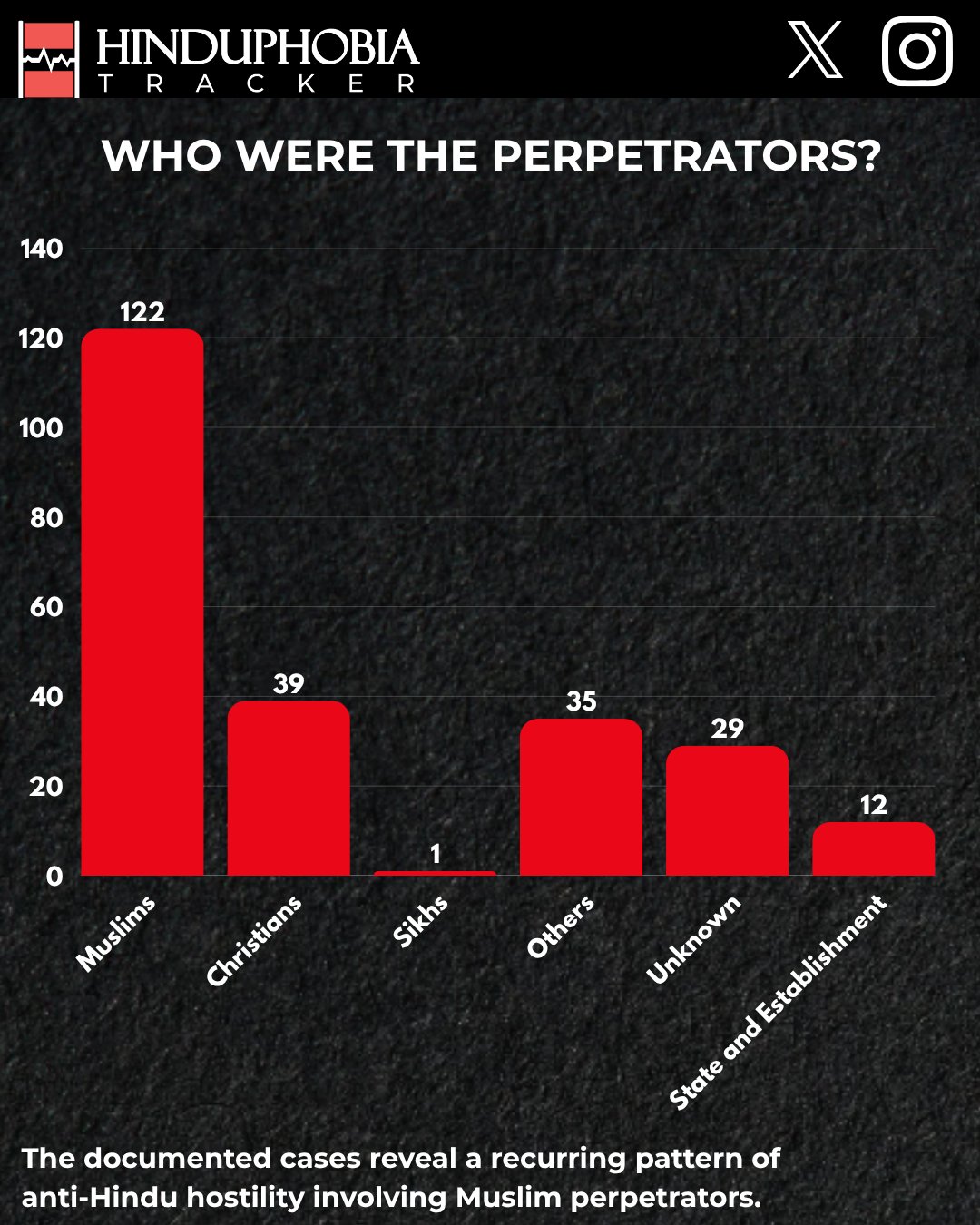
Of all identified perpetrators, nearly four out of five were Muslim or Christian. Muslims accounted for almost three out of every five identified perpetrators, while Christians accounted for around one in five.
What stands out in September?
1. The victim count was shaped by a small number of large events
The clearest pattern in September is the concentration of victims in eight mass conversion cases. These incidents account for nearly 94 per cent of the total recorded victim count. Without them, the aggregate would look substantially different.
This does not make the other 231 cases unimportant. Rather, it shows why incident counts and victim counts must be examined separately. A month with fewer incidents can still record many more victims when a small number of events involve large groups.
2. Predatory proselytisation was the largest recorded category
With 68 cases, predatory proselytisation was the most frequently recorded category in September. The supplied subcategory data includes conversion attempts directed towards Christianity and Islam, alongside reported methods such as manipulation, coercion and inducements.
The figures provide a basis for examining how the cases were documented and classified. They should not, on their own, be used to assume that all conversion activity is coercive or that all cases within the category share an identical pattern. The distinction depends on the conduct recorded in each case.
3. Attacks on Hindu religious representations remained prominent
The tracker recorded 62 cases involving attacks on Hindu religious representations. This placed the category close to hate speech, which accounted for 63 cases.
The figures indicate that incidents involving Hindu religious representations made up a substantial share of September’s documented cases. A fuller assessment of the pattern would require examining individual records, including the nature of the targeted representation, the circumstances of the incident, and the evidence supporting its classification.
4. Hate speech remained a major category
With 63 cases, hate speech was the second-largest category in the supplied September chart. Its prominence alongside attacks on religious representations reflects the range of conduct the tracker captures, from speech-based incidents to acts directed at religious symbols or representations.
The count establishes how often the category appears in the database. The content, context and target of the statements remain important when assessing the significance of individual cases.
August–September Comparison
September recorded fewer incidents than August but substantially more victims. The comparison below places the two months side by side while keeping incident counts and victim counts separate.
| Measure | August 2026 | September 2026 |
|---|---|---|
| Total cases | 260 | 239 |
| Total victims | 2,619 | 7,187 |
| Cases in India | 214 | 194 |
| Cases outside India | 46 | 45 |
| Predatory proselytisation | 54 | 68 |
| Hate speech | 76 | 63 |
| Attacks on Hindu religious representations | 51 | 62 |
| Attacks not resulting in death | 35 | 49 |
| Crimes against women in relationships and other sexual crimes/crimes against women in relationships | 50 | 44 |
Fewer cases, but a much larger recorded victim count
The total number of cases fell from 260 in August to 239 in September, a decline of approximately 8.1 per cent. However, the number of victims rose from 2,619 to 7,187, an increase of 4,568, or about 174.4 per cent. September’s recorded victim count was about 2.7 times that of August.
The eight mass conversion cases recorded in September explain much of this increase. They accounted for 6,735 victims, whereas August’s supplied data identified two mass conversion cases involving 2,290 victims. The comparison shows how a small number of large events can significantly affect the monthly total, even when recorded incidents fall.
The category figures also moved in different directions. Predatory proselytisation rose from 54 cases in August to 68 in September, an increase of approximately 25.9 per cent. Attacks on Hindu religious representations rose from 51 to 62, while attacks not resulting in death increased from 35 to 49. Hate speech declined from 76 to 63, and crimes against women in relationships declined from 50 to 44.
These movements reflect changes in the number of cases recorded under the relevant categories, not proof of a corresponding change in the overall prevalence of such incidents. Reporting coverage, classification and overlap can affect monthly totals.
The number of incidents that occured in India was broadly similar in both months: 214 of 260 in August, or 82.3 per cent, compared with 194 of 239 in September, or 81.2 per cent. Cases outside India also changed only slightly, from 46 to 45.
Conclusion
September 2026 recorded fewer cases than August, but the number of victims rose dramatically. The Hinduphobia Tracker documented 239 cases involving 7,187 victims, with eight mass conversion cases alone accounting for 6,735 people. This sharp contrast shows why the monthly figures must be read beyond the headline count. The number of incidents tells only part of the story; the scale of their impact matters just as much.
Predatory proselytisation emerged as the largest recorded category, followed by hate speech and attacks on Hindu religious representations. The data also records cases involving manipulation, coercion, harassment and inducements in conversion-related incidents, alongside cases involving women and minors. Taken together, these figures offer a closer look at the different forms of religious targeting documented during the month.
September’s data is a reminder that a decline in the number of cases does not necessarily mean a decline in the scale of harm. Behind the monthly totals are individual incidents, affected families and, in some cases, thousands of people caught up in a single event. Continuing to document these cases, examine their patterns and scrutinise the circumstances in which they occur remains essential to understanding the nature and extent of the incidents recorded by the Hinduphobia Tracker.