

1. Introduction
Religious representations encapsulate belief, memory and communal identity. For Hindu communities, these representations include temples, icons, ritual paraphernalia, sacred precincts and the customs that animate them. When those objects and practices are deliberately targeted, the harm extends beyond material loss. It reaches into the public expression of identity, the continuity of ritual life and the sense of safety that underpins communal belonging.
This report examines recorded incidents of hostility directed at Hindu religious representations. The focus is explicit: to treat acts such as desecration, temple attacks, ritual interference and land encroachment as not merely criminal acts but as phenomena that may reflect identity-based hostility. The primary aim is to present a clear, evidence-based reading of the dataset, draw out striking numeric patterns, and articulate why the distribution and modality of these incidents are consistent with hate-motivated action. The analysis is purposeful and pragmatic. The objective is to inform researchers, policy makers, civil society actors and law enforcement about the patterns that warrant tailored prevention and response.
The material analysed originates from a compiled dataset of 781 recorded incidents of ‘attacks on Hindu religious representations’ across several countries, with further detail at national and subnational levels for India. The dataset records multiple offence categories per incident, where applicable.
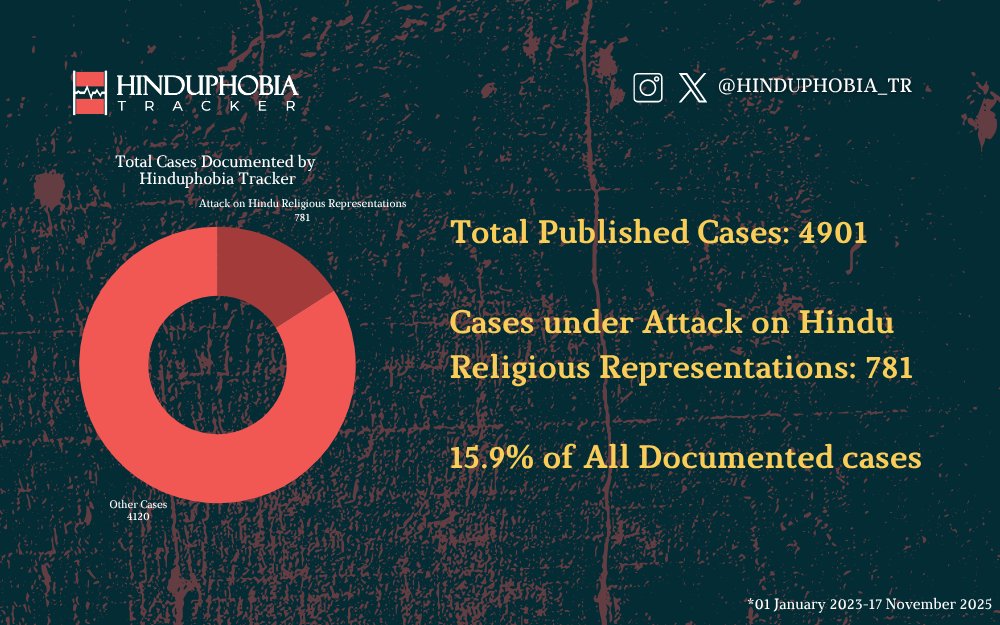
The dataset supplied forms the core empirical basis. Basic quantitative techniques were applied to compute relative shares, concentration ratios, and comparative intensities across geographies and offence types. Where percentages are cited, they are calculated with the global total of 781 incidents unless otherwise noted. Where the dataset permits, state-level breakdowns were used to detect clustering and to identify high-burden jurisdictions. Interpretative claims emphasise reproducible patterns such as concentration, prevalence of symbolic offences, and recurrence across borders.
2. Understanding Attacks on Hindu Religious Representations
2.1 Defining religious representation
Religious representation in the Hindu context includes temples, murtis, sacred images, ritual implements, sanctified land, sacred threads, and the customs that govern worship. These objects and practices are not decorative elements. They embody presence, memory and meaning. They serve as points where individual belief connects with a shared cultural inheritance.
Temples and sacred objects may exist in the physical world, but they are not experienced as mere property. They hold emotional, spiritual and social weight that material goods cannot carry. A stolen artefact can be replaced; a desecrated murti cannot be restored to its original sanctity without elaborate ritual.
Acts against religious representations show certain consistent signals of targeted hostility. The selection of temples, murtis or ritual moments is rarely accidental. These sites are chosen because they are visible, vulnerable and symbolically charged. The repetition of similar acts in the same regions strengthens the inference of motive. The public nature of many attacks, especially those carried out during festivals or at night when temples are typically unguarded, suggests an intent to unsettle the community.
2.2 Historical context of symbolic targeting of Hindu sites and customs
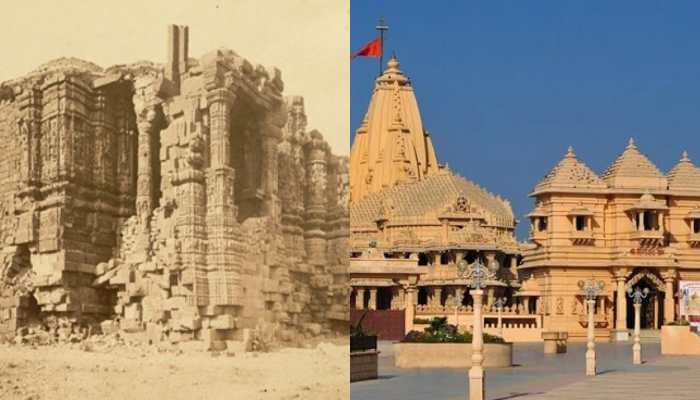
Symbolic attacks on Hindu sacred spaces have a long documentary trail. Several medieval campaigns targeted major temples to signal dominance. The demolition of Kashi Vishwanath under Muslim tyrants like Aurangzeb, the repeated destruction of the Somnath temple during Mahmud of Ghazni’s invasions, and the conversion of the Keshavdeva temple in Mathura into the Shahi Idgah complex are among the clearest examples. These were deliberate strikes on centres of pilgrimage, ritual and local identity.
Colonial rule introduced a different form of symbolic pressure. British administrators often treated Hindu public ritual as a disturbance to be controlled. Restrictions on Ganesh Chaturthi processions in Pune and Mumbai (then Bombay), as well as limits placed on Durga Puja observances in Bengal, and police curbs on major festival routes, signalled that Hindu public worship required supervision rather than respect.
The Religious Endowments Act of 1863 brought temples like Jagannath in Puri and many others under direct state oversight, allowing the administration to intervene in finances, priestly appointments, and offerings. In Banaras, colonial authorities interfered in the management of the Kashi Vishwanath temple and even dictated access routes and festival protocols.
Surveillance of yatras and melas under the Criminal Procedure Code and the Police Act further reinforced the view that Hindu assemblies were suspect gatherings needing regulation. Missionary literature of the period also described Hindu worship in patronising or hostile terms, echoing the tone of figures like Alexander Duff in Bengal and evangelicals in the Madras Presidency.
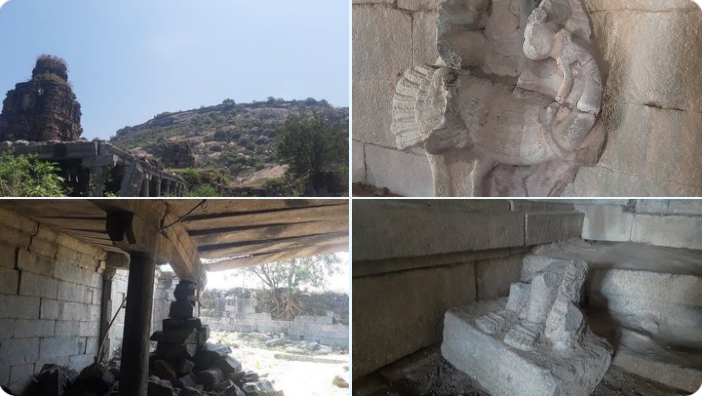
Added to this was the extensive removal of temple sculptures and artefacts by colonial officers and collectors. Many idols and carved panels taken during this period are now held in British museums, and the stripped condition of numerous temple sites today is a stark reminder of how openly these sacred spaces were plundered. These layers of interference shaped official attitudes and social perceptions in ways that diminished the standing of Hindu customs and eroded traditional authority and practice.
2.3 The role of symbolism, sacred space and ritual in Hindu practice
Hindu practice depends on the continuity of sacred spaces and the integrity of ritual action. Temples are not merely venues for prayer; they are living institutions that shape the rhythm of community life. Rituals reinforce belonging and offer reassurance in times of distress. Sacred symbols, whether a murti, a flag or a piece of temple land, act as anchors for memory and identity. When these are attacked, the community loses more than an object. It experiences a rupture in its sense of safety and a direct challenge to its place in the social landscape.
3. Major Categories of Attacks on Hindu Religious Representations
3.1 Desecration of Hindu religious symbols
Desecration involves deliberate damage or insult to sacred objects such as murtis, images, flags, ritual vessels or sanctified stones. These acts often include breaking, smearing, burning or throwing away objects that hold spiritual meaning. Because each object represents presence and continuity, desecration strikes at the emotional core of community belief.
3.2 Attacks on temples and sacred structures
Temple attacks include vandalism, arson, forced entry, destruction of inner chambers and targeted damage to architecture or inscriptions. These structures are visible markers of faith, so harm done to them is witnessed widely and quickly spreads fear.
3.3 Defiling Hindu religious customs
This category refers to disruption or mockery of rituals, obstruction of worship, interference during aarti, processions or puja, and actions meant to ridicule sacred moments. Such acts aim to humiliate practitioners by targeting the heart of their religious expression.
3.4 Breaking rules inside places of worship
Violations include entering sanctum areas without permission, engaging in prohibited behaviour, or showing deliberate disrespect to ritual norms. These actions challenge the sanctity of the space and undermine the authority of caretakers and priests.
3.5 Violence against religious structures or centres
This includes attacks on ancillary buildings, community halls, heritage centres and institutions linked to temples. Damage to these spaces affects education, charity and cultural continuity, eroding trust in communal safety.
3.6 Encroachment or illicit takeover of temple land
Encroachment uses bureaucratic pressure, coercive capture or gradual occupation to weaken religious presence. Losing sacred land severs historical memory and limits the ability to maintain rituals tied to those spaces.
3.7 Abrahamic religious chanting near Hindu spaces
Chanting intended to drown out Hindu rituals or provoke devotees introduces an atmosphere of intimidation. It uses sound and symbolism to assert dominance and disrupt the spiritual environment, turning prayer into a moment of unease.
4. Global Quantitative Overview
| Metric | Value |
| Total recorded incidents (global) | 781 |
| Incidents in India | 615 |
| India as share of global incidents | 78.7% |
| Remaining named countries (Bangladesh, Pakistan, United States, Canada) | 145 |
| Other or unspecified countries | 21 |
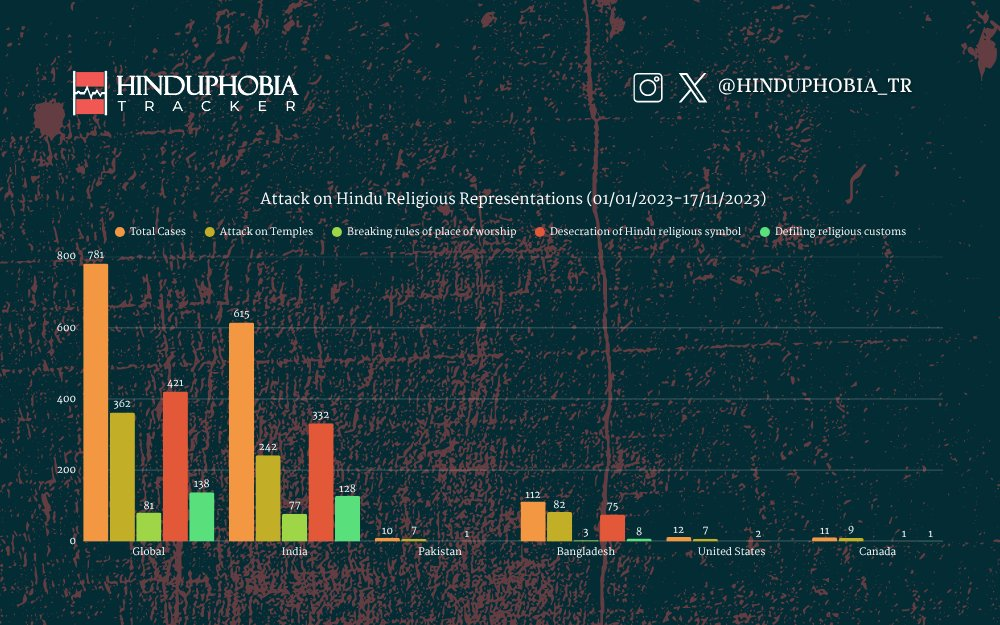
• The dataset recorded 781 incidents of hostility against Hindu religious representations across multiple countries.
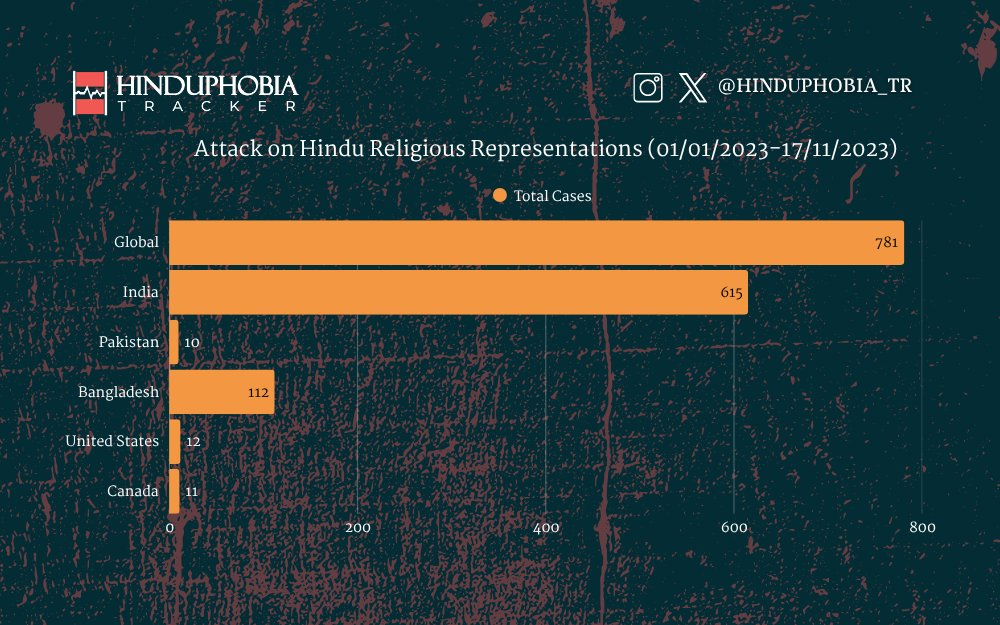
• India accounts for 615 incidents, which is 78.7 per cent of the global total. This makes India the central geography of recorded hostility.
• Bangladesh follows with 112 incidents, while Canada (11), the United States (12) and Pakistan (10) contribute smaller numbers, though their patterns remain significant.
It is important to note that Pakistan’s numbers appear small only because reporting of anti-Hindu violence is heavily restricted. Independent documentation is routinely blocked, victims face pressure not to file complaints, and many incidents never reach the media due to censorship and intimidation. As a result, the recorded figures reflect only a fraction of the actual cases, creating the false impression that the scale of violence is lower than it truly is.
• Across all countries, desecration of Hindu religious symbols is the dominant form of attack, recorded 421 times, which is 53.9 per cent of all incidents.
• Attacks on temples appear 362 times, or 46.4 per cent, making physical harm to places of worship the second most common pattern worldwide.
| Offence type | Count | Percentage of global total (781) |
| Desecration of Hindu religious symbol | 421 | 53.9% |
| Attack on temples | 362 | 46.4% |
| Defiling religious customs | 138 | 17.7% |
| Breaking rules of place of worship | 81 | 10.4% |
| Violence against religious structures or centres | 54 | 6.9% |
| Encroachment or illicit takeover of temple land | 52 | 6.7% |
| Abrahamic religious chanting outside Hindu places or during Hindu activities | 22 | 2.8% |
• The global landscape, therefore, shows a clear preference for symbolic and architectural targets rather than generalised offences.
• Bangladesh mirrors the global pattern, with a heavy concentration of temple attacks and desecration, forming roughly two-thirds of its total.
• Canada presents a narrow but intense pattern, where over 80 per cent of incidents involve direct attacks on temples.
• Pakistan’s small sample is also heavily temple-centric, indicating that even limited datasets reflect similar priorities of targeting.
| Country | Count | Share of global total (781) |
| India | 615 | 78.7% |
| Bangladesh | 112 | 14.3% |
| Pakistan | 10 | 1.3% |
| United States | 12 | 1.5% |
| Canada | 11 | 1.4% |
| Other or unspecified | 21 | 2.7% |
• Key global trivia points reinforce the scale of concentration:
- More than half of all global incidents involve desecration.
- Hate crime against Hindus is not limited only to India.
• These recurring patterns across countries indicate a transnational structure of symbolic hostility, where Hindu sacred objects and places of worship consistently emerge as primary targets.
5. India Focus: National Level Patterns
India forms the core of the dataset, recording 615 of the 781 incidents, which is 78.7 per cent of all cases worldwide. This overwhelming share means that national-level patterns in India effectively shape the global picture of hostility toward Hindu religious representations.
Dominant offence types
Two categories define India’s profile:
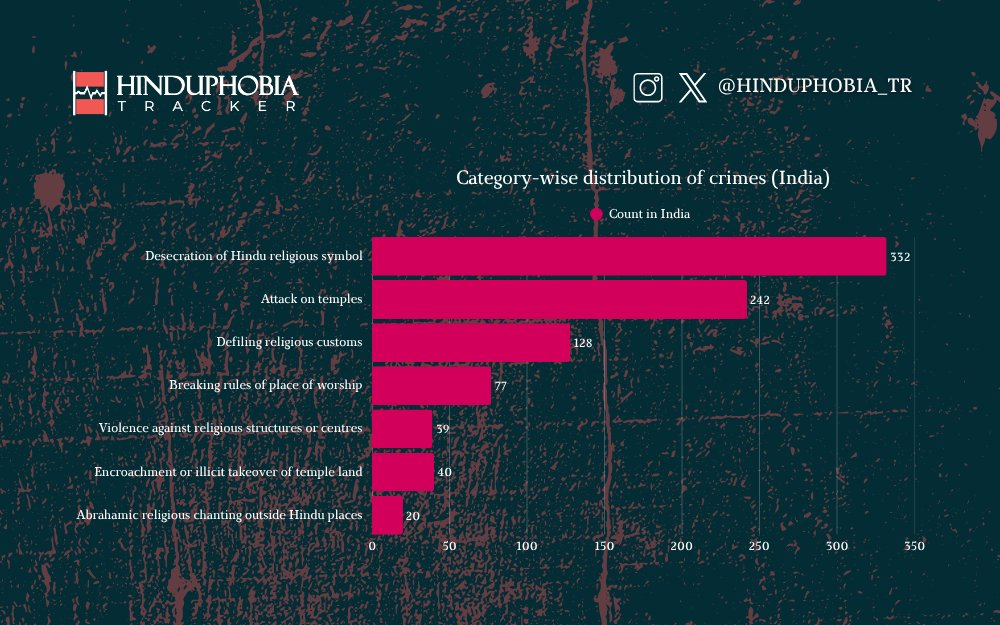
• Desecration of Hindu religious symbols: 332 incidents, 54 per cent of the national total.
• Attacks on temples: 242 incidents, 39.4 per cent.
| Offence type | Count in India | Percentage of India total (615) |
| Desecration of Hindu religious symbol | 332 | 54.0% |
| Attack on temples | 242 | 39.4% |
| Defiling religious customs | 128 | 20.8% |
| Breaking rules of place of worship | 77 | 12.5% |
| Violence against religious structures or centres | 39 | 6.3% |
| Encroachment or illicit takeover of temple land | 40 | 6.5% |
| Abrahamic religious chanting outside Hindu places | 20 | 3.3% |
These two forms of hostility account for most recorded activity and show that the main targets are sacred objects and places of worship rather than secondary structures or economic assets.
Regional triggers and distribution
Patterns vary significantly across states. Regions with sharper social or political tension often show higher proportions of direct temple attacks.
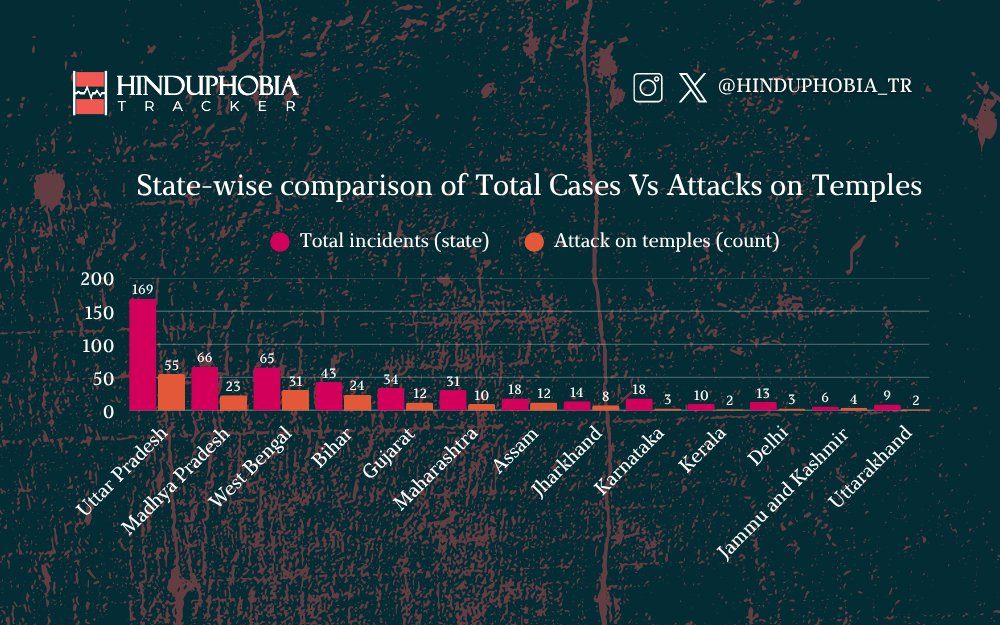
• Assam and Jammu and Kashmir register 66.7 per cent of incidents as temple attacks.
• Jharkhand records 57.1 per cent temple attacks relative to its smaller base.
• Karnataka and Kerala show lower temple attack proportions but higher instances of symbolic and ritual interference.
| State | Total incidents (state) | Attack on temples (count) | Attack on temples as share of state incidents |
| Uttar Pradesh | 169 | 55 | 32.5% |
| Madhya Pradesh | 66 | 23 | 34.8% |
| West Bengal | 65 | 31 | 47.7% |
| Bihar | 43 | 24 | 55.8% |
| Gujarat | 34 | 12 | 35.3% |
| Maharashtra | 31 | 10 | 32.3% |
| Assam | 18 | 12 | 66.7% |
| Jharkhand | 14 | 8 | 57.1% |
| Karnataka | 18 | 3 | 16.7% |
| Kerala | 10 | 2 | 20.0% |
| Delhi | 13 | 3 | 23.1% |
| Jammu and Kashmir | 6 | 4 | 66.7% |
| Uttarakhand | 9 | 2 | 22.2% |
State-wise data pointers
Uttar Pradesh
• 169 total cases, the highest in the country.
• 55 temple attacks, forming one of the largest absolute counts nationally.
• 79 desecration incidents, the single highest desecration count for any state.
• 38 cases of defiling customs, showing frequent ritual-related interference.
• Represents the most intense multi-category concentration in India.
Bihar
• 43 total cases with 24 temple attacks, giving the state a high structural attack ratio.
• 30 desecration cases, indicating strong symbolic targeting.
• Low ritual interference but high focus on temples and symbols.
Madhya Pradesh
• 66 cases, making it a major contributor.
• 23 temple attacks and 28 desecration incidents form the state’s core pattern.
• 16 instances of defiling customs, showing significant ritual disruption.
West Bengal
• 65 cases with 31 temple attacks.
• 41 desecration incidents, one of the highest symbolic harm counts.
• 14 ritual defilement incidents, indicating multi-category hostility.
Gujarat
• 34 cases overall.
• Balanced pattern: 12 temple attacks, 15 desecrations, and 4 ritual defilements.
• Low on rule-breaking inside temples.
Maharashtra
• 31 cases, moderate but diverse profile.
• 10 temple attacks, 17 desecrations, 7 ritual defilements.
Chhattisgarh
• 22 cases, with 10 temple attacks and 15 desecrations, showing a strong symbolic focus.
Assam
• 18 cases, but 12 temple attacks, creating a very high temple attack ratio (two thirds).
• Lower symbolic and ritual profiles but intense structural targeting.
Rajasthan
• 20 cases with 8 temple attacks.
• 12 desecrations, 4 ritual defilements, showing a mixed symbolic profile.
Delhi
• 13 cases, lower overall count.
• 3 temple attacks and 8 desecrations, indicating mostly symbolic harm.
Jharkhand
• 14 cases, but 8 temple attacks, producing a notable structural attack concentration.
• Moderate symbolic interference.
Karnataka
• 18 cases, but only 3 temple attacks.
• 15 desecration incidents, showing a strong preference for symbolic targets.
Telangana
• 15 cases, 6 temple attacks and 12 desecrations.
• Emerging pattern of symbolic and structural harm.
Tamil Nadu
• 16 cases, featuring 6 temple attacks and 11 desecrations.
• Balanced symbolic and structural interference.
Kerala
• 10 cases, low overall numbers.
• 2 temple attacks but 4 desecrations and 5 ritual defilements, showing more ritual based targeting.
Jammu and Kashmir
• 6 cases, small dataset.
• 4 temple attacks, giving it one of the highest temple attack proportions.
Uttarakhand
• 9 cases, moderate but significant.
• 2 temple attacks, 4 desecrations, and 4 ritual defilements, showing a mixed pattern.
National trivia and notable concentrations
• The top five Indian states together contribute 61.3 per cent of all incidents.
• Desecration in India alone exceeds the total number of incidents recorded in all countries outside India.
• Some states show narrow offence profiles, while others present a mix of desecration, ritual disruption and land-related interference.
Indicators of systemic hostility
The selection of sacred items and spaces as primary targets, the repetition of similar categories across distant states, and the clustering of incidents in specific regions suggest a pattern deeper than isolated crime. Such targeting undermines religious presence and community confidence, providing strong indicators of sustained hostility directed at Hindu identity and its public expressions.
Three cases in the dataset involve recorded deaths, and they stand out as the gravest indicators of how hostility toward Hindu religious identity can escalate beyond symbolic injury into fatal violence. These incidents move the pattern from intimidation and desecration into direct attacks on life, showing that the underlying motive is not limited to controlling ritual space or humiliating the community but can extend to eliminating individuals who resist or represent Hindu presence.
Death linked to religious hostility has a distinct social impact: it creates a shock that spreads far beyond the immediate location, deepens fear among local devotees, and signals that refusal to submit to coercive pressure may carry fatal consequences. Such cases mark the extreme end of the spectrum of Hinduphobic violence and are critical for understanding both the severity and the intentional nature of targeted aggression against Hindus.
6. Thematic insights from the data
The dataset reveals several consistent themes that help explain the nature, scale and intention behind attacks on Hindu religious representations. These themes show how symbolic aggression is selected, where it concentrates and why it resonates across countries.
Predominance of desecration as the primary mode of hostility
Desecration is the most common offence, with 421 global cases and 332 in India alone. This dominance indicates that attackers often seek to target symbols rather than assets. Breaking, smearing or defiling sacred objects serves no material purpose. It exists to insult, unsettle and communicate contempt. The numbers show that symbolic injury is not an occasional pattern but the primary mode of hostility across the dataset.
Symbolism and ritual as central targets
Ritual objects, murtis, temple flags, sanctified stones and ritual spaces are repeatedly chosen as points of attack. This pattern underscores that the aim is not theft or gain but disruption of worship and the meaning carried by those objects. Interference during aarti, processions or puja further shows that rituals are treated as opportunities for psychological pressure rather than neutral events.
The geographic logic of high-frequency areas
States with large Hindu populations and intense political or social contestation, such as Uttar Pradesh, West Bengal and Bihar, show higher incident counts. Meanwhile, states like Assam and Jammu and Kashmir show a much higher proportion of temple attacks, suggesting that the nature of hostility differs based on local dynamics rather than uniform national behaviour.
Patterns linking temple attack intensity with cultural demography
Regions with sharper communal fault lines display a stronger tendency toward direct attacks on temples. Assam, Jammu and Kashmir and Jharkhand show unusually high temple attack ratios, reflecting how demographic tensions can shape the form of symbolic aggression. Conversely, states with different social configurations, such as Karnataka and Kerala, see more symbolic interference rather than structural damage.
Consistency of targeted hostility across multiple countries
The same categories of attack repeat in Bangladesh, Pakistan, the United States and Canada, despite differing political environments. Temple attacks dominate in Canada and Pakistan, while Bangladesh mirrors India’s combination of desecration and structural harm. This repetition suggests a broader pattern of hostility that transcends local triggers.
The psychological aim of public desecration
Desecration and temple damage are often carried out in ways that maximise public visibility. A broken murti in a village shrine, a vandalised temple gate or a defiled sanctum is meant to be seen. These acts generate fear, humiliation and moral shock in Hindus. Public desecration, therefore, functions as a tactic designed to erode confidence and signal that sacred spaces are not safe. The dataset shows that this psychological dimension is central to how symbolic hostility operates.
7. Why these incidents constitute Hate Crimes Against Hindus
The patterns in this dataset align closely with how hate-motivated crime is recognised in research and law. The offences repeatedly target Hindu identity rather than opportunity or material value, and the nature of the attacks makes this intention unmistakable. The focus on murtis, temples, ritual spaces, processions and sacred items shows deliberate selection of objects that hold emotional and spiritual meaning for Hindus. When symbols are harmed while valuables are ignored, the act signals contempt for the community rather than interest in gain.
This pattern is not confined to one region. Nearly identical forms of hostility appear in India, Bangladesh, Pakistan, Canada and the United States. Desecration, temple damage and interference in Hindu rituals recur in these different settings, indicating that the hostility arises from attitudes toward Hindu identity rather than specific local disputes.
The impact also extends well beyond the physical damage. A broken murti or a vandalised sanctum unsettles entire neighbourhoods. Families may avoid temples, celebrations may become subdued, and the everyday ease of practising one’s faith is replaced by caution. This wider emotional injury is characteristic of a hate crime, where the real target is the collective confidence of the community.
The manner of the attacks further strengthens the interpretation. Desecration often involves breaking or discarding sacred objects that have no practical use outside worship. Temple attacks frequently involve arson or forced entry without theft. Interrupting aarti or chanting rival religious slogans near Hindu spaces serves no purpose but provocation. These acts reflect a clear Hinduphobic impulse.
Viewed individually, each incident might seem like vandalism. Seen together, the repetition across states and countries forms a coherent pattern. The dominance of symbolic offences and their public visibility creates a climate of fear, signalling that Hindu sacred spaces can be violated without consequence. This emotional intimidation is central to the logic of Hinduphobia and gives these incidents their character as hate crimes.
8. Why these incidents warrant inclusion in the Hinduphobia Tracker
These incidents warrant inclusion in the Hinduphobia Tracker’s Hate Crime database because they exhibit the core features used by researchers, legal frameworks and monitoring bodies to identify bias-motivated offences. Hate crime classification begins with target selection, where the victim or object is harmed not for material gain but for its identity significance. The dataset reflects this principle with unusual clarity. Most incidents are directed at murtis, temples, ritual spaces, sacred flags and public religious gatherings that hold exclusive meaning within Hindu practice. Their destruction offers no tangible benefit to the perpetrator, yet it strikes directly at the community’s sense of sanctity and belonging, which is a defining marker of identity-based hostility.
The repetition of these patterns across regions reinforces their classification as hate crimes. The same forms of desecration, ritual interference and symbolic damage appear in India, Bangladesh, Pakistan, Canada and the United States, despite diverse political settings and social conditions. When identical categories of harm recur across borders, the implication is that the hostility flows from animus toward Hindu identity rather than from isolated disputes or local friction. This cross-regional similarity is a recognised indicator of group-directed hate.
Hate crime analysis also considers the broader impact on the affected community, and these incidents clearly meet that threshold. A vandalised murti or a burnt sanctum affects more than a single shrine. It unsettles the surrounding neighbourhood, reduces participation in religious spaces, disrupts festival routines and generates fear that open practice of the Hindu faith may provoke danger. The collective shock and withdrawal that follow such attacks demonstrate why they must be understood not as ordinary offences but as targeted violence aimed at silencing or diminishing a religious community. This cumulative pattern justifies their inclusion in the Hinduphobia Tracker’s Hate Crime database as a clear record of identity-driven hostility.