

Harshu Thakur, a Hindu activist and social worker from Maharashtra, has been the target of a sustained campaign of Islamist harassment, intimidation, and physical violence. On 11 October 2025, she was physically assaulted at a bakery in Nanded by two Muslim men, after enduring over two years of continuous threats, online abuse, and obscene propaganda designed to silence her advocacy for Hindu identity and religious freedom.
Harshu has been actively working to support Hindu transgender victims facing religious coercion and conversion pressures in Nanded and Parbhani. Her efforts to document these abuses and stand up for Hindu victims brought her under a coordinated hate campaign. Since 2023, she has filed multiple police complaints against Muslim individuals who issued death threats, circulated morphed and sexually explicit images, and used profane, blasphemous language to insult Hindu deities. Despite repeated appeals and formal FIRs, authorities failed to take decisive action, allowing the perpetrators to escalate their campaign of hate unchecked.
The Hinduphobia Tracker team reached out to Harshu soon after the 2025 assault. In her detailed account, supported by digital evidence including call logs, screenshots, and audio recordings, a clear pattern of religiously motivated hatred emerged.
This case stands as a disturbing example of how Hinduphobia evolves, beginning with online abuse and blasphemous attacks on Hindu deities, intensifying through sexualised insults and death threats, and culminating in physical assault. The perpetrators did not merely target Harshu as an individual; they targeted her as a symbol of assertive Hindu resistance, attempting to humiliate and silence her through a coordinated campaign of religiously motivated violence and humiliation.
The Hinduphobia Tracker documents this case as a critical instance of religious hate, exposing how anti-Hindu hostility, when ignored by law enforcement, emboldens perpetrators and normalises violence against Hindus. Harshu Thakur’s ordeal is not an isolated event but part of a broader pattern of hate where outspoken Hindu voices face systematic harassment for defending their faith and community.
Details of the 11 October 2025 attack on Harshu Thakur
On 11 October 2025, Harshu Thakur was attacked at Bangalore Bakery, located in the Vazirabad area of Nanded, around 12:30 pm, while having breakfast with her younger sister.
As per Harshu’s statement recorded at Vazirabad Police Station, two unknown men, aged between 25 and 30 years, arrived on a motorcycle and entered the bakery. One of them, wearing a black T-shirt and carrying a bag, made sexually suggestive remarks directed at her. He first said, “My lips are dry too, give me some water to drink,” and then, while eating a sweet, added, “Do you want to eat too?” When Harshu went to pay her bill, he again harassed her, saying, “Pay for my sweet too.”
When Harshu confronted him and asked why he was staring at her and making such remarks, the man suddenly lunged toward her, slapped her on the left cheek, and pushed her shoulder. Bystanders intervened and forced the assailant out of the bakery. The attacker then began abusing her verbally on the street. Harshu ran after him, grabbed his T-shirt, but he pushed her again. His companion, wearing a Pathani outfit and a green Islamic cap, started the motorcycle, and both fled the scene, shouting, “We’ll deal with you.”
The FIR detailed these actions and sought legal action against the two unknown assailants. Later, Harshu identified one of them as Sohel Sheikh, stating that he appeared to recognise her, made objectionable remarks before the attack, and had been associated with individuals previously involved in threatening her.
The attack took place while Harshu was on her way to file an FIR against another individual, Salman Sheikh, who had recently issued death threats and circulated a morphed video depicting her in obscene and defamatory ways.
The case involving Salman Sheikh represents one of the most disturbing episodes in the sustained campaign of Islamist harassment against Harshu Thakur. According to Harshu’s formal complaint filed at the Airport Police Station, Nanded, Salman Sheikh, identifying himself as Sheikh Salman Sheikh Yusuf, initiated contact through repeated phone calls beginning 20 September 2025. In these conversations, he unleashed a torrent of filthy and demeaning abuses, calling her “Rand” and “Randi” (Prostitute) and repeatedly mocking her activism for the Hindu cause.
When Harshu confronted him and asked for his name and address, he brazenly introduced himself, displaying no fear of law enforcement. He taunted her, saying, “You speak ill words against the Muslim community,” and openly dared her to take legal action, boasting, “File an FIR, do whatever you want—it doesn’t make any difference to me. I don’t follow the Constitution. I’ll deal with you.” His language reflected not only personal hostility but also deep-seated religious animosity and contempt for the state’s legal authority and Hindus.
The harassment did not stop at verbal abuse. Salman Sheikh escalated his campaign by morphing Harshu’s photographs using AI to create obscene and defamatory videos designed to humiliate her publicly. In one such fabricated clip, he placed her image beside that of a Middle Eastern man dressed as a Sheikh, with a caption in Hindi claiming, “Hindustan ki ai ladki khudko bhagwadhari samajhne wali sheikh ko 5,00,000 rupaye mein Saudi Arabia mein bech di gayi hai” (“This girl from India, who considers herself saffron-clad, has been sold to a Sheikh in Saudi Arabia for five lakh rupees”). This malicious video, shared online, was meant to humiliate Harshu, damage her reputation, and shame her as a Hindu woman. It used both sexist and religious stereotypes, portraying her as disgraced and “sold” to Muslims—a common communal tactic used to insult and silence Hindu women who speak up or stand for their faith.
Harshu reported that Salman Sheikh continued his abuse over WhatsApp and voice calls, even after she filed her complaint. His language was laden with sexual obscenity, mixing personal threats with blasphemous references to Hinduism. He repeatedly called her a “prostitute,” mocked her saffron identity, and issued death threats, saying he would “deal with her” for speaking out against Muslims.
A case of Hinduphobia: Targeted doxxing and harassment of a Hindu woman for her faith
This section of the report qualifies the case of Harshu Thakur as a religiously motivated hate crime, warranting its inclusion in the Hinduphobia Tracker under the categories “Attacked for Hindu Identity” within the primary category “Attack not resulting in death” and “Doxxing and harassment of Hindu for religious reasons”, within the primary category “Hate speech against Hindus”.
The evidence and testimony reveal that Harshu was targeted primarily because of her visible Hindu identity, her saffron symbolism, and her activism in defence of the Hindu faith.
The campaign against Harshu Thakur was not limited to personal harassment; it was fundamentally driven by religious hatred toward her Hindu identity and the faith-based activism she represented. Every stage of the abuse, verbal, digital, and physical, was infused with explicit anti-Hindu animosity. The language used in threats and messages repeatedly invoked Hindu deities in obscene and blasphemous ways, ridiculing sacred symbols such as the Bhagwa flag, Tilak, and the names of Hindu gods. This shows that the intent was not just to insult Harshu personally, but to degrade the religion she stood for.
In Hinduism, these symbols and deities are not mere representations but sacred embodiments of divine power, virtue, and truth. To insult or sexually defile them is to attack the very foundation of a Hindu’s faith and spiritual identity. Such desecration, therefore, constitutes a direct affront to the Hindu religion itself, transforming what might appear as personal abuse into an act of religious blasphemy and hate.
By attacking her as a “Hindu woman” and mocking her saffron identity, the perpetrators made her religion the core reason for their hate. The morphed videos, obscene messages, and public defamation were deliberately crafted to strip her of dignity as a Hindu, turning her into a public example meant to intimidate other Hindu voices. The fake video portraying her as “sold to a Sheikh” was not random—it drew on long-standing communal stereotypes used to portray Hindu women as dishonoured or subdued under Islamic dominance. This reflects a deeper ideological contempt for Hindus, not a personal dispute.
The abuse also involved doxxing and coordinated digital harassment, where her photographs and personal details were stolen, edited, and circulated online. This had two clear purposes: to intimidate her into silence and to publicly shame her for asserting her Hindu faith.
The perpetrators themselves made the motive explicit, repeatedly referencing her “speaking against the Muslim community” and mocking her devotion to Hindu causes. Their use of religious slurs, threats, and blasphemous references establishes beyond doubt that the harassment was religiously motivated persecution, designed to punish her for affirming her faith and defending Hindu victims.
Targeting someone for being openly Hindu, for wearing saffron, invoking Hindu gods, or defending Hindu victims, constitutes a direct attack on religious freedom and dignity. In Harshu’s case, the harassment intensified precisely because she refused to hide her religious identity or compromise her fight for the Hindu cause. This makes the case a clear instance of Hinduphobia, where religious identity itself became the justification for humiliation, threats, and violence.
Harassment and threats faced by Harshu Thakur before the attack
The 2025 assault was not an isolated act but rather the culmination of continuous harassment and religiously motivated targeting that began in 2023 and persisted for over two years.
Between 2023 and 2025, Harshu was subjected to: Death threats over phone calls, WhatsApp messages, and social media platforms, circulation of morphed and obscene videos, often linking her with Muslim men to defame her publicly, abusive messages directed at Hindu gods and goddesses, particularly using profane and violent sexualised language and threat calls traced to Middle Eastern countries, indicating the involvement of international Islamist networks.
In 2023, Harshu filed a detailed complaint with the Sambhajinagar Police Commissioner, where she stated that after she participated in a Jan Akrosh Morcha in Jalna against the murder of a Hindu Dalit boy belonging to the Matang community by Muslim individuals, she became the target of online defamation. Muslim youths created fake “Valima” invitation cards using her morphed photographs with the murderers and spread them via WhatsApp, Instagram, and Facebook.
The Matang community is a Hindu community primarily in Maharashtra, sometimes referred to as Mang, known for traditional occupations like rope and broom making. They are considered an “Other Backwards Class” or Dalit community.
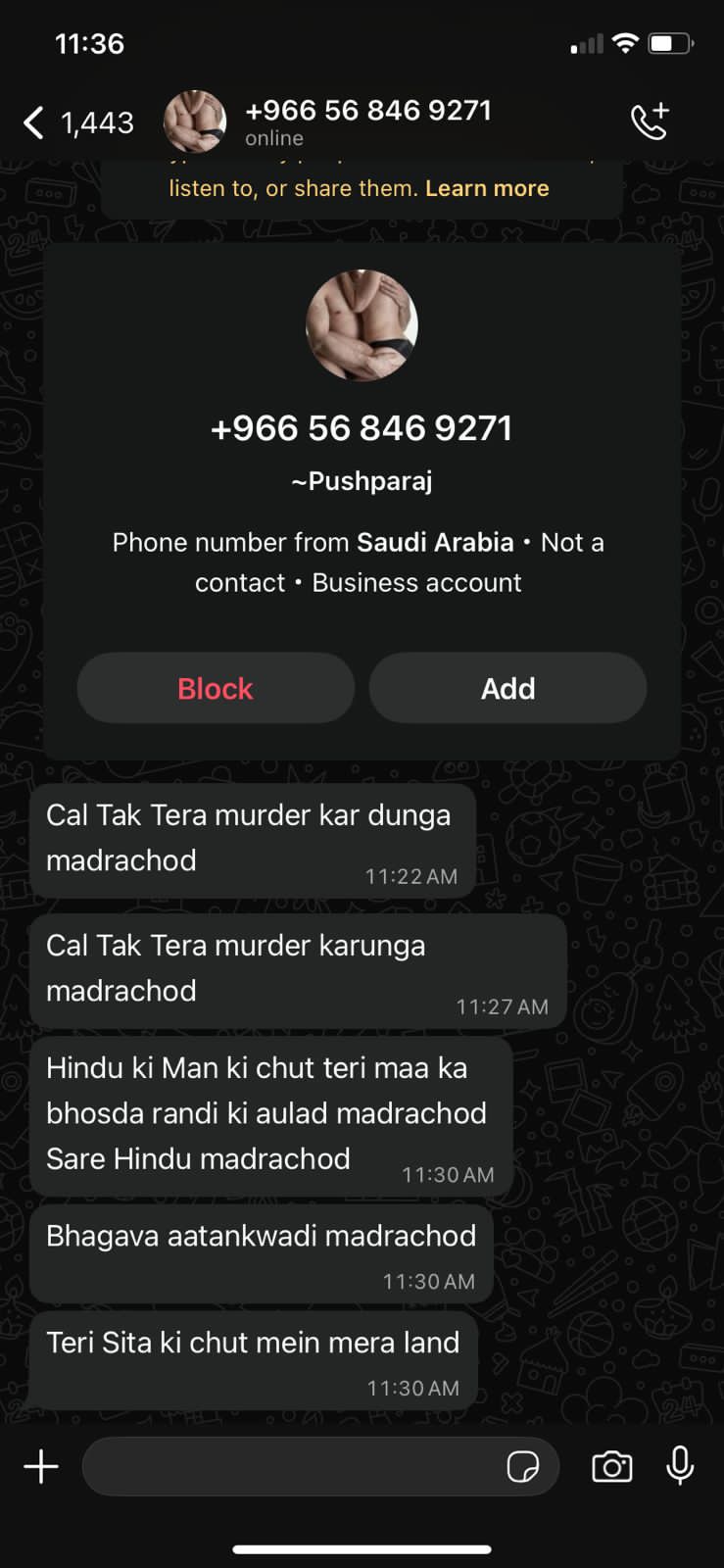
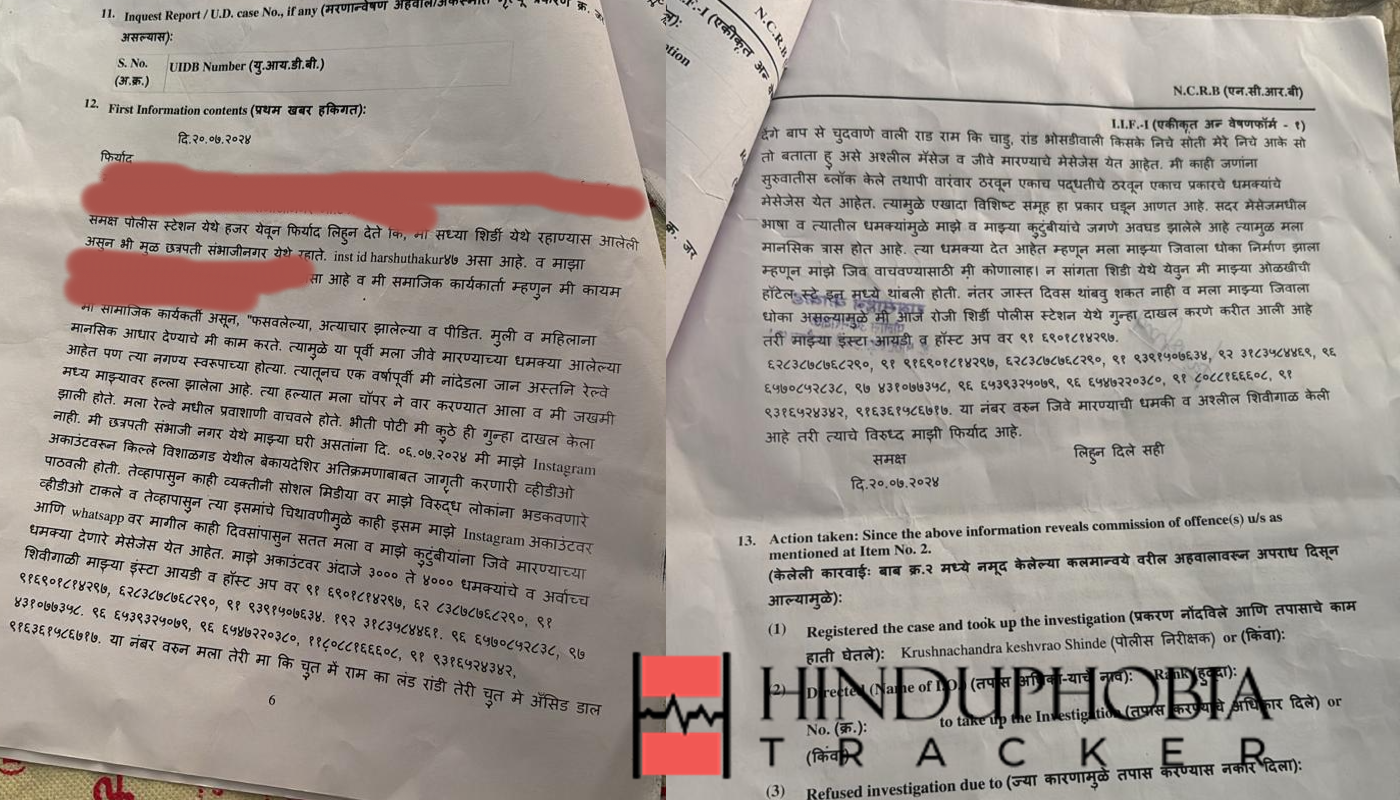
In September 2024, Harshu Thakur lodged a comprehensive complaint against 13 individuals for an extensive campaign of threatening, harassing, and defamatory messages. She reported that after posting an awareness video about illegal encroachment at Vishalgad Fort, she began receiving continuous abuse via Instagram and WhatsApp. She claimed that these messages included death threats, obscene sexual content, repeated insults, and mockery of her Hindu identity. Many messages reportedly came from multiple numbers; she estimated having received 3,000–4,000 such abusive messages in this period. She named specific phone numbers from which threats came. Among the abuses were phrases such as “Teri ma ki chut mein Ram ka lund,” “Randi teri chut mein acid daalenge,” and “Raah Ram ki chadu,” which combined sexual profanity with insults to Hindu symbols and gods. She described severe mental distress caused by the harassment, not only for herself but also for her family.
In her 2024 FIR, Harshu also recounted earlier instances of violence and harassment that had not been properly addressed. She said that about a year earlier, between Nandurbar and Jaunr rail lines, she had been attacked with a chopper while travelling, sustaining injuries. Out of fear, she did not report that incident. She also explained that the online abuse was coordinated, with people creating morphed images and videos designed maliciously to defame her reputation.
Harshu says these acts were not isolated but part of a deliberate strategy of intimidation. She claimed the harassment intensified in frequency and severity after she became more outspoken about sensitive issues, particularly around land encroachments and religious coercion by Muslims.
Despite providing extensive evidence—including screenshots of messages, morphed images, phone numbers, and temporal records of abuse—Harshu says that authorities did not take decisive steps following the 2024 FIR. There was no major arrest, nor to her knowledge any visible action that curtailed the harassment. The perceived inaction contributed to her feeling unsafe and being forced to temporarily relocate (she stayed in Shirdi for a time) because she worried about threats to her life and safety. The 2024 FIR therefore stands as a significant marker—both for the severity of the abuses she documented and for what Harshu views as a failure of law enforcement to protect a citizen facing religiously motivated and gendered hate.
The Hinduphobia Tracker team reviewed screenshots shared by Harshu that corroborated her account. One message, traced to a Saudi Arabian number, contained graphic death threats and sexualised profanity, demonstrating clear religious hatred.
Religious abuse and desecration of faith
The content of the threats sent to Harshu was not limited to personal abuse. It represented direct blasphemy and desecration of the Hindu faith and symbols. The perpetrators used deeply offensive language against Maa Sita, mocked Lord Ram, and hurled slurs at Hindu religious icons.
Messages regularly contained obscenities like “Teri ma ki chut mein Ram ka lund” and “Raah Ram ki chadu,” combining sexual humiliation with deliberate insult to Hindu deities. Hindu religious markers such as the Bhagwa flag, Tilak, and Hindutva symbols were ridiculed, and Harshu was repeatedly called a “terrorist” for being associated with Hindu causes.
Such abuse went far beyond mere personal animosity. It demonstrated systematic religious hatred and a clear intention to demean the Hindu faith. The messaging patterns reviewed by the Hinduphobia Tracker show that the harassment targeted both her gender and her religious identity.
This kind of hate speech falls squarely under the “Hate Speech and Anti-Hindu Slurs” category documented by the Hinduphobia Tracker, which monitors instances where Hindus are subjected to verbal or written desecration of their deities, scriptures, or religious identity.
Hindu deities are not merely symbolic figures but sacred embodiments of divinity, virtue, and cosmic order within the Sanatan Dharma. They represent ideals such as truth, compassion, courage, and wisdom, forming the spiritual and emotional foundation of a Hindu’s identity. For millions of Hindus, reverence toward deities like Shri Ram, Krishna, Shiva, and Devi is an expression of personal devotion and cultural continuity. When an individual is abused through references that mock or sexually defile these gods, it is not a mere personal insult but an assault on faith itself. Such language desecrates what is held sacred by an entire community and is thus classified under Indian law as a form of religiously motivated hate speech.
In cases where these abuses are laced with assertions of Muslim superiority or invocations of Islamic symbols while desecrating Hindu gods, the intent goes beyond personal enmity. It reflects a desire to assert religious dominance and humiliate a faith group by targeting its divine icons. This deliberate desecration of Hindu deities in the process of abusing a Hindu woman embodies both gendered and communal aggression. It seeks to degrade not just the individual but the collective spiritual identity she represents, aligning the act with hate crimes that aim to establish the supremacy of one religion over another.
Background: Harshu Thakur, her activism and earlier complaints
Harshu Thakur, aged 26, is a Hindu activist, social worker, and speaker known for her work supporting Hindus in Maharashtra. She has been active in Nanded, Parbhani, and Chhatrapati Sambhaji Nagar, helping marginalised Hindu individuals facing threats, extortion, and forced religious conversion.
Her activism earned her both recognition and hostility. Since 2023, she had filed multiple complaints against Islamists who had targeted her online. One such individual, Mohd Salman, had openly threatened to kill her and said, “Tere ko maarna tha” (“You were meant to be killed”).
In 2024, Harshu recounted an earlier assault on a train between Nandurbar and Jaunr, where she was attacked with a chopper but survived due to the intervention of other passengers. She did not file a complaint at that time due to fear. Later, after more threats emerged, she relocated temporarily to Shirdi for safety.
The lack of concrete action from law enforcement emboldened her harassers, leading to the eventual escalation into physical violence in 2025.
Targeting for supporting Hindu Transgender victims
A major factor behind Harshu’s sustained targeting has been her support for Hindu transgender victims who reported religious coercion and conversion attempts by Muslim transgender individuals in Nanded and Parbhani. The Hinduphobia Tracker documented this incident extensively, revealing how Hindu transgender individuals were pressured to abandon their faith, forced to eat beef, and mocked for their devotion to Hindu gods. Those who refused to comply faced violent assaults and threats of eviction from their homes.
In the districts of Nanded and Parbhani, Maharashtra, reports emerged in 2024 of Hindu transgender individuals being pressured by members of the Muslim transgender community to abandon their faith and convert to Islam. Victims described systematic intimidation, including threats, physical assaults, and public humiliation, aimed explicitly at eroding their Hindu identity. Several individuals reported being attacked for wearing symbols of Hindu devotion, such as Kumkum, while others stated they were coerced into eating beef or paying weekly bribes under duress.
Some recounted being thrown from moving trains, a harrowing tactic that reportedly had been used against members of their community for years to enforce compliance with conversion demands. Videos documenting these testimonies circulated online, revealing a pattern of religiously motivated coercion and intimidation, targeting individuals for their Hindu faith.
India's Most Insane Interview!
— Treeni (@TheTreeni) June 29, 2025
"I know they will kill me soon!…"
EXCLUSIVE: Attempted Murders of Hindu Transgenders, Threats to Convert, Protection Money (Hafta Wasooli), & Prostitution.
— The Underworld of Muslim Transgenders & Police ignorance
The world you know nothing… pic.twitter.com/eGIXDJJ5Tl
Harshu Thakur became involved after the victims’ stories came to public attention. Known for advocating on behalf of Hindu communities and vulnerable groups, Thakur documented the testimonies, helped victims raise their concerns, and called for legal action. Her intervention, however, drew retaliatory harassment. She reportedly received threatening and abusive messages, some of which contained explicit sexualised content and blasphemous references to Hindu gods, underscoring that the abuse was not merely personal but motivated by religious animosity. The threats intensified after she highlighted the victims’ refusal to abandon Hindu practices, revealing a direct link between her activism and the ongoing communal tensions.
In Nanded, Maharashtra, Hindu transgenders, in an exclusive interview with us, alleged that Muslim transgenders threaten Hindu transgenders, stating that to live in Nanded, Maharashtra, they must convert to Islam. pic.twitter.com/30PXYF6IwV
— Treeni (@TheTreeni) June 29, 2025
Victims reported that the coercion explicitly linked their Hindu identity to punishment. They were told they could not live safely in Nanded or Parbhani unless they abandoned their dharma and accepted Islam. Individuals identified in the reports demanded that Hindu transgenders cease worshipping Hindu gods, follow Islamic customs, and submit to various forms of extortion. Those who resisted faced repeated attacks, tracking across districts, and threats of death or eviction.
Muskan Khan and Farida, two Muslim transgender people, told Hindu transgender individuals, “If you want to live in Nanded and Parbhani, you must accept Islam and follow our culture.” On Eid, Muskan and Farida demanded that Hindu transgender people eat beef and meat. Those who refused were threatened with severe consequences like eviction and even death.
Muskan Khan and Farida threatened us, saying, "If you want to live in Nanded and Parbhani, you must accept Islam and follow our culture."
— Treeni (@TheTreeni) June 29, 2025
They had an issue with one of our transgenders who wore kumkum (vermilion powder) on her forehead, so they threw her out of a train and… pic.twitter.com/bgCHD7HS6A
Some were threatened with fatwas, while others were publicly shamed through the circulation of private images and personal details. Activists like Harshu Thakur, who spoke out against this religious coercion, were similarly targeted with threats from both domestic and international sources, reflecting a coordinated campaign to intimidate defenders of Hindu faith and identity.
The Nanded–Parbhani cases illustrate a clear pattern in which Hindu religious identity became the central point of both coercion and resistance. The targeting of Hindu transgenders and the harassment of Harshu Thakur demonstrate how communal lines intersect with gender vulnerability, and how public advocacy for Hindu victims can provoke backlash.
Conclusion
The harassment and assault faced by Harshu Thakur are a clear manifestation of a religiously motivated hate crime against Hindus, reflecting both systemic patterns and individual targeting of Hindu identity. From the earliest incidents in 2023 to the physical attack in October 2025, the campaign against her followed a recognisable trajectory, beginning in the digital sphere and escalating into physical violence. Initially, the perpetrators circulated morphed images, defamatory edits, and obscene videos targeting Harshu, often combining personal abuse with direct attacks on her Hindu identity. These materials were not neutral insults—they explicitly mocked Hindu religious symbols, gods, and sacred practices, thereby transforming personal harassment into an attack on the faith itself.
Central to the abuse was a blasphemous targeting of Hindu deities, particularly Maa Sita and other revered figures, alongside symbols such as the Bhagwa (saffron) and Tilak. The messages often contained sexually explicit threats entwined with insults directed at Hindu gods, portraying them as objects of mockery or derision. This pattern demonstrates a fundamental feature of anti-Hindu hate campaigns: the assault is not merely on the individual but on the collective spiritual and cultural identity they embody. The perpetrators framed Hindus as polytheistic, idolatrous, and inherently inferior, reflecting an ideological posture rooted in religious supremacism. Such messaging has the dual effect of intimidating the target and reinforcing communal hierarchies, communicating that those who identify as Hindu are legitimate subjects of contempt and subjugation.
The campaign against Harshu, which escalated into online abuse, was reinforced by death threats and continuous harassment through phone calls, including numbers traced to the Middle East, revealing transnational coordination. In this stage, the abuse transitioned from psychological and symbolic attacks into immediate threats of bodily harm, a classic escalation observed in other Hinduphobia Tracker cases.
This mirrors prior incidents in India where anti-Hindu vitriol online has frequently preceded lethal violence. Public figures such as Nupur Sharma, an ex-Bharatiya Janata Party (BJP) leader, received explicit threats of (Sar Tan Se Juda) beheading, demonstrating that Islamist actors often frame their hostility as a moral and religious imperative, sanctioning violence against those who are perceived to insult or challenge Islamic orthodoxy.
“Gustakh-e-Rasool ki Ek hi saza, sar tan se Juda, sar tan se Juda”, which translates to “There is only one punishment for being disrespectful to Rasool (Prophet Muhammad), their head separated from their torso, their head separated from the torso”, is an Islamist clarion call, that has become a staple feature of violent protests that have so far claimed the lives of at least 6 Hindus, including Kanhaiya Lal in Udaipur and Umesh Kolhe in Amravati, after Muslim fundamentalists, egged on by the dog-whistling of Alt News co-founder Mohammed Zubair against former BJP spokesperson Nupur Sharma, resorted to violence for what they perceived as ‘blasphemy’ against Prophet Muhammad.
From Kanpur in India’s northern plains to the southern metropolis of Bengaluru, from Kolkata in the east to Hyderabad in the south, protests in the name of blasphemy have erupted in almost every corner of the country as Islamists took to the streets running amok and shouting “Sar Tan Se Juda” chants over the perceived belief of blasphemy against the Prophet.
Though a radical Muslim outfit in Pakistan coined the slogan, it has gained popularity among Islamists in regions beyond its geographical origins. Over the years, we have seen large crowds of Islamists chanting the “Sar Tan Se Juda” slogan, which is nothing but a direct incitement to violence, leading to murders committed in the name of blasphemy.
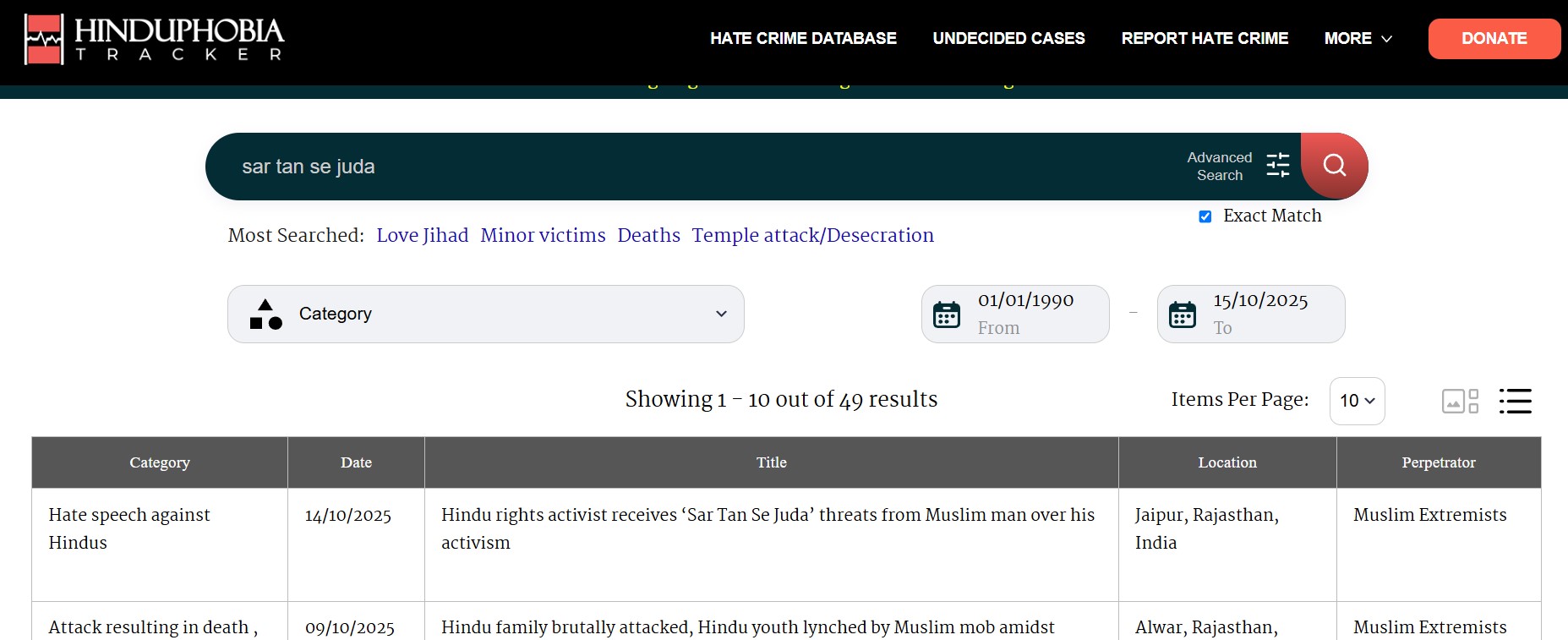
The radicalised outcry is not merely a statement of disapproval; it is a call for the execution of an individual through beheading, based on their religious identity. When this slogan is raised, it sends a clear and terrifying message not just to the individual targeted but also to anyone else who might share similar views or dare to express them. This tactic of intimidation aims to silence dissent and suppress freedom of expression, particularly in religious discourse. It aims to instil fear in the broader community. Islamists use this tactic to settle personal scores with Hindu and Christian families by levelling fabricated charges of blasphemy against them, which causes outrage and paints a target on them. The underlying hatred and animosity toward non-Muslims, especially Hindus, drive these false blasphemy accusations as a means to subjugate and victimise them. The Hinduphobia Tracker has documented 49 cases in which Islamists have openly issued ‘Sar Tan Se Juda’ beheading threats against Hindus.
The 2019 murder of Kamlesh Tiwari in Lucknow was another example of this continuum. A former Hindu Mahasabha leader, Tiwari, was assassinated in his own residence by assailants who travelled from Gujarat after online outrage over his earlier comments on the Prophet Muhammad. The case revealed a blueprint of targeted violence that begins with digital incitement and culminates in premeditated execution. His death, like those of Kolhe and Kanhaiyalal, demonstrated how individuals identified with outspoken Hindu positions have become recurring targets of ideologically charged violence. Together, these incidents illustrate a consistent pattern in which religious hatred against Hindus, once normalised online, metastasises into real-world atrocities, underscoring the urgent need for stronger deterrence.
The slogan “Gustakh-e-Rasool ki ek hi saza, sar tan se juda”—translated as “There is only one punishment for blasphemy against the Prophet: beheading”—has emerged as a chilling Islamist rallying cry and a recurring feature of violent protests across India. This slogan has been directly associated with several murders, including those of Kanhaiya Lal in Udaipur and Umesh Kolhe in Amravati, both brutally killed by Muslim fundamentalists after being accused of “blasphemy.” These attacks followed a wave of online incitement and mob mobilisation triggered after former BJP spokesperson Nupur Sharma was vilified for her remarks about the Prophet Muhammad, an outrage that was amplified by Alt News co-founder Mohammed Zubair’s targeted campaign against her.
From Kanpur to Bengaluru, Kolkata to Hyderabad, mobs chanting “Sar Tan Se Juda” have taken to the streets in the name of religious outrage. Originally popularised by a radical outfit in Pakistan, the slogan has since transcended borders and become a symbol of Islamist extremism—an open call for execution cloaked in religious justification.
This chant is not an emotional outburst; it is explicit incitement to murder. It legitimises beheading as divine justice, presenting violence as a moral obligation sanctioned by faith. When raised publicly, it sends a message of terror—not just to the immediate target but to anyone who might share their beliefs, opinions, or religious identity. Its purpose is to intimidate, silence, and enforce submission through fear. Moreover, false accusations of “blasphemy” are often weaponised to settle personal scores or persecute non-Muslims, particularly Hindus and Christians, by painting them as enemies of Islam. The underlying animosity toward non-Muslims, especially Hindus, drives these fabricated blasphemy charges as a means of social control and religious domination.
Thus, “Sar Tan Se Juda” is more than a slogan—it is an ideological instrument of terror that transforms theological intolerance into real-world violence. Given its repeated use to justify targeted killings of Hindus, it constitutes religiously motivated hate propaganda and is documented by the Hinduphobia Tracker as a form of incitement leading to violence.
The 2019 murder of Kamlesh Tiwari in Lucknow exemplified this deadly continuum. A former Hindu Mahasabha leader, Tiwari, was assassinated in his own residence by assailants who travelled from Gujarat following online outrage over his earlier comments about the Prophet Muhammad. The case revealed a clear blueprint of Islamist violence—digital incitement culminating in premeditated execution. His death, like those of Kolhe and Kanhaiyalal, showed how individuals identified with Hindu advocacy are systematically targeted by ideologically motivated attackers. Together, these incidents demonstrate a consistent pattern: religious hatred against Hindus, once normalised online, metastasises into real-world atrocities, underscoring the urgent need for deterrence and accountability.
In Harshu Thakur’s case, the sequence of events mirrors this very trajectory. It began with digital vilification and defamation, escalated into explicit religious abuse targeting her and Hindu deities, progressed to death threats and international harassment, and culminated in a physical assault in Nanded. Each stage reinforced the next: online hate normalised aggression, blasphemous insults framed her as a “legitimate” target, and the inaction of law enforcement emboldened the perpetrators. The attack on Harshu was therefore not an isolated act of violence—it was the culmination of an orchestrated campaign of Hinduphobia, aimed at punishing a Hindu woman who dared to stand against religious coercion and defend her faith.
The trajectory of anti-Hindu hate typically begins in the digital sphere, where defamatory posts, morphed images, and obscene messages targeting Hindu individuals and deities circulate widely. These online campaigns serve both as a warning and a rallying cry for extremist actors, marking the target as an acceptable object of violence. Over time, this digital hate escalates into explicit threats invoking “Sar Tan Se Juda,” and in many cases, culminates in physical assaults or killings, such as those of Umesh Kolhe, Kanhaiyalal, and Kamlesh Tiwari. This chilling continuum demonstrates how unchecked online Hinduphobia, blasphemous abuse, and religious intimidation lay the groundwork for real-world atrocities, revealing the lethal potential of sustained hate when ignored by society and the state.