Hindu students served cow meat at event organised by Muslim man at Jagannath University in Dhaka, Bangladesh
 Dhaka District, Bangladesh
  13 August, 2026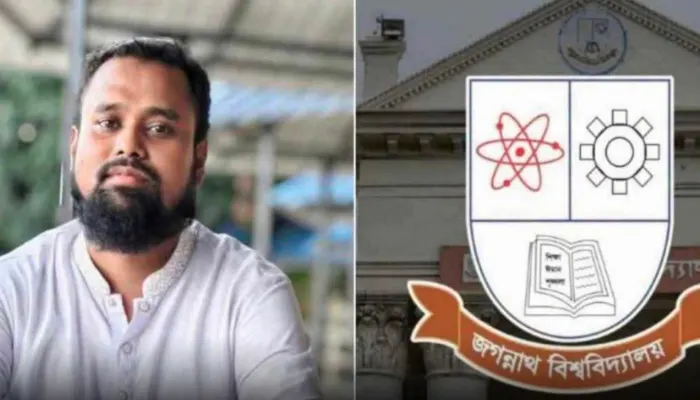
Case Summary
In Bangladesh, at Jagannath University in Dhaka, Hindu students were deliberately served food containing cow meat during an event organised for meritorious library students on 14 August 2026. The event was organised by a Muslim man named Riasal Rakib, the Library and Seminar Secretary of the university’s Central Students’ Union and a leader of the Chhatra Dal. Several Hindu students stated that they specifically asked the organisers before eating whether the food contained cow meat, but did not receive a clear answer. During the food distribution, boxes containing Beef Bhuna Khichuri were handed to Hindu students. After consuming the food, several students learned that the meal contained cow meat and expressed distress and anger over the incident, as cow meat is prohibited for them on religious grounds. The Hindu students subsequently raised the matter publicly and demanded that organisers respect their religious beliefs and dietary restrictions, particularly when they had expressly sought clarification about the contents of the meal before eating it. They also demanded an investigation and measures to prevent Hindu students from being placed in a similar situation in future. Riasal Rakib, however, claimed that the incident was not intentional and described it as a mix-up caused by delayed food delivery. He claimed that Morog Polao (Chicken Pulao) had been specifically ordered for Hindu students, but the separate food had not arrived on time, while the beef khichuri boxes were distributed before the organisers could control the situation. He said that 50 boxes of Morog Polao (Chicken Puloa) were subsequently arranged for the Hindu students. Rakib further acknowledged that the organisers had failed to make a clear announcement about the food menu over the microphone and issued an apology to the Hindu students. The incident nevertheless caused distress among the Hindu students because food containing beef was served to them despite their religious dietary restrictions and their prior request for clarification. The incident also led to concerns among some students that the serving of cow meat may have been a deliberate attempt to undermine their religious practices and facilitate conversion to Islam. This incident occurred amidst the escalation of violence against Hindus in Bangladesh. It had unfolded in three distinct phases: first, following the ouster of Sheikh Hasina’s government in August 2024; second, after the death of Sharif Osman Bin Hadi in December 2025; and third, in the immediate aftermath of the 13th National Parliamentary Election 2026. Following the ouster of Sheikh Hasina, multiple reports documented attacks on Hindu homes, temples, and religious institutions, alongside intimidation campaigns, arson, and mob assaults targeting minority neighbourhoods. The Hinduphobia tracker has recorded 336 such incidents against the Hindu minority, underscoring the scale and persistence of anti-Hindu violence during this period. A further escalation occurred following the death of Sharif Osman Bin Hadi, a Muslim political activist and student leader known for his anti-Hindu and anti-India rhetoric. Hadi had been involved in political unrest after the fall of the Hasina government and was killed in Dhaka on 18 December 2025 during clashes. In the aftermath of his death, Hindu communities were blamed and subsequently targeted in retaliatory violence. Hindu homes were selectively set ablaze in multiple localities, forcing families to flee and leaving many displaced. The attacks appeared patterned rather than sporadic, with Muslim mobs focusing on Hindu neighbourhoods, properties, and religious symbols. Among the victims was Dipu Chandra Das, who was lynched to death and his body was set ablaze by a Muslim mob over false blasphemy allegations. The Hinduphobia tracker documented 51 incidents of anti-Hindu violence in the period following Hadi’s death alone. Such incidents underscore the vulnerability of the Hindu minority amid rising communal hostility and the weaponisation of religious accusations. Reports further indicated that posters and written materials calling for the extermination of Hindus were displayed in public spaces, signalling an alarming normalisation of genocidal rhetoric. When combined with acts of arson, vandalism, assault, and targeted intimidation, these developments suggest a coordinated environment of hostility aimed at terrorising the Hindu community and reinforcing majoritarian dominance. The third phase of violence was unleashed after the 13th National Parliamentary Election 2026. Within days of the announcement of results, Hindu families in districts such as Noakhali, Rangpur, Nilphamari, Sylhet, Thakurgaon, and Dinajpur reported coordinated attacks involving arson, looting, assault, and vandalism of temples and homes. In several instances, Hindu homes were selectively targeted, looted, and families were threatened with displacement.
Why it is Hate Crime ?
The primary category selected for this case is: Attack on Hindu religious representations. The subcategory selected for this case is: Defiling religious customs. Sanatan Dharma is not a religion of one book, which is to say that while it has religious scriptures that form the central tenets of the faith, there are several traditions followed through thousands of years, mostly passed from generation to generation orally. There are several such customs and traditions that are followed by various Hindus and Hindu sects. Defiling these traditions and customs is a breach of an individual or group’s religious practices. Such practices can range from dietary restrictions like not eating non-vegetarian food for a certain period of the year, not eating non-vegetarian food at all, not eating beef since the cow is considered holy in Hinduism, the sanctity of religious customs followed in the house (like many ISCKON devotees), etc. Any malicious action leading to the breach of such traditions or defilement of these traditions owing to animosity towards the faith or for the sake of activism stems not only from the lack of faith in the religion itself but also from disregard for the faith of the devotees who follow the customs/traditions and implicit bias against the faith, the tradition itself. Since these specific traditions are central to the faith of the devotees of that specific sect of Hindus, any non-compliance with these traditional rules would be considered a religiously motivated hate crime. The next primary category selected for this case is: Attack not resulting in death. The subcategory selected for this case is: Attacked for Hindu identity. In several cases, Hindus are attacked merely for their Hindu identity without any perceived provocation. A classic example of this category of religiously motivated hate crime is a murder in 2016. 7 ISIS terrorists were convicted for shooting a school principal in Kanpur because they got ‘triggered’ seeing the Kalava on his wrist and the tilak that he had put. In this, the Hindu victim had offered no provocation except for his Hindu religious identity. The motivation for the murder was purely religious, driven by religious supremacy. Such cases where Hindus are targeted merely for their religious identity would be documented as a hate crime under this category. This case constituted a religiously motivated attack on Hindu students because they were served cow meat despite specifically asking whether the food contained it, while the organisers failed to provide them with a clear answer before the meal was served. For the Hindu students, this was not merely a matter of personal food preference but concerned a religious restriction rooted in their Hindu faith. Their decision to ask about the contents of the food beforehand demonstrated that they were consciously seeking to avoid violating this religious practice. The cow holds profound religious significance in Hinduism and is widely revered as a sacred animal. Its veneration is deeply embedded in Hindu religious traditions, scriptures, rituals, and cultural practices. Consuming cow meat ranks as one of the gravest sins in Hinduism, viewed as ultimate desecration that severs spiritual purity, pollutes the soul, and mocks the faith's core tenets of reverence for life Serving cow meat to Hindu students without clearly informing them of its presence therefore goes beyond an ordinary dietary preference. Abstaining from cow meat is therefore an important expression of Hindu religious observance. Serving such meat to Hindu students without their knowledge placed them at risk of consuming food that was considered religiously impermissible and directly conflicted with their faith-based practices. The fact that the students specifically asked whether the food contained cow meat was particularly significant. They had taken a clear precaution to ensure that they could make a dietary choice consistent with their faith. The failure to provide a clear answer deprived them of the information necessary to make that informed religious choice, following which some Hindu students consumed the food and subsequently discovered that it contained cow meat. This resulted in their religious dietary restriction being violated without their informed consent. The religious dimension of the incident therefore arose from the direct interference with a practice associated with Hindu identity. Religious dietary observances form part of the broader manner in which individuals practise and express their faith, and disregarding such practices can undermine the religious dignity of those affected. The students’ subsequent anger and protest reflected the religious significance they attached to the consumption of cow meat and to their expectation that their faith-based dietary restrictions would be respected within a university environment. Historically, the forced consumption of cow meat has been documented as a tool used by Muslim extremists and Islamic invaders as a method of humiliation and symbolic severance from Hindu identity. In these contexts, the tactic was employed to deliberately violate core religious norms in order to break spiritual resistance and enforce submission through social ostracisation. This same historical pattern is reflected in modern cases where the deliberate imposition of a strictly prohibited act is used to degrade a victim’s religious identity and erode their psychological and spiritual boundaries. Such actions reinforce the act as targeted religious humiliation rather than incidental abuse, fundamentally rooted in hostility toward Hindu beliefs and identity. The incident therefore represented a serious disregard for the religious dietary practices of Hindu students. Their specific request for clarification, followed by their consumption of cow meat without being clearly informed of its presence, directly affected a practice rooted in their Hindu identity. Therefore, the case has been added to the tracker. Disclaimer: The victim count has been conservatively recorded as 50, based on the available reports stating that 50 boxes of chicken polao were subsequently arranged for the Hindu students after the incident. Therefore, the Hinduphobia Tracker has conservatively used 50 as the victim count for this case, given the reported arrangement of 50 separate food boxes for the affected Hindu students. Furthermore, the perpetrator count has been recorded as 1 because Riasal Rakib was the only individual explicitly identified by name in the available reports in connection with the organisation of the event and the food arrangements.


Case Status
Unknown


Perpetrators Details
Perpetrators
Muslim Extremists
Perpetrators Range
One Person
Perpetrators Gender
male
 Sources




