Hindu revered festival of Kali Puja banned as Hindu students face institutional discrimination in Dhaka, Bangladesh
 Dhaka District, Bangladesh
  17 October, 2025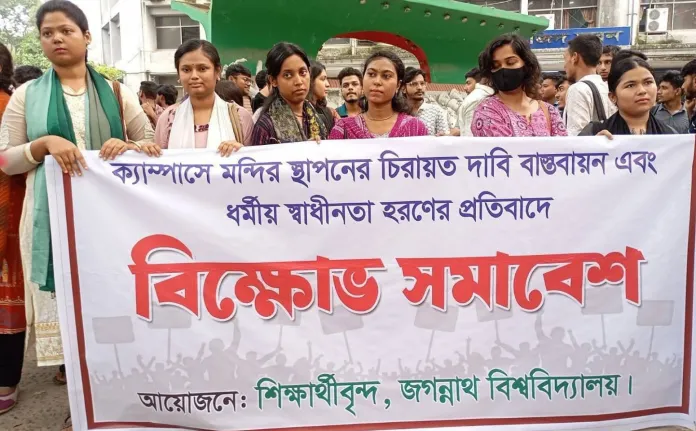
Case Summary
Kali Puja celebration was banned in Jagannath University in Dhaka, Bangladesh, triggering widespread outrage among Hindu students, teachers, and rights activists. The university, one of the oldest and most respected institutions in the country, prohibited the observance of the Hindu festival despite its historical foundation on land donated by a Hindu landlord and developed with contributions from Sanatan philanthropists. The act was widely condemned as a deliberate attempt to suppress Hindu religious expression and erase the cultural heritage of Bengal. The controversy deepened after the university’s proctor reportedly remarked that “Kali Puja is part of North Indian culture.” The statement was denounced as historically false, culturally offensive, and reflective of the growing intolerance towards Hindu traditions in Bangladesh. Students and alumni expressed anguish, noting that an institution built by Hindu benefactors now denies the right to worship Goddess Kali — the central deity symbolising Bengal’s spiritual strength and feminine divinity. The outrage gained momentum on social media under hashtags such as #JagannathUniversity, #KaliPuja, #SanatanDharma, and #ReligiousFreedom. Many demanded an immediate withdrawal of the ban and a public apology from the authorities for the proctor’s “arrogant and culturally insulting” remarks. This case serves as a stark reminder of the growing Muslim extremism and anti-Hindu sentiments in Bangladesh, which have only increased manifold since the fall of Sheikh Hasina’s Awami League government on August 5, 2024. After her violent ouster, Bangladesh plunged into chaos as Islamist extremists took advantage of the political turmoil to unleash a wave of terror and violence against the Hindu community. The Islamist mobs have attacked Hindu homes, burned them to the ground, and abducted women in a horrific descent into anarchy. Several temples have been destroyed in various parts of the Islamic country in a major crackdown on Hindus. Reports have exposed how Muslim students forced around 60 Hindu teachers, professors, and government officials to resign. Exiled Bangladeshi activist Asad Noor has also revealed that the minority Hindu community is now being coerced into joining ‘Jamaat-e-Islami’. Hindu religious events have been repeatedly targeted. On 6th September, a procession carrying Lord Ganesha’s idol was attacked in Chittagong. Ahead of Durga Puja, multiple incidents of idol vandalism occurred, including attacks in Mymensingh, Pabna, Rajshahi, Kishoreganj, and Dhaka. On 29th November, a violent Muslim mob attacked three temples in Patharghata, Chittagong, immediately after Jumma Namaz. The crackdown on Hindu voices has also escalated. On 30th November, Hindu journalist Munni Saha was arrested in Dhaka. Muslim mob attacks have increased in Bangladesh, for example, on 22nd May 2025, a Muslim mob carried out arson attacks selectively on Hindu homes in Dahar Mashihati village in Abhaynagar upazila in Jessore district of Bangladesh. Even ISKCON leader Chinmoy Krishna Das Prabhu and his aides have been targeted, and attempts have been made to ban ISKCON and suppress Hindu protests through sedition charges. These arbitrary actions point to a systematic pattern of persecution under Muhammad Yunus’s interim government.
Why it is Hate Crime ?
The primary category in this case is: Restriction/ban on Hindu practices. The subcategory under this is: Administration restricting religious practice. In several cases, it is seen that the administration/state disallows a religious practice owing to prejudicial orders and concerns, targeted specifically against the Hindu community. Such restriction/prohibition would be considered documented as a hate crime because the orders are often a result of pressure by groups that harbour animosity towards Hinduism and Hindus. Often, the restriction by the authorities is driven by bias, hostility, or prejudice against the specific community being stopped from holding a religious practice, by pressure groups that harbour animosity towards Hindus, intrinsic to their faith. Since practices are intrinsic to the faith of the Hindus, such prejudicial restriction is considered a curtailing of the fundamental rights of the Hindu community. In several cases, for example, the authorities ban a Hindu religious practice due to pressure from groups opposed to the religion. In other instances the prohibition is selectively enforced against one religious group (Hindus) while others are allowed to proceed. There are still other cases where the authorities preemptively restrict a religious practice by Hindus because those who hold animosity towards Hindus may get “provoked” leading to them being violent, thereby assuaging the sentiments of those who hold animosity towards Hindus by curtailing the religious rights of Hindus. Such acts and orders are prejudiced, indicating discriminatory motives owing to the capitulation to groups that harbour animosity towards Hindus and therefore, would be categorized as a religiously motivated hate crime since the original pressure leading to the order itself is a result of hatred/bias/prejudice/religious hate against Hindus. The banning of Kali Puja celebrations at Jagannath University in Dhaka represents a clear case of administrative prejudice and institutional discrimination directed against the Hindu community in Bangladesh. The university’s decision to prohibit a centuries-old Hindu festival, deeply ingrained in Bengal’s cultural and spiritual heritage, constitutes a deliberate act of religious suppression. It illustrates how institutional authority is being used to silence Hindu identity and prevent its public expression within state-supported institutions. The act of banning Kali Puja cannot be viewed in isolation. It is part of a broader and rapidly escalating pattern of persecution against Hindus in Bangladesh following the fall of Sheikh Hasina’s Awami League government on 5 August 2024. Since her ouster, the country has witnessed a sharp rise in Islamist extremism and anti-Hindu violence. In the ensuing political vacuum, radical Islamist factions have asserted control over educational and administrative bodies, using their influence to restrict, intimidate, and erase the Hindu presence in civic and cultural life. The restriction imposed by Jagannath University is emblematic of this systemic hostility. The institution, historically built on land donated by a Hindu zamindar and developed through Sanatan philanthropic contributions, has now become a site where Hindu students are denied the right to worship their own deities. The university’s proctor, instead of safeguarding constitutional freedoms, aggravated the communal divide by declaring that “Kali Puja is part of North Indian culture.” This statement was not only historically inaccurate but also a thinly veiled attempt to delegitimise Bengali Hindu traditions, suggesting that Hindu rituals are alien to Bengal’s identity. Such rhetoric reflects a growing ideological bias within Bangladeshi institutions where the Hindu faith is treated as foreign, marginal, or unwelcome. This administrative restriction, therefore, qualifies as a hate crime because it stems from deep-seated prejudice against Hinduism and from the capitulation of authorities to Islamist pressure groups that harbour animosity toward Hindus. It represents not a neutral administrative decision, but a calculated act of exclusion intended to silence a minority faith. When authorities prevent a religious practice not due to logistical or safety reasons but because of anticipated hostility from extremist elements, they effectively reward those who promote hatred. By prohibiting Kali Puja, Jagannath University legitimised bigotry, sanctioned religious inequality, and institutionalised discrimination against Hindus. The context in which this ban has occurred further reinforces its significance. Bangladesh has experienced an alarming escalation in anti-Hindu incidents since 2024. Hindu homes have been burned, temples desecrated, women abducted, and religious leaders attacked. Reports have revealed that around sixty Hindu teachers, professors, and government officials were forced to resign under intimidation from Muslim students and administrative pressure. These developments collectively demonstrate a pattern of targeted hostility toward Hindus that has intensified under the interim regime led by Muhammad Yunus, where state mechanisms and administrative bodies have increasingly yielded to Islamist dominance. The Jagannath University ban thus serves as a stark reminder of this ongoing institutionalisation of Hinduphobia in Bangladesh. It is not an isolated case of cultural insensitivity but a deliberate and ideologically motivated act meant to marginalise the Hindu minority, restrict their rights, and erase their visible presence in the nation’s public and educational spaces. By denying Hindu students the right to celebrate a festival so central to Bengal’s identity, the university has reinforced the growing climate of religious apartheid and intolerance that defines the present phase of Bangladesh’s political and social disorder. The case, therefore, has been documented in the tracker to highlight this pattern of state-enabled discrimination. It underscores how administrative decisions, cloaked under the guise of secular management, are being weaponised to curtail Hindu religious life, suppress cultural heritage, and perpetuate the exclusion of an entire community. This is a clear instance of a religiously motivated hate crime, emerging from institutional prejudice and fuelled by the larger resurgence of Islamist extremism across Bangladesh. Disclaimer: The exact date on which Jagannath University officially imposed the ban on Kali Puja has not been specified by any media source. For documentation purposes, the date has been recorded based on when the incident was first reported in credible media outlets.


Case Status
Unknown


Perpetrators Details
Perpetrators
State and Establishment
Perpetrators Range
N/A
Perpetrators Gender
unknown
 Sources




