Cow meat cooked outside Hindu temple, temple bricks stolen at Jagannath University, Bangladesh
 Dhaka, Dhaka District, Bangladesh
  11 October, 2026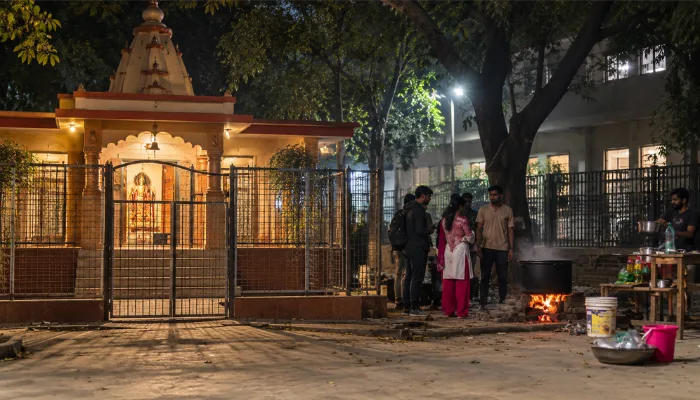
Case Summary
At Jagannath University in Bangladesh, the religious sentiments of Hindu students were hurt after beef was cooked directly in front of the university’s Central Hindu Temple. Hindu students also raised concerns that bricks belonging to the temple had been stolen, adding to anger over the treatment of the Hindu place of worship. According to accounts circulated on social media, Hindu students protested the cooking activity because of its proximity to the temple. After their objections, the university moved the cooking area some distance away, though the cooking continued. Students condemned the incident and questioned the university administration's response, saying it had not intervened enough to protect the temple's dignity and respect their religious sentiments. They stressed that religious places of worship within the university should be treated with due respect. The incident subsequently sparked wider reactions on social media, with demands that university authorities verify the circumstances surrounding the episode and investigate the removal of bricks from the temple. At the time of documentation, the identities of those responsible for the cooking and the brick removal were not revealed. This incident occurred against the broader backdrop of the historical persecution faced by Hindus in Bangladesh. While the Hindu minority has endured discrimination, targeted violence, and religious hostility over decades, such persecution has intensified in distinct spurts during periods of political and social instability. The latest major escalation began after the ouster of Sheikh Hasina’s government in August 2024, continued after the death of Sharif Osman Bin Hadi in December 2025, and surged again in the immediate aftermath of the 13th National Parliamentary Election in 2026. Following the ouster of Sheikh Hasina, multiple incidents involving attacks on Hindu homes, temples and religious institutions were documented, alongside intimidation, arson and mob violence targeting Hindu localities. The Hinduphobia Tracker recorded 336 incidents involving the Hindu minority during this period, reflecting the scale of the escalation and the continuing vulnerability of Hindus in Bangladesh. A further spurt of violence followed the death of Sharif Osman Bin Hadi, a Muslim political activist and student leader known for his anti-Hindu and anti-India rhetoric, in December 2025. In the aftermath, Hindu communities were subjected to retaliatory violence, with Hindu homes and properties selectively attacked and several families forced to flee. Among the victims was Dipu Chandra Das, who was lynched and whose body was subsequently set ablaze by a Muslim mob over false blasphemy allegations. The Hinduphobia Tracker documented 51 incidents of anti-Hindu violence in the period following Hadi’s death alone, further illustrating how existing hostility towards the Hindu minority intensified during moments of communal mobilisation. During the same period, posters and written material calling for the extermination of Hindus were also displayed in public spaces. Such rhetoric, when viewed alongside incidents of arson, vandalism, assault and targeted intimidation, reflected an environment in which hostility towards Hindus was not merely episodic but repeatedly resurfaced in more intense forms during periods of unrest. The most recent escalation followed the 13th National Parliamentary Election in 2026. In the immediate aftermath of the election results, Hindu families in districts including Noakhali, Rangpur, Nilphamari, Sylhet, Thakurgaon and Dinajpur faced attacks involving arson, looting, assault and vandalism of Hindu homes and temples. In several instances, Hindu properties were selectively targeted, and families were threatened with displacement. The present incident therefore occurred within a much longer history of persecution of Hindus in Bangladesh, where hostility towards the community has persisted over time and intensified in repeated spurts. The latest cycle began after the ouster of Sheikh Hasina and continued through subsequent periods of political and communal upheaval, leaving the Hindu minority increasingly vulnerable to targeted violence, intimidation and religious hostility.
Why it is Hate Crime ?
The primary category selected for this case is: Attack on Hindu religious symbols. The subcategory selected is: Breaking rules of places of worship. Sanatan Dharma is not a religion of one book, which is to say that while it has religious scriptures that form the central tenets of the faith, there are several traditions followed through thousands of years, mostly passed from generation to generation orally. One of these oral traditions or written traditions is the rules of specific temples. Certain temples have rules which are traditional, dependent on the worship of the presiding deities. These rules and traditions have been followed for thousands of years, whether or not they find scriptural mention. Such traditions are based on the nature and rules of worship of the presiding deity of that temple. Any non-compliance with these traditions owing to animosity towards the faith or for the sake of activism stems not only from the lack of faith in the presiding deity but also from disregard for the faith of the devotees of that deity/temple and implicit bias against the faith, the tradition and the deity itself. Since these specific traditions are central to the faith of the devotees of that specific temple and presiding deity, any non-compliance with these traditional rules would be considered a religiously motivated hate crime. The next subcategory is: Defiling religious customs. Sanatan Dharma is not a religion of one book, which is to say that while it has religious scriptures that form the central tenets of the faith, there are several traditions followed through thousands of years, mostly passed from generation to generation orally. There are several such customs and traditions that are followed by various Hindus and Hindu sects. Defiling these traditions and customs is a breach of an individual or group’s religious practices. Such practices can range from dietary restrictions like not eating non-vegetarian food for a certain period of the year, not eating non-vegetarian food at all, not eating beef since the cow is considered holy in Hinduism, the sanctity of religious customs followed in the house (like many ISKCON devotees), etc. Any malicious action leading to the breach of such traditions or defilement of these traditions owing to animosity towards the faith or for the sake of activism stems not only from the lack of faith in the religion itself but also from disregard for the faith of the devotees who follow the customs/traditions and implicit bias against the faith and the tradition itself. Since these specific traditions are central to the faith of the devotees of that specific sect of Hindus, any non-compliance with these traditional rules would be considered a religiously motivated hate crime. This case qualifies as a religiously motivated hate crime because the conduct directly affected the sanctity of a Hindu temple and the religious practices associated with Hindu worship. In Hindu Dharma, a temple is not merely a physical structure; it is a consecrated sacred space centred on the presence of the deity. Conduct that violates this sacred environment therefore affects Hindu devotees collectively through their place of worship. The location of the cooking activity is central to the incident. In Hindu religious tradition, a temple is not merely a building whose sanctity begins and ends at the inner sanctum. The temple premises and the surrounding area are also associated with worship, prayer, religious gatherings and the spiritual life of devotees. The space immediately around a temple is not an ordinary setting devoid of religious significance; it forms part of the environment in which the faith is practised and experienced. Conduct that disregards the religious character of these surroundings can therefore offend devotees even when it does not take place inside the sanctum itself. This is particularly significant in the present case because beef was reportedly cooked directly in front of Jagannath University’s Central Hindu Temple. The cow is revered as gau mata by Hindus, and the consumption of beef is deeply offensive to many Hindu devotees. Cooking beef immediately outside a Hindu temple, in full view of a place dedicated to worship, showed disregard for the religious sensitivities of the students who used the temple. Hindu students objected specifically to the activity's proximity, and although the cooking area was reportedly moved after their protest, the cooking continued. The fact that the activity took place outside the temple’s inner sanctum does not diminish the religious significance of its location or the offence caused to devotees. Removing bricks from the temple further aggravated the violation because it interfered with the physical premises of a Hindu religious institution. A temple and its constituent structures form part of a sacred religious space, and interference with that space carries significance beyond ordinary damage or property removal. Taken together, the acts targeted the sanctity of a Hindu temple, the customary rules surrounding a place of worship and a deeply rooted Hindu religious practice concerning the sacred status of the cow. The harm was therefore directed not merely at individual students but at religious beliefs and practices shared by the Hindu community, making the case appropriate for documentation as a religiously motivated hate crime. Disclaimer: The Hinduphobia Tracker records incident dates based on when the incident occurred, not when it was subsequently reported. In this case, the exact date beef was cooked outside the Central Hindu Temple, and bricks were taken from the temple could not be ascertained. Therefore, 12th October 2026, the earliest date the incident came to public attention through the available source, has been selected as the indicative incident date for documentation purposes. At the time of documentation, the identities of the people responsible for cooking beef outside the temple and taking bricks from the temple were unknown; therefore, the perpetrators are recorded as “Unknown.”


Case Status
Unknown


Perpetrators Details
Perpetrators
Unknown
Perpetrators Range
Unknown
Perpetrators Gender
unknown
 Sources




