Hindus sentiments outraged as Muslim students slaughter cow at Jagannath University during Durga Puja, in Dhaka, Bangladesh
 Dhaka, Dhaka District, Bangladesh
 15 October, 2026
Case Summary
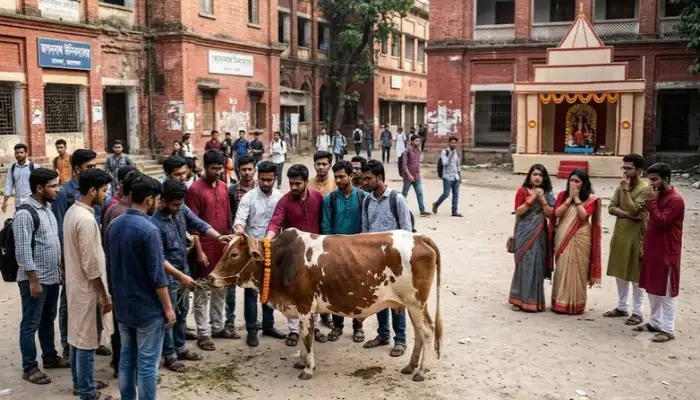
In Dhaka, Bangladesh, Muslim students at Jagannath University slaughtered a cow on campus on 16th October 2026, the day Maha Shashthi marked the beginning of Durga Puja. The slaughter came only days after Hindu students had objected to cow meat being cooked near the university’s Central Hindu Temple. The dispute began on 12th October, when students from the Department of Islamic History and Culture cooked cow-meat khichuri near the Muktamancha, close to the Hindu temple. Hindu students objected to the location and said it hurt their religious sentiments. Bricks belonging to the temple were also used to make a temporary cooking stove. The cooking arrangement was later shifted after intervention by the university authorities. Hindu students then protested and formed a human chain, demanding protection for the temple and action over the incident. On 14th October, the university issued a notice asking students and staff to refrain from slaughtering animals on campus. Muslim students opposing the decision held a procession and announced that they would organise a cow slaughter and cow-meat feast in protest on 16th October, 2026. The university later withdrew the restriction verbally. Acting Proctor Prof Md Azam Khan said the programme could proceed under supervision if it was conducted hygienically. Abdul Alim Arif, General Secretary of the Jagannath University Central Students’ Union and president of the university unit of Islami Chhatra Shibir, described the restriction as unreasonable. On 16th October, Muslim students brought a cow onto the campus and slaughtered it on the road between the Vice-Chancellor’s building and the Mathematics Department. The meat was then cooked with khichuri and distributed among students. Organisers collected Tk 70 from participants and said the cow had been purchased through registration fees and donations. Accounts from the event also stated that participants chanted “La ilaha illallah” during the programme. The timing made the incident especially sensitive for Hindu students. The cow is revered in Hindu Dharma as Gau Mata, and the slaughter took place at the beginning of Durga Puja, soon after objections had already been raised over cow meat being cooked near the temple. The episode therefore intensified an existing religious dispute on the campus. The controversy continued after the feast. The Jagannath University unit of Khelafat Chhatra Majlis announced another cow-meat feast and Qawwali programme and purchased another cow. This incident did not occur in isolation. It formed part of a continuing series of events at Jagannath University that the Hinduphobia Tracker had already documented separately. The earlier incidents included cow meat being cooked beside the Central Hindu Temple and temple bricks being used for the cooking arrangement, followed by Muslim students raising anti-Hindu slogans, telling Hindus to leave Bangladesh and threatening to slaughter cows in front of them. The Tracker also documented Golam Rabbi’s warning directing Hindus to accept Islam or face “extremely terrible” consequences, as well as the separate case concerning Hindu student Saikat Haldar and his temporary expulsion amid the same controversy. These incidents together provide the immediate backdrop to the 16th October cow slaughter. Viewed in sequence, the events progressed from cow meat being cooked near a Hindu temple and interference with temple property, to conversion-related intimidation, exclusionary slogans against Hindus, threats of cow slaughter, and hostility surrounding Hindu objections. The actual slaughter of a cow on campus during Durga Puja therefore represented a further escalation within an already documented pattern of anti-Hindu hate, intimidation and hostility at Jagannath University, rather than an isolated dispute over food or a standalone campus event. This incident occurred against the broader backdrop of the longstanding persecution of Hindus in Bangladesh. The Hindu minority has faced discrimination, targeted violence and religious hostility over decades, with attacks intensifying during periods of political and social instability. The latest major escalation began after the ouster of Sheikh Hasina’s government in August 2024, continued after the death of Sharif Osman Bin Hadi in December 2025, and resurfaced immediately after Bangladesh’s 13th National Parliamentary Election in 2026. Following Sheikh Hasina’s ouster, attacks on Hindu homes, temples and religious institutions were reported alongside intimidation, arson and mob violence targeting Hindu localities. The Hinduphobia Tracker recorded 336 incidents involving the Hindu minority during this period, reflecting the scale of the escalation and the vulnerability of Hindus amid the political upheaval. Another spurt of violence followed the death of Sharif Osman Bin Hadi, a Muslim political activist and student leader known for his anti-Hindu and anti-India rhetoric, in December 2025. In the aftermath, Hindu communities faced retaliatory violence, with Hindu homes and properties selectively attacked and several families reportedly forced to flee. Among the victims was Dipu Chandra Das, who was lynched and whose body was subsequently set ablaze by a Muslim mob over false blasphemy allegations. The Hinduphobia Tracker documented 51 incidents of anti-Hindu violence in the period following Hadi’s death alone, illustrating how hostility towards the Hindu minority intensified amid communal mobilisation. During this period, posters and written material calling for the extermination of Hindus were also displayed in public spaces. Viewed alongside reports of arson, vandalism, assault and targeted intimidation, such rhetoric pointed to a recurring pattern in which hostility towards Hindus intensified during periods of unrest. The most recent escalation followed the 13th National Parliamentary Election in 2026. In the immediate aftermath of the election results, Hindu families in districts including Noakhali, Rangpur, Nilphamari, Sylhet, Thakurgaon and Dinajpur faced attacks involving arson, looting, assault and vandalism of Hindu homes and temples. In several instances, Hindu properties were reportedly singled out, and families faced threats of displacement. The incident at Jagannath University must therefore be understood within this wider context of recurring hostility towards Bangladesh’s Hindu minority. The slogans did not merely express support for beef consumption or slaughter; they included calls for Hindus to leave the country and statements rejecting them as fellow citizens.
Why it is Hate Crime ?
The incident has been added to the tracker under the primary category: Attack on Hindu religious representations. Within this, the sub-category selected is: Desecration of Hindu religious symbol. Icons and symbols, or religious representations of a spiritual ideal, are widely revered in Hinduism. Iconography is of vital significance in the Hindu milieu. It helps connect people’s spiritual beliefs with the real world. Iconography within the Hindu faith takes several shapes and forms. Murtis are of most significance to Hindus, to which daily rituals, prayers and offerings are done. Besides the murtis, there are several other symbols which have deep significance in the Hindu faith – the Om and Swastika, for example. Since these Hindu religious symbols hold paramount importance in Hinduism, any desecration of symbols, icons, murtis, religious representations and manifestations is driven by animosity towards the faith itself, which manifests itself through these murtis, icons and symbols. Therefore, any desecration of these Hindu religious symbols and representations is considered religiously motivated hate crimes under this category. The other subcategory is: Defiling religious customs. Sanatan Dharma is not a religion of one book, which is to say that while it has religious scriptures that form the central tenets of the faith, there are several traditions followed through thousands of years, mostly passed from generation to generation orally. There are several such customs and traditions that are followed by various Hindus and Hindu sects. Defiling of these traditions and customs is a breach of an individual or group’s religious practices. Such practices can range from dietary restrictions like not eating non-vegetarian food for a certain period of the year, not eating non-vegetarian food at all, not eating beef since the cow is considered holy in Hinduism, the sanctity of religious customs followed in the house (like many ISCKON devotees), etc. Any malicious action leading to the breach of such traditions or defilement of these traditions owing to animosity towards the faith or for the sake of activism stems not only from the lack of faith in the religion itself but also from disregard for the faith of the devotees who follow the customs/traditions and implicit bias against the faith, the tradition itself. Since these specific traditions are central to the faith of the devotees of that specific sect of Hindus, any non-compliance with these traditional rules would be considered a religiously motivated hate crime. This case qualifies as a religiously motivated hate crime because the public slaughter of a cow took place after the sacred status of the cow had already become central to a religious confrontation involving Hindu students. The organisers were already aware that Hindu students had objected to cow meat being prepared near their temple. Proceeding with a public cow slaughter after those objections, and turning it into a protest programme, gave the act a deliberate and confrontational character rather than that of an ordinary food event. The cow holds profound significance in Hindu Dharma and is revered as Gau Mata, symbolising motherhood, nourishment, purity and sacredness. For Hindus, therefore, cow slaughter directly affects a deeply held religious belief. In this case, that belief had already been openly expressed before the slaughter was organised. Carrying out the act publicly despite this knowledge amounted to a conscious disregard for something Hindu students considered sacred and gave the programme an intimidating character. The timing made the religious message still more pronounced. The slaughter took place on 16th October 2026, during Maha Shashthi and the beginning of Durga Puja, one of the most sacred periods of Hindu worship dedicated to Goddess Durga. Hindu students were entering an important period of prayer and religious observance when the cow was publicly slaughtered on their university campus. Conducting the programme at such a time, after days of controversy over Hindu religious concerns, intensified the sense that Hindu beliefs were being deliberately challenged. The chanting of “La ilaha illallah” during the cow-slaughter programme added an explicitly religious element to the event. The phrase itself is an Islamic declaration of faith and is not inherently anti-Hindu. However, its use during a public cow slaughter that followed Hindu objections and took place during Durga Puja changed the context in which it was heard. The combination of an Islamic religious declaration with an act deeply offensive to Hindu beliefs gave the programme a triumphalist and intimidating character, particularly for Hindu students already affected by the preceding hostility. The Central Hindu Temple remained an important part of this context. The earlier controversy involved cooking cow meat near the temple and using temple bricks for the cooking arrangement. Hindu students had already objected and sought respect for their place of worship. The subsequent decision to publicly slaughter a cow instead of allowing the dispute to de-escalate showed deliberate disregard for those objections and had the effect of frightening and intimidating Hindus through an act centred on a sacred Hindu belief. Taken together, the deliberate public slaughter of a cow, despite prior objections from Hindu students and during the sacred period of Durga Puja and the religious slogans raised during the programme, reflects a deliberate disregard for Hindu religious sentiments and raises serious concerns of anti-Hindu animosity. In the broader context of Bangladesh, where the Hindu minority has faced repeated incidents of religious hostility, the act takes on added significance as a public affront to Hindu beliefs and sacred traditions. Given the circumstances surrounding the incident, it has been added to the Tracker.


Case Status
Complaint filed


Perpetrators Details
Perpetrators
Muslim Extremists
Perpetrators Range
N/A
Perpetrators Gender
male
 Sources



