Hindus subjected to religious intimidation and pressured to convert to Islam by Muslim student at Jagannath University, Bangladesh
 Dhaka, Dhaka District, Bangladesh
  13 October, 2026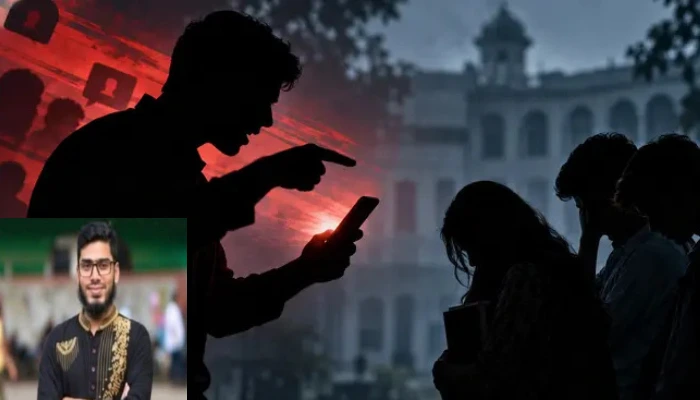
Case Summary
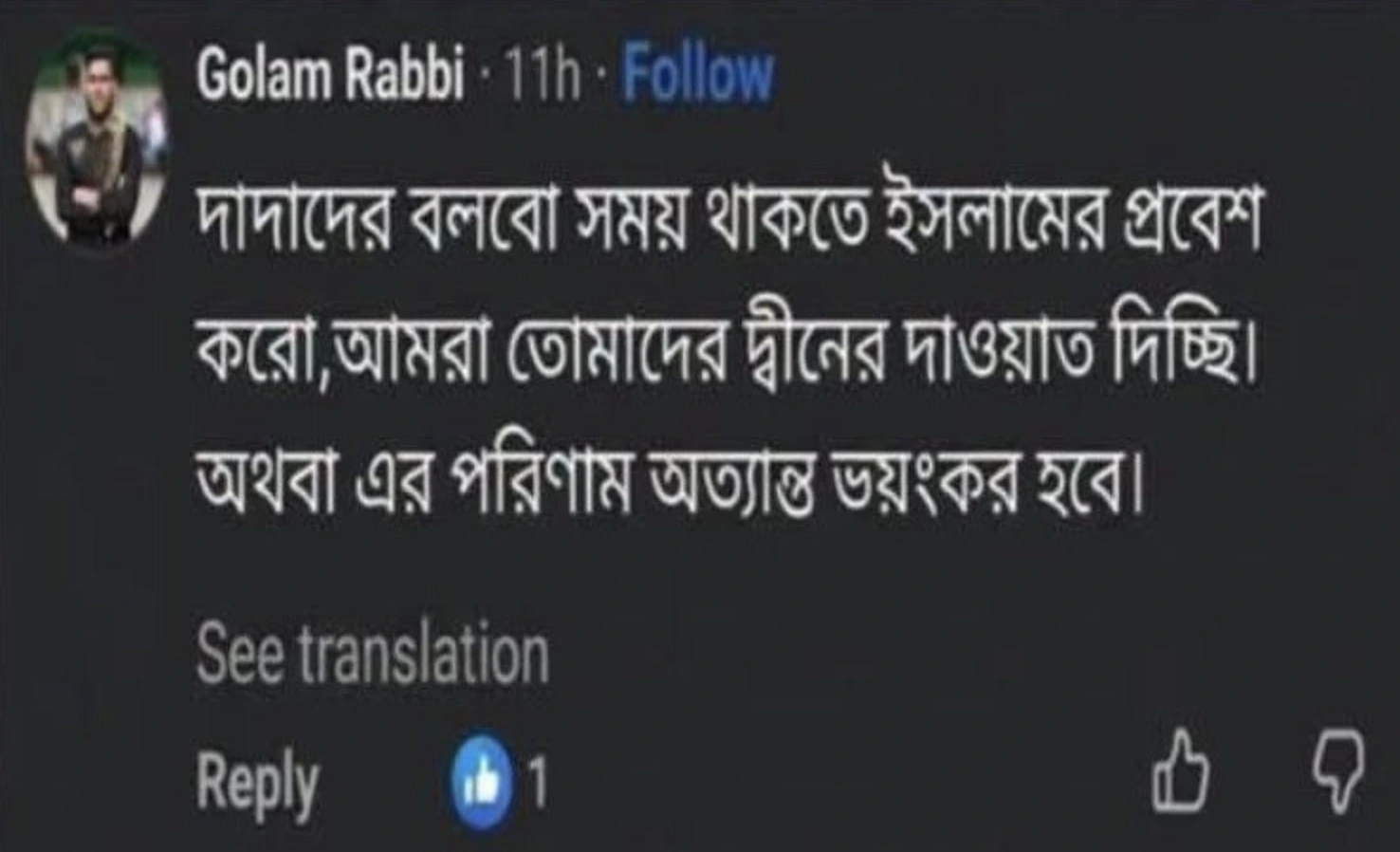
At Jagannath University in Bangladesh, Hindus were subjected to religious intimidation and pressured to convert to Islam by a Muslim student. The accused posted on social media, threatening “extremely severe consequences” if Hindus refused to abandon their faith and convert to Islam. The controversy arose after a post appeared on social media from an account bearing the name of Golam Rabbi, a Muslim student of the university’s Department of History. The post read, “I would tell our Hindu brothers to embrace Islam while there is still time. We are inviting you to our faith. Otherwise, the consequences will be extremely severe”. The post concluded with the identification “Golam Rabbi, Department of History, Jagannath University”. The post prompted concern among members of the Hindu community, who objected to the pressure to change religious beliefs and the threat of severe consequences for refusing to do so. They emphasised that coercion over religious conversion and intimidation based on faith were contrary to individual liberty, religious freedom and communal harmony. The incident also raised particular concern because it involved a higher education institution, where freedom of thought, tolerance and respect for differing beliefs were expected to be upheld. The controversy further highlighted concerns about the safety of students from religious minorities and the preservation of a peaceful academic environment. In response, demands were made for the Jagannath University administration and law enforcement agencies to investigate the incident fairly and take appropriate disciplinary action in accordance with university regulations. Calls were also made for effective measures to ensure the safety of all minority students on campus, particularly Hindu students, and to prevent religious incitement, intimidation and hateful conduct. The demands underscored the need to uphold religious freedom, protect students from threats and preserve an inclusive and secure educational environment. This incident occurred against the broader backdrop of the historical persecution faced by Hindus in Bangladesh. While the Hindu minority has endured discrimination, targeted violence, and religious hostility over decades, such persecution has intensified in distinct spurts during periods of political and social instability. The latest major escalation began after the ouster of Sheikh Hasina’s government in August 2024, continued after the death of Sharif Osman Bin Hadi in December 2025, and resurfaced in the immediate aftermath of the 13th National Parliamentary Election in 2026. Following the ouster of Sheikh Hasina, multiple incidents involving attacks on Hindu homes, temples and religious institutions were documented, alongside intimidation, arson and mob violence targeting Hindu localities. The Hinduphobia Tracker recorded 336 incidents involving the Hindu minority during this period, reflecting the scale of the escalation and the continuing vulnerability of Hindus in Bangladesh. A further spurt of violence followed the death of Sharif Osman Bin Hadi, a Muslim political activist and student leader known for his anti-Hindu and anti-India rhetoric, in December 2025. In the aftermath, Hindu communities were subjected to retaliatory violence, with Hindu homes and properties selectively attacked and several families forced to flee. Among the victims was Dipu Chandra Das, who was lynched and whose body was subsequently set ablaze by a Muslim mob over false blasphemy allegations. The Hinduphobia Tracker documented 51 incidents of anti-Hindu violence in the period following Hadi’s death alone, further illustrating how existing hostility towards the Hindu minority intensified during moments of communal mobilisation. During the same period, posters and written material calling for the extermination of Hindus were also displayed in public spaces. Such rhetoric, when viewed alongside incidents of arson, vandalism, assault and targeted intimidation, reflected an environment in which hostility towards Hindus was not merely episodic but repeatedly resurfaced in more intense forms during periods of unrest. The most recent escalation followed the 13th National Parliamentary Election in 2026. In the immediate aftermath of the election results, Hindu families in districts including Noakhali, Rangpur, Nilphamari, Sylhet, Thakurgaon and Dinajpur faced attacks involving arson, looting, assault and vandalism of Hindu homes and temples. In several instances, Hindu properties were selectively targeted, and families were threatened with displacement. The present incident therefore occurred within a much longer history of persecution of Hindus in Bangladesh, where hostility towards the community has persisted over time and intensified in repeated spurts. The latest cycle began after Sheikh Hasina's ouster. It continued through subsequent periods of political and communal upheaval, leaving the Hindu minority increasingly vulnerable to targeted violence, intimidation and religious hostility.
Case Images
Why it is Hate Crime ?
The primary category selected in this case is: Predatory Proselytisation. The subcategory selected is: Harassment, threats, coercion for conversion. Harassment covers a wide range of behaviours of an offensive nature. It is commonly understood as behaviour that demeans, humiliates, and intimidates a person, including threats and coercion. Harassment and threats, in this case, find their root on discriminatory grounds which has the effect of nullifying a person’s rights or infringing upon his freedom to exercise his right specifically owing to the victim’s religious identity. Verbal and physical threats and psychological or physical harassment are often used against Hindu victims because they choose to practice their professed religion. Religious harassment also includes forced and involuntary conversions by harassment, threats or coercion. Coercion includes intimidatory tactics like force-feeding a Hindu victim beef to convert to another religion, forceful circumcision etc. In several cases documented, non-Hindu perpetrators or those who harbour specific animosity towards Hinduism, harass victims simply based on their religious identity. Such cases often also include harassment to ensure the Hindu victim abandons his/her professed religion and adopts the religion of the perpetrator. Such cases where Hindu victims are harassed to convert to the perpetrator’s religion are rooted in animosity towards the victim’s religious identity and are therefore documented as religiously motivated hate crimes. This case is an example of a religiously motivated hate crime because the accused pressured Hindu students to convert to Islam and threatened severe consequences for refusing to abandon their faith. The hostile nature of the act forms the basis for its inclusion in the Hinduphobia Tracker database. Firstly, pressuring Hindu students to abandon their faith and convert to Islam directly targeted their religious identity and undermined their right to preserve their Hindu beliefs, traditions and spiritual values. The demand that Hindus embrace another religion went beyond extending an invitation to a different faith when a warning of severe consequences for refusal accompanied it. It placed Hindu students in a position where their continued adherence to Hinduism was presented as unacceptable, and their religious identity was subjected to coercive pressure. For Hindus, their faith is not merely a matter of personal preference but an integral part of their cultural heritage, religious practices and sense of belonging. Pressuring them to renounce it therefore amounted to an attack on their religious autonomy and dignity. The conduct also disregarded the fundamental principle that Hindu students had the same right as students of other faiths to retain their beliefs without facing pressure to convert. By making conversion the expected response, the message undermined religious equality and conveyed hostility towards the continued religious identity of Hindus. Secondly, threatening Hindu students with “extremely severe consequences” if they refused to convert to Islam introduced an element of intimidation into the attack on their religious freedom. The warning linked their refusal to abandon Hinduism with the prospect of serious repercussions, placing pressure on them to consider conversion out of fear rather than personal conviction. Such threats targeted Hindus specifically in the context of their refusal to relinquish their faith and created a sense of insecurity around their ability to practise and maintain their religious identity freely. The message carried the implication that remaining faithful to their religion would expose them to adverse consequences. This undermined their sense of safety and dignity while challenging their right to make deeply personal religious decisions without intimidation. The threat also reinforced the coercive nature of the conversion pressure: rather than respecting Hindu students' freedom to reject another religion, it attached a warning of severe repercussions to that choice. In this context, the threat constituted a form of religious intimidation directed against Hindus because of their unwillingness to abandon their faith, undermining the principles of religious freedom, equality and peaceful coexistence. The fact that Hindus constitute a religious minority in Bangladesh leaves the community vulnerable to religious discrimination, communal violence, intimidation and threats to its religious identity and security. Coercive demands to abandon Hinduism, reinforced by threats of severe consequences for refusing to convert, directly undermined the religious freedom, dignity and safety of Hindu students and the wider Hindu community. Collectively, the pressure to abandon Hinduism and the threat of severe consequences for refusing to convert to Islam reflected a pattern of religious coercion that undermined the freedom, dignity and security of Hindu students. Such conduct reinforced the notion that their continued adherence to Hinduism was grounds for intimidation, disregarding their right to retain their religious identity without fear or external pressure. Accordingly, this case has been documented in the Hinduphobia Tracker's Hate Crime Database as an instance of religiously motivated hostility directed against Hinduism and the religious identity of the Hindu community. Disclaimer: The Hinduphobia Tracker records incidents based on when an event occurred or when the victim's ordeal began. It is important to clarify that none of the media sources covering this case has specified the exact date when the incident occurred. Therefore, for documentation purposes, we have recorded the date based on when the incident was reported in the media, 14 October 2026.


Case Status
Unknown


Perpetrators Details
Perpetrators
Muslim Extremists
Perpetrators Range
One Person
Perpetrators Gender
male
 Sources




