Hindu student targeted with false blasphemy accusations and expulsion for opposing anti-Hindu abuse amid conversion threats and communal intimidation at Jagannath University, Dhaka
 Dhaka, Dhaka District, Bangladesh
 12 October, 2026
Case Summary
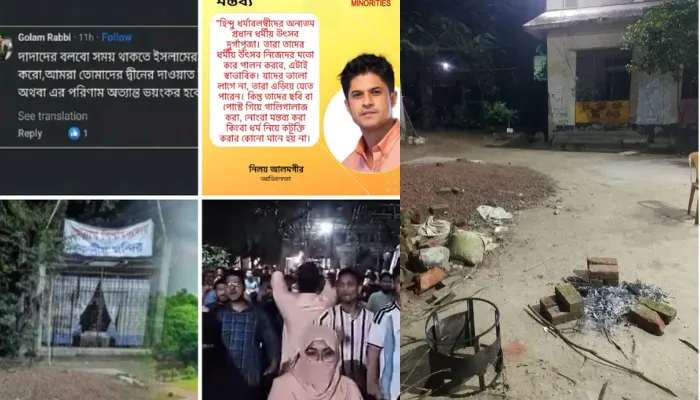
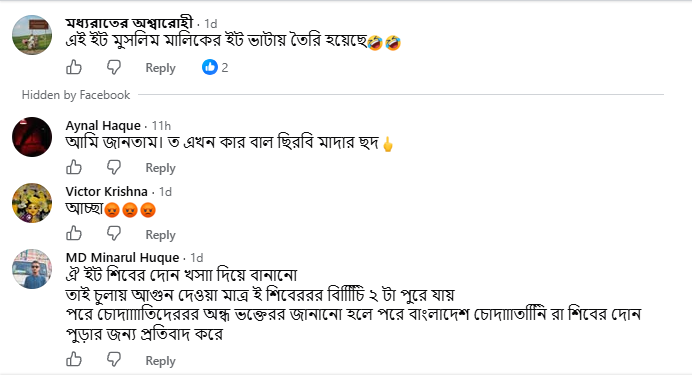
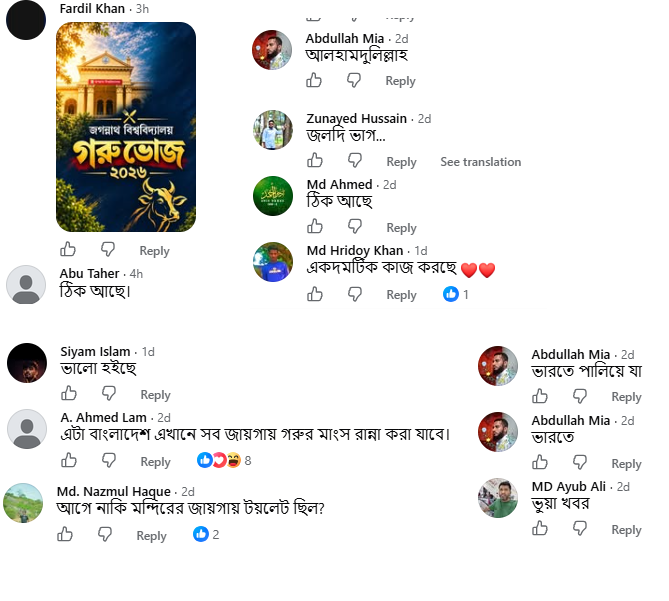
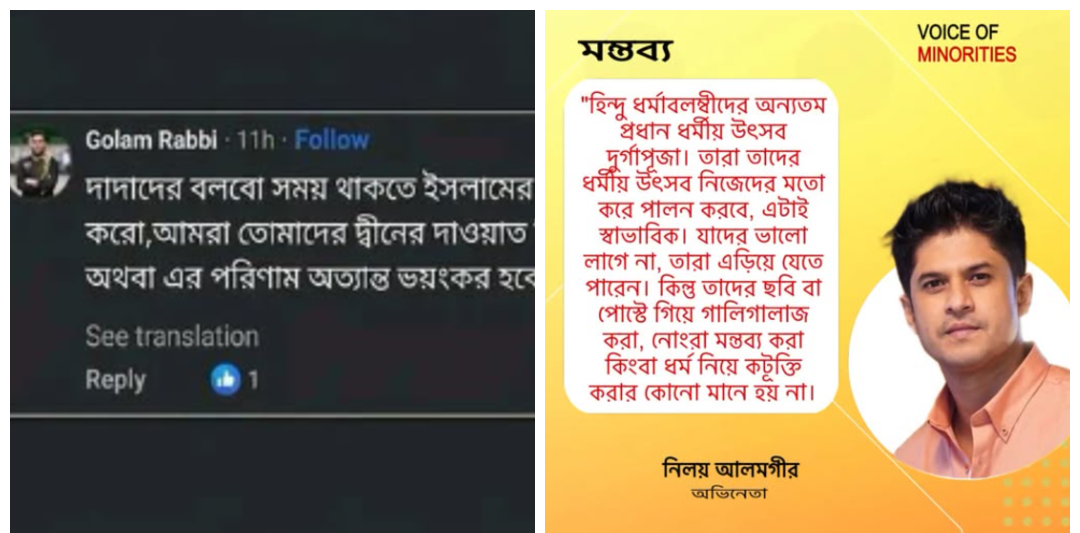
In Dhaka, Bangladesh, Hindu student Saikat Haldar of Jagannath University was temporarily expelled on 13th October 2026 after he was falsely accused of making derogatory remarks about Islam and Muhammad. The Hindu student was targeted after he had spoken against vulgar and hateful comments directed at Hindus and Hinduism. Hindu Voice stated that the blasphemy accusations against Haldar were unsubstantiated and that his suspension came while anti-Hindu threats, religious abuse and intimidation were spreading around the university dispute. The controversy began on the night of 12th October 2026, when students from the 17th batch of Jagannath University’s Department of Islamic History and Culture organised a graduation feast beside the Central Hindu Temple. They cooked cow-meat khichuri near the temple entrance and built a makeshift cooking stove from temple bricks. Hindu students held a protest at around 9 PM. After the protests, the organisers claimed they hadn't realised the bricks belonged to the temple. The protest led by the Hindu students prompted the varsity to issue a notice asking students to refrain from slaughtering animals on campus, citing public health, hygiene, and cleanliness. On October 15, 2026, the backlash against the notice grew. Muslim students of the Jagannath University Central Students’ Union (JnUCSU)—led largely by members of Islami Chhatra Shibir—held protests, issued a four-point demand (including withdrawing the notice and serving beef and mutton in cafeterias), and announced a counter-event. The administration later clarified that students could organise events as long as they did not disrupt others. As the dispute spread online, Golam Rabbi, identified as a History student of Jagannath University, issued a religious warning directed at Hindus. He wrote: “I will tell the brothers/Hindus to accept the invitation to Islam while there is still time. We are inviting you to the faith, or else the consequences will be extremely terrible.” The statement linked an invitation to convert to Islam with a warning of severe consequences for those who did not accept it. The Hinduphobia Tracker had documented this incident. The controversy then widened into open anti-Hindu rhetoric. One Muslim student declared that Bangladesh was not the land of Rabindranath Tagore but the land of Kazi Nazrul Islam and Shah Alam, and said that it was “not the land of cows and Gobind.” He further warned that if Hindus or Hindu organisations attempted to assert their religious beliefs, “18 crore Muslims” would cause bloodshed, walk over their blood and bodies and establish Islam, before declaring that Bangladesh was not a Hindu country. During the agitation, a university student leader was also quoted as saying that “Bangladesh does not belong to Rabindranath.” Social-media posts calling for Hindus to leave Bangladesh also circulated during the controversy. Online abuse extended to Hindu religious figures and beliefs. One user mocked objections over the temple bricks by stating that the bricks had been made in a Muslim-owned brick kiln, while another comment used highly obscene and sexually degrading language against Lord Shiva and Hindu devotees. Other posts contained vulgar remarks concerning Hindu deities, Hinduism and the university temple. The dispute also intensified over cow slaughter on the university campus. After Hindu objections to cow meat being cooked beside the temple, plans circulated for another cow-meat feast on 16th October 2026, the opening day of Durga Puja, while cows were also stated to have been brought onto the campus. The university administration subsequently banned animal slaughter on campus. The order itself triggered protests and further statements rejecting accommodation of Hindu religious sensitivities. By 15th October 2026, the hostility had drawn wider public attention. Actor Nilay Alamgir condemned the abuse directed at Hindus during Durga Puja, stating: “Durga Puja is one of the main religious festivals of the Hindu community. Naturally, they will observe their religious festival in their own way. Those who do not like it can simply avoid it. But going to their pictures or posts to abuse them, make dirty comments, or insult their religion makes no sense.” His statement directly addressed the abusive comments and religious insults being directed at Hindus amid the controversy. On October 16, coinciding with Maha Shashthi and the start of Durga Puja, Muslim student organisers purchased a cow for 125,000 Tk and publicly slaughtered it on campus between the Vice-Chancellor’s residence and the Mathematics Department. A day later, the Islamist party's student wing, Bangladesh Khelafat Majlis, organised another beef feast on campus. Hindu student organisations and groups like the Socialist Students' Front criticised the cow slaughter timing during Durga Puja as a provocation. This incident occurred against the broader backdrop of the historical persecution faced by Hindus in Bangladesh. While the Hindu minority has endured discrimination, targeted violence, and religious hostility over decades, such persecution has intensified in distinct spurts during periods of political and social instability. The latest major escalation began after the ouster of Sheikh Hasina’s government in August 2024, continued after the death of Sharif Osman Bin Hadi in December 2025, and resurfaced in the immediate aftermath of the 13th National Parliamentary Election in 2026. Following the ouster of Sheikh Hasina, multiple incidents involving attacks on Hindu homes, temples and religious institutions were documented, alongside intimidation, arson and mob violence targeting Hindu localities. The Hinduphobia Tracker recorded 336 incidents involving the Hindu minority during this period, reflecting the scale of the escalation and the continuing vulnerability of Hindus in Bangladesh. A further spurt of violence followed the death of Sharif Osman Bin Hadi, a Muslim political activist and student leader known for his anti-Hindu and anti-India rhetoric, in December 2025. In the aftermath, Hindu communities were subjected to retaliatory violence, with Hindu homes and properties selectively attacked and several families forced to flee. Among the victims was Dipu Chandra Das, who was lynched and whose body was subsequently set ablaze by a Muslim mob over false blasphemy allegations. The Hinduphobia Tracker documented 51 incidents of anti-Hindu violence in the period following Hadi’s death alone, further illustrating how existing hostility towards the Hindu minority intensified during moments of communal mobilisation. During the same period, posters and written material calling for the extermination of Hindus were also displayed in public spaces. Such rhetoric, when viewed alongside incidents of arson, vandalism, assault and targeted intimidation, reflected an environment in which hostility towards Hindus was not merely episodic but repeatedly resurfaced in more intense forms during periods of unrest. The most recent escalation followed the 13th National Parliamentary Election in 2026. In the immediate aftermath of the election results, Hindu families in districts including Noakhali, Rangpur, Nilphamari, Sylhet, Thakurgaon and Dinajpur faced attacks involving arson, looting, assault and vandalism of Hindu homes and temples. In several instances, Hindu properties were selectively targeted, and families were threatened with displacement. The present incident therefore occurred within a much longer history of persecution of Hindus in Bangladesh, where hostility towards the community has persisted over time and intensified in repeated spurts. The latest cycle began after Sheikh Hasina's ouster. It continued through subsequent periods of political and communal upheaval, leaving the Hindu minority increasingly vulnerable to targeted violence, intimidation and religious hostility. The Hinduphobia Tracker has previously documented multiple connected incidents emerging from the same sequence of events at Jagannath University in Bangladesh, including cow meat being cooked beside the Central Hindu Temple using bricks belonging to the temple, the subsequent protest and mobilisation by Muslim students over restrictions on cow slaughter, and Golam Rabbi’s warning to Hindus to accept Islam or face “extremely terrible” consequences. Taken together, these were not isolated or unrelated incidents. They formed part of a continuing atmosphere of anti-Hindu hate and hostility in which Hindu religious practices, sacred symbols and community identity repeatedly became the target of ridicule, intimidation, coercive rhetoric and threats. The present case involving Saikat Haldar’s temporary expulsion therefore developed within this broader and already documented pattern of hostility towards Hindus at Jagannath University.
Case Images
Why it is Hate Crime ?
The primary category selected for this case is: Attack not resulting in death. Within this, the first subcategory selected is: Attacked over 'Blasphemy'. Blasphemy essentially refers to the desecration of anything which is held sacred/holy to a group of people. However, for religious supremacist groups, the elements of ‘blasphemy’ are ever-changing, shifting and expanding – leading to infringement on the rights of other religious groups, freedom of speech and expression, threats and even physical violence. There are instances where blasphemy is also used as a dog whistle to target Hindus owing to intrinsic animosity towards Hinduism. There are several instances where stating truths as mentioned in the non-Hindu doctrine itself has led to unmitigated violence against Hindus. There have also been instances where non-Hindus have themselves created a ‘blasphemous’ situation, like placing a Quran in a temple, to use it as an excuse to attack Hindus. Essentially, Blasphemy charges are often made up and/or are used to shut down any form of criticism of non-Hindu faiths and as a tool to target Hindus. Any physical violence over Blasphemy charges against Hindus are foundationally based on animosity for Hindus and their faith owing to religious supremacist ideologies, therefore, such attacks would be documented as religious motivated hate crimes under this category. The other subcategory is: Attacked for opposing radicals or trying to save victim. In several cases, Hindus are attacked for opposing religiously motivated crimes being committed against a fellow Hindu or simply for voicing an opinion opposing radical elements, who either have in the past or continue to persecute Hindus. In such cases, the initial attack against the victim, against which the Hindu was trying to defend the victim, would also need to be classified as a religiously motivated hate crime. Since the initial crime itself was religiously motivated and the subsequent crime of attempting to save the victim or speaking against the radical elements ends up inviting a violent attack, it would also be classified as a religiously motivated hate crime under this category. The temporary expulsion of Hindu student Saikat Haldar from Jagannath University came amid escalating hostility towards Hindus and their religious beliefs on campus. Haldar had spoken out against vulgar and hateful comments directed at Hindus and Hinduism, but he subsequently found himself accused of making derogatory remarks about Islam and Muhammad. Hindu Voice described the allegations as unsubstantiated. The sequence of events points to a troubling reversal: a Hindu student who objected to the denigration of his faith became the target of blasphemy accusations and disciplinary action. The circumstances surrounding his expulsion make the incident particularly significant. What began with Hindu students objecting to the cooking of cow meat beside the Central Hindu Temple, reportedly using bricks belonging to the temple, soon escalated into a wider campaign of hostility. Muslim students protested against restrictions on animal slaughter on campus, while anti-Hindu rhetoric spread through public statements and social media. One student warned Hindus to accept Islam or face “extremely terrible” consequences. Others threatened bloodshed if Hindus asserted their religious beliefs, declared that Bangladesh was not a Hindu country and called for Hindus to leave. Hindu deities and religious traditions were also subjected to vulgar and degrading abuse. In this atmosphere, the false blasphemy allegations against Haldar served to turn the tables on a Hindu student who had spoken out against the abuse of his own faith. Instead of addressing the hostility directed at Hindus, the controversy shifted towards accusing and punishing the Hindu student who challenged it. His temporary expulsion exemplifies how blasphemy accusations can be weaponised to silence Hindus who speak up against religious hostility, while allowing the wider climate of anti-Hindu abuse to overshadow their original grievance. The effect is deeply intimidating: Hindu students are left with the message that challenging insults against their religion can expose them to accusations and disciplinary consequences of their own. The incident also needs to be understood against the wider pattern of persecution faced by Hindus in Bangladesh. Following the ouster of Sheikh Hasina’s government in August 2024, the Hinduphobia Tracker documented 336 incidents involving the Hindu minority. Another 51 incidents were documented following the death of Sharif Osman Bin Hadi in December 2025, amid a fresh wave of violence and intimidation. The lynching of Dipu Chandra Das over false blasphemy allegations further demonstrated the grave consequences such accusations can have for Hindus. This history gives particular significance to the use of blasphemy allegations against a Hindu student in the middle of an episode marked by explicit anti-Hindu threats and religious abuse. The targeting of Haldar also raises concerns about the unequal treatment of religious grievances. Hindu students had objected to conduct they considered disrespectful towards their temple and religious sensitivities. Yet the dispute escalated into hostility directed at Hindus, and a student who challenged the abuse of his faith was temporarily expelled after being accused of blasphemy. The broader context matters: when a minority community is subjected to threats, its religious beliefs are openly mocked, and one of its members faces disciplinary action after objecting to that hostility, the consequences extend beyond the individual. Such treatment can discourage other Hindus from speaking up and reinforce an environment in which their religious dignity is treated as expendable. This case reflects anti-Hindu hostility not merely through the abuse directed at Hindu beliefs, but through the targeting of a Hindu student who challenged that abuse. The unsubstantiated blasphemy allegations, as described by Hindu Voice, and Haldar’s temporary expulsion amid the wider anti-Hindu campaign demonstrate how the focus was shifted away from hostility towards Hindus and towards the Hindu student who objected to it. The incident therefore represents a serious instance of anti-Hindu targeting, in which accusations of religious offence were used against a Hindu student in a climate of explicit hostility towards his community and its faith.
Victim Details
Total Victim
1
Deceased
0
Gender
- Male 1
- Female 0
- Third Gender 0
- Unknown 0
Caste
- SC/ST 0
- OBC 0
- General 0
- Unknown 1
Age Group
- Minor 0
- Adult 1
- Senior Citizen 0
- Unknown 0


Case Status
Unknown


Perpetrators Details
Perpetrators
Muslim Extremists
Perpetrators Range
N/A
Perpetrators Gender
male
 Sources



