Hindus told to leave Bangladesh; Muslim students at Jagannath University chant anti-Hindu slogans and threaten to slaughter cows in front of them
 Dhaka, Dhaka District, Bangladesh
  11 October, 2026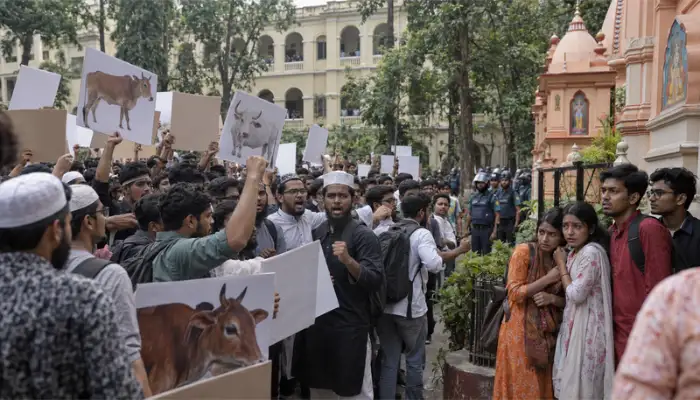
Case Summary
In Bangladesh’s Jagannath University, Hindu students were subjected to aggressive anti-Hindu slogans during the Durga Puja period, with Muslim students calling for Hindus to be driven out of the country and declaring that cows would be slaughtered on campus and in front of Hindus. In a video that went viral, Muslim students were heard chanting slogans including “Goru Khaowar Adhikar” (the right to eat beef), “Shah Jalal er Bangla” (this is Shah Jalal’s country), “Hindu aamader bhai naye” (Hindus are not our brothers) and “Hindu aamader chai naye” (we do not want Hindus here). The slogans went beyond asserting a right to consume beef: they rejected Hindus as members of the national community, demanded their exclusion from Bangladesh and invoked cow slaughter as a direct provocation against Hindu religious sentiments. The confrontation followed an incident on 12 October 2026, when cow-meat khichuri was cooked at the university’s Muktamancha, near the Central Hindu Temple. Students of the 2021-22 academic session (17th batch) of the Department of Islamic History and Culture organised the cookout to celebrate completing their honours programmes. The activity sparked objections over the sanctity of the Hindu place of worship. Hindu students also raised concerns that bricks belonging to the temple had been used to construct a temporary stove for cooking beef, adding to anger over the treatment of the religious site. Following the objections, a group of students announced a “beef feast” as a counter-protest, asserting their right to eat cow meat. The confrontation subsequently escalated, with slogans calling for Hindus to leave Bangladesh and declarations that cows would be slaughtered on campus and in front of them. What began as a dispute over a cooking activity near a Hindu temple had thus developed into open hostility directed at Hindus collectively on the basis of their religious identity. The slogans were particularly alarming because they combined religious provocation with the explicit rejection of Hindu belonging. Declaring that Bangladesh was not the country of Hindus, insisting that Hindus were not their brothers and demanding that they leave the country conveyed a message of exclusion to the Hindu minority. The accompanying references to cow slaughter added a further religious dimension, given the sacred status of the cow in Hindu tradition and the profound offence its slaughter causes many Hindus. The episode therefore extended beyond a disagreement over dietary practices to include collective intimidation and rhetoric questioning whether Hindus belonged in Bangladesh at all. Amid the escalating tensions, the Jagannath University administration initially banned the slaughter of all animals on campus. The directive, issued by Proctor (additional charge) Prof. Md Azam Khan, cited the need to prevent disorder, maintain discipline and ensure hygiene, and warned that violations would invite punitive action. Later, however, the varsity revoked the ban and expressed regret over the directive restricting animal slaughter on campus. This incident occurred against the broader backdrop of the longstanding persecution of Hindus in Bangladesh. The Hindu minority has faced discrimination, targeted violence and religious hostility over decades, with attacks intensifying during periods of political and social instability. The latest major escalation began after the ouster of Sheikh Hasina’s government in August 2024, continued after the death of Sharif Osman Bin Hadi in December 2025, and resurfaced immediately after Bangladesh’s 13th National Parliamentary Election in 2026. Following Sheikh Hasina’s ouster, attacks on Hindu homes, temples and religious institutions were reported alongside intimidation, arson and mob violence targeting Hindu localities. The Hinduphobia Tracker recorded 336 incidents involving the Hindu minority during this period, reflecting the scale of the escalation and the vulnerability of Hindus amid the political upheaval. Another spurt of violence followed the death of Sharif Osman Bin Hadi, a Muslim political activist and student leader known for his anti-Hindu and anti-India rhetoric, in December 2025. In the aftermath, Hindu communities faced retaliatory violence, with Hindu homes and properties selectively attacked and several families reportedly forced to flee. Among the victims was Dipu Chandra Das, who was lynched and whose body was subsequently set ablaze by a Muslim mob over false blasphemy allegations. The Hinduphobia Tracker documented 51 incidents of anti-Hindu violence in the period following Hadi’s death alone, illustrating how hostility towards the Hindu minority intensified amid communal mobilisation. During this period, posters and written material calling for the extermination of Hindus were also displayed in public spaces. Viewed alongside reports of arson, vandalism, assault and targeted intimidation, such rhetoric pointed to a recurring pattern in which hostility towards Hindus intensified during periods of unrest. The most recent escalation followed the 13th National Parliamentary Election in 2026. In the immediate aftermath of the election results, Hindu families in districts including Noakhali, Rangpur, Nilphamari, Sylhet, Thakurgaon and Dinajpur faced attacks involving arson, looting, assault and vandalism of Hindu homes and temples. In several instances, Hindu properties were reportedly singled out, and families faced threats of displacement. The incident at Jagannath University must therefore be understood within this wider context of recurring hostility towards Bangladesh’s Hindu minority. The slogans did not merely express support for beef consumption; they included calls for Hindus to leave the country and statements rejecting them as fellow citizens.
Why it is Hate Crime ?
The primary category selected for this case is: Hate speech against Hindus. The subcategory selected is: Anti-Hindu slurs, mocking faith. Anti-Hindu slurs and the deliberate mocking of the Hindu faith owing to religious animosity involve the usage of derogatory terms, stereotypes, or offensive references to religious practices, symbols, or figures. One of the common anti-Hindu slurs used against Hindus is “cow-worshipper” and “cow piss drinker”. The intention of using this term is to demean and mock Hindus as a group and their religious beliefs, since Hindus consider the cow holy. Additionally, some symbols and the slurs attached to them have a historical context that exacerbates the insult, hate, stereotyping, dehumanisation and oppression against Hindus. Cow worship has been used for centuries to denigrate Hindus, insult their faith and oppress Hindus specifically as a religious group. There has been overwhelming documentation about how cow slaughter has been used to persecute Hindus, with cow meat being thrown in temples and places of worship. There has also been overwhelming documentation that cow meat (beef) has been force-fed to Hindus to either forcefully convert them to Islam or denigrate their faith. Apart from cow worship, the Swastika – which holds deep religious significance for the Hindus – has also been misinterpreted and distorted to be used as a slur against Hindus. Similarly, the worship of the Shivling has been used by supremacist ideologies and religions to denigrate Hindus owing to religious animosity. Such slurs and denigration stem from inherent animosity and hate towards Hindus and their faith; therefore, they are categorised as hate speech targeted at Hindus specifically owing to their religious identity. The next subcategory selected for this case is: Violent threats. Violent threats, explicit, implicit or implied, is the most dangerous form of hate speech since it goes beyond discriminatory and prejudicial language to express the intent of causing harm to an individual or a group of people based on their religious identity and faith. There could be several different kinds of threats that are issued to Hindus based on religious animosity. An explicit threat would mean the direct threat of violence towards an individual Hindu, a group of Hindus or Hindus at large. Physical violence, death threats, threats of destruction of property belonging to Hindus and threats of genocide would mean explicit threats against Hindus for their religious identity. Implicit threats may not be a direct threat but implied through the use of symbols or actions – for example – in the Nupur Sharma case, other than explicit threats, there were also implicit threats when Islamists took to the streets to burn and beat her effigies. It implies that they want to do the same to Nupur Sharma; therefore, it is considered an implicit threat. Violent threats can be delivered in person, through letters, phone calls, graffiti, or increasingly through social media and other online platforms. It would be important to understand that a threat – explicit or implicit, online or offline – to an individual who happens to be a Hindu does not qualify as a religiously motivated threat. Such a threat, while vile and dangerous, could be owing to non-religious reasons and/or personal animosity. To qualify as a religiously motivated threat, it would need to exhibit an indication that the individual is being targeted for religious reasons and/or owing to his/her religious identity as a Hindu. This case qualifies as a religiously motivated hate crime because Hindus were collectively targeted through language that combined contempt for Hindu religious beliefs with explicit exclusionary and violent threats. The hostility was not directed at an individual over a personal dispute. Hindus were addressed as a religious community, their reverence for the cow was deliberately invoked, and their very right to belong in Bangladesh was challenged. The religious character of the incident was evident from the repeated invocation of cow slaughter as a means of provoking and intimidating Hindus. In Hindu Dharma, the cow is revered as Gau Mata and occupies a deeply sacred position in religious, cultural and devotional life. Consequently, threatening to slaughter cows specifically in front of Hindus cannot be separated from the religious meaning attached to the act. The threat used something sacred to Hindus as an instrument of humiliation and hostility. This becomes particularly significant because the dispute had already arisen after cow meat was cooked near Jagannath University’s Hindu temple, prompting objections over the sanctity of the religious space. Instead of remaining a disagreement concerning food, the matter escalated into declarations that cows would be slaughtered on campus and in front of Hindus. The religious sensitivity that had prompted the original objection was therefore deliberately turned into the very point through which Hindus were threatened. The slogans demanding that Hindus leave Bangladesh carried an even broader form of religious hostility. Statements that Bangladesh was “not the country of Hindus” did not attack one individual or one organisation; they denied Hindus collectively a legitimate place in the country because of their religious identity. Such language treats an entire religious community as outsiders whose presence is unwanted and whose continued existence in the shared national space is conditional. Calling for Hindus to be driven out also went beyond insult or mockery. It communicated an exclusionary threat directed at the community as a whole. The message was that Hindus should either accept the deliberate violation of their religious sentiments or leave the country. This created an atmosphere of intimidation in which Hindu identity itself became the reason for hostility. The timing during the Durga Puja period further aggravated the religious nature of the incident. Durga Puja is one of the most significant Hindu religious observances, centred on the worship of Goddess Durga and celebrated publicly by Hindu communities. Issuing threats of expulsion and deliberately invoking cow slaughter during such a sacred period intensified the attack on Hindu religious dignity and created fear at a time when Hindus were openly expressing and celebrating their faith. The threat involving cow slaughter also carried significance beyond the physical act itself. Anti-Hindu hostility has historically used the sacred status of the cow as a point of ridicule, provocation and humiliation, precisely because perpetrators understand the religious importance Hindus attach to it. Using cow slaughter rhetorically against Hindus therefore functions as a direct attack on a deeply rooted religious belief and not merely as a statement concerning dietary preference. The case also demonstrates how mockery and violent intimidation operated together. Hindu religious sentiment was first treated with contempt, and that contempt was then reinforced through threats directed at the community’s continued presence in Bangladesh. The movement from “we will slaughter cows in front of you” to “Hindus must leave” linked denigration of Hindu faith with an explicit attempt to intimidate Hindus collectively. Taken together, the incident targeted the sacred status of the cow, the dignity of Hindu religious practice, the security of Hindus as a community and their right to belong in Bangladesh. The rhetoric expressed hatred, animosity and hostility towards Hindus specifically because they were Hindu, while the threats of cow slaughter and expulsion transformed that hostility into direct religious intimidation. For these reasons, the case is appropriately documented as a religiously motivated hate crime under Hate speech against Hindus, particularly Anti-Hindu slurs, mocking faith and Violent threats. Disclaimer: The Hinduphobia Tracker records incident dates based on when the incident occurred, not when it was subsequently reported. In this case, the exact date on which the anti-Hindu slogans, threats to drive Hindus out of Bangladesh, and declarations about slaughtering cows in front of Hindus were first raised could not be ascertained. Therefore, 12th October 2026, being the earliest date connected with the dispute that subsequently escalated into these anti-Hindu threats, has been selected as the indicative incident date for documentation purposes.


Case Status
Unknown


Perpetrators Details
Perpetrators
Muslim Extremists
Perpetrators Range
N/A
Perpetrators Gender
both
 Sources




