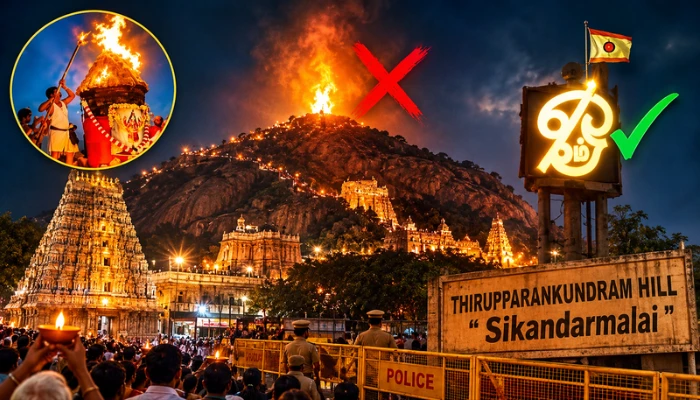
Hindu devotees betrayed as Tamil Nadu government denies right to light Karthigai deepam at Deepathoon, renames sacred hill “Sikandarmalai” despite Supreme Court order
 Madurai, Tamil Nadu, India
 23 November, 2026
Case Summary
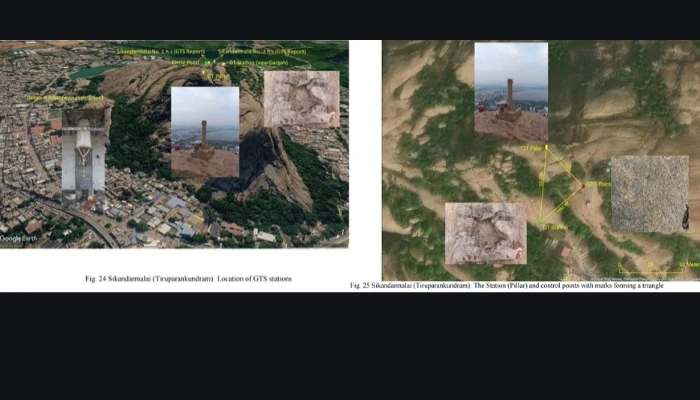
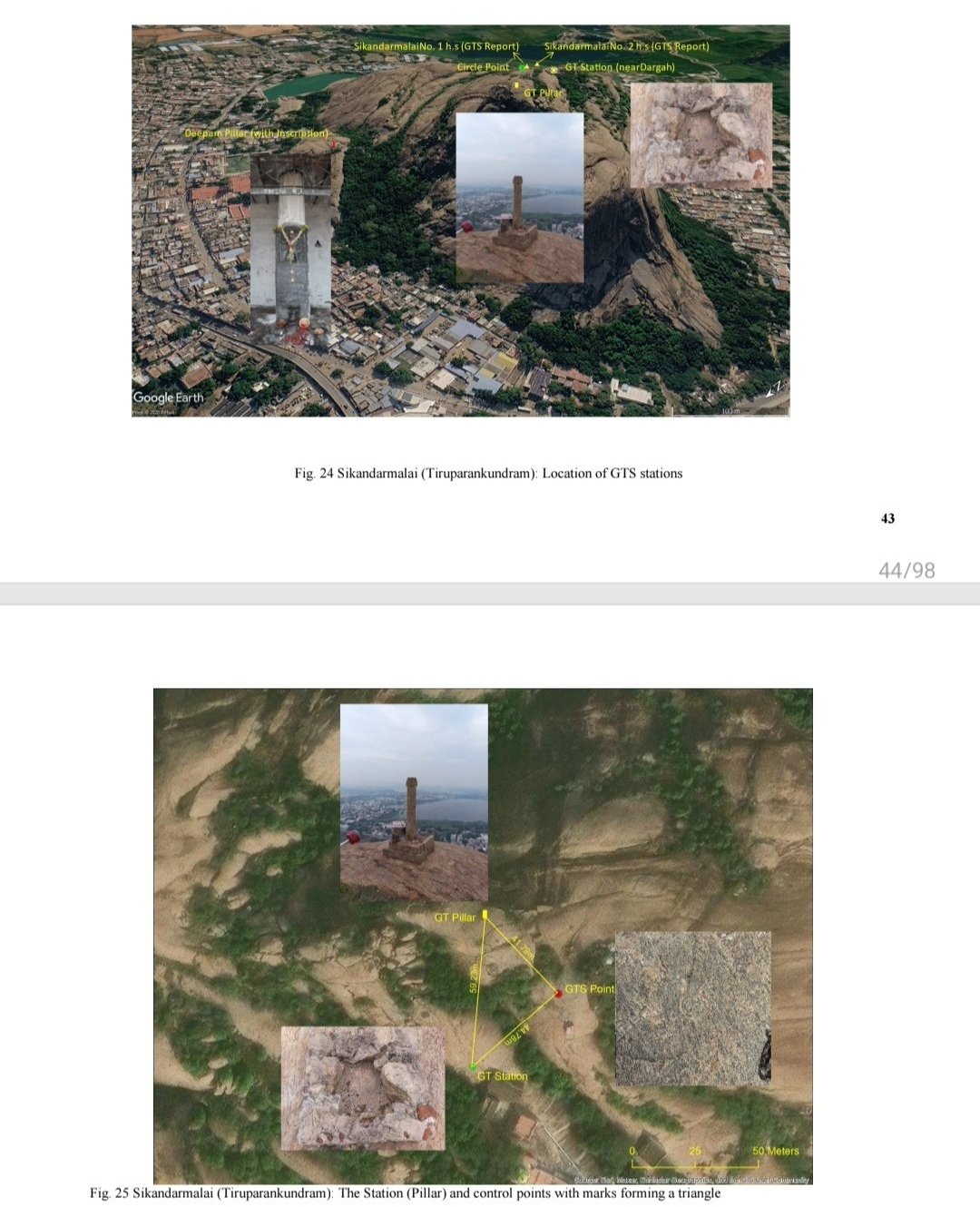
In Tamil Nadu, Hindu devotees were denied the opportunity to light the sacred Karthigai Deepam at the Deepathoon on Thirupparankundram Hill despite the Supreme Court's order permitting the ritual. On 24 November 2026, the Tamil Nadu government, led by Chief Minister C. Joseph Vijay, disallowed the ceremonial lamp from being lit at the customary location and instead lit it near the Uchipillaiyar Temple, leaving the Deepathoon unlit and Hindu devotees unable to perform the ritual at the court-authorised site. On 20 November 2026, the Supreme Court permitted the lighting of Karthigai Deepam at the Deepathoon as a one-time arrangement between 6.00 pm and 6.30 pm. However, the state government did not facilitate the ritual at the designated time and location. Instead, the customary lighting was conducted at a different location. Additionally, on 24 November, 20,26 Hindu devotees also faced extensive restrictions on accessing Thirupparankundram Hill during the festival. More than 5,000 police personnel were deployed, prohibitory orders were imposed, and barricades were erected around the hill. Several Hindu leaders were placed under house arrest or prevented from travelling to the site. The government's position also came under scrutiny after a five-volume report, spanning over 1,800 pages and prepared by its Departments of Survey and Settlement and Archaeology, repeatedly referred to Thirupparankundram Hill as "Sikandarmalai hill station (Thirupparankundram)". The report claimed that the Deepathoon near the Sikandar Badusha Dargah was a British-era Great Trigonometrical Survey pillar rather than the original lamp pillar, which it identified at a lower location on the hill. This mattered because the Madras High Court had previously directed that the hill be referred to as Thirupparankundram Hill, not Sikandar Malai or Samanar Kundru. The Hinduphobia Tracker had previously documented 10 incidents at Thirupparankundram involving obstruction of Hindu religious practices and restrictions on devotees. These included government restrictions, death threats issued by Muslim men to Hindu devotees for visiting the sacred hill, as well as incidents in which Muslim men hoisted Islamic flags within the temple premises. In December 2025 and January 2026, Hindu devotees were prevented from lighting the ceremonial Karthigai Deepam at the Deepathoon, despite orders from the Madurai Bench of the Madras High Court. The Court had directed the temple administration to light the lamp at the Deepathoon in addition to the customary location. When the temple did not implement this direction, the Court issued a further order permitting the petitioner and ten other devotees to light the lamp under CISF protection. However, the police prevented them from reaching the site after the District Collector imposed prohibitory orders under Section 163 of the BNSS.
Case Images
Why it is Hate Crime ?
The primary category selected is: Restriction/ban on Hindu practices. The sub-category selected under it is: Administration restricting religious practice. In several cases, it is seen that the administration/state disallows a religious practice owing to prejudicial orders and concerns, targeted specifically against the Hindu community. Such restriction/prohibition would be considered documented as a hate crime because the orders are often a result of pressure by groups that harbour animosity towards Hinduism and Hindus. Often, the restriction by the authorities is driven by bias, hostility, or prejudice against the specific community being stopped from holding a religious practice, by pressure groups that harbour animosity towards Hindus, intrinsic to their faith. Since practices are intrinsic to the faith of the Hindus, such prejudicial restriction is considered a curtailment of the fundamental rights of the Hindu community. In several cases, for example, the authorities ban a Hindu religious practice due to pressure from groups opposed to the religion. In other instances, the prohibition is selectively enforced against one religious group (Hindus) while others are allowed to proceed. There are still other cases where the authorities preemptively restrict a religious practice by Hindus because those who hold animosity towards Hindus may get “provoked”, leading to them being violent, thereby assuaging the sentiments of those who hold animosity towards Hindus by curtailing the religious rights of Hindus. Such acts and orders are prejudiced, indicating discriminatory motives owing to the capitulation to groups that harbour animosity towards Hindus and therefore would be categorised as a religiously motivated hate crime since the original pressure leading to the order itself is a result of hatred/bias/prejudice/religious hate against Hindus. The other sub-category selected is: Restriction on expression of Hindu identity. An example of the state-affected prejudicial and targeted orders against the Hindu community would be a government denying the right of a Hindu or a group of Hindus to hold a religious procession owing to the animosity of non-Hindu groups. Denial of the religious right of Hindus to assuage the non-Hindu group which harbours animosity to a point where it could lead to violence against Hindus is not only a failure of law and order but is a prejudicial order against Hindus, denying them their fundamental rights to express their religious identity. An example of a hate crime against Hindus by a non-Hindu would be a non-Hindu institution forcing its Hindu employees to abandon religious symbols that a Hindu would wear as an expression of faith owing to inherent prejudice against the faith professed by the victim, or a non-Hindu group of people restricting a Hindu group from constructing a place of worship simply because the demography of the area in which the temple is being built is dominated by non-Hindus. Such actions are driven by religious animosity and/or prejudice against Hindus and their faith and would therefore be categorized as a hate crime. The other primary category selected is: Hate Speech against Hindus. The subcategory selected is: Anti-Hindu subversion and prejudice. Hate speech is defined as any speech, gesture, conduct, writing, or display that is prejudicial against a specific individual and/or group of people, which is leading to or may lead to violence, prejudicial action,n or hate against that individual and/or group. Media plays a specific and overarching role in perpetuating prejudicial attitudes towards a community owing to unfair, untrue coverage and/or misrepresentation/misinterpretation, selective coverage and/or omission of facts of/about issues affecting a specific religious group. This type of bias can dehumanise the victim group, making it easier for others to justify harmful actions against them, which aligns with the objectives of hate speech laws aimed at preventing such harm. It is often observed that the media takes a prejudicial stand against the Hindu community, driven by their need to shield the aggressor community,y which happens to be a numeric minority; however, it is the one perpetrating violence against Hindus. For example, the media is often quick to contextualise religiously motivated crimes against Hindus, omit or misrepresent facts that point towards religiously motivated hate crimes, justify and/or downplay religiously motivated hate crimes, es or simply present fake news to stereotype Hindus. Such media bias leads to the denial of persecution and is often used to dehumanise Hindus, leading to justification for violence against them. For example, the media covered several fake allegations of Hindus targeting Muslims and forcing them to chant Jai Shree Ram. Most of these cases were proved false and fabricated after police investigation. These fake news reports were subsequently never retracted or clarified. Such fake news led to the justification of violence and dehumanisation of Hindus based on the argument that since Hindus targeted Muslims and forced them to chant Jai Shree Ram, the dehumanisation of Hindus and violence against them was par for the course and merely a retaliation. Such media bias leads to prejudicial portrayal of Hindus and offers a justification for violence against them and therefore is considered hate speech under this category. This case was included in the Hinduphobia Tracker because it involved the obstruction of a centuries-old Hindu religious practice, the denial of Hindu devotees' right to worship at a traditionally designated sacred location despite judicial directions, and the official use of a name associated with an adjoining Dargah for a hill of immense religious significance to Hindus. Karthigai Deepam is an important Hindu festival in which devotees light lamps to worship Lord Shiva in the form of divine light. Lighting the Deepam at the designated Deepathoon on Thirupparankundram Hill is not an incidental ritual or a matter of choosing an alternative location. The Deepathoon holds specific religious significance because it was traditionally associated with the temple's observance of Karthigai Deepam. The ritual's location is intrinsic to its religious significance. Lighting the lamp at the designated pillar preserved the continuity of a centuries-old Hindu practice and the connection between the sacred hill, the temple, and the worship of Lord Shiva. The administration's actions amounted to a deliberate prioritisation of the adjoining Dargah over Hindu devotees' religious rights and sentiments. A centuries-old Hindu religious observance was effectively held hostage by objections arising from the Deepathoon's proximity to the Dargah. The question is straightforward: how could lighting a Hindu ceremonial lamp at a pillar associated with an ancient Hindu temple be treated as an infringement of another religious establishment's rights when the Karthigai Deepam tradition at the site predated the establishment of the adjoining Dargah? The lamp had been lit as part of Hindu religious observance long before the Dargah came into existence. How, then, could a religious practice that had existed for centuries before the Dargah's establishment suddenly be portrayed as an infringement of its rights? The mere presence of a Dargah nearby could not confer upon it the authority to dictate how Hindus practised their faith on a sacred hill. More importantly, the Supreme Court had already provided safeguards to ensure that the Dargah and mosque remained undisturbed during the ceremony. There was, therefore, no justification for sacrificing Hindu religious rights to accommodate such objections. By refusing to facilitate the ritual at the designated location, the administration effectively appeased Muslims objecting to the Hindu observance while leaving Hindu devotees to bear the cost of that appeasement. This was not a matter of maintaining communal harmony; it was a matter of making Hindu religious expression conditional on the approval of those who opposed it. The injustice became even more pronounced when one considers the historical and religious identity of Thirupparankundram. The hill is one of the six sacred abodes of Lord Murugan, known as the Arupadai Veedu, and had been an important centre of Tamil Hindu devotion for centuries. Its sanctity and religious identity existed independently of, and long before, the adjoining Dargah's establishment. Yet, the objections of a subsequently established religious structure were allowed to become an instrument for restricting Hindu religious practices at a site intrinsically associated with Hindu worship. How could the religious rights of an ancient temple and its devotees be subordinated to the objections of a religious establishment that had emerged later on the same hill? Such an arrangement effectively reversed the site's historical and religious relationship, placing the claims of the later establishment above Hindus' centuries-old devotional traditions. It sent an unmistakable message that Hindu religious practices had to retreat whenever another religious group objected to their observance. The Tamil Nadu government's repeated use of the name "Sikandarmalai" for Thirupparankundram Hill in its official report further compounded this displacement of Hindu religious identity. This was not an inconsequential choice of terminology. The hill is not an ordinary geographical formation whose identity could be casually replaced in official records. It is a sacred Hindu landscape, inseparable from Lord Murugan, the Arupadai Veedu tradition and centuries of uninterrupted Hindu devotion. By repeatedly invoking a name associated with the adjoining Dargah, the government effectively lent official recognition to a competing religious identification of a hill whose established Hindu identity was central to its history. This amounted to an institutional erasure of Hindu religious heritage, wherein the identity of a sacred Hindu hill was gradually displaced through official nomenclature. The implications were particularly disturbing when viewed alongside the obstruction of Karthigai Deepam itself: while Hindu devotees were denied their centuries-old religious observance at the designated Deepathoon, the government was simultaneously giving official prominence to a name associated with the Dargah. The combined effect was to diminish the Hindu character of the sacred landscape and normalise the subordination of its religious identity. What made this pattern particularly egregious was that Hindu devotees were repeatedly made to surrender their religious rights despite judicial intervention. Taken together, the obstruction of Karthigai Deepam, the restrictions imposed on devotees visiting the hilltop shrines, and the official promotion of the alternative nomenclature were not isolated administrative decisions. They reflected a continuing displacement of Hindu religious interests in favour of objections and claims associated with another religious establishment. Hindu devotees were effectively told that their festivals could be restricted, their access to sacred shrines could be controlled, and even the identity of their sacred hill could be redefined to accommodate another community's religious sensitivities. This incident also needs to be viewed against the wider anti-Hindu prejudice displayed by the successive Tamil Nadu governments. Under the previous DMK government led by M.K. Stalin, a ban on wearing Hindu religious symbols, framed as a measure to address caste-based issues, raised concerns about fairness, particularly as it did not apply to the veil, hijab, or turban worn by students. Further, the recommendation to create special units to investigate the "saffronisation" of educational institutions suggested an anti-Hindu bias. In September 2023, then Minister Udhayanidhi Stalin compared Sanatana Dharma to diseases such as dengue and malaria and called for its eradication. He reiterated this position in the Tamil Nadu Assembly in May 2026. In December 2025 and January 2026, Hindu devotees were prevented from lighting the ceremonial Karthigai Deepam at the Deepathoon on Thirupparankundram Hill in Madurai despite orders from the Madurai Bench of the Madras High Court. The Court directed the temple administration to light the lamp at the Deepathoon in addition to the customary location. After the direction was not implemented, the Court issued a further order permitting the petitioner and ten other devotees to light the lamp under CISF protection. However, police prevented them from reaching the site after the District Collector imposed prohibitory orders under Section 163 of the BNSS. The change in government did not dispel these concerns. The Vijay-led TVK government has also displayed its anti-Hindu prejudice in handling Hindu religious observances. On November 24, 2026, the TN government defied the Supreme Court order to light the ceremonial Karthigai Deepam at the Deepathoon on Thirupparankundram Hill in Madurai. This raised further questions about the administration's approach to Hindu religious rights and its willingness to facilitate their observance. This incident must therefore be viewed as part of a wider pattern of restrictions and hostility surrounding the public expression of Hindu faith in Tamil Nadu. The burden of maintaining communal harmony was placed entirely on Hindus, who were expected to sacrifice their religious rights to prevent the displeasure of those objecting to their faith. Such unequal accommodation, particularly when it overrode judicial directions and undermined an ancient religious tradition, constituted a grave infringement of the religious rights, identity and sentiments of Hindus, warranting inclusion in the tracker.


Case Status
Unknown

Perpetrators Details
Perpetrators
State and Establishment
Perpetrators Range
Unknown
Perpetrators Gender
unknown
 Sources