Hindu devotees' Vel Yatra to Murugan Temple stopped by police and organiser detained near Chengalpattu, Tamil Nadu
 Chingleput, Tamil Nadu, India
 12 November, 2026
Case Summary
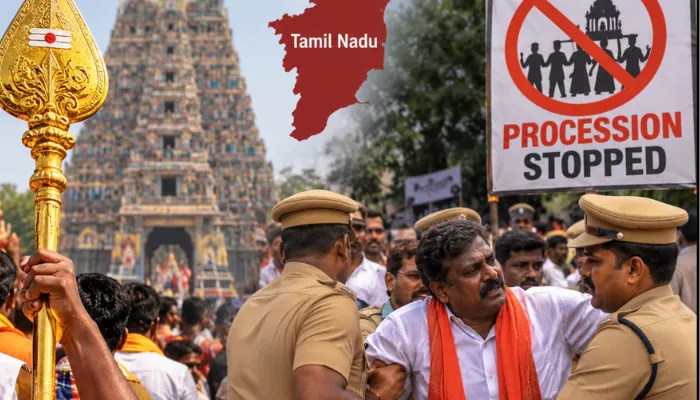
In Chengalpattu district, Tamil Nadu, police stopped a Vel Yatra (also called Vetri Vel Yatra, meaning "Victorious Spear March) organised by Hindu devotees towards the Murugan Temple during the Kandha Sashti (a major six-day Hindu festival dedicated to Lord Murugan) celebrations. The procession was centred on the Vel, the sacred spear associated with Lord Murugan (Kartikeya), which symbolises divine protection and victory in Hindu tradition. Police intervention prevented devotees from continuing their religious procession towards the temple. On November 13, 2026, during the intervention, police used force to stop devotees from carrying out the procession. Vishwa Hindu Parishad (VHP) North-South Tamil Nadu State Dharma Prasar Organiser S.V. Raman was manhandled and detained by the police. The incident drew condemnation from the VHP, which objected to the police action against devotees participating in a Hindu religious programme. The incident took place amid the VHP's announcement of Vel Pooja programmes at 2,500 locations across Tamil Nadu on November 13, 14 and 15, as part of centenary celebrations for its former leader, Ashok Singhal. The organisation had also announced a statewide Hindu outreach campaign targeting 10 lakh people, scheduled to take place from November 22 to December 10. Condemning the police intervention, the VHP accused the Tamilaga Vettri Kazhagam (TVK) government of restricting Hindu religious activities and applying unequal standards in dealing with religious programmes. The planned Vel Yatra was also linked to the VHP's efforts to mobilise Hindu support for the Karthigai Deepam celebrations (a traditional Hindu festival of lights celebrated by Tamil and Malayali Hindus) and the ongoing dispute over lighting the Deepam (diya) on the ancient stone pillar atop Thirupparankundram hill in Madurai.
Why it is Hate Crime ?
The primary category selected in this case is: Restriction/ban on Hindu practices. The other subcategory selected for this case is: Administration disallows religious procession. The tertiary category selected for this case is: Religious procession. In several cases, it is seen that the administration/state disallows a religious procession owing to prejudicial orders and concerns, targeted specifically against the Hindu community. Such restriction/prohibition would be considered documented as a hate crime because the orders are often a result of pressure by groups that harbour animosity towards Hinduism and Hindus. Often, the restriction by the authorities is driven by bias, hostility, or prejudice against the specific community being stopped from holding a religious procession, by pressure groups that harbour animosity towards Hindus, intrinsic to their faith. Since the religious procession is inherent to the faith of the Hindus, such prejudicial restriction is considered a curtailing of the fundamental rights of the Hindu community. In several cases, for example, the authorities ban a Hindu religious procession due to pressure from groups opposed to the religion. In other instances, the prohibition is selectively enforced against one religious group (Hindus) while others are allowed to proceed. There are still other cases where the authorities preemptively restrict a religious process by Hindus because those who hold animosity towards Hindus may get “provoked” leading to them being violent, thereby assuaging the sentiments of those who hold animosity towards Hindus by curtailing the religious rights of Hindus. Such acts and orders are prejudiced, indicating discriminatory motives owing to the capitulation to groups that harbour animosity towards Hindus and therefore, would be categorized as a religiously motivated hate crime since the original pressure leading to the order itself is a result of hatred/bias/prejudice/religious hate against Hindus. The other subcategory is: Administration restricting religious practice. In several cases, it is seen that the administration/state disallows a religious practice owing to prejudicial orders and concerns, targeted specifically against the Hindu community. Such restriction/prohibition would be considered documented as a hate crime because the orders are often a result of pressure by groups that harbour animosity towards Hinduism and Hindus. Often, the restriction by the authorities is driven by bias, hostility, or prejudice against the specific community being stopped from holding a religious practice, by pressure groups that harbour animosity towards Hindus, intrinsic to their faith. Since practices are intrinsic to the faith of the Hindus, such prejudicial restriction is considered a curtailment of the fundamental rights of the Hindu community. In several cases, for example, the authorities ban a Hindu religious practice due to pressure from groups opposed to the religion. In other instances the prohibition is selectively enforced against one religious group (Hindus) while others are allowed to proceed. There are still other cases where the authorities preemptively restrict a religious practice by Hindus because those who hold animosity towards Hindus may get “provoked”, leading to them being violent, thereby assuaging the sentiments of those who hold animosity towards Hindus by curtailing the religious rights of Hindus. Such acts and orders are prejudiced, indicating discriminatory motives owing to the capitulation to groups that harbour animosity towards Hindus and therefore would be categorised as a religiously motivated hate crime since the original pressure leading to the order itself is a result of hatred/bias/prejudice/religious hate against Hindus. The police intervention effectively restricted Hindu devotees from peacefully practising and publicly expressing their faith during an important festival dedicated to Lord Murugan. The Vel Yatra was a religious procession centred on the sacred Vel, an important symbol of Lord Murugan and integral to his worship. Preventing devotees from carrying the Vel towards the temple during Kandha Sashti directly interfered with their religious observance and their right to participate in a traditional Hindu religious programme. What makes the action particularly concerning is the pre-emptive restriction of Hindu religious expression on the presumption that the procession could provoke objections or create a law-and-order problem. Such an approach places the burden on Hindus to curtail their religious practices to accommodate the anticipated hostility of others. Instead of ensuring that devotees could exercise their religious rights without interference, the authorities stopped the procession and subjected participants to police action. This effectively rewards the possibility of opposition by allowing anticipated objections to become grounds for restricting Hindu religious observances. This incident also needs to be viewed against the wider anti-Hindu prejudice displayed by the successive Tamil Nadu governments. Under the previous DMK government led by M.K. Stalin, a ban on wearing Hindu religious symbols, framed as a measure to address caste-based issues, raised concerns about fairness, particularly as it did not apply to the veil, hijab, or turban worn by students. Further, the recommendation to create special units to investigate the "saffronisation" of educational institutions suggested an anti-Hindu bias. In September 2023, then Minister Udhayanidhi Stalin compared Sanatana Dharma to diseases such as dengue and malaria and called for its eradication. He reiterated this position in the Tamil Nadu Assembly in May 2026. In December 2025 and January 2026, Hindu devotees were prevented from lighting the ceremonial Karthigai Deepam at the Deepathoon on Thirupparankundram Hill in Madurai despite orders from the Madurai Bench of the Madras High Court. The Court directed the temple administration to light the lamp at the Deepathoon in addition to the customary location. After the direction was not implemented, the Court issued a further order permitting the petitioner and ten other devotees to light the lamp under CISF protection. However, police prevented them from reaching the site after the District Collector imposed prohibitory orders under Section 163 of the BNSS. The change in government did not dispel these concerns. The Vijay-led TVK government has also displayed its anti-Hindu prejudice in handling Hindu religious observances. On November 24, 2026, the TN government defied the Supreme Court order to light the ceremonial Karthigai Deepam at the Deepathoon on Thirupparankundram Hill in Madurai. This raised further questions about the administration's approach to Hindu religious rights and its willingness to facilitate their observance. The Vel Yatra incident must therefore be viewed as part of a wider pattern of restrictions and hostility surrounding the public expression of Hindu faith in Tamil Nadu. The police stopped a procession dedicated to Lord Murugan, organised during his sacred festival and centred on his divine weapon. When Hindu religious observances are curtailed on the presumption that they might offend or provoke others, the authorities effectively make the exercise of Hindu religious rights conditional on the approval of those who may oppose them. Such actions normalise the suppression of Hindu religious expression and reinforce an environment in which Hindus are made to feel that practising and publicly displaying their faith is unwelcome. The underlying hostility lies in treating Hindu religious expression as something that must be restricted, accommodated or suppressed rather than protected as a fundamental religious right.
Victim Details
Total Victim
1
Deceased
0
Gender
- Male 1
- Female 0
- Third Gender 0
- Unknown 0
Caste
- SC/ST 0
- OBC 0
- General 1
- Unknown 0
Age Group
- Minor 0
- Adult 1
- Senior Citizen 0
- Unknown 0


Case Status
Unknown

Perpetrators Details
Perpetrators
State and Establishment
Perpetrators Range
One Person
Perpetrators Gender
male
 Sources