Hindu religious site desecrated by Muslims; Islamic flag hoisted within temple premises in Tamil Nadu
 Madurai, Tamil Nadu, India
  11 December, 2025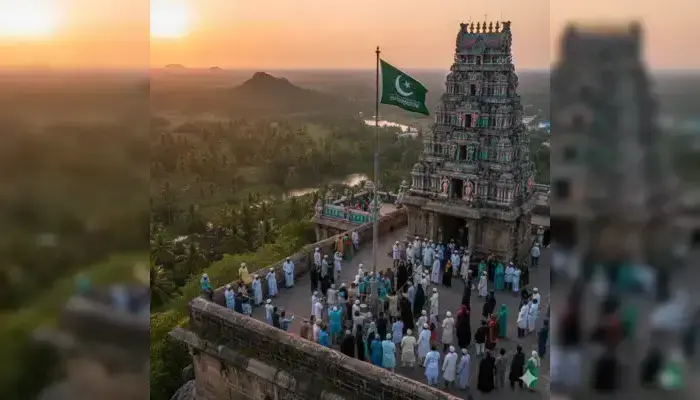
Case Summary
In Madurai, Tamil Nadu, a Hindu temple named Arulmigu Subramaniya Swamy Temple of Thiruparankundram Hill was desecrated as Muslims belonging to the nearby Sikandar Badusha Dargah hoisted an Islamic flag (Pallivasal flag) on the premises of the temple. This incident came to light when the temple official lodged a complaint before Thiruparankundram police on 10 January 2026, over unauthorised flag hoisting atop Thiruparankundram Hill. According to police sources, on the night of 12 December 2025, Muslims trespassed on the premises belonging to the temple and erected a flag on top of the Kallathi tree, a sacred tree belonging to the temple, to announce the Sandhanakoodu Festival at the Sikandar Badusha Dargah. It was further stated that it was illegal to trespass on the premises belonging to the temple and erect the flag on the tree. The complainant requested the police to identify the people involved in the criminal act and take appropriate action against them for trespassing and destroying the sanctity of the Kallathi tree. Executive officer of the temple, Yagna Narayanan, conceded that what was committed by the dargah officials was a rank criminal trespass. Since the property of the temple was unauthorisedly trespassed upon by the dargah officials, he stated that he would lodge a complaint immediately before the jurisdictional police. Even the Madras High Court, on 9 January 2026, sharply questioned the Executive Officer of the Arulmigu Subramaniya Swamy Temple at Thiruparankundram over the hoisting of a dargah flag on land declared as temple property, observing that the act amounted to criminal trespass. Justice GR Swaminathan, while hearing a contempt petition relating to non-compliance of an earlier court order, sought a clear explanation from temple authorities on how the dargah management was allowed to hoist a flag at the Deepathoon area for the Sandhanakoodu festival. At the outset, the Court asked the Executive Officer whether the place where the flag was hoisted belonged to the dargah or the temple. In response, the Executive Officer admitted that the land belonged to the temple. When questioned on whether any complaint had been lodged against the dargah authorities, the Executive Officer stated that no complaint had been filed and cited illness and absence from duty as reasons. The Court expressed strong displeasure over this explanation and directed the Executive Officer to immediately lodge a complaint and instructed the Police Commissioner to take action upon receipt of the complaint. Referring to the recent order of the Division Bench, the Court reiterated that the Deepathoon area, located on the lower peak of the Thiruparankundram Hill, had been categorically declared as temple land. The Court noted that despite this declaration, the dargah authorities had tied the Pallivasal flag, an Islamic flag, on a tree located in the said area. Furthermore, the court said that it could frame charges against the authorities for inaction and adjourned the matter to 2 February 2026. This incident occurred against the backdrop of ongoing disputes regarding this temple. In December 2025, Tamil Nadu's Dravida Munnetra Kazhagam government barred Hindu devotees from lighting the traditional Karthigai Deepam lamp at the ancient Deepathoon stone pillar on Thiruparankundram Hill in Madurai, despite a Madras High Court ruling permitting it. The Madurai Bench, led by Justice G.R. Swaminathan, approved the ritual on 1 December 2025, after petitions sought permission for the full moon ceremony honouring Shiva's Agni form. The judge rejected objections from groups citing proximity to Sikandar Badusha Dargah and alternative sites near Uchipillaiyar temple, affirming it posed no harm to Muslim rights. He added that upholding the practice strengthened the Subramaniya Swamy temple's claim over unoccupied hill areas amidst dargah expansion attempts. Despite this clear court order permitting Hindus to practise their faith, officials of the Hindu Religious and Charitable Endowments Department and police working at the behest of the Dravida Munnetra Kazhagam Government physically prevented lamp lighting on the ancient hill lamp post.
Why it is Hate Crime ?
This incident has been added to the Hinduphobia Tracker under the primary category- Attack on Hindu religious representations. Within this, the sub-category selected is- Desecration of Hindu religious symbol. Icons and symbols or a religious representation of a spiritual ideal are widely revered in Hinduism. Iconography is of vital significance in the Hindu milieu. It helps connect people’s spiritual beliefs with the real world. Iconography within the Hindu faith takes several shapes and forms. Murtis are of most significance to Hindus, to which daily rituals, prayers and offerings are done. Besides the murtis, there are several other symbols which have deep significance in the Hindu faith – the Om and Swastika for example. Since these Hindu religious symbols hold paramount importance in Hinduism, any desecration of symbols, icons, murtis, religious representations and manifestations, is driven by animosity towards the faith itself which manifests itself through these murtis, icons and symbols. Therefore, any desecration of these Hindu religious symbols and representations is considered religiously motivated hate crimes under this category. The other sub-category selected is- Breaking rules of place of worship. Sanatan Dharma is not a religion of one book, which is to say that while it has religious scriptures that form the central tenets of the faith, there are several traditions followed through thousands of years, mostly passed from generation to generation orally. One of these oral traditions or written traditions is the rules of specific temples. Certain temples have rules which are traditional rules, dependent on the worship of the presiding deities. These rules and traditions have been followed for thousands of years whether they find scriptural mention or not. Such traditions are based on the nature and rules of worship of the presiding deity of that temple. Any non-compliance of these traditions owing to animosity towards the faith or for the sake of activism stems not only from the lack of faith in the presiding deity but also disregard for the faith of the devotees of that deity/temple and implicit bias against the faith, the tradition and the deity itself. Since these specific traditions are central to the faith of the devotees of that specific temple and presiding deity, any non-compliance with these traditional rules would be considered a religiously motivated hate crime. This case was added to the hate crime database because the Muslim perpetrators from Sikandar Badusha Dargah deliberately targeted the Arulmigu Subramaniya Swamy Temple by hoisting an Islamic Pallivasal flag on its sacred Kallathi tree. This action clearly desecrated the temple's sanctity and wounded the religious sentiments of the Hindu devotees, turning a place of peace and devotion into a site of deliberate provocation and fear. Hindu temples serve as sacred spaces where devotees feel the living presence of the divine, pouring their hearts into worship and spiritual solace. The Muslim perpetrators' brazen hoisting of an Islamic flag within the temple compound on the night of 12 December 2025 shattered this sanctity without regard for Hindu traditions. This was no accident but a calculated act of hostility ahead of the Sandhanakoodu Festival that sparked justified religious tension and terrorised the local Hindu community. The act of hoisting the Islamic Pallivasal flag directly on the sacred Kallathi tree, a revered symbol central to the Arulmigu Subramaniya Swamy Temple's rituals and worshipped by Hindus as an embodiment of divine presence on Thiruparankundram Hill, deliberately desecrated this holy site. This violation inflicted deep hurt on the religious sentiments of Hindu devotees who regarded the tree as an inviolable sacred symbol integral to their faith. Such an act constituted a profound violation of a key religious emblem, unequivocally amounting to a targeted anti-Hindu hate crime. Such iconoclastic acts formed part of a sinister pattern where desecration is used to assert religious dominance and goad religious communities into conflict, inflicting profound emotional pain on Hindus who cherish their faith and sacred temples. The perpetrators ripped apart communal peace, violated the temple's inviolable holiness on declared temple land at Deepathoon, and constituted outright religious harassment. Such acts of desecration, violating the sacred temple and shattering its inviolable rules, were unequivocally religiously motivated, rooted in raw hostility towards the Hindu faith and community, marking this as a blatant anti-Hindu hate crime. Furthermore, the temple authorities displayed inaction in this matter. Instead of confronting the Muslim perpetrators head-on, registering charges for criminal trespass, and delivering swift justice, the Executive Officer delayed filing a complaint, citing illness, prompting the Madras High Court on 9 January 2026 to express strong displeasure and direct immediate action. This discriminatory response targeted victimised Hindus, shielding the Muslim aggressors while officials from the Hindu Religious and Charitable Endowments Department and police, acting at the behest of the Dravida Munnetra Kazhagam government, had previously prevented the Karthigai Deepam ritual despite court orders, laying bare a rotten systemic bias against Hindus precisely when they fell prey to religiously motivated targeting and crimes. Since this case met the parameters of a religiously motivated offence, it was added to the hate crime database of the tracker.


Case Status
Complaint filed


Perpetrators Details
Perpetrators
Muslim Extremists
Perpetrators Range
Unknown
Perpetrators Gender
unknown
 Sources




