Hindu Temple demolished within a day of Karthigai Deepam judgement by state government in Tiruppur, Tamil Nadu
 Tiruppur, Tamil Nadu, India
  6 January, 2026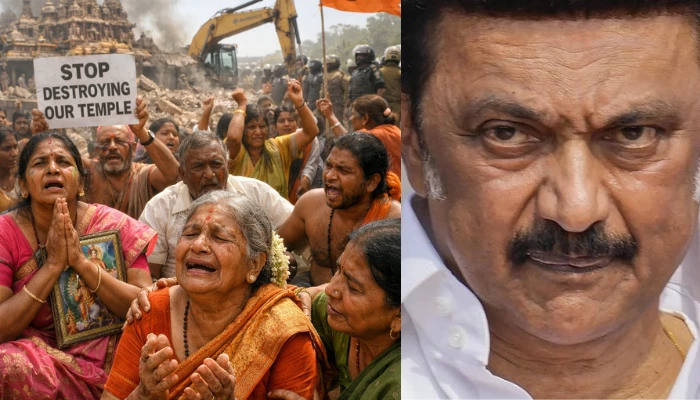
Case Summary
A Hindu temple, Selva Muthukumarar Temple, located in the Perumanallur–Ettiveerampalayam area of Tiruppur District, was demolished by the Dravida Munnetra Kazhagam government in Tiruppur, Tamil Nadu, on 7 January 2026. The temple, known locally as Kumarankundru or Selvamuthu Kumarasamy Temple, had been constructed on approximately 2.8 acres of government poramboke land. The temple complex included shrines dedicated to Murugan, Vinayagar, a Sivalingam, and Nandi. The Selva Muthukumarar Temple, located in the Ettiveerampalayam area of Perumanallur in Tiruppur District, was an ancient shrine that served as the kuladeivam (family deity) place of worship for the Hindus of the region. It was associated with the renowned Alagumulai Murugan Temple in Tiruppur District. It carried long-standing religious and cultural significance for the local Hindu population and had been worshipped by generations of devotees. The demolition was carried out by the Revenue Department under the leadership of Avinashi Tahsildar Chandrasekar, with heavy police deployment. More than 100 police personnel were present at the site, led by Avinashi Deputy Superintendent of Police Sivakumar. As the demolition began, members of Hindu Munnani and local residents, including a large number of women, gathered at the site and raised slogans opposing the removal of the temple. Protesters accused the authorities of targeting a place of worship and demanded that the demolition be halted. When the police attempted to clear the area and disperse the crowd, heated arguments broke out between officials and protesters, leading to scuffles and pushing. Some of the protestors were injured and subsequently hospitalised.
Why it is Hate Crime ?
The primary category selected is: Attack on Hindu religious representations. The sub- category selected under is: Attack on temples. In Hinduism, a temple is the abode of the Deity. The Deity in the Temple is consecrated, thereby making it a real, breathing entity. Hindus believe that not just the Deity but the temple premises itself are sacred to Hindus since Hindus hold the faith that the entire Temple space is an amalgamation of the divine energy of the deity. Given the central significance of Temples in Hindu Dharma, any attack against a Hindu Temple or its peripheral premises is an attack on the faith itself and is born out of animosity towards the faith, of which the Temple is a central tenet. Any manner of attack against a Temple and/or its premises would therefore be considered a religiously motivated hate crime. The other sub-category is: 'Violence against religious structures or centres.' In Hinduism, a religious structure is also considered divine. Hindus believe that not just the Deity but the religious structure itself is sacred. In this sub-category, we would document attacks against religious structures which are not consecrated temple spaces. Such religious spaces could be temporary in nature – for example, the religious spaces erected specifically for festivals like Durga Puja et, etc. This category would also document cases of attacks against religious centres. These spaces in their own right may not be ‘sacred’ per se; however, are often spaces where religious gurus live, religious teaching is imparted, or belong to religious institutions. Any attack against religious structures is a result of animosity towards the religion itself, which manifests itself through the religious spaces, and therefore, such attacks are considered religiously motivated hate crimes. Religious centres are also manifestations of the religion, its teachings or gurus and therefore, attacks against such centres would be considered religiously motivated hate crimes. The other primary category selected is 'Restriction/ban on Hindu practices." The subcategory selected under this is: 'Administration restricting religious practice.' . In several cases, it is seen that the administration/state disallows a religious practice owing to prejudicial orders and concerns, targeted specifically against the Hindu community. Such restriction/prohibition would be considered documented as a hate crime because the orders are often a result of pressure by groups that harbour animosity towards Hinduism and Hindus. Often, the restriction by the authorities is driven by bias, hostility, or prejudice against the specific community being stopped from holding a religious practice, by pressure groups that harbour animosity towards Hindus, intrinsic to their faith. Since practices are intrinsic to the faith of the Hindus, such prejudicial restriction is considered a curtailing of the fundamental rights of the Hindu community. In several cases, for example, the authorities ban a Hindu religious practice due to pressure from groups opposed to the religion. In other instances, the prohibition is selectively enforced against one religious group (Hindus) while others are allowed to proceed. There are still other cases where the authorities preemptively restrict a religious practice by Hindus because those who hold animosity towards Hindus may get “provoked,” leading to them being violent, thereby assuaging the sentiments of those who hold animosity towards Hindus by curtailing the religious rights of Hindus. Such acts and orders are prejudiced, indicating discriminatory motives owing to the capitulation to groups that harbour animosity towards Hindus and therefore, would be categorised as a religiously motivated hate crime since the original pressure leading to the order itself is a result of hatred/bias/prejudice/religious hate against Hindus. This case has been included because the demolition of the Selva Muthukumarar Temple reflects a pattern of state action that disproportionately targets Hindu religious institutions under the DMK government. The temple was not a casual structure but an ancient shrine with deep religious, cultural, and familial significance, serving as the kuladeivam for local Hindu families and forming part of a long-standing network of Murugan worship in the region. Its removal directly disrupted the collective religious life of the Hindu community and erased a site that had been revered across generations. While the authorities framed the action as an administrative exercise, the scale of police deployment, the absence of accommodation for devotees’ sentiments, and the refusal to explore alternatives short of demolition indicate that the state treated Hindu worship as expendable. The heavy policing and forceful dispersal of protesting devotees, including women, further compounded the harm by criminalising religious resistance and inflicting physical and emotional injury on worshippers seeking to protect their sacred space. The context is critical. The DMK government has repeatedly been accused of hostility toward Hindu temples through selective enforcement, administrative takeovers, demolitions, and public rhetoric that diminishes Hindu religious traditions. Against this backdrop, the demolition cannot be viewed in isolation as a neutral land issue but as part of a broader precedent where Hindu places of worship are singled out for coercive state action. By dismantling an active temple and suppressing protest from devotees, the state effectively restricted the public practice and expression of the Hindu faith. Such actions send a clear message that Hindu religious spaces lack protection and can be removed despite deep community attachment, reinforcing fear, alienation, and religious insecurity. This targeting of a Hindu place of worship, combined with the broader pattern of anti-Hindu governance, justifies the inclusion of this incident as a faith-motivated violation against Hindus.


Case Status
Unknown


Perpetrators Details
Perpetrators
State and Establishment
Perpetrators Range
From 10 to 100
Perpetrators Gender
unknown
 Sources




