Hindus blocked to light ritualistic deepam by DMK despite court orders while Muslims permitted to perform rituals in Tamil Nadu
 Madurai, Tamil Nadu, India
  6 January, 2026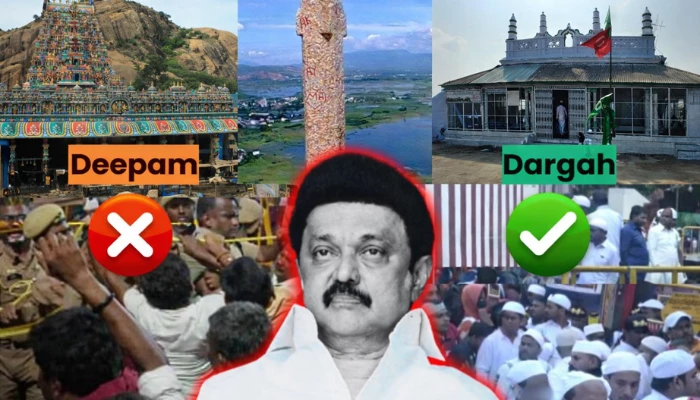
Case Summary
In Tamil Nadu, the DMK government blocked the Hindu Karthigai Deepam ritual at the Deepathoon stone lamp pillar on Thiruparankundram Hill, even as it permitted the Santhanakoodu festival at the adjoining Sikandar Badusha Dargah in Madurai. On 7 January 2026, Hindu devotees were prevented from lighting the sacred Karthigai Deepam at Deepathoon despite multiple orders from the Madurai Bench of the Madras High Court affirming that the ritual was a lawful Hindu religious practice. The Court had specifically directed that ten Hindu devotees be allowed to perform the ritual under CISF protection. However, the state government and temple authorities failed to comply with these directions. Earlier, in December 2025, the High Court had twice ordered that the Deepam be lit at Deepathoon, a stone lamp pillar traditionally associated with the Arulmigu Subramania Swamy Temple. After the first order was ignored, a second order explicitly allowed the petitioner and ten devotees to proceed with the ritual under security cover. Despite this, access to the hilltop was blocked by police, and the ritual was stopped after the District Collector imposed prohibitory orders under Section 163 of the Bharatiya Nagarik Suraksha Sanhita, citing possible communal tension. In contrast, the High Court permitted the Santhanakoodu festival at the adjacent Dargah, allowing up to fifty participants while imposing conditions such as a ban on animal sacrifice, cooking, or distribution of non-vegetarian food. Police were directed to enforce these conditions and maintain law and order from the foothills to the hilltop. The differential enforcement effectively resulted in Hindu religious practice being blocked despite court orders, while a parallel religious event at the same site was allowed to proceed.
Why it is Hate Crime ?
The primary category selected is: Restriction/ban on Hindu practices. The sub-category selected under it is: Administration restricting religious practice. In several cases, it is seen that the administration/state disallows a religious practice owing to prejudicial orders and concerns, targeted specifically against the Hindu community. Such restriction/prohibition would be considered documented as a hate crime because the orders are often a result of pressure by groups that harbour animosity towards Hinduism and Hindus. Often, the restriction by the authorities is driven by bias, hostility, or prejudice against the specific community being stopped from holding a religious practice, by pressure groups that harbour animosity towards Hindus, intrinsic to their faith. Since practices are intrinsic to the faith of the Hindus, such prejudicial restriction is considered a curtailing of the fundamental rights of the Hindu community. In several cases, for example, the authorities ban a Hindu religious practice due to pressure from groups opposed to the religion. In other instances, the prohibition is selectively enforced against one religious group (Hindus) while others are allowed to proceed. There are still other cases where the authorities preemptively restrict a religious practice by Hindus because those who hold animosity towards Hindus may get “provoked”, leading to them being violent, thereby assuaging the sentiments of those who hold animosity towards Hindus by curtailing the religious rights of Hindus. Such acts and orders are prejudiced, indicating discriminatory motives owing to the capitulation to groups that harbour animosity towards Hindus and therefore, would be categorised as a religiously motivated hate crime since the original pressure leading to the order itself is a result of hatred/bias/prejudice/religious hate against Hindus. The other sub-category selected is: Restriction on expression of Hindu identity. An example of the state-affected prejudicial and targeted orders against the Hindu community would be a government denying the right of a Hindu or a group of Hindus to hold a religious procession owing to the animosity of non-Hindu groups. Denial of the religious right of the Hindus to assuage the non-Hindu group which harbours animosity to a point where it could lead to violence against Hindus is not only a failure of law and order but is a prejudicial order against Hindus, denying them their fundamental rights to express their religious identity. An example of a hate crime against Hindus by a non-Hindu would be a non-Hindu institution forcing its Hindu employees to abandon religious symbols that a Hindu would wear as an expression of faith owing to inherent prejudice against the faith professed by the victim or a non-Hindu group of people restricting a Hindu group from constructing a place of worship simply because the demography of the area in which the temple is being built is dominated by non-Hindus. Such actions are driven by religious animosity and/or prejudice against Hindus and their faith and would therefore be categorized as a hate crime. This case has been included because a core Hindu ritual was prevented by state authorities despite clear judicial directions permitting it. The obstruction of the Karthigai Deepam was not a neutral public order measure, as safeguards had already been laid down by the court, yet the administration still blocked Hindu devotees from performing the ritual. The restriction was applied selectively. While Hindu worship at the Deepathoon lamp pillar was stopped, another religious event at the same site was allowed to proceed under regulated conditions. This differential treatment indicates bias in enforcement rather than equal application of the law. By denying access to a sacred lamp pillar traditionally linked to a Hindu temple, the administration curtailed the public practice and visibility of the Hindu faith. Such actions send a message that Hindu religious expression can be suspended through executive discretion even when it is lawful. The use of administrative powers to suppress Hindu worship, alongside the facilitation of another religious practice at the same location, reflects religious discrimination and justifies the inclusion of this incident as a faith-motivated violation against Hindus.


Case Status
Unknown


Perpetrators Details
Perpetrators
State and Establishment
Perpetrators Range
Unknown
Perpetrators Gender
unknown
 Sources




