Hindus targeted as second cow-slaughter feast held at Jagannath University on Maha Saptami, in Dhaka, Bangladesh
 Dhaka, Dhaka District, Bangladesh
 16 October, 2026
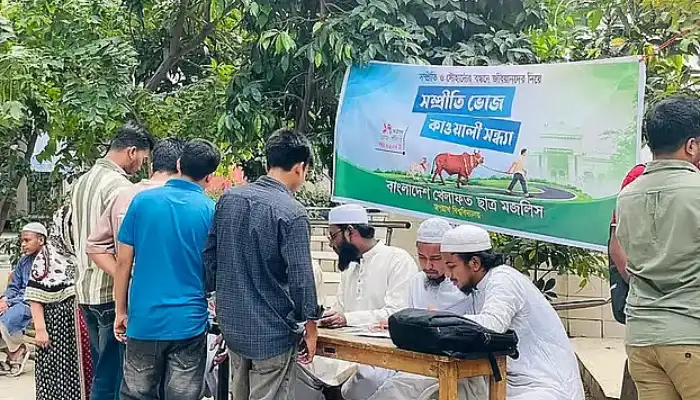
Case Summary
In Dhaka, Bangladesh, a second consecutive cow-slaughter and cow-meat feast was organised at Jagannath University on 17th October 2026, on Maha Saptami during Durga Puja. The programme was organised by the university unit of Bangladesh Khelafat Chhatra Majlis, affiliated with the Islamist Bangladesh Khelafat Majlis. A cow was slaughtered on campus, cow-meat tehari was distributed among hundreds of students, and a Qawwali programme was arranged later in the evening. The cow was slaughtered in the morning on the road between the Vice-Chancellor’s residence and the Mathematics Department. Organisers purchased the cow for Tk 85,000 and collected Tk 40 from each registered participant. Food was prepared for more than 600 people and distributed near the Central Shaheed Minar between around 3:30 PM and 5:30 PM. The organisers also arranged mutton kacchi separately for Hindu students. The programme came one day after another cow-slaughter feast held on 16th October under the banner of the Jagannath University Central Students’ Union. During that event, a cow was slaughtered on campus, and cow meat with khichuri was distributed among students. Most members of the elected JnUCSU committee, including its vice-president and general secretary, were identified as leaders of Islami Chhatra Shibir. Both programmes followed the controversy that began on 12th October, when students from the Department of Islamic History and Culture cooked cow-meat khichuri near the university’s Central Hindu Temple. Hindu students objected because of the activity’s proximity to the temple. Bricks belonging to the temple were also used for the temporary cooking arrangement, following which Hindu students staged protests on campus. On 14th October, the university administration asked students and staff to refrain from slaughtering animals on campus to prevent tension and maintain hygiene. JnUCSU opposed the restriction and held a protest march. The administration later clarified that students could organise events involving animal slaughter as long as they did not interfere with other activities. The administration was initially reluctant to permit the 17th October programme, but later granted conditional approval. Obaidul Islam, member secretary of the Jagannath University unit of Khelafat Chhatra Majlis, described the cow-meat feast and Qawwali programme as a protest movement and said it was intended to promote harmony among students of different beliefs. The timing nevertheless drew criticism because the programme was held on Maha Saptami, an important day of Durga Puja, when Hindu devotees were engaged in one of the most sacred phases of the festival. Dhaka University professor Mohammad Tanzimuddin Khan said an event that created fear among another religious community should not be organised and viewed such conduct as an assertion of dominance on campus. Shamsul Arefin of Jatiyatabadi Chhatra Dal questioned the decision to organise the programme during the Hindu community’s biggest festival, while Ivan Tahseeb of the Socialist Students’ Front criticised the organisation of cow slaughter during another religion’s festival and warned against creating communal tension. The 17th October programme therefore became the second consecutive public cow-slaughter and cow-meat feast at Jagannath University during Durga Puja, following an already escalating dispute over cow meat near the Hindu temple, Hindu student protests and the university’s earlier attempt to restrict animal slaughter on campus. This incident did not occur in isolation. It formed part of a continuing series of events at Jagannath University that the Hinduphobia Tracker had already documented separately. The earlier incidents included cow meat being cooked beside the Central Hindu Temple and temple bricks being used for the cooking arrangement, followed by Muslim students raising anti-Hindu slogans, telling Hindus to leave Bangladesh and threatening to slaughter cows in front of them. The Tracker also documented Golam Rabbi’s warning directing Hindus to accept Islam or face “extremely terrible” consequences, as well as the separate case concerning Hindu student Saikat Haldar and his temporary expulsion amid the same controversy. These incidents together provide the immediate backdrop to the 16th October cow slaughter. Viewed in sequence, the events progressed from cow meat being cooked near a Hindu temple and interference with temple property, to conversion-related intimidation, exclusionary slogans against Hindus, threats of cow slaughter, and hostility surrounding Hindu objections. The actual slaughter of a cow on campus during Durga Puja therefore represented a further escalation within an already documented pattern of anti-Hindu hate, intimidation and hostility at Jagannath University, rather than an isolated dispute over food or a standalone campus event. This incident occurred against the broader backdrop of the longstanding persecution of Hindus in Bangladesh. The Hindu minority has faced discrimination, targeted violence and religious hostility over decades, with attacks intensifying during periods of political and social instability. The latest major escalation began after the ouster of Sheikh Hasina’s government in August 2024, continued after the death of Sharif Osman Bin Hadi in December 2025, and resurfaced immediately after Bangladesh’s 13th National Parliamentary Election in 2026. Following Sheikh Hasina’s ouster, attacks on Hindu homes, temples and religious institutions were reported alongside intimidation, arson and mob violence targeting Hindu localities. The Hinduphobia Tracker recorded 336 incidents involving the Hindu minority during this period, reflecting the scale of the escalation and the vulnerability of Hindus amid the political upheaval. Another spurt of violence followed the death of Sharif Osman Bin Hadi, a Muslim political activist and student leader known for his anti-Hindu and anti-India rhetoric, in December 2025. In the aftermath, Hindu communities faced retaliatory violence, with Hindu homes and properties selectively attacked and several families reportedly forced to flee. Among the victims was Dipu Chandra Das, who was lynched and whose body was subsequently set ablaze by a Muslim mob over false blasphemy allegations. The Hinduphobia Tracker documented 51 incidents of anti-Hindu violence in the period following Hadi’s death alone, illustrating how hostility towards the Hindu minority intensified amid communal mobilisation. During this period, posters and written material calling for the extermination of Hindus were also displayed in public spaces. Viewed alongside reports of arson, vandalism, assault and targeted intimidation, such rhetoric pointed to a recurring pattern in which hostility towards Hindus intensified during periods of unrest. The most recent escalation followed the 13th National Parliamentary Election in 2026. In the immediate aftermath of the election results, Hindu families in districts including Noakhali, Rangpur, Nilphamari, Sylhet, Thakurgaon and Dinajpur faced attacks involving arson, looting, assault and vandalism of Hindu homes and temples. In several instances, Hindu properties were reportedly singled out, and families faced threats of displacement. The incident at Jagannath University must therefore be understood within this wider context of recurring hostility towards Bangladesh’s Hindu minority. The slogans did not merely express support for beef consumption or slaughter; they included calls for Hindus to leave the country and statements rejecting them as fellow citizens.
Why it is Hate Crime ?
The incident has been added to the tracker under the primary category: Attack on Hindu religious representations. Within this, the sub-category selected is: Desecration of Hindu religious symbol. Icons and symbols, or religious representations of a spiritual ideal, are widely revered in Hinduism. Iconography is of vital significance in the Hindu milieu. It helps connect people’s spiritual beliefs with the real world. Iconography within the Hindu faith takes several shapes and forms. Murtis are of most significance to Hindus, to which daily rituals, prayers and offerings are done. Besides the murtis, there are several other symbols which have deep significance in the Hindu faith – the Om and Swastika, for example. Since these Hindu religious symbols hold paramount importance in Hinduism, any desecration of symbols, icons, murtis, religious representations and manifestations is driven by animosity towards the faith itself, which manifests itself through these murtis, icons and symbols. Therefore, any desecration of these Hindu religious symbols and representations is considered religiously motivated hate crimes under this category. The other subcategory is: Defiling religious customs. Sanatan Dharma is not a religion of one book, which is to say that while it has religious scriptures that form the central tenets of the faith, there are several traditions followed through thousands of years, mostly passed from generation to generation orally. There are several such customs and traditions that are followed by various Hindus and Hindu sects. Defiling these traditions and customs is a breach of an individual or group’s religious practices. Such practices can range from dietary restrictions like not eating non-vegetarian food for a certain period of the year, not eating non-vegetarian food at all, not eating beef since the cow is considered holy in Hinduism, the sanctity of religious customs followed in the house (like many ISKCON devotees), etc. Any malicious action leading to the breach of such traditions or defilement of these traditions owing to animosity towards the faith or for the sake of activism stems not only from the lack of faith in the religion itself but also from disregard for the faith of the devotees who follow the customs/traditions and implicit bias against the faith, the tradition itself. Since these specific traditions are central to the faith of the devotees of that specific sect of Hindus, any non-compliance with these traditional rules would be considered a religiously motivated hate crime. This case qualifies as a religiously motivated hate crime because a second public cow slaughter was organised at Jagannath University after the sacred status of the cow had already become central to an ongoing confrontation involving Hindu students. By 17th October, the organisers were acting in the backdrop of repeated Hindu objections, protests over cow meat near the Central Hindu Temple and a cow-slaughter feast held only a day earlier. Organising another large-scale cow-meat programme in this environment gave the act a deliberate and confrontational religious character rather than that of an ordinary campus food event. The cow holds profound religious significance in Hindu Dharma and is revered as Gau Mata, symbolising motherhood, nourishment, purity and sacredness. The religious objection of Hindu students was therefore not based merely on dietary preference. It concerned an animal that occupies a sacred position within their faith. Once this religious concern had become publicly known across the university, repeating the slaughter on campus demonstrated conscious disregard for a Hindu belief that had already become the centre of the controversy. The timing made the act still more significant. The second slaughter took place on 17th October 2026, on Maha Saptami during Durga Puja. Maha Saptami is one of the principal days of Durga Puja, when devotees are deeply engaged in the worship of Goddess Durga and associated rituals. Many Hindus also maintain religious discipline and vegetarian practices during this sacred period. Choosing this day for another public cow slaughter and cow-meat feast, immediately after the previous day's programme, intensified the affront to Hindu religious customs and created an intimidating atmosphere for Hindu students celebrating their festival on the same campus. The fact that this was the second consecutive cow-slaughter programme is particularly important. The controversy had already moved far beyond a disagreement about individual food choices. Hindu students had expressed their concerns, the university administration had attempted to prevent further tension, and the religious significance of the issue was fully visible. Despite this, another cow was slaughtered, and cow meat was publicly distributed to hundreds of participants. The repetition conveyed that Hindu objections and the sacred nature of the ongoing festival would have no bearing on how the programmes were conducted. The arrangement of separate mutton food for Hindu students does not alter this religious context. The concern was never simply whether Hindu students themselves would be made to consume cow meat. The issue concerned the public slaughter of Gau Mata during Durga Puja in an environment where Hindu students had already expressed distress over the treatment of their sacred beliefs. Providing an alternative meal could accommodate dietary choice, but it could not remove the symbolic impact of the slaughter itself. The wider reaction further reflected the intimidating character of the event. Professor Mohammad Tanzimuddin Khan specifically questioned programmes that create fear among another religious community and described such conduct as an assertion of dominance. Other student representatives also questioned why cow-slaughter programmes were being organised during the Hindu community's largest festival. These responses are significant because they show that concerns surrounding the event extended beyond food and centred on the atmosphere being created for Hindu students. Taken together, the sacred status of Gau Mata, the deliberate repetition of the slaughter, its timing on Maha Saptami, the ongoing Durga Puja observances and the prior objections of Hindu students give the incident a clear anti-Hindu religious dimension. In the continuing series of events at Jagannath University, the second consecutive slaughter further intensified an environment in which Hindu beliefs and customs were publicly disregarded during their most important religious festival. The circumstances therefore indicate hostility towards Hindu religious traditions and an attempt to assert dominance in a manner capable of frightening and intimidating the Hindu community on campus.


Case Status
Complaint filed


Perpetrators Details
Perpetrators
Muslim Extremists
Perpetrators Range
N/A
Perpetrators Gender
male
 Sources



