Hindu man spearheading construction of Asia's largest Ram statue arrested and sentenced to one year of imprisonment amid rising anti-Hindu hostility in Bangladesh
 Gaibandha District, Bangladesh
  11 July, 2026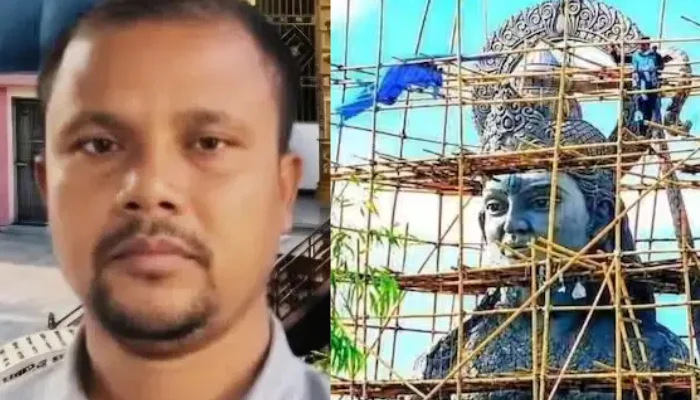
Case Summary
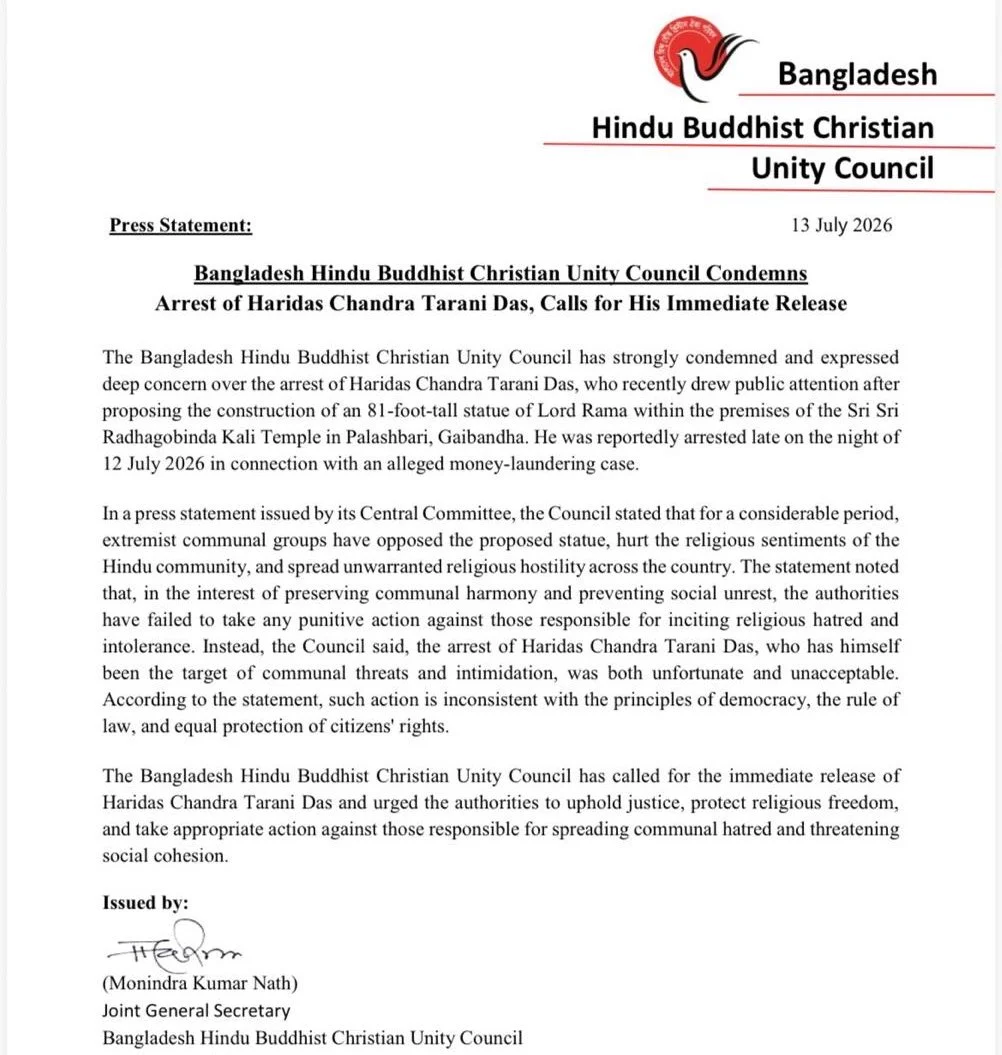
In Gaibandha district of Bangladesh, Haridas Chandra Tarani, the Hindu organiser spearheading the construction of what was planned to be Asia's tallest 81-foot Ram statue at Palashbari, was arrested by the Criminal Investigation Department (CID) on money laundering charges, weeks after the project became the centre of an intense campaign of opposition by Islamist groups. The CID registered a case against him under the Prevention of Money Laundering Act, alleging suspicious financial transactions without legitimate sources of income, following which a Dhaka court granted a four-day custodial remand for interrogation. Subsequently, the victim was sentenced to 1 year of imprisonment by a court in Mymensingh district. During the court proceedings, the prosecution claimed that Haridas had laundered crores of taka and argued that further custodial interrogation was necessary to investigate the alleged financial transactions. Opposing the remand, defence counsel Shyamal Kumar Roy sought bail, stating that his client had been implicated in a false case and that there was no evidence linking him to money laundering or illegal financial dealings. The prosecution rejected the defence's submissions, maintaining that the arrest was based on evidence collected during the investigation. Haridas denied any wrongdoing before the court. Explaining that he had previously worked in agriculture and now managed a temple, he questioned how donations received from devotees for the construction of a Hindu temple and Ram statue could be treated as a criminal act. "If a devotee gives me money to spend for the satisfaction of God, how is that my fault? Is building a temple my sin?" he told the court. Notably, this is not the first time that Haridas has been targeted. In fact, he was arrested previously on similar charges on November 8, 2022, the same year the Ram statue project was first announced under the Sri Sri Radha Gobinda and Kali Temple in Palashbari, for which Haridas was a key figure. After the project was announced, it met with sustained protests by Islamist organisations and sections of the Muslim community against the Ram statue project. Muslims demanded that the idol be removed, Haridas be arrested, and the construction be stopped, arguing that such a prominent Hindu religious monument should not be permitted in Muslim-majority Bangladesh. As the agitation intensified, the temple committee was forced to announce in June 2022 that construction of the statue would be suspended to maintain communal harmony and respect the sentiments of the Muslim community. Soon after, Haridas was arrested for the first time, and after securing bail, Tarani left the country, only to return following Sheikh Hasina's exile in August 2024. After returning to Bangladesh, he once again found himself at the centre of legal proceedings as opposition to the Ram statue project resurfaced. This time, the authorities again claimed that he had engaged in fraudulent activities in the name of religion and idols, while also publicising allegations regarding his personal religious history. Following the arrest, Manindra Kumar Nath, General Secretary of the Bangladesh Hindu Buddhist Christian Unity Council, condemned the action and stated that those responsible for inciting communal hostility against the Ram statue should have been proceeded against instead. In a statement issued on 13 July 2026, the Council said that extremist communal groups had opposed the proposed statue for a prolonged period, hurt the religious sentiments of Hindus, and spread religious hostility across the country. It further criticised the authorities for failing to act against those responsible for inciting hatred while arresting Haridas, who had himself been subjected to threats and intimidation. Videos of Haridas being taken into custody also surfaced online. In one such video, when journalists attempted to question him about the allegations, police officers prevented him from speaking and did not allow him to respond publicly. In a subsequent development, on 21 July 2026, the Mymensingh Joint District and Sessions Judge (Finance and Loan) Court sentenced Haridas Chandra Tarani to one year of imprisonment after he was produced before the court following his arrest in the supposed money laundering case. The sentencing further prolonged the legal action initiated against the Hindu organiser, whose proposed Ram statue project had already become the focal point of sustained opposition by Islamic groups and broader anti-Hindu mobilisation in Bangladesh. Notably, as previously reported by Hinduphobia Tracker, after construction of the Ram statue began in June 2026, the project became the focal point of widespread anti-Hindu mobilisation across Bangladesh. Several Muslim groups organised protests demanding that construction of the Ram statue be halted and the idol removed, arguing that such a prominent Hindu idol should not be permitted in a Muslim-majority country. During these protests, Hindu temples were threatened with desecration, including threats to urinate inside temples and on the Ram idol, while calls were made to demolish the statue if the authorities failed to act. Muslim protesters also staged demonstrations in which images and banners of Lord Ram were struck with shoes as a mark of disrespect. Protesters and social media users directed abusive and derogatory remarks at Lord Ram and the Hindu community, issued threats of violence against Hindus, and warned that Hindus should leave Bangladesh if they wished to worship idols. The sustained agitation created an atmosphere of fear and hostility towards the Hindu minority, with the Ram statue controversy emerging as a flashpoint for broader anti-Hindu mobilisation across the country. This escalation of violence against Hindus in Bangladesh has unfolded in three distinct phases: first, following the ouster of Sheikh Hasina’s government in August 2024; second, after the death of Sharif Osman Bin Hadi in December 2025; and third, in the immediate aftermath of the 13th National Parliamentary Election 2026. Following the ouster of Sheikh Hasina, multiple reports documented attacks on Hindu homes, temples, and religious institutions, alongside intimidation campaigns, arson, and mob assaults targeting minority neighbourhoods. The Hinduphobia Tracker has recorded 336 such incidents against the Hindu minority, underscoring the scale and persistence of anti-Hindu violence during this period. A further escalation occurred following the death of Sharif Osman Bin Hadi, a Muslim political activist and student leader known for his anti-Hindu and anti-India rhetoric. Hadi had been involved in political unrest after the fall of the Hasina government and was killed in Dhaka on 18th December 2025 during clashes. In the aftermath of his death, Hindu communities were blamed and subsequently targeted in retaliatory violence. Hindu homes were selectively set ablaze in multiple localities, forcing families to flee and leaving many displaced. The attacks appeared patterned rather than sporadic, with Muslim mobs focusing on Hindu neighbourhoods, properties, and religious symbols. Among the victims was Dipu Chandra Das, who was lynched to death and his body was set ablaze by a Muslim mob over false blasphemy allegations. The Hinduphobia Tracker documented 51 incidents of anti-Hindu violence in the period following Hadi’s death alone. Reports further indicated that posters and written materials calling for the extermination of Hindus were displayed in public spaces, signalling an alarming normalisation of genocidal rhetoric. Combined with acts of arson, vandalism, assault, and intimidation, these developments suggested a coordinated environment of hostility aimed at terrorising the Hindu community and reinforcing majoritarian dominance. The third phase of violence was unleashed after the 13th National Parliamentary Election 2026. Within days of the announcement of results, Hindu families in districts such as Noakhali, Rangpur, Nilphamari, Sylhet, Thakurgaon, and Dinajpur reported coordinated attacks involving arson, looting, assault, and vandalism of temples and homes. In several instances, Hindu homes were selectively targeted, looted, and families were threatened with displacement.
Case Images
Why it is Hate Crime ?
The primary category selected in this case is: Attack not resulting in death. The subcategory selected is: Attacked for Hindu identity. In several cases, Hindus are attacked merely for their Hindu identity without any perceived provocation. A classic example of this category of religiously motivated hate crime is a murder in 2016. 7 ISIS terrorists were convicted for shooting a school principal in Kanpur because they got ‘triggered’ seeing the Kalava on his wrist and tilak that he had put. In this, the Hindu victim had offered no provocation except for his Hindu religious identity. The motivation for the murder was purely religious, driven by religious supremacy. Such cases where Hindus are targeted merely for their religious identity would be documented as a hate crime under this category. The other subcategory selected is: Attacked for supporting/being part of perceived Hindu party/org or working for Hindu community. In several cases, Hindus are attacked specifically or tangentially for their association with parties or organisations perceived to be pro-Hindu and/or for working in favour of the Hindu community. One of the classic cases was the attack against a Bharatiya Janata Party Yuva Morcha (BJYM) worker Praveen Nettaru. Nettaru was attacked and hacked to death for his association with Hindu organizations and his work for the Hindu community. He was murdered by PFI, a terror organization which aimed to commit a genocide of Hindus, target Hindu leaders specifically and turn India into an Islamic Nation. In such cases, it is possible that the immediate trigger for the violence is non-religious – either according to the perpetrator or the police. However, there are surrounding circumstances from which the conclusion can be reached that the victim was attacked for his association with a Hindu organization. In a similar case, Rinku Sharma was attacked by radicals. He was a member of Bajrang Dal and regularly worked for the Hindu community. While the police cited a different non-religious trigger for the attack, it is true that he was associated to a Hindu organization and the family of Rinku Sharma specifically attributed his gruesome murder to him working for Bajrang Dal and raising Jai Shree Ram slogans. Such cases are intrinsically driven by religious hate and would therefore be documented as a hate crime under this category. In this case, the arrest of Haridas Chandra Tarani by the Bangladesh authorities stands out as a clear-cut, textbook example of a religiously motivated hate crime executed under the deceptive guise of state legality. Tarani, a dedicated Hindu man and a pivotal figure behind the construction of Asia’s largest, 81-foot-tall statue of Lord Ram in Palashbari, Gaibandha, was forcefully taken into custody, not once but twice, under the pretext of a money laundering case. This state-sanctioned action did not occur in a vacuum. The circumstances surrounding the arrest of Haridas Chandra Tarani indicate that the action against him cannot be viewed in isolation from the religious controversy surrounding the Ram statue project. Tarani was not an ordinary individual but the principal organiser behind the construction of what was planned to be Asia's tallest 81-foot statue of Lord Ram, making him the most visible face of a prominent Hindu religious initiative. The project became the focal point of sustained opposition from Islamist organisations and sections of the Muslim community, who openly objected to the construction of a large Hindu idol in Bangladesh, demanded that it be demolished, and repeatedly called for Tarani's arrest. The legal action against him came only after this prolonged campaign had gathered momentum, making the chronology difficult to ignore. The sequence of events raises serious questions about the neutrality of the state's response. Instead of taking visible action against those who threatened the Ram statue, abused Hindu religious beliefs, or mobilised hostility against the Hindu community, the authorities proceeded against the organiser of the Hindu religious project itself. Construction of the statue had already been suspended in the name of maintaining "communal harmony", effectively achieving the protesters' objective. Soon afterwards, Tarani became the subject of criminal proceedings. The sequence leaves little doubt that the state acted against the victim of the intimidation campaign rather than those responsible for creating it, reinforcing concerns that the legal proceedings were shaped by the religious controversy surrounding the project. The events of 2026 become even more significant when viewed alongside what had happened four years earlier. In 2022, when the Ram statue project was first announced, it immediately attracted organised opposition from Islamist groups and sections of the Muslim community. As pressure mounted, the temple committee suspended construction, citing concerns about communal harmony. Within months, Tarani was arrested on allegations of embezzlement, fraud, and tender manipulation before later securing bail. The same pattern resurfaced in 2026. As work on the Ram statue resumed, Muslim groups once again organised protests, renewed their demands that the idol be removed, and called for action against Tarani. Shortly afterwards, he was arrested again, this time on money laundering charges. The repetition of an almost identical sequence across two separate occasions, in which progress on the Ram statue is followed by organised religious mobilisation and then by criminal proceedings against its principal organiser, makes it difficult to dismiss the similarity as mere coincidence. While the authorities relied on different criminal allegations on each occasion, the consistent chronology creates the appearance that legal proceedings repeatedly followed campaigns opposing a major Hindu religious project. The concerns surrounding the arrest become stronger when viewed against the conduct of those opposing the project. The Ram statue was met with open hostility not because of any financial dispute but because it represented a visible assertion of Hindu faith in a Muslim-majority country. Protesters demanded that the idol be demolished, publicly insulted Lord Ram, threatened Hindu temples, warned Hindus against practising idol worship, and declared that such a monument had no place in Bangladesh. Yet despite these acts of intimidation and incitement, there was no comparable action against those responsible for fuelling communal hostility. Instead, the principal organiser of the Hindu religious initiative became the one facing criminal prosecution. This disparity reinforces the perception that the legal action disproportionately affected the Hindu victim while those who sought to suppress the project escaped similar scrutiny. The arrest also occurred against the backdrop of an increasingly hostile environment for Hindus in Bangladesh. As documented by the Hinduphobia Tracker, the period following the ouster of Sheikh Hasina's government in August 2024, the violence after the death of Sharif Osman Bin Hadi, and the unrest following the 2026 parliamentary elections witnessed repeated attacks on Hindu homes, temples, businesses, and religious institutions. Within this broader climate of anti-Hindu violence, the repeated targeting of the organiser of one of the country's most prominent Hindu religious projects assumes greater significance. It reflects the vulnerability of Hindus who publicly assert their religious identity in an environment where organised hostility against Hindu symbols has become increasingly normalised. The conduct of the authorities after Tarani's arrest also contributed to these concerns. Videos circulating online showed police preventing him from responding to questions from journalists regarding the allegations against him. Although the authorities maintained that the case concerned financial offences, preventing him from publicly responding at the time of his arrest further reinforced perceptions that the proceedings lacked transparency. Furthermore, the subsequent sentencing of Haridas Chandra Tarani to one year of imprisonment reinforces the pattern of institutional bias faced by Hindus in Bangladesh. The fact that the Hindu organiser, who had already become the target of sustained Islamist hostility for spearheading the Ram statue project, was ultimately sentenced to imprisonment further illustrates how legal processes can be used to persecute members of the Hindu minority. Such actions demonstrate that state institutions, including the judiciary, fail to protect Hindus from targeted persecution and instead facilitate it. The use of criminal proceedings and imprisonment against a Hindu religious figure in the backdrop of sustained anti-Hindu mobilisation amounts to legal persecution, making this a clear case of anti-Hindu hostility. Taken together, the sustained campaign against the Ram statue, the repeated public demands for Tarani's arrest, the suspension of the project following communal pressure, the strikingly similar sequence of arrests in both 2022 and 2026, and the absence of comparable action against those who openly incited hostility towards the Hindu community collectively point towards a recurring pattern rather than isolated events. The chronology suggests that Tarani became the target of state action because he represented a prominent assertion of Hindu religious identity and refused to abandon the Ram statue project despite sustained communal opposition. For these reasons, this case has been documented in the Hinduphobia Tracker as a religiously motivated hate crime.
Victim Details
Total Victim
1
Deceased
0
Gender
- Male 1
- Female 0
- Third Gender 0
- Unknown 0
Caste
- SC/ST 0
- OBC 0
- General 0
- Unknown 1
Age Group
- Minor 0
- Adult 1
- Senior Citizen 0
- Unknown 0


Case Status
Unknown


Perpetrators Details
Perpetrators
State and Establishment
Perpetrators Range
Unknown
Perpetrators Gender
unknown
 Sources




