Hindu religious project targeted in Bangladesh; Muslim leaders oppose construction of Ram idol amidst ongoing persecution of Hindu minority
 Gaibandha District, Bangladesh
  9 June, 2026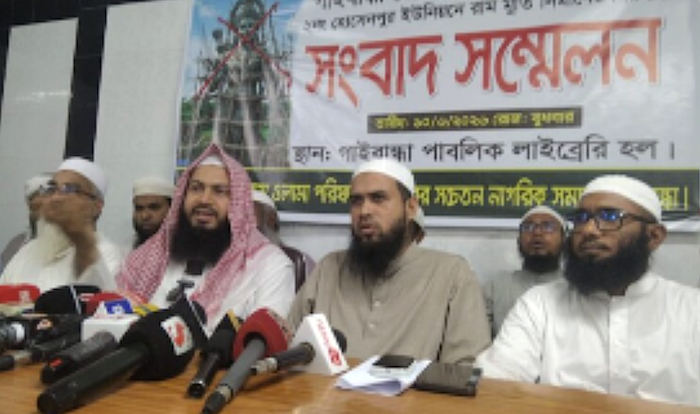
Case Summary
In Palashbari upazila of Bangladesh's Gaibandha district, Islamist organisations organised a public campaign against the construction of a massive Hindu religious complex featuring a towering idol of Bhagwan Shri Ram. The campaign culminated in a press conference and the submission of a formal memorandum to the government demanding intervention against the project, which has been the target of sustained opposition, inflammatory rhetoric, and communal mobilisation since construction began. The controversy centres on the under-construction Sanatan Complex in Komorpur village under Hosenpur Union, a sprawling Hindu religious project being developed around the historic Sri Sri Radha Govinda Kali Temple. The complex is expected to house 144 idols of Hindu deities and feature what is being described as the tallest idol of Bhagwan Shri Ram in a Muslim-majority country. Since construction commenced in 2025, the project has faced repeated opposition from Islamist groups, radical preachers, and online activists who have objected specifically to the Ram idol and sought to mobilise resistance against its construction. On 10 June 2026, the Gaibandha district branch of Imam-Ulama Parishad, along with allied Islamist organisations and a self-described citizens' platform, organised a press conference at the Public Library auditorium in Palashbari. Prior to the event, an eight-point memorandum was submitted to the Prime Minister through the district administration seeking official intervention against the Ram idol project. During the press conference, Imam-Ulama Parishad district secretary Mufti Manjur Rahman Khan delivered a written statement highlighting the construction of the giant Ram idol and calling attention to what organisers described as concerns surrounding the project. Speakers argued that the idol was being built in a sensitive area and claimed that it could affect communal harmony and public order. The gathering was convened specifically to oppose the construction of the Ram idol and to urge government authorities to halt the project. The memorandum demanded an immediate suspension of all activities connected to the idol's construction. It further called for investigations into the project's funding sources, expenditure, financial transactions, domestic and foreign connections, and the individuals and organisations involved in its development. Additional demands included scrutiny of any foreign involvement, investigations into purported links with external entities, and government action if any such connections were identified. The memorandum also urged authorities to take necessary measures to preserve communal harmony and public order in Gaibandha district and the wider Rangpur Division. The press conference was attended by several prominent Islamic leaders, including Imam-Ulama Parishad district president Mufti Mahmudul Hasan Qasemi, Hefazat-e-Islam district president Maulana Abdul Baset, Islami Andolan Bangladesh district president Abdul Majed, Khelafat Majlis district president Mufti Yunus Qasemi, Palashbari Ulama Parishad president Maulana Shahidul Islam, Maulana Shah Alam Farazi, Maulana Taslim Uddin, and others. The campaign against the Sanatan Complex did not emerge in isolation. Since the construction of the Ram idol began in May 2025, the project has been subjected to a sustained campaign of opposition involving social media mobilisation, communal rhetoric, and repeated calls for its demolition. Radical preachers and Islamists have portrayed the idol as a symbol of "Hindutva" and demanded that the government intervene to stop or demolish the project. Social media platforms have been flooded with provocative posts, misinformation, and inflammatory videos portraying the presence of a prominent Hindu religious symbol as unacceptable in Bangladesh. In one previously documented incident, a Muslim man described as being associated with the banned terrorist organisation Al Qaeda publicly called on Muslims to desecrate the under-construction idol of Bhagwan Shri Ram by urinating on it. The campaign sought to humiliate a revered Hindu deity and transform opposition to the project into a direct attack on Hindu religious beliefs. In another instance, an Islamist preacher associated with the Insaf Kayemkari Chhatra Sramik Janata organisation demanded that the idol and temple be demolished, declaring that if the authorities failed to act, Muslims themselves should destroy the structure. The same campaign was accompanied by inflammatory rhetoric directed at Hindu religious symbols and anti-India statements, including vows to crush "Modi and his Ram Rajya." The rhetoric surrounding the Sanatan Complex has increasingly moved beyond disagreement with a construction project and into open hostility towards a Hindu deity, a Hindu place of worship, and the religious rights of the Hindu community. While earlier incidents primarily involved online mobilisation, threats, and hate speech, the present case represents an escalation into organised public activism, with Islamist groups formally petitioning the state and publicly campaigning against a lawful Hindu religious project through coordinated political and religious pressure. The events occurred against the backdrop of escalating hostility towards Hindus in Bangladesh. This escalation of violence against Hindus in Bangladesh has unfolded in three distinct phases: first, following the ouster of Sheikh Hasina's government in August 2024; second, after the death of Sharif Osman Bin Hadi in December 2025; and third, in the immediate aftermath of the 13th National Parliamentary Election 2026. Following the ouster of Sheikh Hasina, multiple reports documented attacks on Hindu homes, temples, and religious institutions, alongside intimidation campaigns, arson, and mob assaults targeting minority neighbourhoods. The Hinduphobia Tracker recorded 336 such incidents against the Hindu minority, underscoring the scale and persistence of anti-Hindu violence during this period. A further escalation occurred following the death of Sharif Osman Bin Hadi, a Muslim political activist and student leader known for his anti-Hindu and anti-India rhetoric. Hadi had been involved in political unrest after the fall of the Hasina government and was killed in Dhaka on 18th December 2025 during clashes. In the aftermath of his death, Hindu communities were blamed and subsequently targeted in retaliatory violence. Hindu homes were selectively set ablaze in multiple localities, forcing families to flee and leaving many displaced. The attacks appeared patterned rather than sporadic, with Muslim mobs focusing on Hindu neighbourhoods, properties, and religious symbols. Among the victims was Dipu Chandra Das, who was lynched to death and his body was set ablaze by a Muslim mob over false blasphemy allegations. The Hinduphobia Tracker documented 51 incidents of anti-Hindu violence in the period following Hadi's death alone. Reports further indicated that posters and written materials calling for the extermination of Hindus were displayed in public spaces. Alongside incidents of arson, vandalism, assault, intimidation, and organised anti-Hindu mobilisation, these developments contributed to a climate of increasing insecurity for the Hindu minority. The third phase of violence emerged after the 13th National Parliamentary Election 2026. Within days of the announcement of results, Hindu families in districts including Noakhali, Rangpur, Nilphamari, Sylhet, Thakurgaon, and Dinajpur reported attacks involving arson, looting, assault, and vandalism of temples and homes. In several instances, Hindu homes were selectively targeted, looted, and families were threatened with displacement.
Why it is Hate Crime ?
This case has been added to the tracker under the primary category of - Hate speech against Hindus. Within it, the sub-category selected - Anti-Hindu subversion and prejudice. Hate speech is defined as any speech, gesture, conduct, writing, or display that is prejudicial against a specific individual and/or group of people, which is leading to or may lead to violence, prejudicial action or hate against that individual and/or group. Media plays a specific and overarching reach in perpetuating prejudicial attitudes towards a community owing to unfair, untrue coverage and/or misrepresentation/misinterpretation, selective coverage and/or omission of facts of/pertaining to issues affecting a specific religious group. This type of bias can dehumanise the victim group, making it easier for others to justify harmful actions against them, which aligns with the objectives of hate speech laws aimed at preventing such harm. It is often observed that the media takes a prejudicial stand against the Hindu community driven by their need to shield the aggressor community which happens to be a numeric minority, however, is the one perpetrating violence against Hindus. For example, the media is often quick to contextualise religiously motivated crimes against Hindus, omit or misrepresent facts that point towards religiously motivated hate crimes, justify and/or downplay religiously motivated hate crimes or simply present fake news to stereotype Hindus. Such media bias leads to the denial of persecution and is often used to dehumanise Hindus, leading to justification for violence against them. For example, the media covered several fake allegations of Hindus targeting Muslims and forcing them to chant Jai Shree Ram. Most of these cases were proved false and fabricated after police investigation. These fake news reports were subsequently never retracted or clarified. Such fake news led to the justification of violence and dehumanisation of Hindus based on the argument that since Hindus targeted Muslims and forced them to chant Jai Shree Ram, the dehumanisation of Hindus and violence against them was par for the course and merely a retaliation. Such media bias leads to prejudicial portrayal of Hindus and offers a justification for violence against them and therefore, is considered hate speech under this category. Another sub-category selected for this case is - Anti-Hindu slurs, mocking faith. Anti-Hindu slurs and the deliberate mocking of the Hindu faith owing to religious animosity involve the usage of derogatory terms, stereotypes, or offensive references to religious practices, symbols, or figures. One of the common anti-Hindu slurs used against Hindus is “cow-worshipper” and “cow piss drinker”. The intention of using this term is to demean and mock Hindus as a group and their religious beliefs since Hindus consider the cow holy. Additionally, some symbols and the slurs attached to them have a historical context that exacerbates the insult, hate, stereotyping, dehumanisation and oppression against Hindus. Cow worship has been used for centuries to denigrate Hindus, insult their faith and oppress Hindus specifically as a religious group. There has been overwhelming documentation about how cow slaughter has been used to persecute Hindus with cow meat being thrown in temples and places of worship. There has also been overwhelming documentation where cow meat (beef) has been force-fed to Hindus to either forcefully convert them to Islam or denigrate their faith. Apart from cow worship, the Swastika – which holds deep religious significance for the Hindus – has also been misinterpreted and distorted to use as a slur against Hindus. Similarly, the worship of the Shivling has been used by supremacist ideologies and religions to denigrate Hindus owing to religious animosity. Such slurs and denigration stem out of inherent animosity and hate towards Hindus and their faith, therefore, it is categorised as hate speech targeted at Hindus specifically owing to their religious identity. The primary religious marker in this case is that the opposition was directed not at any unlawful activity, land dispute, encroachment, or threat to public safety, but at the construction of a Hindu religious symbol itself. The Sanatan Complex was being developed on land associated with an existing Hindu temple and was intended to serve as a place of worship for the local Hindu community. There is no indication that the project involved the demolition of any mosque, the occupation of Muslim-owned land, or the interference with the religious rights of the Muslim majority. Yet the construction of a towering idol of Bhagwan Shri Ram became the subject of organised opposition, public mobilisation, and demands for state intervention. This establishes that the objection was rooted not in the manner of construction but in the religious character of the project itself. The targeting of the Shri Ram idol is particularly significant because idols occupy a central place in Hindu religious life. For Hindus, murtis are not decorative objects or mere artistic representations. They are sacred manifestations through which devotees establish a spiritual connection with the divine. Temples and idols serve as focal points of worship, devotion, and community life. An attack on a revered deity's idol is therefore not merely an attack on a structure but an attack on the religious beliefs, practices, and identity of the community that worships it. The repeated demands to halt, demolish, or desecrate the idol directly targeted a symbol that is sacred to Hindus and central to their faith. The conduct of the Islamist organisations also demonstrates a deeper intolerance towards the religious rights of others. The Hindu community was not demanding restrictions on Islamic practices, nor was it attempting to prevent Muslims from constructing mosques or practising their faith. The project depicted Hindus exercising their religious freedom on the premises of their religious institution. Despite this, the very existence of a prominent Hindu religious symbol was portrayed as unacceptable. Such a reaction reveals hostility not towards any unlawful act but towards the visible expression of Hindu faith itself. The broader campaign surrounding the Sanatan Complex further reinforces this conclusion. The project has been subjected to sustained opposition since construction began, including calls for demolition, campaigns portraying the idol as a threat, demands that Muslims physically destroy the structure, and even appeals to desecrate the idol by urinating on it. These actions moved far beyond criticism of a construction project. They transformed a lawful Hindu religious initiative into a target of organised hostility directed at a Hindu deity, a Hindu place of worship, and the community associated with it. The focus remained consistently on the fact that the structure was Hindu and that it prominently celebrated Bhagwan Shri Ram. The incident also reflects a mindset of religious supremacy. The underlying message conveyed by the campaign was that a large and visible Hindu religious symbol should not be permitted to exist within a Muslim-majority society. The objection was not that the project violated anyone's rights, but that Hindus were asserting their own religious identity in a prominent and confident manner. Such opposition reflects an unwillingness to accept Hindus as equal participants in public and religious life. It suggests a belief that the minority Hindu community should remain subordinate, invisible, or restricted in the public expression of its faith, while the religious preferences of the majority are treated as the norm that must prevail. This aspect becomes even more significant when viewed against the wider backdrop of escalating hostility towards Hindus in Bangladesh. The campaign did not emerge in isolation but formed part of a broader environment marked by attacks on Hindu homes, temples, religious institutions, and community leaders. Within such a context, organised efforts to block the construction of a major Hindu religious symbol take on deeper significance. They serve not merely as opposition to a building project but as an attempt to deny Hindus equal religious dignity and equal access to public religious expression. Taken together, the facts indicate that the opposition to the Sanatan Complex was directed at a Hindu religious symbol because it was Hindu. The organised campaign against the idol, the demands for its demolition, the calls for its desecration, and the efforts to mobilise state action against a lawful Hindu religious project demonstrate hostility towards Hindu religious identity and the public expression of Hindu faith. The incident, therefore, represents a clear manifestation of anti-Hindu prejudice and religiously motivated hostility directed at a minority community's right to worship and celebrate its faith openly. Disclaimer: The Hinduphobia Tracker acknowledges that multiple Islamist organisations and their members were involved in organising and supporting the campaign against the Hindu Ram idol project. However, as only Mufti Manjur Rahman Khan, Mufti Mahmudul Hasan Qasemi, Maulana Abdul Baset, Abdul Majed, Mufti Yunus Qasemi, Maulana Shahidul Islam, Maulana Shah Alam Farazi, and Maulana Taslim Uddin were explicitly identified in available reports, the perpetrator count has been recorded as 8, while noting that additional members of various Islamic organisations also participated in and supported the campaign against the Hindu religious project.


Case Status
Unknown


Perpetrators Details
Perpetrators
Muslim Extremists
Perpetrators Range
From 5 to 10
Perpetrators Gender
male
 Sources




