Hindu faith targeted in Bangladesh; inflammatory posts object to the construction of Ram idol, portrays Hindu religious project as unacceptable within a Muslim-majority locality
 Gopalganj District, Bangladesh
  4 June, 2026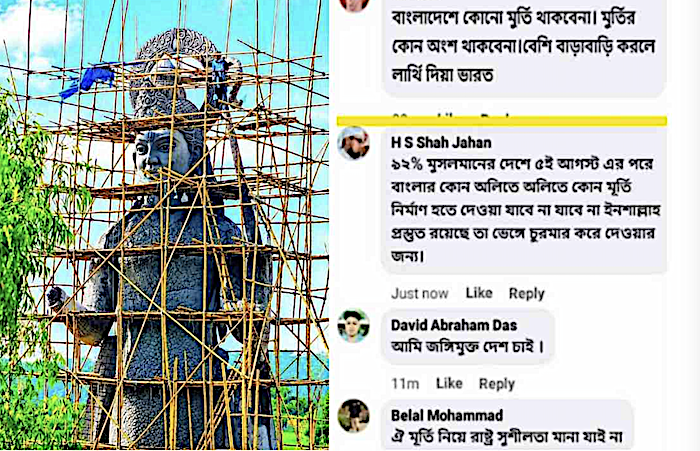
Case Summary
In Gopalganj district’s Palashbari area of Bangladesh, a campaign of communal hate speech, incitement, and misinformation was directed against a Hindu religious institution centred around the construction of a large Shri Ram idol at the historic Shri Shri Radhagobinda and Kali Temple. The temple, a longstanding Hindu place of worship containing multiple Hindu religious symbols and idols, became the focus of inflammatory social media posts that objected to the construction of the Ram idol and portrayed the Hindu religious project as unacceptable within a Muslim-majority locality. The incident occurred in Ramchandrapur (Bedan Para) under Haridaspur Union of Palashbari upazila, where construction work on a large Bhagwan Shri Ram idol was underway within the temple premises. The temple had long served as an important centre of worship for local Hindus and housed several Hindu religious symbols, including a Shiva lingam and other sacred representations. As construction progressed, social media platforms began circulating posts and comments targeting the idol and the temple. Individuals and groups spread provocative messaging specifically targeting the Shri Ram idol, objecting to its construction and questioning its presence in a public, visible location. Some posts highlighted Bangladesh’s Muslim-majority population while challenging the legitimacy of constructing a prominent Hindu religious symbol in the area. Several social media posts escalated from criticism of the idol to open calls for its destruction. One Islamist preacher associated with the Insaf Kayemkari Chhatra Sramik Janata organisation publicly demanded that the under-construction Shri Ram idol be demolished and urged both the government and ordinary Muslims to ensure its removal. He stated that if the authorities did not demolish the idol, Muslims themselves should destroy it. The same messaging further called for the demolition of the temple and portrayed the continued construction of the Shri Ram idol as unacceptable. The rhetoric was accompanied by openly communal and inflammatory language directed at Hindu religious beliefs and symbols. Posts referred to Bhagwan Shri Ram as a "Hindutva god" and portrayed the construction of a Hindu religious symbol as a threat requiring action by Muslims. Social media users circulated messages objecting to the idol's presence in Bangladesh and framed opposition to the temple project as a religious obligation. The campaign, therefore, moved beyond disagreement with a construction project and became centred on hostility towards a Hindu deity, a Hindu temple, and the religious rights of the local Hindu community. The threats were further amplified through statements advocating violence against India and Hindu political symbolism. The preacher declared that an operation would be launched from Bangladesh into India, stated that India would be occupied, and vowed that "Modi and his Ram Rajya" would be crushed. These statements linked hostility towards the Shri Ram idol with broader anti-Hindu and anti-India rhetoric, while encouraging a climate of religious antagonism surrounding a Hindu religious institution in Bangladesh. The online campaign generated significant concern among local Hindus, who viewed the threats against the idol and temple as an attempt to intimidate the community and obstruct a lawful Hindu religious project. Concerns were also raised regarding the spread of misinformation, communal incitement, and calls for violence centred on a Hindu place of worship and a sacred Hindu deity. As public discussion intensified, multiple individuals criticised the posts and argued that religious freedom entitled Hindus to construct religious symbols within their own places of worship. Local residents emphasised that Bangladesh’s constitution guaranteed equal religious rights and that Hindus possessed the same right to establish religious structures as members of any other faith community. Accusations also emerged that misleading information was being spread regarding the temple project and its organisers. Local sources stated that the idol was being constructed through private funding and that public events at the site had previously been attended by figures from different political backgrounds. Temple founder Shri Haridas Chandra appealed for peace and urged people not to be influenced by provocative online content. He stated that Hindus and Muslims had historically lived together in the area and expressed concern that false information was being circulated in connection with the temple. He also called for action against those responsible for spreading divisive content. Local residents reiterated that people of different faiths had coexisted peacefully in Palashbari for many years and urged the authorities to take action against those using social media to circulate provocative, communal content targeting the Hindu religious project. The incident occurred against the backdrop of a wider deterioration in the security environment facing Hindus in Bangladesh. The targeting of a Hindu temple project through organised online hostility, communal rhetoric, and attempts to mobilise opposition against a Hindu religious symbol generated concern among local Hindus who were already living amid heightened insecurity. The focus of the campaign remained a visible expression of Hindu faith, namely the construction of a large Shri Ram idol within a recognised Hindu temple complex. This escalation of violence against Hindus in Bangladesh has unfolded in three distinct phases: first, following the ouster of Sheikh Hasina’s government in August 2024; second, after the death of Sharif Osman Bin Hadi in December 2025; and third, in the immediate aftermath of the 13th National Parliamentary Election 2026. Following the ouster of Sheikh Hasina, multiple reports documented attacks on Hindu homes, temples, and religious institutions, alongside intimidation campaigns, arson, and mob assaults targeting minority neighbourhoods. The Hinduphobia Tracker has recorded 336 such incidents against the Hindu minority, underscoring the scale and persistence of anti-Hindu violence during this period. A further escalation occurred following the death of Sharif Osman Bin Hadi, a Muslim political activist and student leader known for his anti-Hindu and anti-India rhetoric. Hadi had been involved in political unrest after the fall of the Hasina government and was killed in Dhaka on 18th December 2025 during clashes. In the aftermath of his death, Hindu communities were blamed and subsequently targeted in retaliatory violence. Hindu homes were selectively set ablaze in multiple localities, forcing families to flee and leaving many displaced. The attacks appeared patterned rather than sporadic, with Muslim mobs focusing on Hindu neighbourhoods, properties, and religious symbols. Among the victims was Dipu Chandra Das, who was lynched to death and his body was set ablaze by a Muslim mob over false blasphemy allegations. The Hinduphobia Tracker documented 51 incidents of anti-Hindu violence in the period following Hadi’s death alone. Reports further indicated that posters and written materials calling for the extermination of Hindus were displayed in public spaces, signalling an alarming normalisation of genocidal rhetoric. Combined with acts of arson, vandalism, assault, and intimidation, these developments suggested a coordinated environment of hostility aimed at terrorising the Hindu community and reinforcing majoritarian dominance. The third phase of violence was unleashed after the 13th National Parliamentary Election 2026. Within days of the announcement of results, Hindu families in districts such as Noakhali, Rangpur, Nilphamari, Sylhet, Thakurgaon, and Dinajpur reported coordinated attacks involving arson, looting, assault, and vandalism of temples and homes. In several instances, Hindu homes were selectively targeted, looted, and families were threatened with displacement.
Why it is Hate Crime ?
This case has been added to the tracker under the primary category of - Hate speech against Hindus. Within it, the sub-category selected - Anti-Hindu subversion and prejudice. Hate speech is defined as any speech, gesture, conduct, writing, or display that is prejudicial against a specific individual and/or group of people, which is leading to or may lead to violence, prejudicial action or hate against that individual and/or group. Media plays a specific and overarching reach in perpetuating prejudicial attitudes towards a community owing to unfair, untrue coverage and/or misrepresentation/misinterpretation, selective coverage and/or omission of facts of/pertaining to issues affecting a specific religious group. This type of bias can dehumanise the victim group, making it easier for others to justify harmful actions against them, which aligns with the objectives of hate speech laws aimed at preventing such harm. It is often observed that the media takes a prejudicial stand against the Hindu community driven by their need to shield the aggressor community which happens to be a numeric minority, however, is the one perpetrating violence against Hindus. For example, the media is often quick to contextualise religiously motivated crimes against Hindus, omit or misrepresent facts that point towards religiously motivated hate crimes, justify and/or downplay religiously motivated hate crimes or simply present fake news to stereotype Hindus. Such media bias leads to the denial of persecution and is often used to dehumanise Hindus, leading to justification for violence against them. For example, the media covered several fake allegations of Hindus targeting Muslims and forcing them to chant Jai Shree Ram. Most of these cases were proved false and fabricated after police investigation. These fake news reports were subsequently never retracted or clarified. Such fake news led to the justification of violence and dehumanisation of Hindus based on the argument that since Hindus targeted Muslims and forced them to chant Jai Shree Ram, the dehumanisation of Hindus and violence against them was par for the course and merely a retaliation. Such media bias leads to prejudicial portrayal of Hindus and offers a justification for violence against them and therefore, is considered hate speech under this category. Another sub-category selected for this case is - Violent threats. Violent threats, explicit, implicit or implied, is the most dangerous form of hate speech since it goes beyond discriminatory and prejudicial language to express the intent of causing harm to an individual or a group of people based on their religious identity and faith. There could be several different kinds of threats that are issued to Hindus based on religious animosity. An explicit threat would mean the direct threat of violence towards an individual Hindu, a group of Hindus or Hindus at large. Physical violence, death threats, threats of destruction of property belonging to Hindus and threats of genocide would mean explicit threats against Hindus for their religious identity. Implicit threats may not be a direct threat but implied through the use of symbols of actions – for example – in the Nupur Sharma case, other than explicit threats, there were also implicit threats when Islamists took to the streets to burn and beat her effigies. It implies that they want to do the same to Nupur Sharma – thereby is considered an implicit threat. Violent threats can be delivered in person, through letters, phone calls, graffiti, or increasingly through social media and other online platforms. It would be important to understand that a threat – explicit or implicit, online or offline – to an individual who happens to be a Hindu does not qualify as a religiously motivated threat. Such a threat, while vile and dangerous, could be owing to non-religious reasons and/or personal animosity. To qualify as a religiously motivated threat, it would need to exhibit an indication that the individual is being targeted for religious reasons and/or owing to his/her religious identity as a Hindu. This case has been included in the tracker because it involved a coordinated campaign of hostility directed against a Hindu religious symbol, a Hindu place of worship, and the religious beliefs associated with Bhagwan Shri Ram. The controversy did not arise from a dispute over land, construction norms, or public policy. Rather, the focus was on the construction of a large Shri Ram idol within the premises of a Hindu temple. By portraying a lawful Hindu religious project as objectionable and attempting to mobilise opposition against it, the campaign targeted the religious expression of a minority Hindu community. Idol worship and the installation of sacred images form an integral part of Hindu religious practice. The social media posts objected not merely to the construction activity itself but to the presence of a prominent Hindu religious symbol. By invoking Bangladesh's Muslim-majority character and questioning the acceptability of the idol, the messaging suggested that visible expressions of Hindu faith were unwelcome or should be restricted. Such rhetoric effectively challenged the equal right of Hindus to practise and manifest their religion in public. The prejudice underlying the campaign becomes more apparent when viewed in the broader religious context. Within Islamic theology, idol worship is generally regarded as shirk, a grave religious error. While theological disagreement between religions is not in itself a hate crime, the issue in this case was that such disagreement appeared to be translated into hostility towards a lawful Hindu religious project. Rather than respecting the right of Hindus to worship according to their own traditions, the campaign sought to portray the construction of a Shri Ram idol as something objectionable and unacceptable. In doing so, it moved beyond doctrinal difference and into prejudice against a central feature of Hindu religious practice. The second major religious marker in this case was the use of violent threats directed against a Hindu religious symbol and place of worship. The hostility did not remain confined to criticism or online opposition. An Islamist preacher associated with the Insaf Kayemkari Chhatra Sramik Janata organisation openly called for the destruction of the under-construction Shri Ram idol and urged Muslims to ensure that it was demolished if the government failed to do so. He further stated that the temple itself should be demolished. These statements constituted direct threats against a Hindu religious institution and a sacred object of worship, transforming the campaign from religious hostility into explicit incitement against Hindu religious property. The threats were religiously significant because they specifically targeted Bhagwan Shri Ram, one of the most revered deities in Hinduism, and sought to prevent Hindus from constructing and displaying a religious symbol within their own temple premises. The idol was not criticised for planning issues, legal disputes, or public safety concerns. Rather, it was characterised as a "Hindutva" symbol whose existence was considered unacceptable. By framing the idol in this manner and calling for its destruction, the perpetrators effectively equated a Hindu deity and a Hindu religious project with an ideological enemy, thereby directing hostility towards Hindu faith itself. The rhetoric became even more extreme when the preacher declared that if the construction of the Shri Ram idol continued, it would demonstrate the weakness of Islamic religious leadership in Bangladesh and suggested that Muslims would deserve genocide at the hands of "Hindutwadis" if such a development were allowed to proceed. This language invoked existential fear, communal polarisation, and religious mobilisation around a Hindu religious symbol. Rather than addressing any tangible grievance, the statements portrayed the construction of a Hindu idol as a threat requiring collective Muslim action. It is important to understand that the leftists and Islamists often use Hindutva as a euphemism to make the targeting of Hindus and their religious identity and faith more palatable. Hindutva is essentially a unifying ideology for Hindus, which became imperative for Hindus to find and preserve their cultural identity, which was being eroded and attacked due to Islamic invasions, British colonisation, Christian theological impositions and conversions. Hindutva is not a destructive ideology, as some attempt to portray, but one that is used as a unifying edifice for Hindus. However, this term is frequently used by this Islamo-leftist bogey as a semantic jugglery to confuse Hindus into believing that their own persecution by supremacists is somehow 'justified' because the specific victims espoused an ideology (Hindutva) which deserves the onslaught. The fact that the use of 'Hindutva' is merely to mask animosity towards Hindus was evident from the "Dismantling Global Hindutva" conference held in the USA, where speakers unabashedly spoke about how Hindutva and Hinduism are indistinguishable and therefore, to "dismantle Hindutva" one would have to "dismantle Hinduism". The practices of targeting Hindus and their religious and cultural identity, and justifying that victimisation and dehumanisation by using euphemisms like "Hindutva", stem from inherent animosity and hostility towards Hindus. The same preacher further connected the campaign against the idol to broader anti-Hindu and anti-India rhetoric, declaring that an operation would be launched from Bangladesh into India, that India would be occupied, and that "Modi and his Ram Rajya" would be crushed. The repeated references to Shri Ram, Ram Rajya, and the destruction of the idol demonstrated that the threats were not directed merely at a structure under construction but at symbols associated with the Hindu faith and identity. The campaign, therefore, contained a clear element of religiously motivated intimidation aimed at discouraging the public expression of Hindu beliefs and creating fear around a Hindu religious institution. The incident must also be viewed against the backdrop of the increasingly hostile environment faced by Hindus in Bangladesh. Since August 2024, Hindu temples, idols, religious processions, homes, and businesses have repeatedly come under attack amid waves of anti-Hindu mobilisation. In such a context, campaigns directed against Hindu religious symbols cannot be viewed in isolation. The targeting of a Shri Ram idol and a Hindu temple contributed to a wider atmosphere in which Hindu religious identity is portrayed as controversial, unwelcome, or deserving of scrutiny simply because it is Hindu. For the purpose of documenting the anti-Hindu violence and persecution that has intensified in Bangladesh since 2024, the tracker records such incidents where Hindu religious symbols, temples, and expressions of faith become the focus of organised hostility and communal agitation. Should credible evidence later establish that the incident stemmed from motivations unrelated to religious prejudice, the classification may be reviewed. Viewed in its entirety, this was not merely a disagreement about a construction project. It was an attempt to delegitimise a visible expression of Hindu faith, generate opposition to a Hindu religious symbol, and portray a lawful act of Hindu worship as unacceptable. Such conduct reflects prejudice towards Hindu religious practices and contributes to a broader environment of hostility against Hindus as a religious minority. For these reasons, the incident has been included in the tracker as a case of anti-Hindu subversion, prejudice, and religiously motivated hate speech. Disclaimer: The available information showed that the individuals and groups opposing the Shri Ram idol project framed their objections through Islamic religious identity, Muslim-majority dominance, and hostility towards Hindu religious practices and symbols. While the religious identity of every individual involved was not independently established, the communal rhetoric and Islamist context of the campaign provide the basis for recording the perpetrators as Muslim extremists in the tracker for documentation purposes. This classification may be revised if additional verified information emerges. The exact date on which the hate speech campaign and inflammatory social media posts were first circulated was not specified in available reports. Therefore, the publication date of the source article, 5th June 2026, has been used by the Hinduphobia Tracker as the incident date for documentation and database purposes only.


Case Status
Unknown


Perpetrators Details
Perpetrators
Muslim Extremists
Perpetrators Range
Unknown
Perpetrators Gender
unknown
 Sources




