Hindu religious freedom targeted as Jamaat-e-Islami worker protests no temples should be built in Bangladesh amidst ongoing persecution of Hindu minorities
 Gaibandha District, Bangladesh
  11 June, 2026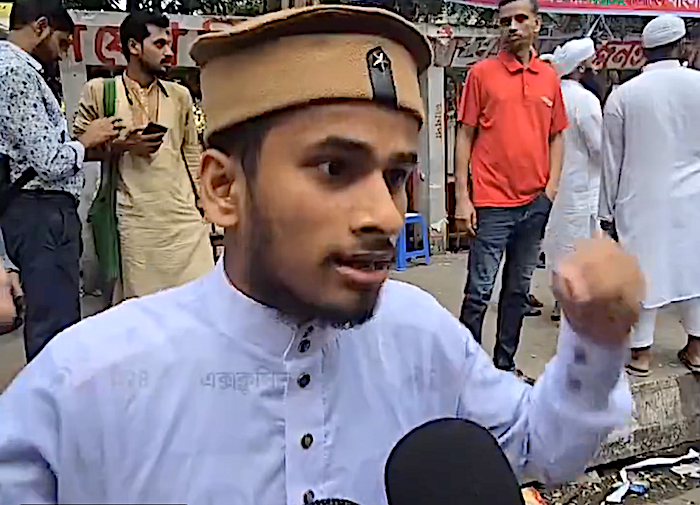
Case Summary
A Jamaat-e-Islami worker delivered a public speech opposing the construction of the Ram idol project in Palashbari, Gaibandha, and called for Muslims to mobilise against the construction of Hindu temples and idols in Bangladesh. The speech formed part of a continuing campaign targeting the Sanatan Complex and the under-construction idol of Bhagwan Shri Ram, a Hindu religious project that had already become the focus of sustained opposition by Muslim groups and activists. The incident centred on a video statement circulated publicly in which the speaker repeatedly declared that no temple should be allowed to be built in Bangladesh. Addressing Hindus associated with the Ram idol project, he stated that they were "slaves of India" and asserted that if any statue was built in Bangladesh, 'Muslims who are patriotic would unite and organise protests against it and topple the government'. Throughout the speech, he presented the construction of Hindu religious structures as something that should not be permitted within the country. The speaker repeatedly stated that no statue should be built in Bangladesh and objected specifically to the construction of the Ram idol. He repeatedly urged Muslims to mobilise collectively in opposition to the project and stated that Muslims would never allow such construction to proceed. He further declared that if a statue was built, protests would continue until sufficient pressure was created to force a response from the government. The speech repeatedly portrayed Hindus and their religious activities as foreign to Bangladesh. The speaker told Hindus that they should remain in their 'own country' (suggesting they should go to India) and suggested that the construction of temples and idols in Bangladesh was unacceptable. He repeatedly linked Hindu religious expression to India and framed Hindu religious projects as incompatible with the country's identity. The speaker also invoked communal and political narratives while discussing the Ram idol project. He referred to Hindus as servants of India, accused them of acting on behalf of foreign interests, and repeatedly urged Muslims to unite against the construction. The speech characterised opposition to the Hindu religious project as a collective Muslim responsibility and encouraged public resistance to the continued development of the site. At several points, the speaker directly appealed to Muslims to protest against the project and suggested that failure to oppose it reflected disloyalty. He repeatedly contrasted Hindus and Muslims and portrayed resistance to the construction of the Ram idol as an obligation. The speech included repeated references to Hindus, Dalits, and supporters of the project, urging Muslims to organise opposition to the construction and prevent it from proceeding. The remarks were made against the backdrop of a broader controversy surrounding the Sanatan Complex in Komorpur village under Hosenpur Union. The project, being developed around the historic Sri Sri Radha Govinda Kali Temple, included a large idol of Bhagwan Shri Ram. As construction progressed, social media platforms became flooded with inflammatory posts targeting the project. Several Muslims portrayed the idol of Lord Ram as a symbol of "Hindutva" and objected to the visible presence of a prominent Hindu religious symbol in a Muslim-majority country. Among the messages circulated online were calls for resistance against the construction of the idol and attempts to frame the temple project as a communal provocation. Some posts invoked the Babri Masjid issue and sought to generate resentment towards the Hindu community by linking the local temple project to broader political and religious narratives. While some provoked Muslims to urinate on the idol of Lord Ram. The hostility escalated when a radical Islamic preacher associated with the Islamic organisation- Insaf Kayemkari Chhatra Sramik Janata, issued open threats. In a widely circulated speech, he called for the demolition of the idol and declared that if the authorities failed to act, ordinary Muslims should take it upon themselves to destroy it. He further instigated his Muslim brethren by claiming that the temple itself should be demolished. The same preacher also made inflammatory remarks against India and Lord Ram, declaring that "Ram Rajya" would be crushed. He went on to call for a coordinated Muslim offensive against India. His comments drew widespread concern due to their openly extremist nature and because they were made against the backdrop of an increasingly hostile environment for minority Hindus in Bangladesh. Following these open threats, Muslims in large numbers started taking to the streets in protest against the construction of the Lord Ram idol. Muslim men were seen carrying placards and banners opposing the project, with some posters explicitly stating that if Hindus wanted a Ram idol, they should "go back to India." Videos also surfaced on social media where a Muslim mob could be seen striking banners carrying images of Lord Ram with shoes and sandals. Amid the escalating campaign, members of the temple committee announced that construction of the idol would be suspended. In a public statement, a committee representative said that the decision had been taken to "restore communal harmony." The representative stated that the work would remain suspended and that any future decision regarding construction would be taken only after consultations with all relevant stakeholders. The suspension of the project effectively halted a lawful Hindu religious initiative following sustained public pressure, threats, and agitation directed against the temple and its organisers. The development generated concern among members of the Hindu community, who viewed the decision as a consequence of growing hostility towards visible expressions of Hindu faith in Bangladesh.
Why it is Hate Crime ?
This case has been added to the tracker under the primary category of - Hate speech against Hindus. Within it, the sub-category selected - Anti-Hindu slurs and mocking faith. Anti-Hindu slurs and the deliberate mocking of the Hindu faith owing to religious animosity involve the usage of derogatory terms, stereotypes, or offensive references to religious practices, symbols, or figures. One of the common anti-Hindu slurs used against Hindus is “cow-worshipper” and “cow piss drinker”. The intention of using this term is to demean and mock Hindus as a group and their religious beliefs since Hindus consider the cow holy. Additionally, some symbols and the slurs attached to them have a historical context that exacerbates the insult, hate, stereotyping, dehumanisation and oppression against Hindus. Cow worship has been used for centuries to denigrate Hindus, insult their faith and oppress Hindus specifically as a religious group. There has been overwhelming documentation about how cow slaughter has been used to persecute Hindus with cow meat being thrown in temples and places of worship. There has also been overwhelming documentation where cow meat (beef) has been force-fed to Hindus to either forcefully convert them to Islam or denigrate their faith. Apart from cow worship, the Swastika – which holds deep religious significance for the Hindus – has also been misinterpreted and distorted to use as a slur against Hindus. Similarly, the worship of the Shivling has been used by supremacist ideologies and religions to denigrate Hindus owing to religious animosity. Such slurs and denigration stem out of inherent animosity and hate towards Hindus and their faith, therefore, it is categorised as hate speech targeted at Hindus specifically owing to their religious identity. Another sub-category selected for this case is - Violent threats. Violent threats, explicit, implicit or implied, is the most dangerous form of hate speech since it goes beyond discriminatory and prejudicial language to express the intent of causing harm to an individual or a group of people based on their religious identity and faith. There could be several different kinds of threats that are issued to Hindus based on religious animosity. An explicit threat would mean the direct threat of violence towards an individual Hindu, a group of Hindus or Hindus at large. Physical violence, death threats, threats of destruction of property belonging to Hindus and threats of genocide would mean explicit threats against Hindus for their religious identity. Implicit threats may not be a direct threat but implied through the use of symbols of actions – for example – in the Nupur Sharma case, other than explicit threats, there were also implicit threats when Islamists took to the streets to burn and beat her effigies. It implies that they want to do the same to Nupur Sharma – thereby is considered an implicit threat. Violent threats can be delivered in person, through letters, phone calls, graffiti, or increasingly through social media and other online platforms. It would be important to understand that a threat – explicit or implicit, online or offline – to an individual who happens to be a Hindu does not qualify as a religiously motivated threat. Such a threat, while vile and dangerous, could be owing to non-religious reasons and/or personal animosity. To qualify as a religiously motivated threat, it would need to exhibit an indication that the individual is being targeted for religious reasons and/or owing to his/her religious identity as a Hindu. This case has been included in the tracker because the statements made by the Jamaat-e-Islami worker expressed hostility not merely towards a specific construction project but towards the very existence of Hindu religious institutions and Hindu religious expression within Bangladesh. The objection was directed at the building of Hindu temples and idols as such. The speaker did not argue that a temple was unlawful, that it infringed upon the rights of others, or that it violated any neutral civic principle. Instead, the message was that Hindu temples should not be built in Bangladesh at all and that Hindus who wished to construct temples or idols should do so elsewhere. Such rhetoric reflects contempt towards Hindu faith itself because it treats a fundamental aspect of Hindu religious practice as illegitimate and unacceptable within the country. When a religious minority is told that its sacred spaces should not exist and that its forms of worship have no place in the nation where it resides, the hostility is directed at the religion and its adherents rather than any specific conduct. The mocking and derogatory nature of the rhetoric becomes even clearer when the speaker repeatedly characterised Hindus as "slaves of India" and suggested that support for Hindu religious institutions was evidence of foreign allegiance rather than religious devotion. These remarks reduced the religious identity of Bangladeshi Hindus to that of outsiders whose loyalty was presumed to lie elsewhere. In doing so, the speaker denied the legitimacy of Hindu belonging within Bangladesh and framed Hindu religious expression as something foreign and suspect. Such language functions as a form of anti-Hindu abuse because it strips Hindus of equal membership within the national community and portrays their religious practices as evidence of disloyalty rather than an exercise of constitutionally protected faith. The statements also demonstrated a broader pattern of contempt towards Hindu religious beliefs. Hindu temples and idols occupy a central place in Hindu worship and are among the most visible manifestations of Hindu faith. Therefore, declarations that no temples should be built and that no idols should be permitted are not criticisms of individual structures but rejections of the religious practices those structures facilitate. The hostility was directed at symbols that are sacred to Hindus precisely because they are sacred to Hindus. The rhetoric effectively conveyed that Hindu worship should be hidden, restricted, or removed from public life. Such messaging constitutes mockery of faith because it treats Hindu religious observance as something objectionable and unworthy of equal respect. The language employed also reflected a deeper ideological dimension rooted in transnational religious solidarity. The speaker repeatedly invoked a collective Muslim identity and framed opposition to Hindu religious construction as a duty of Muslims as a group. This rhetoric is significant because it reflects the concept of the Ummah, the belief that Muslims across national boundaries form a single religious community united by shared interests and obligations. Within this framework, loyalty is directed towards a global Muslim collectivity rather than towards equal coexistence with non-Muslim communities. By explicitly stating that "we Muslims" would unite against the construction of Hindu religious symbols, the speaker transformed what could have been presented as a local disagreement into a communal religious mobilisation. The conflict was not framed as a dispute between individuals but as a struggle between a Muslim collective and a Hindu religious expression. Such framing inherently positions Hindu identity as an adversarial force and reinforces hostility towards Hindus as a religious group. The case also falls within the category of Violent threats because the statements carried clear implications of coercion and intimidation directed at Hindus and their religious rights. While the rhetoric did not always contain direct promises of physical violence, it repeatedly communicated that Hindu religious activity would provoke collective Muslim action and would not be tolerated. The declaration that Muslims would unite in opposition and protest until the government was toppled if a Hindu statue were built conveyed a willingness to generate instability and mass mobilisation in response to Hindu religious expression. Such language was intended to create pressure, fear, and deterrence. The underlying message was that Hindus could not freely practise their faith without facing organised opposition from a larger and more powerful majority community. The demand that Hindus should build temples and idols in India rather than Bangladesh carried clear threatening implications. It suggested that Hindus did not fully belong in Bangladesh and that visible expressions of their faith were unwelcome. By linking Hindu religious identity with exclusion from public space, the rhetoric sought to intimidate a vulnerable minority and discourage the open practice of Hinduism within their own country. Particularly significant was the repeated insistence that Muslims must unite against Hindu religious symbols. By calling for collective opposition from the Muslim majority against the religious practices of a minority community, the rhetoric created an atmosphere of intimidation and hostility. The message conveyed that Hindus who continued to build temples, install idols, or publicly practise their faith would face organised resistance. In a country where Hindus are a vulnerable minority and anti-Hindu hostility has repeatedly manifested in violence and intimidation, such statements carried a clear coercive and threatening character. The intensity of the rhetoric further demonstrates the depth of hostility involved. The willingness to threaten mass protests and political upheaval over the construction of a Hindu temple or idol illustrates that the objection was not merely theological. It reflected an unwillingness to tolerate Hindu religious visibility in the public sphere. The construction of a Hindu temple was portrayed not as a lawful act of worship but as something so intolerable that it justified collective mobilisation by Muslims. Such disproportionate hostility towards a minority community's religious expression is a hallmark of religious prejudice and demonstrates animus directed at Hindus because of their faith. Viewed in its entirety, the statements expressed contempt towards Hindu beliefs, denied the legitimacy of Hindu religious institutions, portrayed Hindus as outsiders within their own country, and threatened organised communal mobilisation if Hindus continued to exercise their religious rights. The rhetoric sought to discourage Hindu religious expression by attaching social, political, and communal consequences to the public practice of Hinduism. The hostility was directed at Hindu identity itself and therefore constitutes both anti-Hindu hate speech and implicit religious intimidation. Given Bangladesh's sustained anti-Hindu persecution environment, this case meets all thresholds for inclusion in the Hinduphobia Tracker's hate crime database. Disclaimer: The opposition campaign against the Shri Ram idol project had been ongoing for an extended period and included multiple speeches, protests, online campaigns, and public statements. The exact date on which the Jamaat-e-Islami worker made the specific anti-Hindu remarks documented in this case is not specified in available sources. Therefore, 12th June 2026, the earliest available source date documenting this instance of hate speech, has been used as the incident date in the Hinduphobia Tracker for documentation purposes.


Case Status
Unknown


Perpetrators Details
Perpetrators
Muslim Extremists
Perpetrators Range
One Person
Perpetrators Gender
male
 Sources




