Hindu community forced to halt construction of Ram idol amid sustained threats, intimidation, and pressure from Muslims in Bangladesh
 Gaibandha District, Bangladesh
  11 June, 2026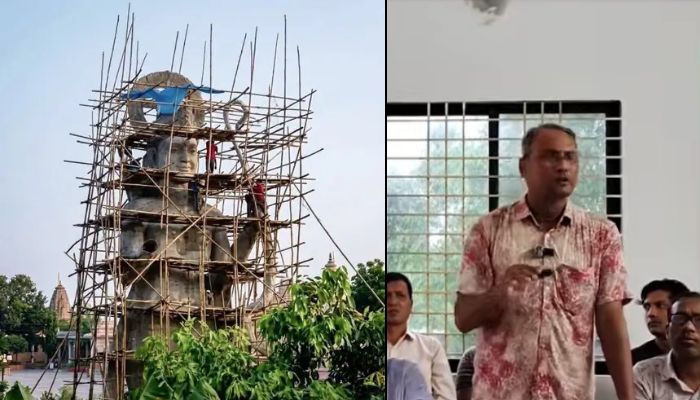
Case Summary
Days after a coordinated campaign of hostility, threats, and incitement against the construction of a Lord Ram idol in Palashbari, Rangpur Division, Bangladesh, the Hindu temple committee announced that it was suspending the project. The decision came amid growing pressure from Muslim groups and radical preachers who had publicly objected to the idol construction and threatened Hindus with violence and vandalism if they went ahead with the project. The idol was being constructed within the premises of the historic Shri Shri Radhagobinda and Kali Temple in Ramchandrapur (Bedan Para) under Haridaspur Union of Palashbari Upazila. As construction progressed, social media platforms became flooded with inflammatory posts targeting the project. Several Muslims portrayed the idol of Lord Ram as a symbol of "Hindutva" and objected to the visible presence of a prominent Hindu religious symbol in a Muslim-majority country. Among the messages circulated online were calls for resistance against the construction of the idol and attempts to frame the temple project as a communal provocation. Some posts invoked the Babri Masjid issue and sought to generate resentment towards the Hindu community by linking the local temple project to broader political and religious narratives. While some provoked Muslims to urinate on the idol of Lord Ram. The hostility escalated when a radical Islamic preacher associated with the Islamic organisation- Insaf Kayemkari Chhatra Sramik Janata, issued open threats. In a widely circulated speech, he called for the demolition of the idol and declared that if the authorities failed to act, ordinary Muslims should take it upon themselves to destroy it. He further instigated his Muslim brethren by claiming that the temple itself should be demolished. The same preacher also made inflammatory remarks against India and Lord Ram, declaring that "Ram Rajya" would be crushed. He went on to call for a coordinated Muslim offensive against India. His comments drew widespread concern due to their openly extremist nature and because they were made against the backdrop of an increasingly hostile environment for minority Hindus in Bangladesh. Following these open threats, Muslims in large numbers started taking to the streets in protest against the construction of the Lord Ram idol. Muslim men were seen carrying placards and banners opposing the project, with some posters explicitly stating that if Hindus wanted a Ram idol, they should "go back to India." Videos also surfaced on social media where a Muslim mob could be seen striking banners carrying images of Lord Ram with shoes and sandals. Amid the escalating campaign, members of the temple committee announced that construction of the idol would be suspended. In a public statement, a committee representative said that the decision had been taken to "restore communal harmony." The representative stated that the work would remain suspended and that any future decision regarding construction would be taken only after consultations with all relevant stakeholders. The suspension of the project effectively halted a lawful Hindu religious initiative following sustained public pressure, threats, and agitation directed against the temple and its organisers. The development generated concern among members of the Hindu community, who viewed the decision as a consequence of growing hostility towards visible expressions of Hindu faith in Bangladesh.
Why it is Hate Crime ?
This incident has been added under the category- Restriction/ban on Hindu practices. Within this, the subcategory selected is- Restriction on expression of Hindu identity. An example of the state-affected prejudicial and targeted orders against the Hindu community would be a government denying the right of a Hindu or a group of Hindus to hold a religious procession owing to the animosity of non-Hindu groups. Denial of the religious right of the Hindus to assuage the non-Hindu group which harbours animosity to a point where it could lead to violence against Hindus is not only a failure of law and order but is a prejudicial order against Hindus, denying them their fundamental rights to express their religious identity. An example of a hate crime against Hindus by a non-Hindu would be a non-Hindu institution forcing its Hindu employees to abandon religious symbols that a Hindu would wear as an expression of faith owing to inherent prejudice against the faith professed by the victim or a non-Hindu group of people restricting a Hindu group from constructing a place of worship simply because the demography of the area in which the temple is being built is dominated by non-Hindus. Such actions are driven by religious animosity and/or prejudice against Hindus and their faith and would therefore be categorized as a hate crime. The other subcategory is- Administration restricting religious practice. In several cases, it is seen that the administration/state disallows a religious practice owing to prejudicial orders and concerns, targeted specifically against the Hindu community. Such restriction/prohibition would be considered documented as a hate crime because the orders are often a result of pressure by groups that harbour animosity towards Hinduism and Hindus. Often, the restriction by the authorities is driven by bias, hostility, or prejudice against the specific community being stopped from holding a religious practice, by pressure groups that harbour animosity towards Hindus, intrinsic to their faith. Since practices are intrinsic to the faith of the Hindus, such prejudicial restriction is considered a curtailing of the fundamental rights of the Hindu community. In several cases, for example, the authorities ban a Hindu religious practice due to pressure from groups opposed to the religion. In other instances the prohibition is selectively enforced against one religious group (Hindus) while others are allowed to proceed. There are still other cases where the authorities preemptively restrict a religious practice by Hindus because those who hold animosity towards Hindus may get “provoked” leading to them being violent, thereby assuaging the sentiments of those who hold animosity towards Hindus by curtailing the religious rights of Hindus. Such acts and orders are prejudiced, indicating discriminatory motives owing to the capitulation to groups that harbour animosity towards Hindus and therefore, would be categorized as a religiously motivated hate crime since the original pressure leading to the order itself is a result of hatred/bias/prejudice/religious hate against Hindus. This case qualifies as a religiously motivated hate crime because the Hindu community was effectively denied its right to freely practise and express its religion. The opposition did not arise because of any legal violation, public safety concern, or administrative issue. The project was vehemently opposed solely because it involved the construction of an idol of Lord Ram, one of Hinduism's most revered deities. The hostility directed at the project reflected a deeper prejudice against Hindus and their faith. The abnormal and extraordinary outrage against the idol's construction was because radical Muslims view the public expression of Hindu identity as something illegitimate, provocative, or undeserving of equal respect. This supremacist mindset was visible in the slogans and messages circulated during the campaign. Protesters openly told Hindus to "go back to India" if they wanted a Ram idol. Such statements are significant because they portray Hindus as outsiders whose religious aspirations do not belong in Bangladesh, despite Hindus being an indigenous community with deep historical roots in the region. The message was not simply opposition to a particular idol. It was a rejection of the Hindu community's right to openly and confidently practise its faith in the land to which it belongs. The hostility towards the idol must also be understood in the religious context in which it emerged. In Islamic theology, idol worship is regarded as shirk, or the gravest form of religious error. For many of the Islamists who opposed the project, the issue was not merely the construction of a structure but the public presence of a Hindu deity being worshipped. This helps explain the intensity of the agitation, the calls for demolition, and the public desecration of images of Lord Ram. The idol became a target because it represented a form of worship that these Islamist elements considered unacceptable. The agitation, therefore, reflected more than disagreement with a construction project. It reflected a belief among the Islamist campaigners that visible Hindu religious expression should not be allowed to flourish in a country they viewed as belonging primarily to the Muslim majority. The demand that the idol be removed, the threats to demolish it, and the pressure that ultimately forced the project to stop all stemmed from the view that Hindu religious practices could be restricted if enough communal pressure was applied. In effect, the message sent to Hindus was that their right to practise and express their faith was contingent upon approval from the Muslims in the country. Since the demand for the removal of the Ram idol and the eventual suspension of the project were both prejudicial to the rights of Hindus, and the original demand itself stemmed from animosity and prejudice against Hindu beliefs, this case is being categorised as a religiously motivated hate crime.


Case Status
Unknown


Perpetrators Details
Perpetrators
Muslim Extremists
Perpetrators Range
Unknown
Perpetrators Gender
unknown
 Sources




