Sacred Hindu lord Shri Ram's idol construction opposed; Public display of anti-Hindu hatred by Muslim group forming human chain against construction in Bangladesh
 Gaibandha District, Bangladesh
  3 July, 2026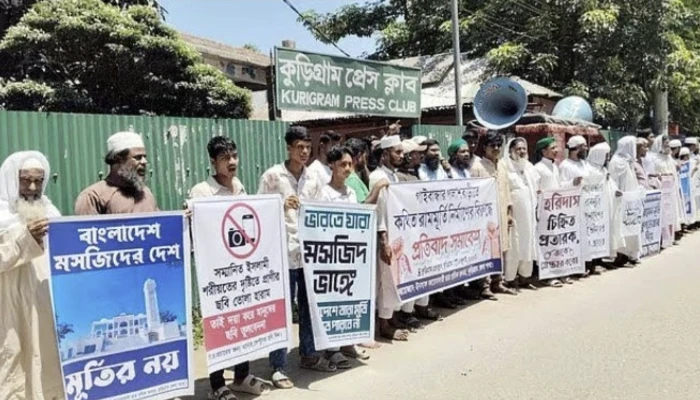
Case Summary
In Bangladesh's Kurigram district, the construction of an idol of the Hindu lord Bhagwan Shri Ram was opposed by a Muslim organisation. It organised a coordinated public campaign opposing the construction of a Bhagwan Shri Ram idol within the premises of the historic Shri Shri Radha Govinda and Kali Temple in Palashbari upazila of Gaibandha district. The campaign consisted of a human chain, a protest rally, and a procession demanding government intervention against the Hindu religious project. The demonstrations specifically targeted the proposed installation of an 82-foot idol of Bhagwan Shri Ram within a Hindu temple complex, raising concerns about organised public opposition to a lawful Hindu religious initiative. The protest was held on Saturday afternoon, 04 July 2026, in front of the Kurigram Press Club under the banner of "Insaf Kayemkari Chhatra-Shramik Janata, Kurigram." Muslim participants assembled, formed a human chain and protest rally, and then took out a procession through different streets of the town. The event was organised with the express purpose of opposing the construction of the Ram idol at the Shri Shri Radha Govinda and Kali Temple in Palashbari. Several leaders of the organisation, including coordinator A K M Ashrafur Rahman, Shahinur Rahman, Manjurul Haque, Ahmed Talukdar, and Rasel Mia, addressed the gathering. During their speeches, they linked the construction of the Ram idol to what they described as the influence of Hindutva politics in India and asserted that the project would damage communal harmony between Muslims in Bangladesh and India. They further stated that the installation of the Ram idol in Palashbari would also undermine communal harmony within Bangladesh. The speakers demanded that the government's relevant authorities investigate the proposed construction of the 82-foot idol of Bhagwan Shri Ram and intervene to stop the project. They portrayed the religious initiative as a matter requiring state scrutiny rather than recognising it as the construction of a Hindu religious representation within a Hindu temple. The campaign also targeted individuals associated with the project. The speakers called for an investigation into Haridas Chandra Toronidas, who was involved with the construction initiative. They demanded inquiries into the source of funds for the project and the nature of the initiative, and sought legal action following such investigations. Following the rally, participants organised a protest march through various parts of Kurigram town, raising slogans against the construction of the Ram idol. The procession concluded after moving through several streets, reinforcing the public campaign opposing the Hindu religious project. The protest formed part of a continuing campaign against the Sanatan Complex being developed around the Shri Shri Radha Govinda and Kali Temple in Palashbari. The complex is expected to house 144 Hindu deities and include an 82-foot idol of Bhagwan Shri Ram, making it one of the most prominent Hindu religious monuments in Bangladesh. Since construction began in 2025, the project has repeatedly faced organised opposition from Islamist groups, religious leaders, and activists who have objected specifically to the Ram idol and sought government intervention to halt its construction. Hinduphobia Tracker had already documented earlier instances of coordinated opposition against this very project, demonstrating that the present mobilisation was not an isolated occurrence but part of an ongoing and organised campaign directed at preventing the establishment of a prominent Hindu religious symbol. The present mobilisation therefore represented a continuation of this sustained campaign. Earlier incidents documented by the Hinduphobia Tracker included organised press conferences, memoranda submitted to the government, demands for investigations into the project's funding and organisers, and public calls to suspend construction. The Ram idol was repeatedly portrayed by Islamist groups as a symbol of "Hindutva", while opposition increasingly shifted from criticism of the project to organised efforts aimed at preventing the construction of a lawful Hindu religious monument. In previous incidents linked to the same controversy, radical Islamist figures publicly called for the desecration or demolition of the under-construction idol of Bhagwan Shri Ram. One individual associated with the banned terrorist organisation Al Qaeda urged Muslims to desecrate the idol, while another Islamist preacher declared that if the authorities failed to demolish the temple and idol, Muslims themselves should destroy the structure. The present protest therefore represented a continuation of a broader campaign directed against the Hindu religious project and the public manifestation of Hindu faith. The events occurred against the backdrop of escalating hostility towards Hindus in Bangladesh. This escalation of violence against Hindus in Bangladesh has unfolded in three distinct phases: first, following the ouster of Sheikh Hasina's government in August 2024; second, after the death of Sharif Osman Bin Hadi in December 2025; and third, in the immediate aftermath of the 13th National Parliamentary Election in 2026. Following the ouster of Sheikh Hasina, multiple reports documented attacks on Hindu homes, temples, and religious institutions, alongside intimidation campaigns, arson, and mob assaults targeting minority neighbourhoods. The Hinduphobia Tracker recorded 336 such incidents against the Hindu minority, underscoring the scale and persistence of anti-Hindu violence during this period. A further escalation occurred following the death of Sharif Osman Bin Hadi, a Muslim political activist and student leader known for his anti-Hindu and anti-India rhetoric. Hadi had been involved in political unrest after the fall of the Hasina government and was killed in Dhaka on 18th December 2025 during clashes. In the aftermath of his death, Hindu communities were blamed and subsequently targeted in retaliatory violence. Hindu homes were selectively set ablaze in multiple localities, forcing families to flee and leaving many displaced. The attacks appeared patterned rather than sporadic, with Muslim mobs focusing on Hindu neighbourhoods, properties, and religious symbols. Among the victims was Dipu Chandra Das, who was lynched to death and his body was set ablaze by a Muslim mob over false blasphemy allegations. The Hinduphobia Tracker documented 51 incidents of anti-Hindu violence in the period following Hadi's death alone. Reports further indicated that posters and written materials calling for the extermination of Hindus were displayed in public spaces. Alongside incidents of arson, vandalism, assault, intimidation, and organised anti-Hindu mobilisation, these developments contributed to a climate of increasing insecurity for the Hindu minority. The third phase of violence emerged after the 13th National Parliamentary Election in 2026. Within days of the announcement of results, Hindu families in districts including Noakhali, Rangpur, Nilphamari, Sylhet, Thakurgaon, and Dinajpur reported attacks involving arson, looting, assault, and vandalism of temples and homes. In several instances, Hindu homes were selectively targeted, looted, and families were threatened with displacement.
Why it is Hate Crime ?
This case has been added to the tracker under the primary category of Hate speech against Hindus. Within it, the sub-category selected is Anti-Hindu subversion and prejudice. Hate speech is defined as any speech, gesture, conduct, writing, or display that is prejudicial against a specific individual and/or group of people, which is leading to or may lead to violence, prejudicial action or hate against that individual and/or group. Media plays a specific and overarching role in perpetuating prejudicial attitudes towards a community owing to unfair, untrue coverage and/or misrepresentation/misinterpretation, selective coverage and/or omission of facts of/about issues affecting a specific religious group. This type of bias can dehumanise the victim group, making it easier for others to justify harmful actions against them, which aligns with the objectives of hate speech laws aimed at preventing such harm. It is often observed that the media takes a prejudicial stand against the Hindu community, driven by their need to shield the aggressor community, which happens to be a numeric minority; however, it is the one perpetrating violence against Hindus. For example, the media is often quick to contextualise religiously motivated crimes against Hindus, omit or misrepresent facts that point towards religiously motivated hate crimes, justify and/or downplay religiously motivated hate crimes, or simply present fake news to stereotype Hindus. Such media bias leads to the denial of persecution and is often used to dehumanise Hindus, leading to justification for violence against them. For example, the media covered several fake allegations of Hindus targeting Muslims and forcing them to chant Jai Shree Ram. Most of these cases were proven false and fabricated after police investigation. These fake news reports were subsequently never retracted or clarified. Such fake news led to the justification of violence and dehumanisation of Hindus based on the argument that since Hindus targeted Muslims and forced them to chant Jai Shree Ram, the dehumanisation of Hindus and violence against them was par for the course and merely a retaliation. Such media bias leads to prejudicial portrayal of Hindus and offers a justification for violence against them and, therefore, is considered hate speech under this category. Another sub-category selected for this case is - Anti-Hindu slurs, mocking faith. Anti-Hindu slurs and the deliberate mocking of the Hindu faith owing to religious animosity involve the usage of derogatory terms, stereotypes, or offensive references to religious practices, symbols, or figures. One of the common anti-Hindu slurs used against Hindus is “cow-worshipper” and “cow piss drinker”. The intention of using this term is to demean and mock Hindus as a group and their religious beliefs, since Hindus consider the cow holy. Additionally, some symbols and the slurs attached to them have a historical context that exacerbates the insult, hate, stereotyping, dehumanisation and oppression against Hindus. Cow worship has been used for centuries to denigrate Hindus, insult their faith and oppress Hindus specifically as a religious group. There has been overwhelming documentation about how cow slaughter has been used to persecute Hindus, with cow meat being thrown in temples and places of worship. There has also been overwhelming documentation where cow meat (beef) has been force-fed to Hindus to either forcefully convert them to Islam or denigrate their faith. Apart from cow worship, the Swastika – which holds deep religious significance for the Hindus – has also been misinterpreted and distorted to be used as a slur against Hindus. Similarly, the worship of the Shivling has been used by supremacist ideologies and religions to denigrate Hindus owing to religious animosity. Such slurs and denigration stem from inherent animosity and hate towards Hindus and their faith; therefore, it is categorised as hate speech targeted at Hindus specifically owing to their religious identity. This case was included in the Hinduphobia Tracker because it involved an organised public campaign directed against the construction of a Bhagwan Shri Ram idol within the premises of a Hindu temple. The religious trigger was the opposition to a lawful Hindu religious representation and the attempt to mobilise public opinion and state intervention against a project solely because it prominently expressed Hindu faith. The campaign targeted the religious identity of the project rather than any unlawful act associated with its construction. The opposition centred on the installation of a sacred Hindu deity within a Hindu place of worship. In Hinduism, consecrated idols are revered as living manifestations of the divine and constitute the focal point of worship, devotion, and religious practice. Constructing an idol of Bhagwan Shri Ram within a temple was a legitimate exercise of the Hindu community's religious freedom. Organising demonstrations, rallies, and protest marches to prevent such worship amounted to opposition against the public expression of Hindu faith itself rather than against any genuine legal or administrative concern. Furthermore, the campaign deliberately portrayed the Hindu religious project as a threat to communal harmony and sought to legitimise state intervention against it. By demanding investigations into the project and those associated with it, the organisers attempted to cast suspicion upon a lawful Hindu religious initiative. This transformed an act of religious worship into a matter of public hostility and placed undue pressure on the Hindu community for exercising rights that should have been equally protected. The manner in which the campaign was organised demonstrated planning and coordination. The human chain, public rally, speeches, and protest procession were not spontaneous expressions of disagreement but formed part of a structured effort to generate opposition to the temple project. The objective was to build public pressure, influence the authorities, and prevent the establishment of a prominent Hindu religious symbol. The focus consistently remained on the fact that the project celebrated Bhagwan Shri Ram, demonstrating that the visible assertion of Hindu religious identity was itself being challenged. Significantly, the Muslim leaders linked the construction of the Ram idol to what they described as the influence of 'Hindutva' politics in India. 'Hindutva' is often used as a euphemism to make the targeting of Hindus more palatable. Hindutva is essentially a unifying ideology for Hindus, which became imperative for Hindus to find and preserve their cultural identity, which was being eroded and attacked due to Islamic invasions, British colonisation, Christian theological impositions and conversions. Hindutva is not a destructive ideology, as some attempt to portray, but one that is used as a unifying edifice for Hindus. Hindutva is also often used as a euphemism to target Hindus on the whole and their religious identity and faith. It is essentially semantic jugglery to confuse Hindus into believing that their own persecution by supremacists is somehow 'justified' because the specific victims espoused an ideology (Hindutva) which deserves the onslaught. The fact that the use of 'Hindutva' is merely to mask animosity towards Hindus was evident from the "Dismantling Global Hindutva" conference held in the USA, where speakers unabashedly spoke about how Hindutva and Hinduism are indistinguishable and therefore, to "dismantle Hindutva" one would have to "dismantle Hinduism". The practices of targeting Hindus and their religious and cultural identity and justifying that victimisation and dehumanisation by using euphemisms like "Hindutva" stem from inherent animosity and hostility towards Hindus. This was not an isolated incident. The Hinduphobia Tracker had previously documented organised campaigns against the same Sanatan Complex, including press conferences, memoranda submitted to the government, demands for investigations, and calls to halt the construction of the Ram idol. Earlier incidents also involved inflammatory rhetoric and open calls to demolish or desecrate the idol. The present mobilisation therefore represented a continuation of a sustained campaign to obstruct the establishment of a major Hindu religious monument, rather than a standalone protest. The incident also reflected a broader pattern of religious intolerance. The Hindu community was exercising its right to develop and expand its own place of worship without interfering with the religious practices of others. Yet the construction of a prominent Hindu deity became the subject of organised resistance. Such conduct conveyed that the public manifestation of Hindu faith was considered unacceptable and sought to discourage Hindus from expressing their religious identity openly and confidently. Viewed against the wider backdrop of escalating hostility towards Hindus in Bangladesh, the campaign assumed even greater significance. It reinforced a pattern in which Hindu temples, religious symbols, and institutions increasingly became targets of organised opposition, intimidation, and attempts to curtail their religious freedoms. The coordinated effort to prevent the installation of a sacred Hindu idol, therefore, constituted a manifestation of anti-Hindu hostility directed at restricting the religious rights and public visibility of the Hindu minority. Disclaimer: The Hinduphobia Tracker acknowledges that the protest involved numerous participants and supporters. However, as only A K M Ashrafur Rahman, Shahinur Rahman, Manjurul Haque, Ahmed Talukdar, and Rasel Mia were specifically identified in the available report as delivering speeches during the programme, the perpetrator count has been recorded as five (5). Additional participants were involved in the organised campaign, but their identities were not disclosed in the source material.


Case Status
Unknown


Perpetrators Details
Perpetrators
Muslim Extremists
Perpetrators Range
From 2 To 5
Perpetrators Gender
male
 Sources




