

Predatory proselytisation refers to religious conversions achieved through force, coercion, deception, inducement, or exploitation of social and personal vulnerabilities, often targeting individuals from marginalised or minority communities. This study examines the phenomenon as it impacts Hindu communities, using the Hinduphobia Tracker’s dataset as a primary empirical source.
The dataset documents 926 global incidents of Predatory Proselytisation, of which 471 cases (50.86 per cent) involved conversion to Islam and 428 cases (over 46.22 per cent) involved conversion to Christianity.
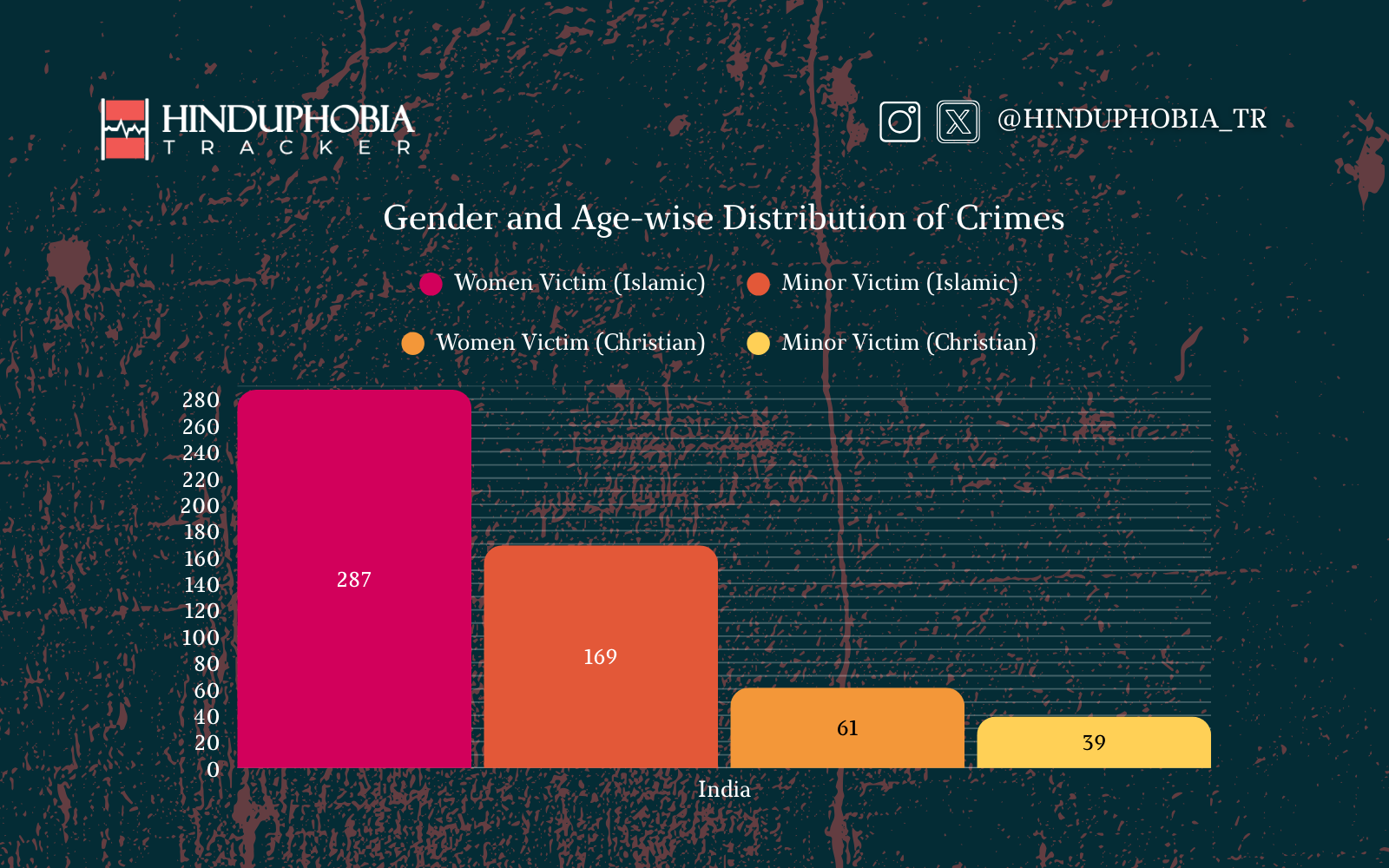
In India alone, out of 858 documented incidents, 407 cases (47.44 per cent) involved Muslim conversions and 426 (49.65 per cent) involved Christian conversions. The number of women victims in India amounts to 348, out of which 287 involved Muslim conversion and 61 involved Christian conversion. Similarly, the number of minors who have been targeted stands at 208 of all victims, of which 169 were targeted for Muslim conversion and 39 for conversion to Christianity.
Geographic analysis reveals Uttar Pradesh as the most affected state, contributing nearly half of India’s cases, while Rajasthan shows the highest proportional death rate.
The findings indicate that predatory proselytisation is not an isolated occurrence but a sustained, systematic practice, often facilitated by organised networks and justified by ideological narratives. This paper situates these patterns within the broader socio-political and legal context, highlighting the vulnerabilities of targeted demographics and the limitations of current legal safeguards. By combining statistical evidence with case-level observations, the study seeks to contribute to academic and community-level understanding of the scale, methods, and impact of predatory proselytisation.
What is Predatory Proselytisation
Religious conversion is often presented as a matter of individual belief and spiritual choice. However, in many contexts, it has been shaped by unequal power dynamics, inducements, and coercive strategies. When conversion is pursued through force, fraud, emotional manipulation, or the exploitation of economic and social vulnerabilities, it moves away from genuine faith and falls into the ambit of predatory proselytisation. This is not merely a theoretical concern. The Indian Constitution guarantees every individual the right to profess, practice, and propagate religion under Article 25, but courts have repeatedly clarified that this freedom does not include the right to convert others by unfair or coercive means. In the landmark (2) Rev. Stainislaus vs. State of Madhya Pradesh (1977), the Supreme Court held that forcible conversions impinge upon the freedom of conscience of others, thereby legitimising state-level restrictions on such practices.
Historical and legal context in India
The fear of coercive conversion has deep historical roots in India. Accounts of mass conversions during periods of Islamic conquest and later missionary activities under colonial rule reflect how religious identity has long been a site of contest. Post independence, several states, including Madhya Pradesh, Odisha, and later Himachal Pradesh and Uttarakhand, introduced legislation regulating religious conversion, commonly referred to as Freedom of Religion Acts. These laws typically prohibit conversions achieved through “force, fraud, or inducement.”
Uttar Pradesh’s more recent legislation in 2020, amended in 2024, has gone further by criminalising conversions connected to marriage and introducing strict penalties, in some cases up to life imprisonment. The recurrence of such laws points to a consistent anxiety about predatory forms of proselytisation and their social consequences.
The need for reliable data
Although the legal and political debates have persisted for decades, one striking absence has been the lack of systematic, incident-level data. Discussions on predatory proselytisation often rely on anecdotal reporting or highly localised studies. The Hinduphobia Tracker, launched by the Gavishti Foundation on December 6, 2024, attempts to address this gap. It collates reports of hate crimes against Hindus, including those linked to coercive or deceptive conversions, through a structured process of verification. Unlike media fragments or case-by-case reports, the Tracker provides a consolidated view of trends across states and even globally, allowing for patterns to be studied with greater precision.
Objectives of the Study
The present research draws on this dataset to offer a comprehensive analysis of predatory proselytisation as it affects Hindu communities. It seeks to
- Map the scale of predatory proselytisation both within India and globally.
- Identify the most vulnerable groups of victims.
- Highlight states and regions with concentrated incidents.
- Examine the methods used by perpetrators and their ideological or organisational backing.
Through both statistical evidence and case-level analysis, the study seeks to move beyond polemical debates on conversion and offer a grounded, fact-based foundation for academic and community-level understanding.
Subcategories and Methods of Predatory Proselytisation
The Hinduphobia Tracker classifies predatory proselytisation into seven subcategories that reveal both the diversity of methods and the systematic nature of the practice.
Conversion or attempts to convert by inducement: Material benefits such as food, money, jobs, or education are frequently used to exploit the economic vulnerabilities of Hindus, particularly among the Scheduled Castes, the Scheduled Tribes, and the rural poor. These inducements often mask a transactional rather than spiritual motivation for conversion.
Harassment, threats, and coercion for conversion: When inducements fail, perpetrators often resort to direct threats of violence, social boycotts, or physical coercion. These cases illustrate how the boundary between proselytisation and hate crime blurs into outright persecution.
Attempting to convert by denigrating Hinduism: A recurring tactic is the deliberate ridicule of Hindu beliefs, deities, and customs to instil doubt and shame. By attacking identity and culture, perpetrators seek to make Hindu victims more susceptible to abandoning their faith.
Suicide after pressure to convert: The dataset tragically records cases where relentless targeting leaves victims feeling cornered, leading them to take their own lives. These instances demonstrate the severe psychological impact of predatory proselytisation.
Murdered for refusing to convert: In its most violent form, refusal to convert has led to killings, concentrated in states like Uttar Pradesh, Rajasthan, and Chhattisgarh. These cases highlight how predatory proselytisation escalates into lethal religious violence.
Proselytisation by grooming, brainwashing, manipulation, or subtle indoctrination: Beyond overt threats, perpetrators also employ psychological strategies to alienate victims from their families and communities. Grooming often targets women and minors, gradually isolating them before pressuring conversion.
Harassment for conversion leading to exodus: This refers to situations where Hindu families or entire communities are subjected to sustained intimidation, social boycotts, or targeted violence until they are left with no option but to abandon their homes and migrate. This form of predatory proselytisation does not always end with an immediate conversion but creates an atmosphere of fear that breaks community resilience. By uprooting people from their ancestral land and livelihoods, perpetrators weaken social bonds and leave displaced Hindus more vulnerable to inducements and coercive pressures for conversion. It represents a collective assault on both identity and belonging, going beyond individual targeting to destabilise entire settlements.
Together, these categories show that predatory proselytisation is not limited to one-off incidents or voluntary conversions but reflects a continuum of coercive practices ranging from inducement to extreme violence. By documenting the breadth of these methods, the Hinduphobia Tracker underscores how conversion, when detached from free will, becomes a tool of domination rather than faith.
Predatory Proselytisation data from the Hinduphobia Tracker and key observations
The Hinduphobia Tracker dataset has recorded 926 global incidents of predatory proselytisation, with 858 cases (92.65 per cent) concentrated in India.
Note: The data presented in this report is compiled from the Hinduphobia Tracker and reflects incidents documented from its inception until 10 September, 2025. As the Tracker is a live platform, the numbers are constantly updated. Our ongoing effort is to monitor, verify, and add new cases of hate crimes against Hindus as they emerge in news reports and other credible sources. Readers should therefore treat these figures as a fluid dataset rather than a conclusive total.
- Incidents of Predatory Proselytisation: Globally, 428 cases (46.22 per cent) involved Christian conversions, while 471 cases (50.87 per cent) involved Islamic conversions. In India alone, out of 858 documented incidents, 407 cases (47.44 per cent) involved Muslim conversions and 426 (49.65 per cent) involved Christian conversions.
Trivia: Globally, Islamic and Christian conversion attempts are almost evenly split, with 471 Islamic cases (50.87%) and 428 Christian cases (46.22%). India mirrors this near parity, recording 407 Islamic-linked cases (47.44%) and 426 Christian-linked cases (49.65%) out of 858 incidents. This balance highlights that Hindus face predatory proselytisation pressure from both major global missionary networks.
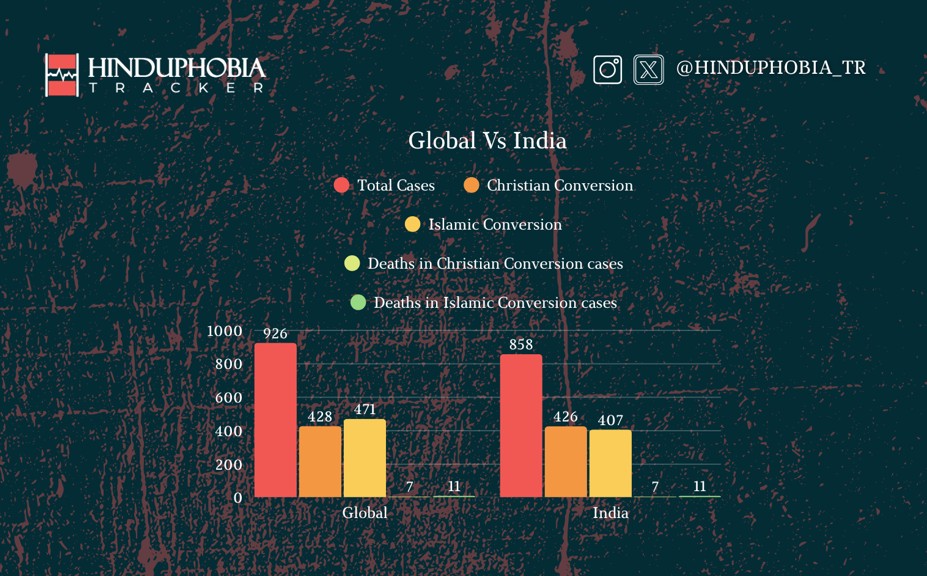
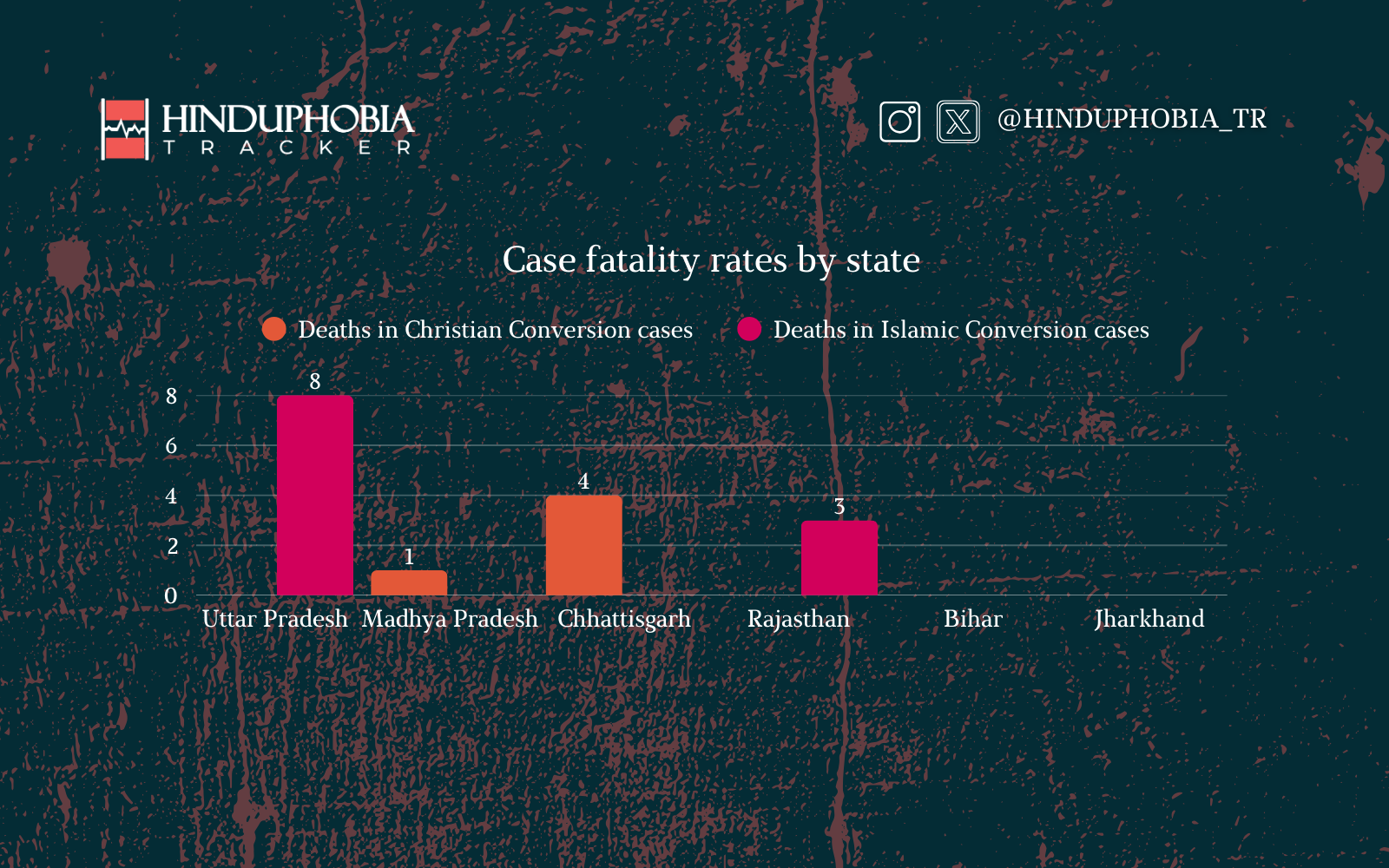
- Deaths: Out of 18 deaths (7 in Christian cases and 11 in Islamic cases) 8 were recorded in Uttar Pradesh, 4 in Chhatisgarh, 3 in Rajasthan and 1 in Madhya Pradesh and 2 in other states.
Trivia: All 18 recorded deaths linked to predatory proselytisation worldwide occurred in India.
Victim Demographics
- Women Victims: Globally, 342 women victims are linked to Islamic conversion cases and 61 to Christian cases. In India, the number of women victims was 287 (Islamic) and 61 (Christian).
- Minor Victims: Globally, 211 minors were victims in Islamic conversion cases, compared to 39 in Christian cases. In India, the figures are 169 (Islamic) and 39 (Christian).
Trivia: Nearly 1 in 2 victims in India is a woman or a minor, showing how predatory proselytisation deliberately exploits the most vulnerable demographics to force or manipulate conversions.
State-Level Distribution
- Uttar Pradesh (UP)
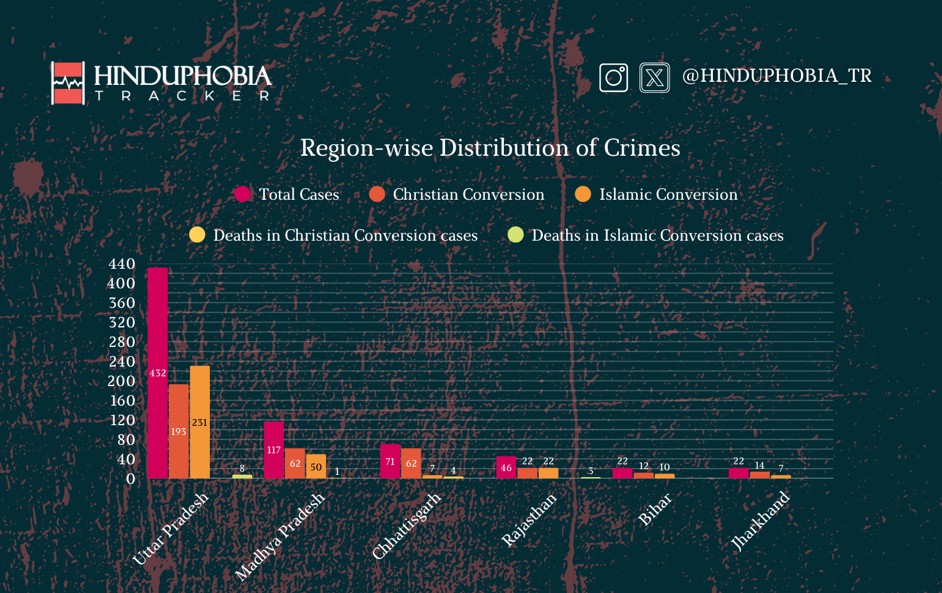
- Cases: 432, nearly half of India’s total.
- Conversions: 193 Christian (44.68 per cent), 231 Islamic (53.47 per cent).
- Deaths: 8 linked to Islamic conversion cases.
- Victims: Women – 167 (Islamic) and 24 (Christian). Minors – 102 (Islamic) and 13 (Christian).
Trivia: Nearly 1 in every 2 incidents in India happens in UP, making it the national epicentre.
- Madhya Pradesh (MP)
- Cases: 117
- Conversions: 62 Christian (52.99 per cent), 50 Islamic (42.74 per cent).
- Deaths: 1 linked to Christian conversion cases.
- Victims: Women – 37 (Islamic) and 9 (Christian). Minors – 17 (Islamic) and 9 (Christian).
Trivia: MP is the only state with a death recorded in a Christian conversion case.
- Chhattisgarh
- Cases: 71
- Conversions: Overwhelmingly Christian-linked (62, 87.32 per cent).
- Deaths: 4 in Christian conversion cases.
- Victims: Women – 4 (Islamic) and 11 (Christian). Minors – 3 (Islamic) and 3 (Christian).
Trivia: Chhattisgarh accounts for more than half of all Christian conversion-related deaths in India.
- Rajasthan
- Cases: 46, split between 22 Christian (47.83 per cent) and 22 Islamic (47.83 per cent).
- Deaths: 3 linked to Islamic conversion cases.
- Victims: Women – 16 (Islamic) and 3 (Christian). Minors – 16 (Islamic) and 2 (Christian).
Trivia: Rajasthan records one of the highest death-to-case ratios in Islamic conversions.
- Bihar
- Cases: 22
- Conversions: 12 Christian (54.55 per cent), 10 Islamic (45.45 per cent).
- Deaths: None.
- Victims: Women – 5 (Islamic) and 2 (Christian). Minors – 4 (Islamic) and none in Christian cases.
Trivia: In Bihar, every recorded minor victim comes from Islamic-linked cases.
- Jharkhand
- Cases: 22
- Conversions: 14 Christian (63.64 per cent), 7 Islamic (31.82 per cent).
- Victims: Women – 5 (Islamic) and 2 (Christian). Minors – 2 (Islamic) and 1 (Christian).
Trivia: Jharkhand mirrors Chhattisgarh’s Christian dominance but with fewer severe outcomes.
Key Observations
Regional disparities: UP remains the numerical hotspot, Chhattisgarh shows extreme Christian dominance, and Rajasthan records a high death ratio in Islamic-linked cases.
- Death clustering: All global deaths occurred in India, concentrated in UP, MP, Chhattisgarh, and Rajasthan.
- Victim profiles: Women and minors together form nearly half of all victims, confirming that vulnerable groups are systematically targeted.
- Distinct state profiles: UP is volume-heavy, MP records Christian-linked fatalities, Chhattisgarh dominates in Christian conversions, Rajasthan has lethal Islamic-linked cases, while Bihar and Jharkhand show smaller but skewed targeting patterns.
Why these incidents warrant inclusion in the ‘HateCrime database’ of the Hinduphobia Tracker
Incidents of predatory proselytisation documented in the Hinduphobia Tracker qualify as hate crimes against Hindus because they systematically target individuals and communities for their religious identity with the explicit aim of erasing or replacing it. Harassment for conversion leading to exodus demonstrates collective persecution, where Hindus are driven from their homes solely because they refuse to abandon their faith. Conversion attempts by inducement prey on poverty and vulnerability, exploiting disadvantaged Hindus in ways that strip them of free choice. Harassment, threats, and coercion reveal the use of fear and intimidation to force religious change, while the denigration of Hinduism seeks to humiliate and break down cultural self-worth.
The extremities of this pattern are visible in cases where sustained pressure pushes victims to suicide, or where refusal to convert results in murder, showing how deeply violence is tied to religious hostility. Grooming, brainwashing, and manipulation further expose how women and minors are deliberately isolated and indoctrinated to sever their Hindu identity.
Taken together, the dataset explains how predatory proselytisation is not a neutral or private matter of belief but a targeted, identity-based assault on Hindus. It weaponises deception, coercion, and violence with the intent to dismantle Hindu existence in specific geographies. For these reasons, such incidents are rightly recorded as hate crimes in the Hinduphobia Tracker, highlighting the religious animosity and systemic prejudice that underpin them.