Hindu community targeted as state authorities in Tamil Nadu deny permission for sacred Rath Yatra procession
 Tiruppur, Tamil Nadu, India
  18 January, 2026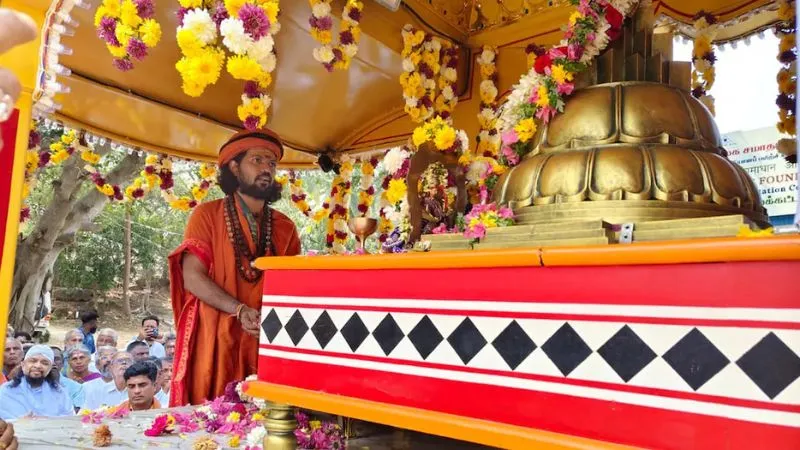
Case Summary
In Tamil Nadu, a Rath Yatra procession, associated with the Kerala Kumbh Mela-Mahamagam Mahotsav, was denied permission by state authorities. The DMK (Dravida Munnetra Kazhagam) government in Tamil Nadu on Monday (19 January 2026) refused permission for the Rath Yatra to be held in the state. The Rath Yatra was scheduled to begin from the Thirumoorthy Hills near Udumalpet in Tiruppur district, the source of the Bharathapuzha River. The procession organisers said that Udumalpet police stopped them midway, stating that senior government officials in Chennai had denied permission for the Rath Yatra. Following this, the Rath Yatra's "Mahameru" idol was transported in a car to the Kerala border, from where the procession proceeded to Palakkad. The Rath Yatra formed a key part of the "Mahamagha Mahotsavam" held along the banks of the Bharathapuzha River in Thirunavaya, Kerala. Organisers said the procession strengthened the age-old cultural and spiritual ties between Tamil Nadu and Kerala. The procession was also to be attended by the heads of several major ashrams and religious institutions in Tamil Nadu. The procession concluded on 21 January 2026 in Thirunavaya, where the main rituals of the Kumbh Mela took place. Despite the DMK government's restrictions on the pilgrimage in Tamil Nadu, the "Mahamagha Mahotsavam 2026" celebrations in Kerala began with great fanfare. On Monday (19 January 2026), Kerala Governor Rajendra Vishwanath Arlekar inaugurated the festival by hoisting the flag. Acharya Dr Srinath Karyat, who led the Rath Yatra, said that even though the administration in Tamil Nadu did not cooperate, the religious rituals and the Yatra were completed in Kerala as per schedule. Notably, this incident was not the first time that the Tamil Nadu government, run by the Dravida Munnetra Kazhagam (DMK) party, engaged in such anti-Hindu acts. The Hinduphobia Tracker previously documented how the Tamil Nadu DMK government disallowed Hindu devotees from performing the traditional Karthigai Deepam ritual at Thiruparankundram Hill in Madurai. Karthigai Deepam, celebrated during the full moon of the Karthigai month, honours Shiva in his Agni form, and the Maha Deepam lighting at the Arunachaleswarar Temple attracts millions of devotees globally. This arbitrary state order came even after the Madurai Bench of the Madras High Court ruled that the Karthigai Deepam lamp could be lit on the ancient stone pillar located on Thiruparankundram Hill in Madurai. The order came on Monday (1 December 2025) after the court heard four petitions requesting permission to light the lamp at this traditional spot, known locally as the Deepathoon. In another instance, in October 2025, in Panchampatti village, a Christian-majority locality in the Dindigul district of Tamil Nadu, the local Hindu community had planned the Kumbhabhishekam (consecration ceremony) of a temple. Following the ceremony, they intended to organise an Annadhanam (religious community feast) on a vacant piece of government land on 3 November 2025. However, the state authorities denied them permission, citing law and order concerns after members of the Christian community asserted that the land belonged to them for conducting Easter celebrations. Both the Christian community and the police opposed granting permission for the Hindus to hold the Annadhanam event there, resulting in restrictions on the Hindu community's request. Even DMK leaders and politicians in the past have repeatedly abused Hindus and their faith. For instance, in August 2025, in Kumbakonam, Tamil Nadu, vicious and inflammatory comments against the Hindu community were made by a Christian Dravida Munnetra Kazhagam (DMK) functionary named Ramesh. He called Hindus "sons of prostitutes". Similarly, on 16 January 2024, derogatory remarks targeting Lord Ram and the Ram Janmabhoomi Temple at Ayodhya were made by Dravida Munnetra Kazhagam (DMK) leader Uma Ilakkiya. A video of her abusing Lord Ram went viral on social media. Similarly, DMK politician and Tamil Nadu Deputy Chief Minister Udhayanidhi Stalin, son of Chief Minister MK Stalin, equated Hinduism to dengue and malaria, calling for its annihilation. He stated, "Sanatana is like malaria and dengue, and so it must be eradicated, not opposed."
Why it is Hate Crime ?
This case is being added to the tracker under the primary category- Restriction/ban on Hindu practices. The subcategory selected is- Administration disallows religious procession. The tertiary category selected is- Religious procession. In several cases, it is seen that the administration/state disallows a religious procession owing to prejudicial orders and concerns, targeted specifically against the Hindu community. Such restriction/prohibition would be considered documented as a hate crime because the orders are often a result of pressure by groups that harbour animosity towards Hinduism and Hindus. Often, the restriction by the authorities is driven by bias, hostility, or prejudice against the specific community being stopped from holding a religious procession, by pressure groups that harbour animosity towards Hindus, intrinsic to their faith. Since the religious procession is inherent to the faith of the Hindus, such prejudicial restriction is considered a curtailing of the fundamental rights of the Hindu community. In several cases, for example, the authorities ban a Hindu religious procession due to pressure from groups opposed to the religion. In other instances, the prohibition is selectively enforced against one religious group (Hindus) while others are allowed to proceed. There are still other cases where the authorities preemptively restrict a religious process by Hindus because those who hold animosity towards Hindus may get “provoked” leading to them being violent, thereby assuaging the sentiments of those who hold animosity towards Hindus by curtailing the religious rights of Hindus. Such acts and orders are prejudiced, indicating discriminatory motives owing to the capitulation to groups that harbour animosity towards Hindus and therefore, would be categorized as a religiously motivated hate crime since the original pressure leading to the order itself is a result of hatred/bias/prejudice/religious hate against Hindus. This case of the Tamil Nadu government denying permission for the Rath Yatra associated with the Kerala Kumbh Mela-Mahamagam Mahotsav stood as a clear example of a hate crime against Hindus perpetrated by the state. This action went beyond mere administrative decision-making; it directly targeted the religious rights and cultural heritage of the Hindu community, especially when halting a procession from the sacred Thirumoorthy Hills in a state with a history of such curbs. By preventing the Yatra from proceeding, the authorities not only disrupted age-old spiritual ties between Tamil Nadu and Kerala but also sent a message that Hindu practices and processions could be curtailed at will, undermining the Hindu community's sense of belonging and security. This decision infringed on the Hindu community's constitutional rights to freedom of assembly and expression, fundamental in India. The move demonstrated religious bias, given the Tamil Nadu Dravida Munnetra Kazhagam (DMK) government's history of opposing Hindu religious practices. From disallowing the traditional Karthigai Deepam ritual at Thiruparankundram Hill despite court orders, to denying permissions for Hindu temple feasts like Annadhanam in Dindigul, to DMK leaders' vicious anti-Hindu remarks calling Hinduism akin to diseases worthy of eradication, ample evidence showed that the Stalin government repeatedly issued prejudicial orders to clamp down on Hindus' religious rights while favouring other communities. Such institutionalised discrimination and targeting leave Hindus feeling scared and insecure about practising their faith openly in Tamil Nadu. It demotivates devotees from organising processions or rituals, fostering a chilling effect that erodes community confidence. By normalising these curbs in the public limelight, it breeds wider prejudice and hatred against Hinduism, amplifying the religiously motivated nature of the crime. Since this case meets the parameters of a religiously motivated offence, it is being added to the hate crime database of the Hinduphobia Tracker.


Case Status
Unknown


Perpetrators Details
Perpetrators
State and Establishment
Perpetrators Range
Unknown
Perpetrators Gender
unknown
 Sources




