Hindus denied permission by state authorities to organise Annadhanam in Christian-majority village of Tamil Nadu
 Dindigul, Tamil Nadu, India
  30 October, 2025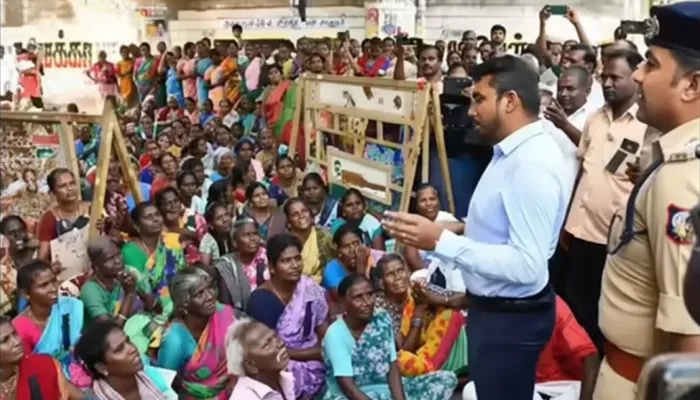
Case Summary
In Panchampatti village, a Christian-majority locality in the Dindigul district of Tamil Nadu, the local Hindu community had been planning the Kumbhabhishekam (consecration ceremony) of a temple. Following the ceremony, they intended to organise an Annadhanam (religious community feast) on a vacant piece of government land on 3rd November 2025. However, the authorities denied them permission, citing law and order concerns after members of the Christian community asserted that the land belonged to them for conducting Easter celebrations. Both the Christian community and the police opposed granting permission for the Hindus to hold the Annadhanam event there, resulting in restrictions on the Hindu community’s request. This dispute began when a Hindu man applied to conduct an Annadhanam in an open public ground near the Kaliyamman Temple. The local authorities rejected his application. Instead, he was given permission to hold the event on a public road. Considering this decision unfair, he approached the High Court seeking redress. The court then asked the police to explain the reason behind the rejection, to which they responded that the event could lead to a ''law and order issue''. During the hearing, the court also heard the arguments of the Christian community. They stated that a stage had been built on one side of the ground about a century ago, which they had long used for Easter celebrations. They contended that Hindus had never been permitted to use that ground for any of their religious functions. They referred to a “peace committee meeting” held in 2017, where it had been decided that no new events would be allowed on the ground, except those traditionally held there over the past 100 years. Justice G. R. Swaminathan, who presided over the case, did not accept this argument. He stated that it was unacceptable for Christians to be allowed to use the ground for Easter while Hindus were denied its use for Annadhanam. He clarified that when the Christian community held their Easter celebrations on a specific date, they alone should have exclusive use of the ground on that day, but it could be used by others at other times. The judge observed that Panchampatti village comprised around 2,500 Christian families and about 400 Hindu families. He described the police’s justification — simply citing opposition from the Christian community as a reason for denying permission — as “a very sorry state of affairs”. The court set aside the rejection order and directed the local authorities to grant permission for the Hindu community’s feast. While examining the ownership of the land, Justice Swaminathan found that the open space in question was identified as a vacant site or gramamatham, owned by the Panchayat, and therefore by the government. He observed that since the land was government property, it should remain accessible to all sections of society, irrespective of religious identity. On 31st October 2025, the judge delivered his judgment, ruling that if a public ground was open for public use, no particular group could be excluded from it. He further held that denying access solely on religious grounds constituted a violation of Article 15 of the Constitution of India, which prohibits discrimination on the basis of religion. As he noted, “A public ground should be available for the use of all communities or none." Following the court order, members of the Christian community in Dindigul began protesting the decision. They gathered near the Dindigul District Collector’s office, expressing their dissatisfaction and declaring their intention to surrender their government-issued identity cards, such as Aadhaar and voter identity cards, as a mark of protest. The protesters blocked the main road leading to the Collectorate and raised slogans condemning district administration officials. The situation became tense, prompting the deployment of more than 100 police personnel to maintain law and order. Later in the day, Dindigul District Collector S. Saravanan and Superintendent of Police A. Pradeep held discussions with the protesters. They succeeded in pacifying the crowd, and following the deliberations, the protest was withdrawn.
Why it is Hate Crime ?
This case has been added to the tracker under the primary category- Restriction/ban on Hindu practices. Within this, the subcategory selected is- Administration restricting religious practice. In several cases, it is seen that the administration/state disallows a religious practice owing to prejudicial orders and concerns, targeted specifically against the Hindu community. Such restriction/prohibition would be considered documented as a hate crime because the orders are often a result of pressure by groups that harbour animosity towards Hinduism and Hindus. Often, the restriction by the authorities is driven by bias, hostility, or prejudice against the specific community being stopped from holding a religious practice, by pressure groups that harbour animosity towards Hindus, intrinsic to their faith. Since practices are intrinsic to the faith of the Hindus, such prejudicial restriction is considered a curtailing of the fundamental rights of the Hindu community. In several cases, for example, the authorities ban a Hindu religious practice due to pressure from groups opposed to the religion. In other instances the prohibition is selectively enforced against one religious group (Hindus) while others are allowed to proceed. There are still other cases where the authorities preemptively restrict a religious practice by Hindus because those who hold animosity towards Hindus may get “provoked” leading to them being violent, thereby assuaging the sentiments of those who hold animosity towards Hindus by curtailing the religious rights of Hindus. Such acts and orders are prejudiced, indicating discriminatory motives owing to the capitulation to groups that harbour animosity towards Hindus and therefore, would be categorized as a religiously motivated hate crime since the original pressure leading to the order itself is a result of hatred/bias/prejudice/religious hate against Hindus. In this case, the actions of the local administration and police in Panchampatti village demonstrated a blatant instance of religious discrimination against the Hindu community. Despite their lawful request to organise an Annadhanam, a sacred community feast held in connection with a temple’s Kumbhabhishekam ceremony, the Hindu residents were denied permission by state authorities. The reason cited was the so-called “law and order concerns” raised by members of the Christian community. Instead of protecting the constitutional right of Hindus to practise their religion freely, the police and local officials sided with the majority group, effectively penalising the minority Hindu community for their faith. This episode reflected not an administrative precaution but a deep-seated religious bias within the state machinery, where state power was exercised in a way that excluded and humiliated Hindus solely because of their religion. The denial of permission on government-owned land — which by law belongs to all citizens equally — amounted to state-sanctioned religious discrimination, revealing an alarming hostility against Hindu traditions and faith practices. The conduct of the Christian community in this case further exposed the presence of anti-Hindu animosity. Their objection to the Annadhanam showed an attitude of entitlement and intolerance towards any public expression of Hindu faith. Although the land had been used for decades for Easter celebrations, they strongly opposed its use for a Hindu event, displaying a mindset rooted in religious supremacy and exclusion. By arguing that the ground could only be used by their community, the Christian residents sought to deny Hindus the same space under the guise of tradition. Such behaviour was not mere disagreement; it reflected a systematic effort to dominate public spaces and suppress Hindu cultural and religious visibility. The manner in which they protested and resisted even a peaceful Hindu religious activity revealed a pattern of prejudice and deliberate obstruction meant to marginalise Hindus within their own village. Such actions are a result of deep-seated religious animosity towards the Hindu community, their faith and traditions. Since this incident took place in a Christian-majority village, it highlighted the entrenched social imbalance and the manifestation of Christian supremacist tendencies against the minority Hindu population. The episode illustrated how majority dominance can evolve into outright hostility when a smaller religious group attempts to assert its identity. The consistent sidelining of Hindus, the rejection of their requests, and the refusal to share public spaces signified a disturbing belief among local Christian groups that they held authority over what religious expression could or could not exist within their locality. This attitude of exclusion — treating Hindus as outsiders in their own land — amounted to clear hostility, reinforcing the larger pattern of religiously motivated discrimination and repression that Hindu minorities continue to endure in such regions. The fact that the Hindu petitioner had to seek judicial intervention to secure permission for a simple community meal underscored the systemic nature of this prejudice. What should have been a routine cultural event turned into a legal struggle because of the entrenched anti-Hindu bias of both the local administration and the Christian respondents. The High Court’s judgment in favour of the Hindu community reaffirmed that the authorities had acted unjustly and in violation of constitutional principles of equality and non-discrimination. This case exemplified not only administrative bias but also targeted hostility directed at Hindus for their religious identity. It stands as a documented instance of anti-Hindu hate, recorded in the Hinduphobia Tracker’s Hate Crime Database as evidence of ongoing religious persecution and institutional discrimination against Hindus. Disclaimer: It must be noted that media reports have not specified the exact date on which the incident first occurred. As per the Hinduphobia Tracker’s documentation protocol, the date of an incident is recorded based on when the discriminatory act or hate-driven event initially took place. In this case, the matter began when the local administration denied the Hindu community permission to organise the Annadhanam. However, since the available reports do not mention the exact date of that denial and only confirm that the Madras High Court delivered its verdict in favour of the Hindu community on 31st October 2025, this date is being used, for documentation purposes, as the indicative date of the incident in the Hinduphobia Tracker’s hate crime database.


Case Status
Perpetrator held guilty by court


Perpetrators Details
Perpetrators
State and Establishment
Perpetrators Range
Unknown
Perpetrators Gender
unknown
 Sources




