Hindu community subjected to abuse by Christian political leader at Christian gathering in Tamil Nadu, called 'sons of prostitutes'
 Kumbakonam, Tamil Nadu, India
  3 August, 2025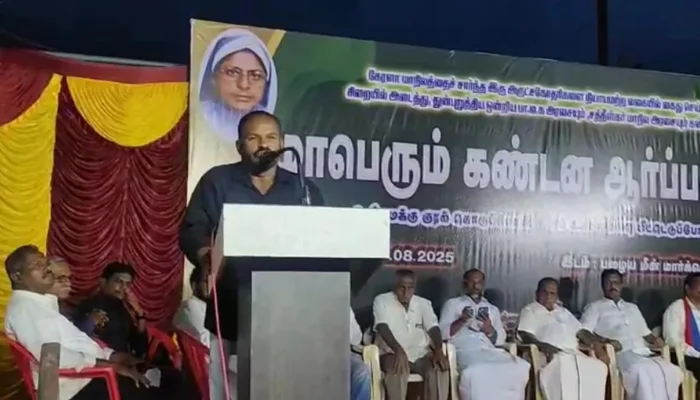
Case Summary
In Kumbakonam, Tamil Nadu, vicious and inflammatory comments against the Hindu community were made by a Christian Dravida Munnetra Kazhagam (DMK) functionary named Ramesh. He called Hindus "sons of prostitutes". According to media reports, this incident occurred at a Christian gathering. The gathering was held to condemn the arrest of two Catholic nuns in Chhattisgarh, who were charged with human trafficking and forced religious conversions. Though later granted bail, their arrest sparked widespread outrage, supported by parties such as the Congress, Left, RJD, SP, TMC, DMK, VCK, NTK and others. The Christian gathering was attended by members of various Christian denominations, political party leaders, and other organisations. In this gathering, the accused, Ramesh, made derogatory remarks against the Hindu community. A video of Ramesh’s speech quickly went viral on social media, sparking sharp criticism. Upon seeing the video, Vasudevan, a coordinator of the Federation of Hindu Associations, lodged a formal online complaint with the Tamil Nadu police, demanding immediate action against the speaker. In his complaint, Vasudevan stated: “I am the coordinator of the Federation of Hindu Associations. On 4 August 2025, a public meeting was held to denounce the arrest of nuns in Chhattisgarh. At this meeting, Ramesh, son of Peter and a Dravidar Kazhagam functionary, had made highly disparaging comments about Hindus. His video, which rapidly went viral, showed him calling Hindus ‘sons of prostitutes’, specifically targeting the community. Despite the presence of women in the audience, whose visible reactions reflected discomfort, he continued unabated. His words were offensive and constituted a blatant case of hate speech. The Supreme Court has repeatedly stressed that such speech has no place in a civilised society and must be dealt with sternly.” Vasudevan also stated that freedom of expression is not absolute and cannot be used to provoke caste or communal tensions. He demanded that the DMK government take appropriate legal action against not only Ramesh but also all individuals present on stage who failed to stop or condemn the derogatory remarks. He further said, “His speech had hurt the sentiments of the Hindu community and amounted to an outrageous attack on their dignity.” Following this, the accused, Ramesh, justified his statement by quoting E. V. Ramasamy Naicker (Periyar), a tactic often employed to evade legal consequences. Such instances of anti-Hindu hate speech by DMK leaders and associates had occurred several times in the past. In 2022, DMK MP A Raja, speaking at an event commemorating Dravidar Kazhagam leader K. Veeramani’s 60 years as editor of Viduthalai, said: “As long as you are a Shudra, you are the son of a prostitute. As long as you are a Hindu, you are a Panchama (Dalit). As long as you are a Hindu, you will be untouchable. How many want to be a prostitute’s son? How many want to be untouchable? If only these questions were asked aloud, the roots of Sanatana Dharma can be destroyed.” Similarly, VCK leader Thol Thirumavalavan, in a 2020 webinar on “Periyar and Feminism”, stated that “Manu Dharma” considers women to be prostitutes by nature. He said: “All Hindu women are ‘prostitutes’ according to Sanatana Dharma. If one were to examine how women are valued, treated, and exploited under Sanatana Dharma, what does it really say about women?” Similarly, in September 2023, Udhayanidhi Stalin, son of Tamil Nadu Chief Minister MK Stalin and a minister in the DMK government, made an anti-Hindu statement at a public event in Chennai. He compared Sanatan Dharma to diseases such as malaria and dengue. Udhayanidhi Stalin stated that Sanatan Dharma was against social justice and equality, and asserted that, like malaria and dengue, it should not merely be opposed, but eradicated. Notably, the Hinduphobia Tracker has previously documented the incident of the two Christian nuns in Chhattisgarh who had attempted to forcibly convert three tribal Hindu girls to Christianity. The Hindu victims in this case were lured, brainwashed and offered inducement for religious conversion.
Why it is Hate Crime ?
This case has been added to the hate crime database under the primary category- Hate Speech against Hindus. Within this, the subcategory selected is- Anti-Hindu slurs, mocking faith. Anti-Hindu slurs and the deliberate mocking of the Hindu faith owing to religious animosity involve the usage of derogatory terms, stereotypes, or offensive references to religious practices, symbols, or figures. One of the common anti-Hindu slurs used against Hindus is “cow-worshipper” and “cow piss drinker”. The intention of using this term is to demean and mock Hindus as a group and their religious beliefs since Hindus consider the cow holy. Additionally, some symbols and the slurs attached to them have a historical context that exacerbates the insult, hate, stereotyping, dehumanisation and oppression against Hindus. Cow worship has been used for centuries to denigrate Hindus, insult their faith and oppress Hindus specifically as a religious group. There has been overwhelming documentation about how cow slaughter has been used to persecute Hindus with cow meat being thrown in temples and places of worship. There has also been overwhelming documentation where cow meat (beef) has been force-fed to Hindus to either forcefully convert them to Islam or denigrate their faith. Apart from cow worship, the Swastika – which holds deep religious significance for the Hindus – has also been misinterpreted and distorted to use as a slur against Hindus. Similarly, the worship of the Shivling has been used by supremacist ideologies and religions to denigrate Hindus owing to religious animosity. Such slurs and denigration stem out of inherent animosity and hate towards Hindus and their faith, therefore, it is categorised as hate speech targeted at Hindus specifically owing to their religious identity. In this case, the Christian accused, Ramesh, made denigrating remarks about the Hindu community. This is a clear instance of religiously motivated hate speech against Hindus. If the accused truly wished to protest the arrest of Christian nuns whom he believed to be innocent, numerous peaceful and legal avenues were available. He and his supporters could have challenged the arrests in court, appealed to human rights commissions, or organised non-inflammatory demonstrations arguing the merits of the nuns’ innocence. Instead, the Christian perpetrator chose to make a sweeping and deeply offensive attack on the entire Hindu community, calling Hindus “sons of prostitutes” in a public forum. This was not merely an expression of frustration or a critique of the authorities; it was a calculated insult directed at the religious identity and dignity of the Hindu community. His comments went beyond personal opinion or a call for justice; rather, they were denigrating insults aimed at the Hindu community. The Christian perpetrator in this case showcased the degree of religious animosity he holds towards Hinduism and Hindus, making this an instance of religiously motivated hate speech. Such language is patently anti-Hindu. It not only dehumanises an entire religious community but also lowers the bar for civil discourse. The public use of slurs by a functionary of a political party, especially when unchallenged by peers, emboldens others to adopt similar language, creating a climate in which hate speech targeting the Hindu community is normalised and potentially even incentivised. This also sends out a dangerous message that denigrating remarks against Hindus can be made freely and without facing any consequences. Moreover, when such actions come from Christian leaders, in a gathering that is ostensibly Christian, there is an implicit assertion of religious supremacy. Instead of fostering dialogue or mutual respect, these words reveal a mindset that is divisive and intent on elevating one religious identity by denigrating another. Such actions are rooted in the religious theology of Christianity, where any non-adherent of Christianity are to be dehumanised unless they convert, making this an instance of doctrinal animosity against Hindus put into action. This clearly showcases the religious animosity behind the crime. Another point to highlight is that the Christian perpetrator, Ramesh, did not express remorse or retract his offensive statements against the Hindu community. Instead, he sought to justify his behaviour by quoting Periyar, E. V. Ramasamy Naicker, who was well-known for his anti-Hindu rhetoric. By invoking Periyar, Ramesh attempted to legitimise and normalise his hateful remarks, further entrenching a pattern of open hostility towards Hinduism within certain political and social circles. This act of using past anti-Hindu leaders as a shield for present-day hate speech not only emboldens others with similar animosity but also starkly showcases the entrenched anti-Hindu behaviour and prejudice that persists among the Dravidian political movement. Such justifications do not mitigate guilt; rather, they highlight the deep-rooted nature of religious hostility against Hindus at the heart of this crime. The situation is further inflamed by the broader pattern of anti-Hindu speech among DMK politicians, who have, over the years, repeatedly pushed boundaries well beyond critical reflection or constructive dialogue. Examples abound: DMK MP A Raja once infamously described all Hindus as untouchables, Shudras, or “sons of prostitutes”, while VCK leader Thol Thirumavalavan has made sweeping derogatory claims about Hindu women as depicted in scripture. Even Udhayanidhi Stalin equated the Sanatan Dharma to diseases needing eradication. These are not isolated slips but a sustained trajectory of rhetoric underpinned by the Dravidian movement’s elements, which, in their zeal against caste or hierarchy, often target the foundational values of Hindu belief itself. In the name of fighting casteism, what they often do is deliberately target Hinduism, Hindu deities, Hindu temples and the Hindu community. Such actions are clear examples of bias and prejudice against the Hindu community, making them instances of religiously motivated hate speech. Given that this case clearly demonstrates religious animosity as the motivating factor behind the hate speech against Hindus, it should therefore be included in the hate crime database.


Case Status
Complaint filed


Perpetrators Details
Perpetrators
Christian Extremists
Perpetrators Range
One Person
Perpetrators Gender
male
 Sources




