Tribals Hindu girls lured on pretext of job for religious conversion by Christian nuns
 Durg, Chhattisgarh, India
  24 July, 2025
Case Summary
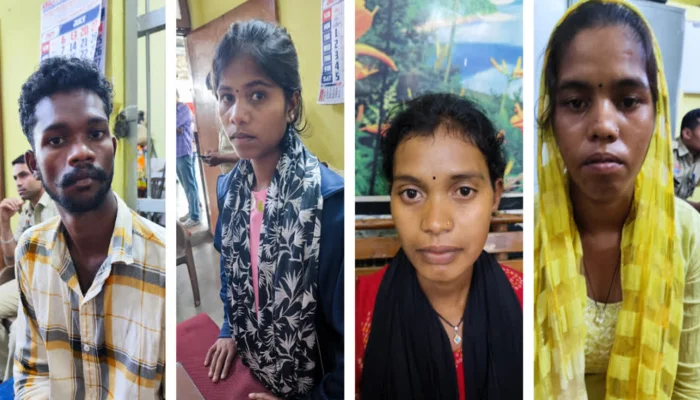
In Durg, three tribal Hindu girls were lured, brainwashed and offered inducement for religious conversion by two Christian nuns and a man. According to reports, the tribal Hindu girls from Orchha village in Narayanpur district were lured away by the Christian nuns on the pretext of getting them a job at a Catholic hospital. The girls were minors, and none of them had studied beyond the eighth grade. Moreover, their parents were also unaware of the situation. They were stopped at the Durg railway station by a train conductor for not having a platform ticket. When they were checked, they did not have any IDs, and one of the girls stated that she was being taken away without her consent. The train conductor became suspicious and informed the police and local Bajrang Dal (Hindu organisation) members. Bajrang Dal members, upon learning of the situation, gathered in large numbers at the railway station and raised slogans of Jai Shri Ram. The two nuns, the man, and the three tribal girls were taken into custody for questioning. It was revealed that the victims were being taken to Agra, where the accused were planning to convert them to Christianity. The man involved had a past record of converting tribal girls and was known to have participated in similar activities earlier. As of the date of writing this report, the police have registered a case against the two nuns and the man. The investigation was ongoing.
Case Images
Why it is Hate Crime ?
This case has been added to the tracker under the primary category of: - Predatory Proselytisation. Within it, the sub-category selected is: - Conversion/ attempts to convert by inducement. Predatory Proselytisation is not just limited to threat, harassment, force and violence, but it also has contours of stealth. In several cases, the Hindu victim is exploited to convert, with non-Hindus taking advantage of their poverty. In such cases, the Hindu victim who is suffering financially is offered monetary benefits, including lucrative offers for jobs, health treatment, education, etc, to induce the victim into changing his/her religion. In such cases, the religious identity of the victim and the aim to disenfranchise him from his faith form the heart of the crime. Also, taking advantage of and exploiting an individual’s economic vulnerabilities is widely acknowledged as exploitation, forms of which are often penalised by law. Such cases therefore are considered religiously motivated hate crimes since the victim’s religious identity forms the very heart of the crime itself. The other sub-category relevant here is: - Proselytisation by grooming, brainwashing, manipulation or subtle indoctrination, with the tertiary category being: - Pattern of targeting Hindus. Religious brainwashing essentially means the often subtle and forcible indoctrination to induce someone to give up their religious beliefs to accept contrasting regimented ideas. Religious grooming or brainwashing also involves propaganda and manipulation. It involves the systematic effort, driven by religious malice and indoctrination, to persuade “non-believers’ to accept allegiance, command, or doctrine to and of a contrasting faith. Cases of such grooming or brainwashing are far more nuanced than direct threats, coercion, inducement and violence. In such cases, it is often seen that there is repeated, subtle and continual manipulation of the victim to induce disaffection towards their own faith and acceptance of the contrasting faith of the perpetrator. While subtle indoctrination is widely acknowledged as predatory, an element which is often understated in such conversions or the attempts of such conversion is the role of loyalty and trust which might develop between the perpetrator and the victim. Fiduciary relationships are often abused to affect such religious conversion. For example, an educator transmitting religious doctrine of a competing faith to a Hindu student. The Hindu student is likely to accept what the teacher is transmitting owing to existence of the fiduciary relationship. The exploitation of the fiduciary relationship to religiously indoctrinate victims would also be included in this category. Since the underlying animosity towards the victim’s faith forms the basis of predatory proselytization, such cases are considered religiously motivated hate crimes. This case has been added to the tracker because three Hindu girls were lured away by Christian nuns under the pretext of providing them employment. In the context of predatory proselytisation, such promises of jobs, healthcare, or education are not expressions of compassion but deliberate instruments of religious manipulation. These are not acts of kindness or charity but are calculated attempts to exploit vulnerable Hindus due to their religion. By providing inducements to Hindus to change their faith, the Christian perpetrators were effectively emotionally blackmailing those vulnerable Hindus who might have been desperate for assistance. Such instances are seen in many cases where members of Christian missionary groups target socially and economically vulnerable Hindus to further their agenda of religious conversions. This form of coercion strips Hindus of their agency and dignity and enforces forced conversions. These are not random or isolated incidents but rather are premeditated efforts to undermine the Hindu faith, persuade Hindus to discard their own faith, and convert to Christianity. Such acts are deeply rooted in religious animosity towards Hindu victims. Furthermore, the reports state that the man involved had a record of converting tribal girls. Such repeated actions, especially when they involve inducement or manipulation, are a clear example of a religiously motivated crime because they are directed at undermining the religious and cultural identity of Hindus through manipulation and unlawful means. It also highlights that the conversions weren’t isolated or accidental but part of a long-term strategy targeting Hindus from tribal areas. By focusing specifically on Hindus, these Christian missionaries were religiously profiling vulnerable individuals (often from economically weaker groups) and working systematically to erase their Hindu identity. The Christian faith, by its very theological foundations, places a strong emphasis on proselytisation. In pursuit of conversion objectives, Christian evangelists often employ unethical means, ranging from psychological pressure and misinformation to inducements such as money or jobs. These tactics are designed not as acts of charity but as tools to engineer religious change under the guise of social upliftment, particularly among vulnerable and underprivileged communities. This systematic attempt to erode the religious foundation of individuals and replace it with allegiance to another faith reflects deep religious malice and animus against the Hindu identity. Because the core motivation of the act stems from hostility toward the victim’s religion, it meets the threshold of a hate crime. The other concerning part here is that all the Hindu victims were minors, indicating a lack of consent and a genuine change of conscience. It is a well-established fact that children are more susceptible to manipulation since they are still developing emotionally, cognitively, and socially. Their brains are not fully mature, making them more vulnerable to influence and less capable of critically evaluating information. Moreover, subtle manipulation tactics can be difficult to detect, especially when employed by trusted authority figures in positions of influence. This makes it challenging for parents to identify and address instances of religious manipulation. Consequently, cases involving religious manipulation of minors not only represent an infringement on an individual's religious freedom but also demonstrate a calculated strategy of targeting those who are less able to resist or understand the long-term implications of conversion, making it a significant case of religiously motivated hate crime. For all the above reasons, this incident has been categorised as a hate crime and documented in the database.
Victim Details
Total Victim
3
Deceased
0
Gender
- Male 0
- Female 3
- Third Gender 0
- Unknown 0
Caste
- SC/ST 3
- OBC 0
- General 0
- Unknown 0
Age Group
- Minor 0
- Adult 3
- Senior Citizen 0
- Unknown 0


Case Status
Case sub-judice


Perpetrators Details
Perpetrators
Christian Extremists
Perpetrators Range
From 2 To 5
Perpetrators Gender
both
 Sources




