Hindu activist targeted; falsely implicated for speaking against Ram Navami attacks on Hindus by Police in West Bengal, Kolkata
 Kolkata, West Bengal, India
  27 March, 2026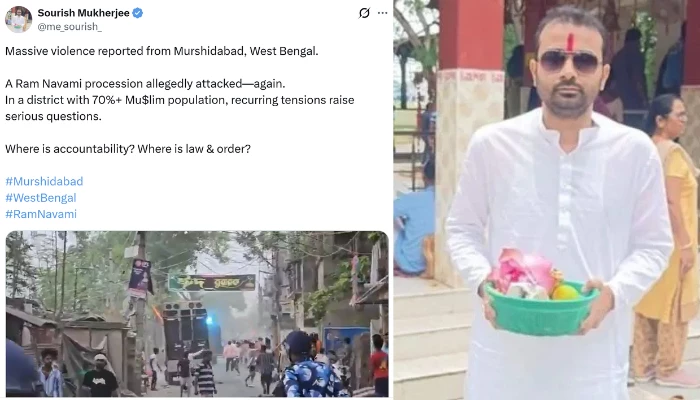
Case Summary
In Kolkata, on 28 March 2026, a Hindu activist was targeted and falsely implicated under penal sections of Bharatiya Nyaya Sanhita. The victim had shared a post on social media speaking against attacks on Hindus during the occasion of Ram Navami. The Kolkata Police registered an FIR against Hindu activist Sourish Mukherjee and the X handle “Befitting Facts” for social media posts concerning the attack on Hindus during Ram Navami processions in Murshidabad and Purulia, West Bengal. The action followed social media posts made by Sourish Mukherjee in relation to the violence that took place on 27 March 2026 during Ram Navami in Murshidabad. In his X post, he stated that severe violence had taken place in the district and that the Ram Navami procession had again come under attack. He also raised questions regarding accountability and law and order in the district. The post referred to the attack on the Ram Navami shobha yatra in Murshidabad, during which stones and bricks were thrown at the procession. The procession was attacked more than once as it moved forward. Hinduphobia documented two such incidents of violence that were reported from West Bengal's Murshidabad area on the day of Ram Navami. The first was reported in the Sisatla area of Raghunathganj, Murshidabad, where a Ram Navami procession was disrupted, and devotees were attacked by some anti-social elements following a dispute over the playing of music. The second incident happened in the Jangipur area of Murshidabad, West Bengal, where violence erupted during a Ram Navami procession after a saffron flag associated with the religious event was desecrated by some miscreants. Notably, police arrested several accused in connection with the clashes that broke out during the Ram Navami procession in Raghunathganj, Murshidabad. Reports stated that more than 29 people were arrested, and several people sustained injuries during the violence. Despite this, the Kolkata police registered an FIR at the Cyber Police Station, Kolkata, under Section 353(2), Section 196(1) and Section 353(1)(b) of the Bharatiya Nyaya Sanhita, accusing the Hindu activist of promoting public disturbance and disseminating false news. After the FIR was registered, Sourish Mukherjee posted on X that he had been booked again for speaking up against the targeting of Hindus during Ram Navami in Murshidabad and stated that the case had been filed over his social media post. It is important to mention here that apart from Murshidabad, similar visuals of violence had also emerged from the Para area of Purulia in West Bengal, where a peaceful Ram Navami procession was also targeted.
Why it is Hate Crime ?
This case has been added to the tracker under the primary category of "Attack not resulting in death." Under this, the subcategory selected is- Attacked for opposing radicals or trying to save victim. In several cases, Hindus are attacked for opposing religiously motivated crimes being committed against a fellow Hindu or simply for voicing an opinion opposing radical elements, who either have in the past or continue to persecute Hindus. In such cases, the initial attack against the victim, against which the Hindu was trying to defend the victim, would also need to be classified as a religiously motivated hate crime. Since the initial crime itself was religiously motivated and the subsequent crime of attempting to save the victim or speaking against the radical elements ends up inviting a violent attack, it would also be classified as a religiously motivated hate crime under this category. The immediate trigger, in this case, was the criminal action taken against a Hindu activist for speaking about the attack on Hindus during Ram Navami. The core issue was not merely the registration of an FIR. Rather, it was the fact that drawing attention to violence against Hindus was itself treated as wrongful conduct. When speaking about an attack on a religious procession became the basis of police action, it directly affected the community’s ability to speak openly about the violence it faced. Further, the response of the authorities shifted attention away from the original attack and towards the person who highlighted it. Instead of focusing on those who disrupted and attacked the procession, legal action was taken against the individual who brought the incident into public view. Consequently, this had the effect of muting discussion around violence against Hindus and, in turn, downplaying the seriousness of the original incident. Moreover, this also amounted to a direct violation of fundamental rights enshrined by the Constitution of India. The Constitution of India under Article 19(1)(a) guaranteed the right to freedom of speech and expression, while under Article 21 protected life and personal liberty. Further, the Supreme Court has consistently interpreted these rights to include the right to live with dignity and free from arbitrary State action. When an individual is prosecuted for speaking the truth about violence faced by a religious community, it strikes at the very core of democratic values. In a constitutional democracy, speech that sought accountability for public violence cannot be casually criminalised. Such action creates fear, suppresses lawful expression, and weakens the citizens’ faith in constitutional protections. Additionally, the police's conduct assumed greater significance in this context. The primary duty of law enforcement was to act against those responsible for the attack and restore public confidence. Instead, proceeding against the speaker created the impression that attention was being diverted from the actual perpetrators. This weakened confidence in impartial policing and gave rise to the perception that awareness itself was being discouraged. Consequently, the implications extended beyond the individual case. It sent a wider message that speaking about attacks on Hindus, even when based on truth, could lead to criminal consequences. Such action discouraged reporting, reduced public awareness, and indirectly shielded those responsible for the original violence. Further, this incident had to be viewed in the broader context of West Bengal, where several incidents involving attacks on Hindus, killings, and the abuse of Hindu deities had been recorded. In the period leading up to Ram Navami, too. Therefore, penalising speech about such violence deepened the sense among Hindu devotees that their suffering was being minimised rather than addressed. For instance, in West Bengal’s Bolpur, Trinamool Congress (TMC) leader Chandranath Sinha made offensive remarks against Lord Ram ahead of Ram Navami. The accused also mocked the revered Hindu slogan "Jai Sri Ram". The accused made offensive remarks about Lord Ram by saying that “Lord Ram is a north Indian deity” and that in Bengal, only Goddess Kali is worshipped. He also went on to mock the revered Hindu slogan “Jai Sri Ram” by saying that “Jai Sri Ram” would not work in West Bengal. In another case, in the Garalgacha area of Tarakeswar in Hooghly district, West Bengal, three Hindu families were targeted and attacked by a Muslim mob following a social media post. They vandalised the houses and the properties of Hindu households. According to reports, the Muslim mob assembled and attacked after the announcement was made from the loudspeaker in a mosque. A FIR against the culprits who obstruct peace is the norm, but filing one only to harass the victim, that too by the State, was a grave misuse of legal process and a direct assault on justice and constitutional freedoms. Overall, this was not a routine legal step. By treating truthful speech on an attack as criminal, the incident weakened accountability, reinforced prejudice, and risked normalising silence around communal violence faced by Hindus. Therefore, this case was included under the tracker. Disclaimer: The Hinduphobia Tracker records incident dates based on when crimes occur, not when they are reported in the media. Since the exact date of the incident was not specified, 28 March 2026, being the date of the notice against the victim, was selected as the indicative incident date for documentation purposes.
Victim Details
Total Victim
1
Deceased
0
Gender
- Male 1
- Female 0
- Third Gender 0
- Unknown 0
Caste
- SC/ST 0
- OBC 0
- General 0
- Unknown 1
Age Group
- Minor 0
- Adult 1
- Senior Citizen 0
- Unknown 0


Case Status
Unknown


Perpetrators Details
Perpetrators
State and Establishment
Perpetrators Range
Unknown
Perpetrators Gender
unknown
 Sources




