Idols of Hindu deities desecrated by miscreants ahead of Ram Navami and during Navratri celebrations in Purulia, West Bengal
 Purulia, West Bengal, India
  24 March, 2026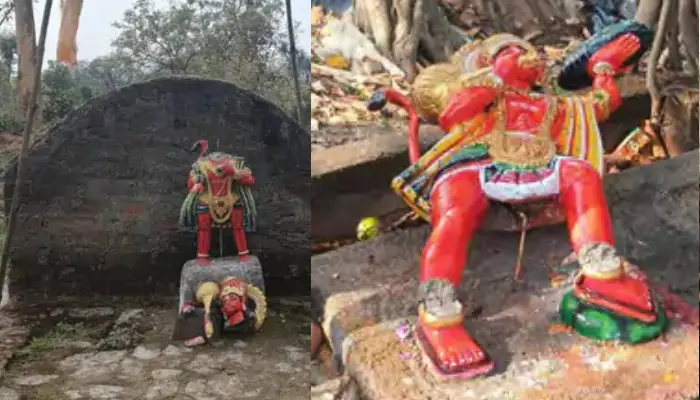
Case Summary
In the Kotshila police station area in Purulia district of West Bengal, two idols of Lord Hanuman and one idol of Goddess Basanti were desecrated by a few miscreants ahead of Ram Navami and during ongoing Navratri celebrations. According to reports, on the day of the incident, late at night, unidentified miscreants vandalised the idols under the cover of darkness. The matter came to light the following morning, leading to local unrest and concern among Hindu residents. Following this, the police were informed, and they arrested four individuals in connection with the case. The accused were identified as Garu Mahato, who was the main accused directly involved in the vandalism, Abinash Mahato, who instigated the act, Kiriti Mahato, and Kripanath Mahato. Police sources claimed that all four were active supporters and members of the Bharatiya Janata Party (BJP) in the area. Police launched a detailed probe and maintained a strict vigil to prevent any escalation of tension in the region. Reacting to the incident, the ruling Trinamool Congress (TMC) said that the vandalised idols would be reinstalled before Ram Navami. The ruling party, TMC, also claimed that the BJP was trying to create social unrest before the West Bengal state elections. Meanwhile, the Bharatiya Janata Party vehemently denied these allegations and claims made by the TMC and the West Bengal police. Party leaders said they had no involvement in the incident and that their workers were implicated as part of a conspiracy. Purulia Superintendent of Police Vaibhav Tiwari said four people were arrested in connection with the vandalism, and the entire incident was under investigation. He added that the police were vigilant to maintain law and order. Police continuously patrolled the area, and precautionary measures were taken to prevent any untoward incidents. The administration maintained that the situation was under control, and every effort was made to maintain peace and order. A news outlet named "Hindu Voice" on their official X handle also made assertions against the claims of the Trinamool Congress, police and their supporters. Hindu Voice asserted that the first accused was named Gaddu Mahato and stated as a fact that all the accused hailed from the Kudmi community and were members of the ‘Kudmi Movement’ in Purulia district, which demanded Scheduled Tribe status and was led by Ajit Prasad Mahato, a known anti-Hindu figure who openly spoke against Hinduism in many rallies, including making derogatory remarks against Goddess Durga, after which Hindus demanded his arrest and filed complaints, but the Trinamool Congress government never acted. It noted that due to his anti-Hindu stance, his organisation splintered, with even his son Biswajit Mahato leaving to join the Bharatiya Janata Party a few years ago. In 2026, Ajit Prasad Mahato demanded a seat in the Joypur Assembly Constituency, but the Bharatiya Janata Party surprisingly nominated Biswajit Mahato instead, angering Ajit and his supporters, who local sources said broke the murti. Hindu Voice added that police immediately arrested four persons, confirmed by local sources as members of Ajit Prasad Mahato's organisation, not the Bharatiya Janata Party, and provided no information or hints about any Bharatiya Janata Party connection.
Why it is Hate Crime ?
This case is added to the Hinduphobia Tracker under the primary category- Attack on Hindu religious representations. The subcategory selected is- Desecration of Hindu religious symbol. Icons and symbols or a religious representation of a spiritual ideal are widely revered in Hinduism. Iconography is of vital significance in the Hindu milieu. It helps connect people’s spiritual beliefs with the real world. Iconography within the Hindu faith takes several shapes and forms. Murtis are of most significance to Hindus, to which daily rituals, prayers and offerings are done. Besides the murtis, there are several other symbols which have deep significance in the Hindu faith – the Om and Swastika for example. Since these Hindu religious symbols hold paramount importance in Hinduism, any desecration of symbols, icons, murtis, religious representations and manifestations, is driven by animosity towards the faith itself which manifests itself through these murtis, icons and symbols. Therefore, any desecration of these Hindu religious symbols and representations is considered religiously motivated hate crimes under this category. This incident in Purulia, West Bengal, represents a clear instance of a religiously motivated hate crime as the perpetrators deliberately desecrated two idols of Lord Hanuman ahead of Ram Navami and one idol of Goddess Basanti during the Navratri festival. In Hinduism, idols hold profound religious significance as they are not mere statues but living manifestations of the divine. Devotees revere them through rituals like prana pratishtha, where the deity's life force is invoked, transforming the idol into a sacred embodiment of gods such as Lord Hanuman, the devoted protector and symbol of strength, or Goddess Basanti, a revered form of the Divine Mother associated with power and protection in regional traditions. The desecration of these specific idols shatters this sacred connection, inflicting deep emotional and spiritual hurt on the Hindu community. It stands as a direct affront to the entire Hindu faith, stirring profound outrage and vulnerability, as it signals to the Hindu community that their most cherished religious symbols can be desecrated with impunity. This act reveals deep-seated religious animosity towards Hindus, targeting their core beliefs and making it unequivocally a hate crime. The timing of these attacks amplifies their malicious intent and underscores their nature as a hate crime. The desecration of the Hanuman idols occurred just ahead of Ram Navami, the joyous festival celebrating the birth of Lord Rama, where Hindus honour Lord Ram along with his eternal companion Hanuman through processions, fasting, and temple rituals that embody devotion and communal unity. Similarly, the shattering of Goddess Basanti's idol took place during the ongoing Navratri celebrations, a nine-night worship of the Goddess in her fierce forms, marked by garba dances, fasting, and prayers for victory over evil. By striking at these precise moments, the perpetrators aimed to sabotage the sacred festivities, instilling fear and desecrating the very spirit of Ram Navami and Navratri. This calculated disruption causes severe pain to Hindu sentiments during their most revered observances, evoking a sense of siege where faith itself feels under assault, thereby fulfilling the hallmarks of a hate crime driven by religious animosity. Given that this case meets multiple parameters of a religiously motivated crime, including targeted desecration of sacred symbols, timing aligned with major festivals, and intent to inflict communal trauma, it is now being added to the hate crime database of the Hinduphobia Tracker. Disclaimer: The Hinduphobia Tracker records incidents based on the date the crime occurs, not when it is reported by the media. In this case, media reports have not specified the exact date of the desecration; therefore, the media reporting date of 25 March 2026 is being used as the indicative incident date solely for documentation purposes.


Case Status
Arrested


Perpetrators Details
Perpetrators
Others
Perpetrators Range
From 2 To 5
Perpetrators Gender
both
 Sources




