Hindu families targeted, houses vandalised over social media post by Muslim mob after announcements to assemble was made on Mosque loudspeaker
 Hooghly district, West Bengal, India
  17 March, 2026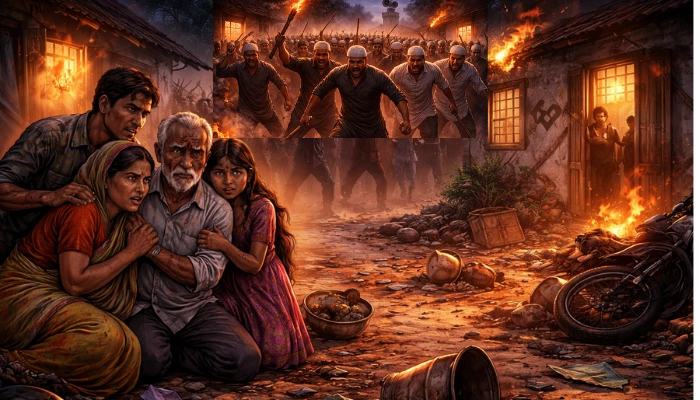
Case Summary
In the Garalgacha area of Tarakeswar in Hooghly district, West Bengal, three Hindu families were targeted and attacked by a Muslim mob following a social media post. They vandalised the houses and the properties of Hindu households. According to reports, the Muslim mob assembled and attacked after the announcement was made from the loudspeaker in a mosque. According to local accounts, the incident was triggered by a Facebook comment made by a Hindu man named Vishal Rui Das. The comment was in response to content shared by a Bangladeshi user. What began as an online interaction escalated beyond the digital space. Subsequently, announcements were made through a mosque loudspeaker in the locality, calling people to gather and attack Hindu houses. Residents stated that this was followed by the assembly of a mob. The gathered mob then targeted three houses belonging to Hindu families in the area. The houses were singled out and vandalised. Eyewitnesses described groups moving through the locality, damaging property. The attack created panic in the area, and the affected families were left in a distressed condition. Residents reported an atmosphere of fear and tension in the locality following the incident. The seriousness of the incident drew the attention of the National Commission for Scheduled Castes. Commission member Partha Biswas visited the area to assess the situation and interact with the victims. During the visit, concerns were raised about recurring tensions in the area and the need for further scrutiny of such incidents. The residents also stated that police action was delayed and that several individuals involved in the violence had not been apprehended. Police stated that efforts were ongoing to identify and apprehend those responsible.
Why it is Hate Crime ?
This case is being added to the tracker under the primary category- Attack not resulting in death. The sub-category selected in this case is "Communal clash/attack". Communal clash is a form of collective violence that involves clashes between groups belonging to different religious identities. For a communal clash between Hindus and non-Hindus to qualify as a religiously motivated hate crime, the trigger of the violence itself would have to be anti-Hindu in essence. For example, if there is a Hindu religious procession that comes under attack from a non-Hindu mob and after the initial attack, Hindus retaliate in self-defence, leading to a communal clash between the two religious communities. While at a later stage, both communities are involved in the clash/violence, the initial trigger of the violence was by the non-Hindu mob against the Hindus, and therefore, it could safely be termed as an anti-Hindu violence. Further, the trigger would also have to be religiously motivated. In the cited example, the attack by the non-Hindu mob was against religious processions and therefore can be concluded to be religiously motivated. In some cases, the trigger may be non-religious; however, it develops into religious violence against Hindus at a later stage. In such cases, too, the foundational animosity towards Hindus becomes the motivating factor of the crime, and therefore, it would be classified as a religiously motivated hate crime against Hindus under this category. The other selected subcategory is "Attacked for Hindu identity." In several cases, Hindus are attacked merely for their Hindu identity without any perceived provocation. A classic example of this category of religiously motivated hate crime is a murder in 2016. 7 ISIS terrorists were convicted for shooting a school principal in Kanpur because they got ‘triggered’ seeing the Kalava on his wrist and the tilak that he had put. In this, the Hindu victim had offered no provocation except for his Hindu religious identity. The motivation for the murder was purely religious, driven by religious supremacy. Such cases where Hindus are targeted merely for their religious identity would be documented as a hate crime under this category. Another primary category selected is- Hate speech against Hindus. The selected subcategory is Violent threats. Violent threats, explicit, implicit or implied, are the most dangerous form of hate speech since they go beyond discriminatory and prejudicial language to express the intent of causing harm to an individual or a group of people based on their religious identity and faith. There could be several different kinds of threats that are issued to Hindus based on religious animosity. An explicit threat would mean the direct threat of violence towards an individual Hindu, a group of Hindus or Hindus at large. Physical violence, death threats, threats of destruction of property belonging to Hindus and threats of genocide would mean explicit threats against Hindus for their religious identity. Implicit threats may not be a direct threat but implied through the use of symbols of actions – for example, in the Nupur Sharma case, other than explicit threats, there were also implicit threats when Islamists took to the streets to burn and beat her effigies. It implies that they want to do the same to Nupur Sharma, which is considered an implicit threat. Violent threats can be delivered in person, by letter, by phone, through graffiti, or increasingly via social media and other online platforms. It would be important to understand that a threat – explicit or implicit, online or offline – to an individual who happens to be a Hindu does not qualify as a religiously motivated threat. Such a threat, while vile and dangerous, could be owing to non-religious reasons and/or personal animosity. To qualify as a religiously motivated threat, it would need to exhibit an indication that the individual is being targeted for religious reasons and/or owing to his/her religious identity as a Hindu. This case was marked by a clear religious identifier from the very beginning; the victims were Hindu families, and their homes were specifically singled out and attacked. At the outset, the violence was directed at identifiable Hindu households, establishing that their religious identity was central to the attack. Further, the trigger itself revealed the nature of the targeting. The social media comment was made by a Hindu individual in response to a Bangladeshi user. However, the reaction came from local Muslims who directed their anger at Hindu families in their own locality. This showed that the social media post was used as a pretext to unleash violence against nearby Hindus. Importantly, the scale of violence was completely disproportionate to the trigger. If we take a moment to think, a social media comment led to a mob attack on uninvolved families; this would surely lead us towards hate-driven, planned attacks. This disproportion showed that the objective was not to resolve a grievance but to assert dominance through fear and force. Moreover, the mobilisation via a mosque loudspeaker gave the incident a coordinated, collective dimension. It indicated that people were called upon to gather and act against Hindu families. This demonstrated that the response was organised and community-driven, not spontaneous. In addition, in a lawful society, such issues were meant to be addressed through legal mechanisms. Instead, the perpetrators chose to bypass the law and resort to mob violence against Hindus, reflecting a deliberate choice. Notably, the aftermath created a deep psychological impact. The affected families were left distressed, and the wider Hindu community experienced fear and insecurity. This atmosphere discouraged normal life and made individuals feel unsafe in their own homes. Taken together, these actions showed that local Hindus were made to bear the brunt of anger and were deliberately targeted, using disproportionate violence to intimidate and silence the community. Disclaimer: In this case, it was reported that members of 3 Hindu families were affected by the violence and harassment. However, the exact number of individuals was not specified. Due to this lack of clarity, the most recent Indian census data was relied upon, which indicates that the average family size in India is approximately 4.8 members per household. To ensure a standardised estimation, an average of 5 members per family was considered. Based on this approach, the estimated total number of victims in this case was 15. Further, media reports indicated that members of 3 Hindu families, estimated at 15 individuals, were affected. However, no gender-wise breakdown was provided. For clarity of documentation, a proportional demographic estimate was applied using India’s Census 2011 and NFHS-5 (2019–21) rural population data. Accordingly, the 15 individuals were estimated as 8 men (50%) and 7 women (50%), reflecting a near-equal gender distribution consistent with typical rural family demographics. As the age-wise segregation was also not specified in the report, a similar proportional estimate was applied. Accordingly, the 15 individuals were estimated as 11 adults (70%) and 4 children (30%).
Victim Details
Total Victim
15
Deceased
0
Gender
- Male 8
- Female 7
- Third Gender 0
- Unknown 0
Caste
- SC/ST 0
- OBC 0
- General 0
- Unknown 15
Age Group
- Minor 4
- Adult 11
- Senior Citizen 0
- Unknown 0


Case Status
Complaint filed


Perpetrators Details
Perpetrators
Muslim Extremists
Perpetrators Range
From 10 to 100
Perpetrators Gender
unknown
 Sources




