Ram Navami procession disrupted and devotees attacked following dispute over music in Raghunathganj, West Bengal
 Murshidabad, West Bengal, India
  26 March, 2026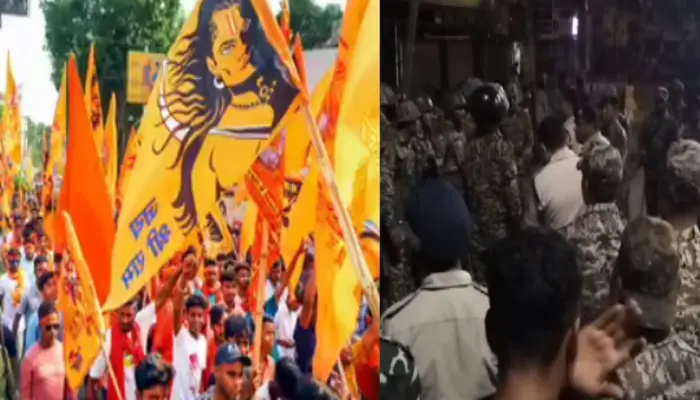
Case Summary
In the Sisatla area of Raghunathganj, Murshidabad, a Ram Navami procession was disrupted, and devotees were attacked by some anti-social elements following a dispute over the playing of music. The procession, comprising Hindu devotees from nearby villages, was moving towards Mackenzie Park when it passed through Sisatla, where an argument erupted between the Hindu devotees and local residents regarding the use of music during the religious event. The disagreement quickly escalated into a confrontation, which turned violent as both sides engaged in clashes. Stones and bricks were hurled at the devotees, leading to chaos in the area and disrupting the movement of the procession. The situation quickly escalated, leading to widespread clashes and disruption in the area. As the clashes intensified, incidents of vandalism and disorder were reported in and around Sisatla, contributing to a wider atmosphere of unrest across Raghunathganj. Several individuals sustained injuries during the confrontation, while fear and panic gripped local residents. Police and security forces, including personnel from the Rapid Action Force, were deployed to the area to control the situation. Authorities undertook measures to disperse the crowds and restore order, following which the situation was brought under control, though tensions persisted in the locality. This incident must also be viewed within the broader pattern of systemic bias against Hindus in West Bengal, where expressions of Hindu religious identity are frequently restricted, contested, or portrayed as provocative. There are increasing instances where the state actively suppresses Hindu religious expression. Hindus have been arrested simply for chanting “Jai Shri Ram”, a phrase vilified by sections of the administration and ruling party. Permission for Hindu processions, especially during festivals like Ram Navami or Hanuman Jayanti, is routinely denied on grounds of "law and order concerns", while Muslim religious gatherings face no such hurdles. Moreover, over the years, the Mamata-led government has issued numerous prejudicial directives, like orders restricting Durga Puja immersions, citing Muharram processions. Inaction on anti-Hindu mob violence in areas like Dhulian, Islampur, and Kaliachak. Public endorsements and appeasement of radical clerics and Islamist leaders, while dismissing concerns raised by Hindu groups as “communal provocation”. The systematic suppression of Hindu voices, the denial of communal violence, and the criminalisation of Hindu identity expressions such as “Jai Shri Ram” reflect not just administrative failure but a deeper ideological hostility toward the Hindu community. This sustained pattern of differential treatment has contributed to an atmosphere in which Hindu religious assertion is not treated on equal footing, and where opposition to such expression is normalised. The incident in Raghunathganj reflects this broader trend, where a Hindu religious procession became the focal point of confrontation, reinforcing concerns regarding the vulnerability of such expressions within an already sensitive communal environment.
Why it is Hate Crime ?
This case is added to the Hinduphobia Tracker under the primary category - Attack not resulting in death. Within it, the sub-category selected is - Attack for Hindu identity. In several cases, Hindus are attacked merely for their Hindu identity without any perceived provocation. A classic example of this category of religiously motivated hate crime is a murder in 2016. 7 ISIS terrorists were convicted for shooting a school principal in Kanpur because they got ‘triggered’ seeing the Kalava on his wrist and tilak that he had put. In this, the Hindu victim had offered no provocation except for his Hindu religious identity. The motivation for the murder was purely religious, driven by religious supremacy. Such cases where Hindus are targeted merely for their religious identity would be documented as a hate crime under this category. The other sub-category selected here is - Attack on religious procession. The outward celebration and display of religious symbols is an intrinsic part of Hinduism. Religious processions on various festivals are age-old traditions and a way to manifest faith and form a part of the religious practices of Hindus. On several occasions, such religious processions come under attack by non-Hindu mobs, in a manifestation of their animosity towards Hinduism and its practices. The reasons cited for such violent attacks are many and range from crossing a non-Hindu resident-dominated area to playing loud music, crossing from an area where there is a religious structure of another faith, etc. The violent attacks are triggered by the outward display of religiosity by Hindus. The attacks are mainly a manifestation of religious supremacist doctrine, which believes that idolatry, essentially the Hindu faith, deserves to be annihilated since the very tenets of Hinduism, its practices and traditions, are considered a sin in those doctrines. Since these attacks emanate from intrinsic and doctrinal animosity towards Hindus and Hinduism, it is considered a religiously motivated hate crime under this category. The other subcategory is - Attack against Hindu devotees. Hindu devotees are a few of the easiest targets of religiously motivated hate crimes because, during the festival/procession/puja, etc., for non-Hindus, it is easy to profile their victims based on religion. Hindu devotees come under attack on several occasions by individual non-Hindus or mobs of non-Hindus owing to their animosity against Hinduism, its symbols and tradition/practices. There are several instances of Hindu devotees being attacked while they worship in temples or temporary religious structures, during religious processions, doing bhajan/kirtan/puja in their own homes, in the residential society, etc. These attacks are perpetrated by non-Hindus primarily because of their animosity towards Hindus and their faith. In some cases, the trigger for the violence may be non-religious; however, two elements make these hate crimes. First, the Hindus who come under attack are attacked violently while indulging in religious activity. Whether they are in a place of worship or not is immaterial to the crime. When individuals are attacked while indulging in religious practices, the attack in itself is a hindrance to their freedom to practice religion and therefore constitutes a hate crime. Secondly, religious supremacist doctrines and ideologies deem religious practices of Hindus to be offensive ab initio since they are considered “sinful” by these ideologies, worthy to be annihilated by force or coercion. Driven by these religious supremacist ideologies and doctrines, the attacks against Hindu devotees stem from intrinsic animosity towards Hinduism. In some cases, the trigger for the violence may be non-religious; however, it develops into a religiously motivated crime during the course of the violence. Since these attacks stem from animosity towards Hindus and Hinduism, they are considered religiously motivated hate crimes under this category. The other subcategory selected is- Communal Clash/Attack. Communal clash is a form of collective violence involving conflicts between groups with different religious identities. For a communal clash between Hindus and non-Hindus to qualify as a religiously motivated hate crime, the trigger of the violence itself would have to be anti-Hindu in essence. For example, if there is a Hindu religious procession that comes under attack from a non-Hindu mob and after the initial attack, Hindus retaliate in self-defence, leading to a communal clash between the two religious communities. While at a later stage, both communities are involved in the clash/violence, the initial trigger of the violence was by the non-Hindu mob against the Hindus, and therefore, it could safely be termed as an anti-Hindu violence. Further, the trigger would also have to be religiously motivated. In the cited example, the attack by the non-Hindu mob was against religious processions and therefore can be concluded to be religiously motivated. In some cases, the trigger may be non-religious; however, it develops into religious violence against Hindus at a later stage. In such cases, too, the foundational animosity towards Hindus becomes the motivating factor of the crime, and therefore, it would be classified as a religiously motivated hate crime against Hindus under this category. This case constituted a potential instance of a religiously motivated hate crime, as a Ram Navami procession in the Raghunathganj area of Murshidabad was disrupted following a dispute over the playing of music during the religious event. The trigger of the incident lay in the public expression of Hindu faith through a religious procession, which is an established and integral form of religious observance. The objection raised to the use of music during the procession directly interfered with a customary religious practice, thereby creating conditions for confrontation. The obstruction and subsequent escalation impacted the ability of the devotees to carry out their religious practices peacefully. Hindu processions, particularly during festivals such as Ram Navami, involve devotional music, chanting, and collective participation, all of which form essential components of the religious experience. The dispute over music, which is intrinsic to such processions, effectively disrupted the normal conduct of the religious event and curtailed the devotees’ ability to practise and express their faith without hindrance. If locals had genuine concerns regarding the playing of music, they could have been addressed through lawful and administrative channels by approaching the authorities. Instead, the procession was obstructed at the site, and the situation escalated into a violent confrontation, indicating a breakdown of lawful means of grievance redressal. Moreover, the escalation into violence reinforced the communal nature of the incident. What began as a disagreement over the playing of music quickly developed into clashes involving stone-pelting and violence against the Hindu devotees, leading to injuries and disruption of public order. The fact that the confrontation occurred in the context of an ongoing Ram Navami procession meant that the Hindu devotees, identifiable through their participation in the event, were placed at risk. They were subjected to violence over a relatively minor issue, and the procession itself was disrupted, further interfering with the peaceful conduct of the religious activity. Importantly, such incidents reflect a recurring pattern where elements intrinsic to Hindu religious expression, such as processions, music, and public celebration, become points of contention. The procession itself, and the associated practices, appeared to act as the immediate trigger for the dispute. There was no indication of any disproportionate action by the devotees beyond the customary conduct of the procession, suggesting that the conflict arose in response to the visible assertion of religious identity in a shared public space. Additionally, the incident reflected a restriction on the expression of Hindu religious identity. The disruption of the procession through confrontation and violence created an environment in which the free and open practice of religion was impeded. Such disruptions not only affect the immediate participants but also contribute to a broader sense of insecurity among the Hindu community, discouraging outward expressions of faith in the future. The interruption of a religious procession due to objections to its customary practices, followed by escalation into violence, undermined this fundamental right by making its exercise contingent upon the absence of opposition. Taken together, the disruption of a Hindu religious procession, the objection to its customary practices such as music, and the escalation into violence indicate elements consistent with a religiously motivated hate crime. However, in the absence of definitive attribution of intent or targeting by identified perpetrators, the case reflects a situation where religious expression became the focal point of conflict, warranting careful classification based on emerging evidence.


Case Status
Unknown


Perpetrators Details
Perpetrators
Unknown
Perpetrators Range
Unknown
Perpetrators Gender
unknown
 Sources




