Hindu faith targeted: Revered Hindu kings, sacred rituals, and Hindutva denigrated by Tamil Nadu politician
 Tamil Nadu, India
  29 January, 2026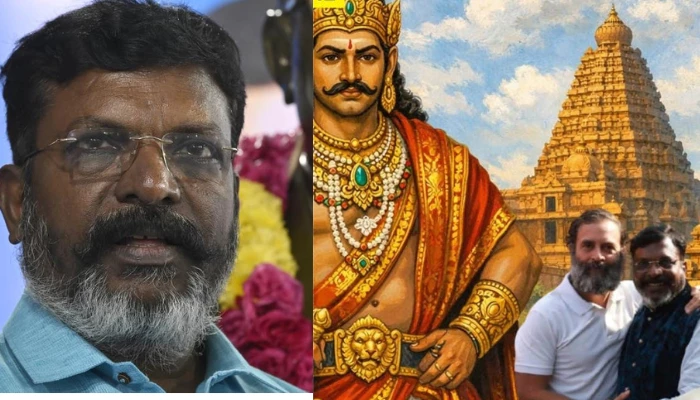
Case Summary
In Tamil Nadu, revered Hindu empires and kings of the Cheras, Cholas, Pandyas, and Pallavas were insulted by Dravida Munnetra Kazhagam (DMK) ally Viduthalai Chiruthaigal Katchi (VCK) Member of Parliament Thiru Thirumavalavan. He remarked that the country became 'worthless' in their time. He also mocked Hinduism by targeting sacred Hindu rituals like yajnas and havans. He further derided the Sanskrit language for its connection to Hinduism and also mocked Hindutva. The accused’s derogatory remarks were widely criticised on social media after a video of him addressing a public gathering surfaced. In the video, he was seen passing disparaging comments against Tamil Hindu rulers. He said, “I had no respect for any king. I did not see anyone as some great power. It was in the time of those kings that this country became worthless, became Sanskrit-ised, became Hindutva-ised.” He further stated that Tamil Hindu rulers mismanaged the kingdom and reduced it to shreds. He stated, “It was in the time when these Pandya kings, Chola kings, Chera kings, Pallava kings ruled that Tamil, which was in the sanctum sanctorum of the Tamil temples, was thrown out.” Taking a jibe at the rulers’ names, he remarked, “The one who conducted sacrificial rites, the one who did yajnas, changed Tamil names and attached northern-language names behind their own names. Was ‘Rajaraja’ a Tamil name? Was ‘Rajendra’ a Tamil name? They were all people who put northern-language names on themselves, who were mesmerised by the northern language (Sanskrit), who were lost in the sacrificial rituals and yajnas of Brahmins.” He further stated that these kings eroded Tamil heritage and culture and devastated it. Meanwhile, K. Annamalai, former Bharatiya Janata Party leader, strongly criticised the remarks against Tamil rulers and kings. He stated on his social media account, “Having long blamed the Bharatiya Janata Party and the Sangh Parivar for anything that happened in Tamil Nadu, Member of Parliament Thiru Thirumavalavan had now travelled back over ten centuries to slander the great Chola and Pandya kings, under whose enlightened rule the Tamil language flourished far beyond the geographical boundaries of present-day Tamil Nadu.” He questioned, “If he chose to question whether the names Raja Raja Chola and Rajendra were Tamil, one may well ask whether names like Karunanidhi, Stalin, Udhayanidhi, Dayanidhi, Kalanidhi and others in the Gopalapuram family were Tamil names.” Further, he objected to the portrayal of the kings in such a lowly manner and stated that such remarks only reflected profound ignorance of rich history. At the time of documenting this incident, Viduthalai Chiruthaigal Katchi Member of Parliament Thiru Thirumavalavan and the Dravida Munnetra Kazhagam had not issued any clarification, apology, or response to the remark.
Why it is Hate Crime ?
This case has been documented under the selected primary category: Hate speech against Hindus. Under this, the selected secondary category is: Mocking/Denigrating Hindu leaders. Hate speech is defined as any speech, gesture, conduct, writing, or display that is prejudicial against a specific individual and/or group of people, which leads to or may lead to violence, prejudicial action or hate against that individual and/or group. Religious leaders are often seen as representatives of the community, especially the community’s religious faith and beliefs. Mocking or denigrating a religious leader specifically owing to his religious identity and/or the religious rituals he observes can be considered hate speech because the motivating factor of the speech is animosity and/or dislike for what he represents – the religious beliefs and faith of the community. It is important to note that mere insulting words against an individual do not constitute hate speech. Insulting words may be used for an individual; however, the specific speech is not the result of religious hate and/or animosity towards the professed faith of the religious leader, but the individual himself. For the speech to be considered hate speech, the speech itself or the motivating factor behind the speech has to be religious in nature. Such speech, which denigrates Hindu religious leaders specifically owing to animosity towards the faith they profess and the community faith they represent, will be treated as hate speech under this category. The other secondary category selected is- Anti-Hindu slurs, mocking faith. Anti-Hindu slurs and the deliberate mocking of the Hindu faith owing to religious animosity involve the usage of derogatory terms, stereotypes, or offensive references to religious practices, symbols, or figures. One of the common anti-Hindu slurs used against Hindus is “cow-worshipper” and “cow piss drinker”. The intention of using this term is to demean and mock Hindus as a group and their religious beliefs since Hindus consider the cow holy. Additionally, some symbols and the slurs attached to them have a historical context that exacerbates the insult, hate, stereotyping, dehumanisation and oppression against Hindus. Cow worship has been used for centuries to denigrate Hindus, insult their faith and oppress Hindus specifically as a religious group. There has been overwhelming documentation about how cow slaughter has been used to persecute Hindus, with cow meat being thrown in temples and places of worship. There has also been overwhelming documentation where cow meat (beef) has been force-fed to Hindus to either forcefully convert them to Islam or denigrate their faith. Apart from cow worship, the Swastika – which holds deep religious significance for the Hindus – has also been misinterpreted and distorted to use as a slur against Hindus. Similarly, the worship of the Shivling has been used by supremacist ideologies and religions to denigrate Hindus owing to religious animosity. Such slurs and denigration stem from inherent animosity and hate towards Hindus and their faith; therefore, it is categorised as hate speech targeted at Hindus specifically owing to their religious identity. In this case, to begin with, the accused's denigration of revered Hindu kings, declaring that they rendered the country 'worthless', constitutes hate speech rooted in anti-Hindu hatred by directly desecrating icons of Hindu pride and heritage. The Cholas, Pandyas, Cheras, and Pallavas command immense reverence among the Hindu community as divine-chosen rulers who built magnificent temples like the Brihadeeswarar (Chola), Meenakshi (Pandya), and Kailasanatha (Pallava), symbolising dharma, architectural genius, and spiritual sovereignty that Hindus worldwide venerate in festivals, literature, and pilgrimage. By mocking these emperors as failures who 'Sanskrit-ised' and 'Hindutva-ised' the land, the accused assaulted the community's historical self-image, inciting emotional injury and communal division through deliberate vilification of Hindu civilisational achievements. Furthermore, his attack on Sanskrit as a catalyst for national downfall exemplifies hate speech by targeting the sacred linguistic foundation of Hinduism, evoking anti-Hindu animus akin to historical Dravidianist campaigns against so-called 'Aryan imposition'. Sanskrit holds unparalleled reverence among Hindus as the devabhasha of the Vedas, Upanishads, Bhagavad Gita, and temple rituals, chanted daily in homes, ashrams, and mandirs from Kashi to Kanchipuram. Downgrading it as a 'northern language' that mesmerised kings erodes Hindu identity at its scriptural core, framing the faith itself as an alien, degenerative force, a trope weaponised to alienate Tamil Hindus from their pan-Indian spiritual legacy. In addition, the remarks' exclusive focus on Hindus and Hinduism, sparing rulers or practices of other faiths, reveals targeted hate speech designed to isolate and demonise one community. While ancient Tamil kings from non-Hindu or syncretic traditions escaped scrutiny, only Hindu Chera-Chola-Pandya-Pallava monarchs faced slander for yajnas, havans, and Sanskritised names, mirroring selective communal targeting. This one-sided assault fosters enmity under the guise of critique, disproportionately targeting Hindus and their revered rulers, due to religious animosity. Moreover, a discernible pattern of anti-Hindu insults emerged in this case. Hindu rulers were demeaned as yajna-obsessed betrayers, essentially belittling sacred Hindu rituals, making it a religiously motivated hate speech. Also, sacred traditions like havans were ridiculed while no equivalent scorn targeted Islamic, Christian, or indigenous non-Hindu elements in Tamil history. Yajnas and havans hold profound significance in Hinduism as Vedic fire rituals invoking divine blessings for prosperity, dharma, and cosmic harmony. They were performed by kings like the Cholas for realm protection and enshrined in texts like the Rigveda as essential to righteous rule. Denigrating such rituals amounts to hate speech by sacrilegiously mocking core Hindu worship and equating spiritual sanctity with fanaticism. This manifests as hate speech by systematically undermining Hindu symbols of reverence, such as the kings' temple-building as a dharmic duty. It evokes the community's collective anguish over erased glories. The one-sidedness amplifies bigotry, portraying Hinduism as inherently regressive. Additionally, the perpetrator mocked the concept of Hindutva, framing it as a degenerative force that 'Hindutva-ised' the country during the era of revered Hindu kings, which constitutes hate speech by weaponising the Hindutva term as a euphemism to target Hindus and Hinduism. The accused's language repeatedly collapsed any distinction between Hindutva and the Hindu religious identity of Tamil rulers like the Cholas and Pandyas, transferring hostility onto the Hindu community and making religious targeting appear politically justified. Hindutva functions as a unifying framework through which Hindus sought to preserve their cultural and religious identity after centuries of erosion due to Islamic invasions, British colonisation, and Christian theological impositions and conversions; it is not inherently destructive, yet he portrayed it as such to delegitimise the kings' dharmic legacy. This rhetorical strategy enabled animosity toward Hindus to be reframed as principled opposition to an ideology, thereby masking religious prejudice. That this euphemism serves as a proxy for hostility toward Hinduism has been openly acknowledged in spaces such as the Dismantling Global Hindutva Conference in the United States, where speakers explicitly stated that Hinduism and Hindutva are indistinguishable and that dismantling Hindutva would require dismantling Hinduism itself. Such admissions expose the semantic strategy used to justify targeting Hindus. This case matches that same pattern of targeting Hinduism and Hindus under the garb of 'Hindutva', making it an anti-Hindu hate speech. Another point to highlight is that anti-Hindu parties like the Dravida Munnetra Kazhagam, allied with Viduthalai Chiruthaigal Katchi Member of Parliament Thiru Thirumavalavan, weaponise such narratives as hate speech to perpetuate ideological assaults on Hinduism, advancing Dravidian separatism by recasting revered Hindu empires as cultural traitors. Hindus revere these dynasties for exporting Hindu traditions like Siddhanta Shaivism and Sri Vaishnavism across Asia via traders and navies, fostering unity through shared epics like the Kamba Ramayanam. By exploiting terminological debates over names like Rajaraja, these statements undermine Hindu unity, incite sectarian discord and infighting, and normalise anti-Hindu bigotry as 'progressive discourse', exposing calculated, religiously motivated hatred. Notably, this incident was not the first time that Dravida Munnetra Kazhagam (DMK) party members or their allies engaged in anti-Hindu hate speech. The Hinduphobia Tracker has meticulously documented many such previous instances. For instance, in January 2026, in Tamil Nadu, a politician named Karunas, associated with the DMK ( Dravida Munnetra Kazhagam) party, stated that there is no religion like Hinduism. He also tried to create conflicts between different Hindu sects. Another example, in August 2025, in Kumbakonam, Tamil Nadu, vicious and inflammatory comments against the Hindu community were made by a Christian Dravida Munnetra Kazhagam (DMK) functionary named Ramesh. He called Hindus "sons of prostitutes". Similarly, on 16 January 2024, derogatory remarks targeting Lord Ram and the Ram Janmabhoomi Temple at Ayodhya were made by Dravida Munnetra Kazhagam (DMK) leader Uma Ilakkiya. A video of her abusing Lord Ram went viral on social media. Similarly, in 2023, DMK politician and Tamil Nadu Deputy Chief Minister Udhayanidhi Stalin, son of Chief Minister MK Stalin, equated Hinduism to dengue and malaria, calling for its annihilation. He stated, "Sanatana is like malaria and dengue, and so it must be eradicated, not opposed." This current case, meeting the criteria for hate speech alongside prior instances by DMK members, has been incorporated into the Hinduphobia Tracker's hate crime database. Disclaimer: The Hinduphobia Tracker records the date of an incident based on when the crime occurs, rather than when it is reported by the media. However, in this case, media reports did not state the exact date on which the crime occurred. Therefore, 30 January 2026, the date on which this incident was first reported by the media, is being recorded as the indicative incident date, for the purpose of documentation only.


Case Status
Unknown


Perpetrators Details
Perpetrators
State and Establishment
Perpetrators Range
One Person
Perpetrators Gender
male
 Sources




