Hindu devotees verbally humiliated by DMK HR&CE minister during Suchindram temple festival, Tamil Nadu
 Suchindram, Tamil Nadu, India
  1 January, 2026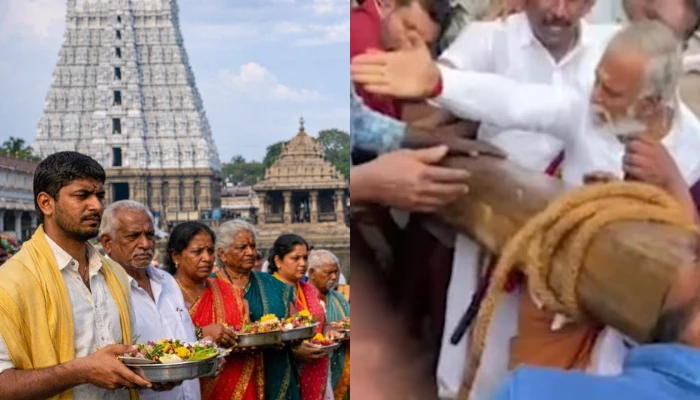
Case Summary
At the Suchindram Temple festival in Kanyakumari district, Tamil Nadu, Hindu devotees were verbally abused and humiliated by a senior Dravida Munnetra Kazhagam leader, P K Sekar Babu. As per reports, during the temple festival, DMK HR&CE Minister P. K. Sekar Babu shouted obscenities at Hindu devotees gathered at the temple premises. He shouted at the Hindu devotees and made a crude remark comparing temple food to filth. This created shock and distress among worshippers present at the sacred site. In a video that circulated publicly, the minister was heard yelling at devotees, asking them whether they were “eating food or shit.” The minister was seen using crude and degrading language directed at worshippers participating in a sacred Hindu religious event. The incident occurred inside a Hindu temple space during an active religious festival attended by families, elderly devotees, and pilgrims. The minister was present in his official capacity as the authority overseeing Hindu temples and religious institutions in the state. The verbal outburst was directed at devotees during temple rituals, not in a political rally or administrative meeting. The language used was abusive, humiliating, and derogatory, reducing Hindu worshippers to objects of contempt within their own sacred space. The incident drew public outrage, with Hindu groups and observers condemning the behaviour as deeply offensive, undignified, and reflective of hostility toward Hindu religious sentiment. No immediate disciplinary action against the minister was reported following the incident.
Why it is Hate Crime ?
The primary category selected for this case is: Hate Speech against Hindus, while the subcategory is: Anti-Hindu slurs, mocking faith. Anti-Hindu slurs and the deliberate mocking of the Hindu faith owing to religious animosity involve the usage of derogatory terms, stereotypes, or offensive references to religious practices, symbols, or figures. One of the common anti-Hindu slurs used against Hindus is “cow-worshipper” and “cow piss drinker”. The intention of using this term is to demean and mock Hindus as a group and their religious beliefs since Hindus consider the cow holy. Additionally, some symbols and the slurs attached to them have a historical context that exacerbates the insult, hate, stereotyping, dehumanisation and oppression against Hindus. Cow worship has been used for centuries to denigrate Hindus, insult their faith and oppress Hindus specifically as a religious group. There has been overwhelming documentation about how cow slaughter has been used to persecute Hindus, with cow meat being thrown in temples and places of worship. There has also been overwhelming documentation where cow meat (beef) has been force-fed to Hindus to either forcefully convert them to Islam or denigrate their faith. Apart from cow worship, the Swastika – which holds deep religious significance for the Hindus – has also been misinterpreted and distorted to use as a slur against Hindus. Similarly, the worship of the Shivling has been used by supremacist ideologies and religions to denigrate Hindus owing to religious animosity. Such slurs and denigration stem from inherent animosity and hate towards Hindus and their faith; therefore, it is categorised as hate speech targeted at Hindus specifically owing to their religious identity. This incident qualified as a hate crime because it reflected institutional hostility towards Hindus expressed through abuse, humiliation, and contempt for Hindu religious life by a state authority. The incident did not occur in isolation. DMK HR&CE Minister P. K. Sekar Babu had repeatedly been associated with remarks and conduct that demonstrated hostility and disregard towards Hindu religious practices and devotees. Primarily, this incident is recorded as a hate crime because: Firstly, the abuse targeted Hindus because they were participating in a Hindu religious festival, making the humiliation inseparable from their religious identity. Secondly, the incident occurred inside a sacred Hindu temple, where worshippers were entitled to dignity and reverence. Verbal degradation within such a space constituted an attack on religious sanctity. Thirdly, the abuse was delivered through state authority. When a minister controlling Hindu religious institutions humiliated devotees during worship, the act assumed an institutional and power-backed character. Fourthly, the language used was vulgar and dehumanising, a recognised marker of hate, stripping devotees of dignity and reducing their religious presence to contempt. Finally, the incident had to be read alongside the minister’s prior conduct and the broader pattern of hostility towards Hindu religious life displayed by the ruling party. The minister had participated in a public meeting calling for the eradication of Sanatana Dharma, an event that drew judicial censure and widespread condemnation for targeting the foundational belief system of Hinduism. He had overseen the placement of a temple-style gopuram structure at the memorial of an avowed atheist leader, an act widely viewed as symbolic appropriation and disrespect towards Hindu religious architecture. He had publicly trivialised the suffering of Hindu devotees standing in long queues at major temples. Hindu devotees affected by the demolition of Lord Murugan temple structures had appeared before the court. They stated that the minister mistreated them and failed in his duty towards Hindu religious interests. Under his tenure, the HR&CE Department had obstructed statutory audits, with the Comptroller and Auditor General recording non-cooperation, raising concerns over the misuse of temple funds and the erosion of accountability towards Hindu charitable assets. His repeated involvement in incidents where Hindu worshippers were treated with disrespect established a clear pattern. The authority entrusted with administering Hindu temples had consistently engaged with devotees in a manner that undermined their dignity and religious sentiment. The episode at Suchindram Temple, therefore, formed part of a continuing pattern rather than an isolated lapse. The hate element was aggravated by the minister’s institutional role as head of the Hindu Religious and Charitable Endowments Department. He bears a statutory duty to protect Hindu religious practices and respect Hindu beliefs. Instead, he used degrading and vulgar language against Hindu devotees inside a consecrated temple space during a religious festival, constituting a misuse of authority and an expression of contempt towards the community he was mandated to serve. The Dravida Munnetra Kazhagam had repeatedly featured in public discourse for actions, rhetoric, and propaganda hostile towards the Hindu religion and religious expression. Multiple cases documented by the Hinduphobia Tracker showed DMK leaders and state authorities engaging in verbal denigration of Hindu beliefs and sacred symbols, administrative obstruction of Hindu religious practices, selective enforcement of regulations disadvantaging Hindu rituals, and state-led actions targeting Hindu temples and sacred spaces. When viewed against this backdrop, the humiliation of Hindu devotees at Suchindram Temple was not an isolated incident of inappropriate language. It reflected an established political and administrative posture where the Hindu faith and worship were treated with disrespect, suspicion, and hostility. Although no physical violence occurred, hate crimes were not limited to bodily harm. Institutional verbal abuse and humiliation of Hindus inside a temple by a state authority constituted a serious violation of religious dignity. For these reasons, the incident qualified as a religiously motivated hate incident against Hindus and was documented in the Hinduphobia Tracker as an instance of state-enabled humiliation and hostility towards Hindu devotees. Disclaimer: The Hinduphobia Tracker records the date of an incident based on when the crime occurs, rather than when it is later reported in social or mainstream media. In this case, no specific date is available regarding when the ordeal began. Therefore, the date, when the matter was first highlighted by the media, 2nd January 2026, is being used as the indicative date of the incident.


Case Status
Unknown


Perpetrators Details
Perpetrators
State and Establishment
Perpetrators Range
One Person
Perpetrators Gender
male
 Sources




