Hindu community subjected to abuses and threats, revered Hindu symbol insulted by Dravidian politicians in Tamil Nadu
 Madurai, Tamil Nadu, India
  21 December, 2025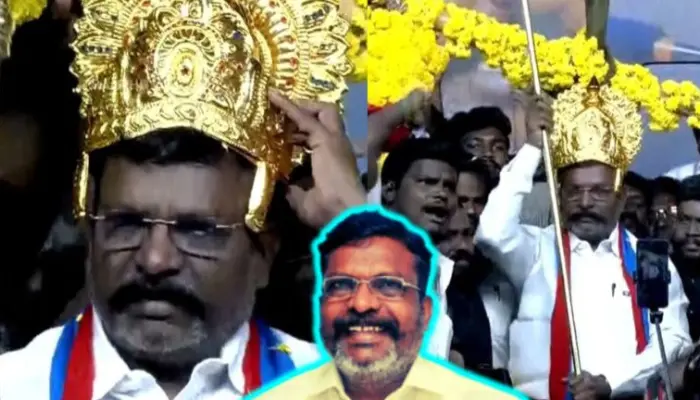
Case Summary
In Tamil Nadu, the Hindu community was subjected to abuses and threats, and the revered Hindu symbol, Vel, a sacred weapon of Lord Kartikeya/Murugan, was insulted by Dravidian politicians associated with the Viduthalai Chiruthaigal Katchi (VCK) party. The accused used the Vel as a tool to run their anti-Hindu politics and make hate speech targeting the Hindu community. A public meeting of the Viduthalai Chiruthaigal Katchi (VCK) took place in Thirupparankundram in Madurai on 22nd December 2025. The meeting featured a striking display of religious symbolism, with party president and DMK-Congress ally Lok Sabha Member of Parliament Thol Thirumavalavan receiving a Vel and a crown from VCK leaders on stage amidst anti-Hindu slogans. Videos circulating in news media showed VCK functionaries presenting the Vel not as a Hindu religious symbol of divine grace associated with Lord Murugan, but as a political emblem representing social justice, caste annihilation, and equality. The cadre repeatedly declared that the Vel served to “drive away Sanatana forces,” meaning Hindu forces, and protect social justice, drawing loud applause and slogan-chanting from the crowd. During the event, VCK leaders from the Madurai southern and suburban districts took turns presenting the Vel and a crown to Thirumavalavan. The people chanted “We will chase them (Hindus) away” and references to confronting “Sanatana gangs.” They also referred to Hindus as “religious extremist groups” and threatened to target them. VCK speakers also referred to Murugan’s Vel as a “victorious weapon” aimed at opposing Hindus, asserting that it symbolised resistance rather than worship. This incident occurred after the Tamil Nadu DMK government disallowed Hindu devotees from performing the traditional Karthigai Deepam ritual at Thiruparankundram Hill in Madurai. Karthigai Deepam, celebrated during the full moon of the Karthigai month, honours Shiva in his Agni form, and the Maha Deepam lighting at the Arunachaleswarar Temple attracts millions of devotees globally. This led to mass mobilisation by Hindu organisations and devotees who called it a violation of their religious rights and led to the Madurai Bench of the Madras High Court ruling that the Karthigai Deepam lamp could be lit on the ancient stone pillar located on Thiruparankundram hill in Madurai. The order came on Monday (1st December 2025) after the court heard four petitions requesting permission to light the lamp at this traditional spot, known locally as the Deepathoon.
Why it is Hate Crime ?
The primary category selected in this case is- Hate speech against Hindus. The subcategory selected is- Anti-Hindu slurs, mocking faith. Anti-Hindu slurs and the deliberate mocking of the Hindu faith owing to religious animosity involve the usage of derogatory terms, stereotypes, or offensive references to religious practices, symbols, or figures. One of the common anti-Hindu slurs used against Hindus is “cow-worshipper” and “cow piss drinker”. The intention of using this term is to demean and mock Hindus as a group and their religious beliefs since Hindus consider the cow holy. Additionally, some symbols and the slurs attached to them have a historical context that exacerbates the insult, hate, stereotyping, dehumanisation and oppression against Hindus. Cow worship has been used for centuries to denigrate Hindus, insult their faith and oppress Hindus specifically as a religious group. There has been overwhelming documentation about how cow slaughter has been used to persecute Hindus with cow meat being thrown in temples and places of worship. There has also been overwhelming documentation where cow meat (beef) has been force-fed to Hindus to either forcefully convert them to Islam or denigrate their faith. Apart from cow worship, the Swastika – which holds deep religious significance for the Hindus – has also been misinterpreted and distorted to use as a slur against Hindus. Similarly, the worship of the Shivling has been used by supremacist ideologies and religions to denigrate Hindus owing to religious animosity. Such slurs and denigration stem out of inherent animosity and hate towards Hindus and their faith, therefore, it is categorised as hate speech targeted at Hindus specifically owing to their religious identity. The other subcategory selected is- Violent Threats. Violent threats, explicit, implicit or implied, is the most dangerous form of hate speech since it goes beyond discriminatory and prejudicial language to express the intent of causing harm to an individual or a group of people based on their religious identity and faith. There could be several different kinds of threats that are issued to Hindus based on religious animosity. An explicit threat would mean the direct threat of violence towards an individual Hindu, a group of Hindus or Hindus at large. Physical violence, death threats, threats of destruction of property belonging to Hindus and threats of genocide would mean explicit threats against Hindus for their religious identity. Implicit threats may not be a direct threat but implied through the use of symbols of actions – for example – in the Nupur Sharma case, other than explicit threats, there were also implicit threats when Islamists took to the streets to burn and beat her effigies. It implies that they want to do the same to Nupur Sharma – thereby is considered an implicit threat. Violent threats can be delivered in person, through letters, phone calls, graffiti, or increasingly through social media and other online platforms. It would be important to understand that a threat – explicit or implicit, online or offline – to an individual who happens to be a Hindu does not qualify as a religiously motivated threat. Such a threat, while vile and dangerous, could be owing to non-religious reasons and/or personal animosity. To qualify as a religiously motivated threat, it would need to exhibit an indication that the individual is being targeted for religious reasons and/or owing to his/her religious identity as a Hindu. Another primary category selected is- Attack on Hindu religious representations. The subcategory selected is- Desecration of Hindu religious symbol. Icons and symbols or a religious representation of a spiritual ideal are widely revered in Hinduism. Iconography is of vital significance in the Hindu milieu. It helps connect people’s spiritual beliefs with the real world. Iconography within the Hindu faith takes several shapes and forms. Murtis are of most significance to Hindus, to which daily rituals, prayers and offerings are done. Besides the murtis, there are several other symbols which have deep significance in the Hindu faith – the Om and Swastika for example. Since these Hindu religious symbols hold paramount importance in Hinduism, any desecration of symbols, icons, murtis, religious representations and manifestations, is driven by animosity towards the faith itself which manifests itself through these murtis, icons and symbols. Therefore, any desecration of these Hindu religious symbols and representations is considered religiously motivated hate crimes under this category. In this case, Viduthalai Chiruthaigal Katchi (VCK) leaders committed a clear instance of anti-Hindu hate speech and hate crime by deliberately misusing the Vel, a sacred Hindu religious symbol wielded by Lord Kartikeya/Murugan, to target, abuse, and threaten the Hindu community. They branded Hindus collectively as "religious extremists", exposing their deep-seated animosity towards an entire religious group. This blanket labelling of all Hindus as extremists stripped the community of dignity and constituted a direct anti-Hindu slur, designed to incite widespread hatred against the Hindu community. The crowd and VCK leaders openly threatened to "chase away" all Hindus, chanting "We will chase them away" while making repeated references to confrontations with "Sanatana gangs." These statements issued explicit violent threats against the Hindu community, promising physical violence, expulsion, and direct confrontation. Such calls elevated the incident beyond mere speech into a religiously motivated hate crime, as they instilled immediate fear among Hindus. Threatening Hindus with physical violence and vowing to drive them out further exposed the VCK's profound religious animosity towards the Hindu community. This aggressive rhetoric not only intimidated individual devotees but also sought to suppress Hindu religious practices and public expressions of faith through sustained fear and intimidation. Hindu participants at the event or viewers online faced palpable terror, underscoring the intent to marginalise and silence the Hindu community. The accused also mocked the Hindu faith by declaring the Vel a "victorious weapon" specifically to oppose Hindus, thereby stripping it of its profound divine significance. They portrayed this sacred lance as a mere political tool for "driving away Sanatana forces," repurposing a Hindu symbol solely to promote violence and hatred against the community. This profane desecration exemplified religiously motivated hate speech, as it ridiculed core Hindu beliefs while weaponising Hindu faith's symbols against devotees. By these actions, the accused desecrated the sanctity of the Vel, a divine weapon held in profound reverence by the Hindu community as Lord Murugan's instrument of protection, grace, and triumph over evil. Lord Murugan (Kartikeya), revered across South India as the god of war and wisdom, wields the Vel in scriptures to vanquish demons and safeguard dharma, making it a potent symbol of spiritual power and cultural identity. The VCK's exploitation of this icon for anti-Hindu propaganda, politics, and inflammatory speeches constituted outright desecration of a sacred Hindu religious symbol, marking a clear, religiously motivated hate crime that wounded the collective faith of millions of devotees. Given that this case meets the parameters of a religiously motivated crime, it is being added to the hate crime database of the Hinduphobia Tracker.


Case Status
Unknown


Perpetrators Details
Perpetrators
Others
Perpetrators Range
Unknown
Perpetrators Gender
unknown
 Sources




