Leftist historian calls Hindu goddess an appropriation of Christian Mother Mary and denigrates Hindutva, portrays it as a colonial product
 Kolkata, West Bengal, India
 15 January, 2026
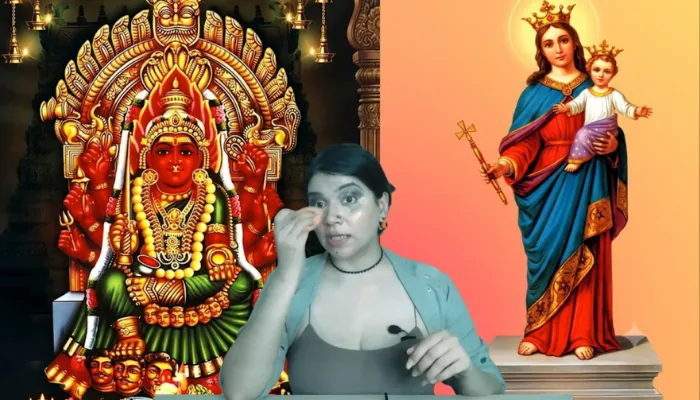
Case Summary
Leftist historian Ruchika Sharma denigrated the revered Hindu goddess Mariamman by claiming that she was Mother Mary, who had been appropriated into Hinduism. Sharma stated that “Mariamma was, of course, the Christian Mary”, presenting this as an example of how Hinduism had appropriated deities from other religions and assimilated local cult figures. Her remarks disregarded the goddess's distinct Hindu identity and indigenous religious origins. She also tried to portray the Hindutva movement as a colonial product. The remarks were made during "The Debate 2026", organised by the Calcutta Debating Circle on 16 January 2026, around the motion “Hinduism Needs Protection From Hindutva”. Sharma spoke in support of the motion alongside Mahua Moitra, a Trinamool Congress (TMC) Member of Parliament; Mani Shankar Aiyar, a former Congress Union Minister and senior party leader; and Ashutosh, a former Aam Aadmi Party (AAP) leader and journalist. Those opposing the motion included Swapan Dasgupta, a journalist and former Rajya Sabha Member of Parliament; Sudhanshu Trivedi, a Bharatiya Janata Party (BJP) Rajya Sabha MP and national spokesperson; Agnimitra Paul, a BJP leader and Member of the West Bengal Legislative Assembly; and J Sai Deepak, an advocate and author. The discussion was moderated by Prasenjit K Basu and Mridula Mukherjee, a historian and former professor at Jawaharlal Nehru University. During the debate, Sharma called the revered Hindu goddess Mariamman an appropriation of the Christian figure of Mother Mary, claiming that the latter had been assimilated into Hinduism. She further argued that Hinduism was inherently pluralistic and had developed through the assimilation of local cults, regional deities and influences from other religious traditions, including Buddhism, Jainism, Sufism and Christianity. Citing "Dabistan-i Mazahib" and Al-Biruni's "Kitab al-Hind", she accused proponents of Hindutva of misunderstanding the historical development of Hinduism and maintained that the term Hindu had been used in a pluralistic sense from as early as the seventh century. Apart from this, Sharma cited Goddess Pampa, whom she described as a local cult deity assimilated into the Shaiva tradition as a form of Shakti. She similarly described Lord Jagannath as a local cult deity assimilated into Vaishnavism. She also referred to Lord Krishna, arguing that his assimilation with a local cowherd deity called Gopal had contributed to his popularity. Sharma further invoked Pir Baba Haji Ratan Nath, whom she described as a Nathpanthi and Sufi saint. She stated that his shrine was located in Peshawar and that a shrine dedicated to Lord Shiva stood outside his mazar. Drawing a connection between the Nathpanthi tradition and Uttar Pradesh Chief Minister Yogi Adityanath, she remarked that it was 'unfortunate' that the tradition had reached its present state. She additionally argued that Hinduism had borrowed the art of temple construction and idol-making from Mahayana Buddhism, while the concept of Ashtadikpalas, the eight guardian deities of temples, had been adopted from Jainism. Citing British colonial administrator William Sleeman's 1849 account of Bahraich, she referred to his observation that Hindus and Muslims revered the shrine of Syed Salar. She used this example to argue that people belonging to different religious communities could worship the same religious figures without changing their faith. Sharma also accused British colonial authorities of defining Hinduism negatively as the religion of those who were neither Muslim nor Christian. She alleged that Hindutva proponents had adopted the same colonial definition of Hindu identity and argued that Hindutva had borrowed extensively from colonialism. Notably, this was not the first time Ruchika Sharma had targeted Hindus, Hinduism or Hindutva. Prior to this incident, the Hinduphobia Tracker had documented two other anti-Hindu antecedents involving Sharma. On 6 October 2025, Sharma abused the Hindu community on X (formerly Twitter), calling Hindus “goons” in response to journalist Rajdeep Sardesai's tweet condemning the attempted shoe-hurling at Chief Justice of India BR Gavai by advocate Rakesh Kishor. Referring to the controversy surrounding CJI Gavai's derogatory remarks about a devotee seeking the restoration of a desecrated Lord Vishnu idol at Khajuraho, Sharma stated: “Average Sanatani (Hindu) is a gunda (goon), who uses violence to subvert democratic institutions. What a shame! Court is court, not your religion’s jagir.” Her remarks portrayed Hindus as violent and intolerant while mocking their religious grievances and devotion to Lord Vishnu. On another occasion, Sharma, a television panellist on India Today and Aaj Tak, made controversial remarks while criticising revisions to the NCERT history curriculum. She described several changes as “factually incorrect”, downplayed the imposition of Jizya by Muslim rulers and questioned the textbook's assertion that the tax was used to incentivise conversions to Islam. She also attempted to justify Mughal emperor Akbar's massacre of Hindus at Chittorgarh by drawing a false equivalence with the plunder and killings committed by Hindu kings during invasions. Furthermore, she disparaged Chhatrapati Shivaji Maharaj by claiming that he had plundered southern Karnataka and promoted the Aryan Invasion Theory, a contested colonial-era interpretation of Indian history. Her remarks came amid controversy over revised NCERT textbooks documenting Mughal-era massacres, temple destruction, religious persecution and the resistance offered by Hindu rulers, including Chhatrapati Shivaji Maharaj.
Why it is Hate Crime ?
The primary category selected in this case is: Hate speech against Hindus. The subcategory selected is: Anti-Hindu subversion and prejudice. Hate speech is defined as any speech, gesture, conduct, writing, or display that is prejudicial against a specific individual and/or group of people, which is leading to or may lead to violence, prejudicial action or hate against that individual and/or group. Media plays a specific and overarching reach in perpetuating prejudicial attitudes towards a community owing to unfair, untrue coverage and/or misrepresentation/misinterpretation, selective coverage and/or omission of facts of/pertaining to issues affecting a specific religious group. This type of bias can dehumanise the victim group, making it easier for others to justify harmful actions against them, which aligns with the objectives of hate speech laws aimed at preventing such harm. It is often observed that the media takes a prejudicial stand against the Hindu community driven by their need to shield the aggressor community which happens to be a numeric minority, however, is the one perpetrating violence against Hindus. For example, the media is often quick to contextualise religiously motivated crimes against Hindus, omit or misrepresent facts that point towards religiously motivated hate crimes, justify and/or downplay religiously motivated hate crimes or simply present fake news to stereotype Hindus. Such media bias leads to the denial of persecution and is often used to dehumanise Hindus, leading to justification for violence against them. For example, the media covered several fake allegations of Hindus targeting Muslims and forcing them to chant Jai Shree Ram. Most of these cases were proved false and fabricated after police investigation. These fake news reports were subsequently never retracted or clarified. Such fake news led to the justification of violence and dehumanisation of Hindus based on the argument that since Hindus targeted Muslims and forced them to chant Jai Shree Ram, the dehumanisation of Hindus and violence against them was par for the course and merely a retaliation. Such media bias leads to prejudicial portrayal of Hindus and offers a justification for violence against them and therefore, is considered hate speech under this category. Ruchika Sharma's remarks reflected hostility towards Hinduism and its religious traditions by questioning the independent identity of a revered Hindu deity and portraying Hinduism as a faith that appropriated religious figures from other religions. Her assertions also need to be viewed in the context of her previous anti-Hindu statements. Mariamman is a revered Hindu goddess extensively worshipped across Tamil Nadu, where she is venerated as a manifestation of Goddess Parvati and Adi Shakti. She holds a significant place in the Hindu religious traditions of the region and is worshipped as the divine mother who protects devotees, grants fertility, brings rain and safeguards people against diseases. Thousands of devotees visit prominent temples dedicated to her, including the Samayapuram Mariamman Temple and Punnainallur Mariamman Temple. Her worship is deeply rooted in the Shaiva and Shakta Hindu traditions of Tamil Nadu and forms an integral part of Hindu religious and cultural life. By claiming that Mariamman was actually the Christian figure of Mother Mary appropriated into Hinduism, Sharma disregarded the goddess's distinct religious identity and denigrated the beliefs of millions of her Hindu devotees. Her assertion that Hinduism had appropriated Christian and other religious figures, without establishing any credible historical basis, further promoted a distorted portrayal of Hinduism as a derivative faith that borrowed from other religions rather than acknowledging its own diverse and independent religious heritage. Sharma's remarks also need to be viewed in the context of her previous anti-Hindu statements, which reveal a recurring pattern of denigrating Hindu religious beliefs, dismissing Hindu grievances and disparaging figures central to Hindu history. The Hinduphobia Tracker had earlier documented her referring to Hindus as 'goons' and mocking their religious sentiments and devotion to Lord Vishnu. On another occasion, she attempted to downplay the persecution of Hindus under Mughal rule, questioned the significance of Jizya, sought to justify Mughal emperor Akbar's massacre of Hindus at Chittorgarh by drawing comparisons with Hindu rulers, and made disparaging remarks about Chhatrapati Shivaji Maharaj. These incidents demonstrate a consistent pattern in which Sharma has dismissed historical and contemporary concerns of the Hindu community, trivialised atrocities committed against Hindus, and portrayed Hindu religious traditions and historical figures in a derogatory light. Her latest remarks equating a revered Hindu goddess with a Christian figure further reflect this pattern of undermining Hindu religious identity and denigrating Hindu traditions. Taken together, these incidents demonstrate recurring hostility towards Hinduism, its religious beliefs, historical legacy and adherents. Furthermore, by portraying Hindutva as a product of British colonialism and accusing it of adopting the colonial definition of Hindu identity, Sharma attempted to discredit a movement rooted in the assertion and preservation of Hindu civilisational identity. Such characterisation dismisses the historical circumstances that made the preservation of Hindu religious and cultural identity imperative, including centuries of Islamic invasions, British colonial rule, Christian missionary activities and religious conversions. By reducing Hindu civilisational assertion to a colonial construct, she also disregarded the efforts of Hindus to reclaim, preserve and protect their religious and cultural heritage. Notably, Hindutva is frequently targeted by leftist commentators like Sharma because it serves as a unifying ideology for Hindus seeking to preserve their civilisational identity and collective cultural heritage. 'Hindutva' is often used as a euphemism to make the targeting of Hindus more palatable. It is essentially a unifying ideology for Hindus, which became imperative for them to find and preserve their cultural identity, which was being eroded and attacked due to Islamic invasions, British colonisation, Christian theological impositions and conversions. Hindutva is not a destructive ideology, as some attempt to portray, but one that is used as a unifying edifice for Hindus. Hindutva is also often used as a euphemism to target Hindus as a whole, along with their religious identity and faith. It is essentially semantic jugglery to confuse Hindus into believing that their own persecution by supremacists is somehow 'justified' because the specific victims espoused an ideology (Hindutva) which deserves the onslaught. The fact that the use of 'Hindutva' can serve to mask animosity towards Hindus was evident from the 'Dismantling Global Hindutva' conference held in the USA, where speakers discussed the relationship between Hindutva and Hinduism, including arguments that dismantling Hindutva would require dismantling Hinduism. This demonstrates how rhetoric directed against Hindutva can extend beyond criticism of a political ideology to undermine Hindu religious identity, traditions and civilisational expression." Overall, considering the nature of Sharma's remarks, which denigrated a revered Hindu deity and misrepresented Hindu religious traditions, the incident meets the parameters of hate speech under the Hinduphobia Tracker's classification framework. Accordingly, the case is being added to the Hinduphobia Tracker's hate crime database.


Case Status
Unknown


Perpetrators Details
Perpetrators
Others
Perpetrators Range
One Person
Perpetrators Gender
female
 Sources



