Anti-Hindu 'historian' abuses Hindu community while backing judiciary’s open anti-Hindu prejudice
 Delhi, India
  5 October, 2025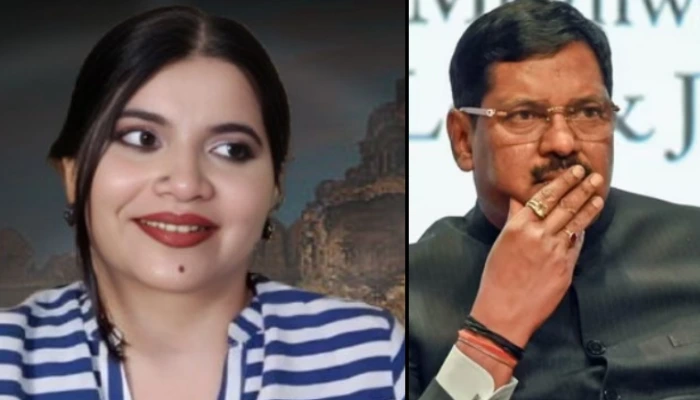
Case Summary
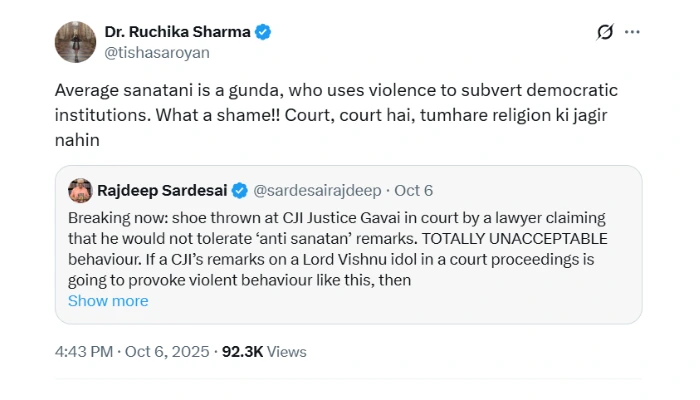
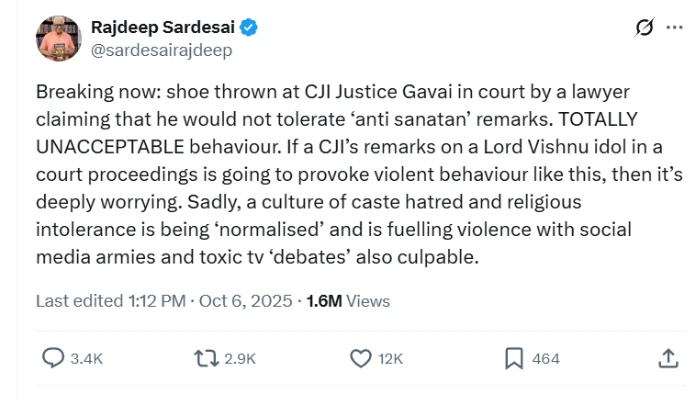
Ruchika Sharma, an anti-Hindu propagandist masquerading as a historian, used X (formerly Twitter) to launch yet another hateful tirade against Hindus, spewing slurs and abuses aimed at the Hindu community. This incident occurred on 6th October 2025. The accused, Ruchika Sharma, made the disparaging remark while replying to a post by Rajdeep Sardesai, an Indian journalist known for his left-leaning views. Rajdeep had tweeted expressing regret over the attempted shoe-hurling at the Chief Justice of India, BR Gavai, during court proceedings in the Supreme Court by a 71-year-old advocate, Rakesh Kishor, on Monday (6th October). CJI Gavai’s Hinduphobic remarks mocking a Hindu devotee of Lord Vishnu during a hearing last month apparently hurt the religious sentiments of the septagenarian advocate. Distressed, the Hindu lawyer attempted to throw a shoe at Justice Gavai in court, expressing anger at his insults towards Lord Vishnu and Hindus. Rajdeep’s tweet condemned the act. He stated, ''Breaking now: shoe thrown at CJI Justice Gavai in court by a lawyer claiming that he would not tolerate 'anti-Sanatan' (anti-Hindu) remarks. TOTALLY UNACCEPTABLE behaviour. If a CJI’s remarks on a Lord Vishnu idol in court proceedings provoke violent behaviour like this, it is deeply worrying. Sadly, a culture of caste hatred and religious intolerance is being normalised, fuelling violence, with social media armies and toxic television debates also culpable.'' In response to Rajdeep's tweet, Ruchika Sharma quote-tweeted an anti-Hindu remark, labelling Hindus as ‘gundas’, meaning ‘goons’. She stated, ''Average Sanatani (Hindu) is a gunda (goon), who uses violence to subvert democratic institutions. What a shame! Court is court, not your religion’s jagir.'' She mocked Hindus by stating that the court is not a place for religious ownership. By making this statement, Sharma not only endorsed the Chief Justice’s earlier insult toward the Hindu faith but also openly abused the Hindu community, portraying Hindus as violent and intolerant. Her remark trivialised the genuine religious grievance that had provoked outrage among devotees, mocking their faith and devotion. To understand the background of the shoe-hurling incident, it is important to recall the preceding controversy. On September 16, 2025, the Supreme Court, led by Chief Justice Gavai, dismissed a petition seeking the restoration of a seven-foot, beheaded idol of Lord Vishnu at the Javari Temple in Khajuraho, Madhya Pradesh. The idol had been desecrated during the Mughal invasions and remained defaced for centuries, a matter that holds immense religious and historical significance for Hindus. The petition, filed by Rakesh Dalal and argued by Senior Advocate Sanjay M. Nuli, sought to restore the idol in its wholeness, emphasising that it was not merely an archaeological issue but one of faith, dignity, and the fundamental right to worship. However, the bench, instead of addressing the concern respectfully, responded with mockery. Chief Justice Gavai remarked: “This is purely publicity interest litigation. Go and ask the deity itself to do something now. You say you are a staunch devotee of Lord Vishnu. So go and pray now. It is an archaeological site, and the Archaeological Survey of India needs to grant permission, etc. Sorry.” The remark, widely seen as mocking Hindu devotion, trivialised centuries of religious pain and desecration. It was in reaction to this dismissive attitude that the 71-year-old advocate later approached the bench during a hearing and attempted to throw his shoe at Justice Gavai, shouting, “Sanatan ka apmaan nahi sahenge!” (“We will not tolerate the insult of Sanatan Dharma”). Security personnel swiftly intervened and escorted him out of the courtroom.
Case Images
Why it is Hate Crime ?
The primary category selected in this case is- Hate Speech against Hindus. The subcategory selected is- Anti-Hindu slurs, mocking faith. Anti-Hindu slurs and the deliberate mocking of the Hindu faith owing to religious animosity involve the usage of derogatory terms, stereotypes, or offensive references to religious practices, symbols, or figures. One of the common anti-Hindu slurs used against Hindus is “cow-worshipper” and “cow piss drinker”. The intention of using this term is to demean and mock Hindus as a group and their religious beliefs since Hindus consider the cow holy. Additionally, some symbols and the slurs attached to them have a historical context that exacerbates the insult, hate, stereotyping, dehumanisation and oppression against Hindus. Cow worship has been used for centuries to denigrate Hindus, insult their faith and oppress Hindus specifically as a religious group. There has been overwhelming documentation about how cow slaughter has been used to persecute Hindus with cow meat being thrown in temples and places of worship. There has also been overwhelming documentation where cow meat (beef) has been force-fed to Hindus to either forcefully convert them to Islam or denigrate their faith. Apart from cow worship, the Swastika – which holds deep religious significance for the Hindus – has also been misinterpreted and distorted to use as a slur against Hindus. Similarly, the worship of the Shivling has been used by supremacist ideologies and religions to denigrate Hindus owing to religious animosity. Such slurs and denigration stem out of inherent animosity and hate towards Hindus and their faith, therefore, it is categorised as hate speech targeted at Hindus specifically owing to their religious identity. This case constitutes a clear instance of anti-Hindu hate speech. The accused, Ruchika Sharma, an anti-Hindu propagandist masquerading as a historian, used X (formerly Twitter) to post a deeply derogatory and abusive comment directed at Hindus. She labelled all Hindus as “gundas” (goons), stating that “the average Sanatani is a goon who uses violence to subvert democratic institutions.” By generalising an entire faith community as violent and lawless, Sharma exhibited explicit religious hostility and contempt for Hindus as a group. Her statement was not a critique of an individual act but a sweeping denunciation of Hindu identity itself — an unmistakable form of hate speech motivated by religious animosity. The remark was made in response to journalist Rajdeep Sardesai’s post condemning a Hindu lawyer who had attempted to hurl a shoe at Chief Justice B. R. Gavai. The act, however, stemmed from personal outrage at Gavai’s earlier Hinduphobic comments mocking Lord Vishnu and the devotion of Hindu worshippers — not from any opposition to the judiciary as an institution. Sharma’s decision to attack Hindus collectively, rather than addressing the issue of religious insult that provoked the outrage, exposes her deep-seated bias and deliberate attempt to vilify the Hindu community. It is necessary to highlight that Ruchika Sharma’s hate remark fits within her well-documented pattern of anti-Hindu behaviour. Over the years, she has repeatedly distorted Hindu history and glorified Islamic invaders under the guise of scholarship. Her writings, including her 2017 article in Scroll titled “History lesson: Padmavati was driven to immolation by a Rajput prince, not Alauddin Khilji,” whitewashed the atrocities of medieval Islamic rulers while portraying Hindu traditions in a derogatory light. She has publicly praised figures like Aurangzeb and Tipu Sultan, downplaying their persecution of Hindus, destruction of temples, and forced conversions. Through her YouTube content and social media presence, Sharma has continually propagated anti-Hindu narratives and attempted to delegitimise Hindu civilisational history. Her record further reveals a deliberate ideological bias. After once facing threats for criticising the Muslim practice of hijab, Sharma publicly declared that she would no longer speak about Islam or Muslims and would focus her criticism solely on Hindus and Hinduism. This admission makes clear that her conduct is not rooted in academic critique or free speech but in a one-sided agenda, shielding Islam from scrutiny while targeting Hindus with persistent hostility. In contrast, public figures like Rajdeep Sardesai and left-leaning media outlets attempted to portray the shoe-hurling incident as an “attack on the judiciary,” which is a dishonest misrepresentation. The act was not against a judicial verdict but a personal reaction to the Chief Justice’s sarcastic, non-judicial remarks ridiculing the Hindu faith. By framing it otherwise, such narratives aim to delegitimise Hindu grievances while excusing overt mockery of their beliefs. Sardesai even attempted to inject caste and religious angles, suggesting that the attack was due to Justice Gavai’s being a Dalit and a Buddhist, despite no evidence to support this claim. This distortion serves only to mask the real issue: the repeated public belittlement of Hindu beliefs without accountability. Returning to Ruchika Sharma, her abusive remark labelling Hindus as “goons” was not an isolated outburst but the continuation of a long-standing pattern of anti-Hindu hate. Her words deliberately demeaned an entire faith, spreading negative stereotypes and reinforcing prejudice against Hindus. Given her influential platform and history of spreading falsehoods about Hinduism, her statement carries far-reaching consequences, promoting intolerance and legitimising bias against the Hindu community. Her conduct, therefore, meets all characteristics of a religiously motivated hate crime, one aimed at demeaning, vilifying, and inciting hatred against Hindus as a group. Her consistent pattern of glorifying Islamic aggressors, distorting Hindu history, and publicly insulting Hindu devotees reflects entrenched animosity toward Hinduism. Accordingly, this case has been recorded in the Hinduphobia Tracker as a verified instance of anti-Hindu hate speech, representing both ideological hatred and targeted verbal abuse against the Hindu community..


Case Status
Unknown


Perpetrators Details
Perpetrators
Others
Perpetrators Range
One Person
Perpetrators Gender
female
 Sources




