Faith of Hindu petitioner mocked by Chief Justice of India while rejecting petition for restoration of beheaded Lord Vishnu idol
 New Delhi, Delhi, India
  15 September, 2025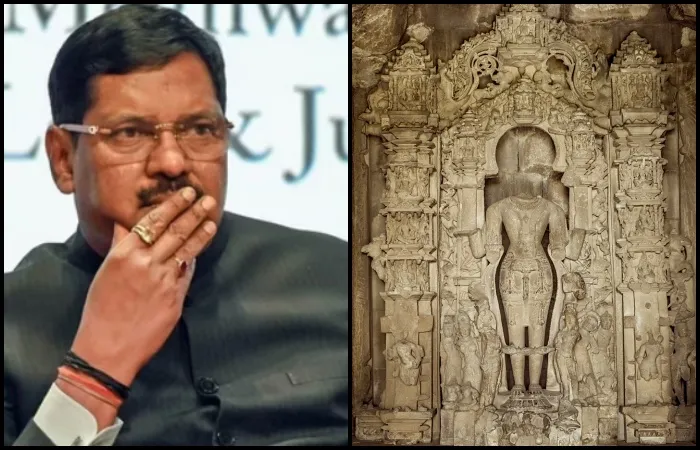
Case Summary
An explicitly anti-Hindu statement was issued by the Chief Justice of India, B.R. Gavai, a Buddhist by faith, during court proceedings, reflecting a departure from judicial reasoning and instead resorting to sarcasm directed at Hindu beliefs. The incident took place on 16 September 2025, when the Supreme Court of India dismissed a petition seeking the restoration of a seven-foot beheaded idol of Lord Vishnu at the Javari Temple in Khajuraho, Madhya Pradesh. The idol, part of the UNESCO-protected Khajuraho Group of Monuments, had been beheaded during the Mughal invasions and left desecrated for centuries, with its desecration remaining unaddressed through both colonial and post-independence neglect. The petition, filed by Hindu devotee Rakesh Dalal and argued by Senior Advocate Sanjay M. Nuli, emphasised that restoration of the idol was not merely an archaeological concern but a matter of religious faith, dignity, and the fundamental right of Hindus to worship their deities in wholeness. Dalal argued that the state’s refusal to undertake restoration constituted a violation of these rights. He further noted that the Chandravanshi rulers had originally built the Khajuraho temples, and that years of British disregard, followed by governmental apathy after independence, had compounded the idols’ degraded condition. Despite numerous protests, public campaigns, and repeated representations, the authorities had failed to act, leaving Hindu devotees without recourse. In response, the bench led by Chief Justice Gavai dismissed the plea with overt sarcasm rather than legal engagement. The Chief Justice stated, “This is purely publicity interest litigation. Go and ask the deity itself to do something now. You say you are a staunch devotee of Lord Vishnu. So go and pray now. It’s an archaeological site, and the ASI needs to give permission, etc. Sorry.” Saying this, BR Gavai asked the petitioner to approach the ASI. This remark mocked the Hindu faith and ridiculed the petitioner’s devotion, thereby trivialising both the historical desecration of the idol and the legitimate grievances of the worshippers. By adopting a tone of derision instead of judicial reasoning, the Supreme Court not only dismissed a petition concerning the religious rights of Hindus but also legitimised institutionalised Hinduphobia at the highest level of India’s judiciary.
Why it is Hate Crime ?
This case has been added to the tracker under the primary category- Hate Speech against Hindus. The subcategory selected is- Anti-Hindu slurs, mocking faith. Anti-Hindu slurs and the deliberate mocking of the Hindu faith owing to religious animosity involve the usage of derogatory terms, stereotypes, or offensive references to religious practices, symbols, or figures. One of the common anti-Hindu slurs used against Hindus is “cow-worshipper” and “cow piss drinker”. The intention of using this term is to demean and mock Hindus as a group and their religious beliefs since Hindus consider the cow holy. Additionally, some symbols and the slurs attached to them have a historical context that exacerbates the insult, hate, stereotyping, dehumanisation and oppression against Hindus. Cow worship has been used for centuries to denigrate Hindus, insult their faith and oppress Hindus specifically as a religious group. There has been overwhelming documentation about how cow slaughter has been used to persecute Hindus with cow meat being thrown in temples and places of worship. There has also been overwhelming documentation where cow meat (beef) has been force-fed to Hindus to either forcefully convert them to Islam or denigrate their faith. Apart from cow worship, the Swastika – which holds deep religious significance for the Hindus – has also been misinterpreted and distorted to use as a slur against Hindus. Similarly, the worship of the Shivling has been used by supremacist ideologies and religions to denigrate Hindus owing to religious animosity. Such slurs and denigration stem out of inherent animosity and hate towards Hindus and their faith, therefore, it is categorised as hate speech targeted at Hindus specifically owing to their religious identity. This is a clear case of hate speech directed against Hindus and their religious beliefs. Firstly, the Chief Justice of India, B.R. Gavai, who is a Buddhist by faith, indulged in sarcasm, mocking the beliefs of a Hindu devotee, and by extension, of the larger Hindu society. By ridiculing the petitioner with remarks such as “This is purely publicity interest litigation. Go and ask the deity itself to do something now. You say you are a staunch devotee of Lord Vishnu. So go and pray now", the Chief Justice turned a serious issue of faith, dignity and religious rights into a matter of jest. Such dismissive conduct goes beyond judicial reasoning and enters into outright mockery of Hindu devotion. Further, Hindus have often been mocked by elements antithetical to the faith with similar jibes. Often, when Hindus talk about their persecution and the desecration of their places of worship and Murtis, those who indulge in such desecration or those who wish to shield the extremists respond with, "If your Gods are real, why did they not protect themselves?". This is essentially the delegitimisation of the faith of Hindus, where those who espouse Abrahamic faiths taunt Hindus, claiming that their faith is not real. Abrahamic faiths propagate that Hinduism is a "false faith" worshipping "false Gods" and therefore, any suggestion to that effect is innately Hinduphobic and results in the delegitimisation of Hindus and their faith. BR Gavai in his statement echoed this taunt which dehumanises Hindus and delegitimises their faith essentially claiming that Hindu Gods are not "real" because if they were, the petitioner could have simply prayed to Vishnu to restore the idol. Secondly, he branded the petition a “publicity stunt”. This language is deeply problematic. It provides a convenient way to brush aside the lived pain of Hindus who wish to restore their ancient temples desecrated during Islamic invasions. By trivialising Hindu concerns, the court normalises Hinduphobia. Such statements from the highest judicial authority give further licence to left‑wing and Islamist ecosystems to deride the Hindu faith under the garb of fighting so‑called “majoritarianism” and ''Hindutva fascism''. It is essential to note that BR Gavai was well within his rights as a Judge to ask the petitioner to approach the ASI. This case is being documented in the Hinduphobia Tracker not because of the legality of the judgment or Gavai's reasoning, but that, instead of simply asking the petitioner to approach the ASI, he made a conscious choice to mock the petitioner for his faith. The Chief Justice could have, and should have, delivered the verdict as is, without sarcasm; however, the fact that he made a choice to mock faith proves that he harbours animosity towards Hinduism itself. It is interesting to note that in 2024, BR Gavai was a part of a Supreme Court bench which had cautioned judges and asked them to moderate their behaviour, so as not to give the impression to any section of society that the Judiciary is biased. This judgment had been delivered in context to a judge who had called a Muslim dominated area in Bangalore "Pakistan". If BR Gavai could understand the importance of maintaining decorum while delivering judgements so as to not offend the religious sentiments of one community, that he chose to ignore the sentiments of Hindus only points towards conscious Hinduphobia. The words of the Chief Justice, therefore, amount not only to mockery but to religiously motivated hate speech. By normalising the derision of the Hindu faith in an official courtroom setting, such remarks intensify discrimination and contribute to a culture where the persecution of Hindus is downplayed or even laughed at. For these reasons, this incident qualifies as hate speech against Hindus, and therefore, it is being added to the hate crime database of the Hinduphobia Tracker.


Case Status
Unknown


Perpetrators Details
Perpetrators
State and Establishment
Perpetrators Range
One Person
Perpetrators Gender
male
 Sources




