TV panellist downplays Mughal atrocities, vilifies Chhatrapati Shivaji Maharaj, and mocks Hindu suffering
 India
India  15 July, 2025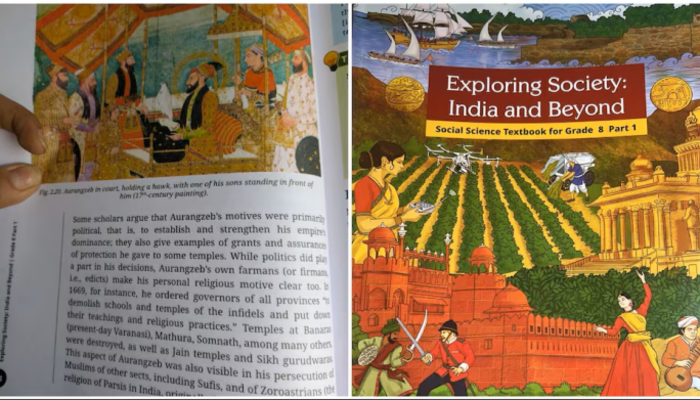
Case Summary
In recent television appearances on India Today and Aaj Tak, TV panellist Ruchika Sharma launched a series of factually incorrect and ideologically biased remarks aimed at whitewashing Mughal atrocities and discrediting Hindu historical figures. She criticised the revised NCERT syllabus, calling several changes “factually incorrect,” despite these revisions being based on primary sources and a long-standing demand to correct historical biases against Hindu civilisation. Sharma downplayed the Jizya tax, claiming it was merely a financial imposition by Muslim rulers, and questioned NCERT’s assertion that it was used to incentivise conversions to Islam. In a blatant display of false equivalence, Sharma attempted to justify Akbar’s brutal massacre of Hindus at Chittorgarh Fort by stating that Hindu kings also looted and killed during invasions. She further defamed Chhatrapati Shivaji Maharaj by alleging that he plundered southern Karnataka. In addition, Sharma promoted discredited colonial narratives, such as the Aryan Invasion Theory, which has been debunked by recent genetic, linguistic, and archaeological findings. Her commentary reflects a broader pattern of anti-Hindu bias, historical revisionism favouring invaders, and contempt toward Hindu civilizational memory. The timing and nature of Ruchika's remark reveal a deeper anxiety within the left-liberal intelligentsia, many of whom have vocally opposed the revised NCERT syllabus. The new textbooks mark a significant shift from earlier, whitewashed narratives that romanticised the Mughals and downplayed the traumatic realities of Islamic conquests in Bharat. For the first time, school children will be taught about the jihadist brutality, temple destruction, and religious persecution carried out by tyrants like Akbar and Aurangzeb, not just their court art or architectural patronage. The updated Class 8 Social Science textbook, for instance, presents Akbar’s reign as a complex mixture of brutality and political strategy. It openly discusses the massacre of 30,000 civilians at Chittorgarh and highlights Akbar’s own words about demolishing temples and enforcing Islamic supremacy. It does not shy away from documenting Aurangzeb’s bans on Hindu practices, his reimposition of the humiliating jizya tax on non-Muslims, and the destruction of temples at Kashi, Mathura, and Somnath. Crucially, the revised syllabus also restores balance by giving due recognition to indigenous resistance. It highlights Chhatrapati Shivaji Maharaj not merely as an efficient administrator, but as a devout Hindu king, a brilliant strategist, and a restorer of desecrated temples who stood up to Mughal tyranny. His campaigns are described as defensive and civilizational in nature, aimed at protecting native religious and cultural life from foreign aggression. This shift towards historical accuracy has triggered a meltdown in sections of the media and academia, long used to monopolising historical interpretation. Ruchika's remarks are emblematic of a deeper malaise: the inability of the secular-left ecosystem to acknowledge the crimes of Muslim invaders and to accept the legitimacy of Hindu resistance. In a related case, Rajdeep Sardesai, a senior TV anchor, sparked outrage by equating Chhatrapati Shivaji Maharaj with Mughal tyrants and dismissing centuries of Hindu resistance. This incident has been documented by the Hinduphobia Tracker, highlighting a growing trend of mainstream media figures maligning Hindu icons under the guise of historical debate.
Why it is Hate Crime ?
This case has been added to the tracker un the primary category of - Hate speech against Hindus. The sub-category selected here is - Mocking/denigrating Hindu leaders. Hate speech is defined as any speech, gesture, conduct, writing, or display that is prejudicial against a specific individual and/or group of people, which is leading to or may lead to violence, prejudicial action or hate against that individual and/or group. Religious leaders are often seen as representatives of the community, especially, the community’s religious faith and beliefs. Mocking or denigrating a religious leader specifically owing to his religious identity and/or the religious rituals he observes can be considered hate speech because the motivating factor of the speech is animosity and/or dislike for what he represents – the religious beliefs and faith of the community. It is important to note that mere insulting words against an individual do not constitute hate speech. It is entirely possible that insulting words are used for an individual, however, the specific speech is not the result of religious hate and/or animosity towards the professed faith of the religious leader, but the individual himself. For the speech to be considered hate speech, the speech itself or the motivating factor behind the speech has to be religious in nature. Such speech which denigrates Hindu religious leaders specifically owing to animosity towards the faith they profess and the community faith they represent will be treated as hate speech under this category. The other sub-category selected is - Anti-Hindu slurs, mocking faith. Anti-Hindu slurs and the deliberate mocking of the Hindu faith owing to religious animosity involve the usage of derogatory terms, stereotypes, or offensive references to religious practices, symbols, or figures. One of the common anti-Hindu slurs used against Hindus is “cow-worshipper” and “cow piss drinker”. The intention of using this term is to demean and mock Hindus as a group and their religious beliefs since Hindus consider the cow holy. Additionally, some symbols and the slurs attached to them have a historical context that exacerbates the insult, hate, stereotyping, dehumanisation and oppression against Hindus. Cow worship has been used for centuries to denigrate Hindus, insult their faith and oppress Hindus specifically as a religious group. There has been overwhelming documentation about how cow slaughter has been used to persecute Hindus with cow meat being thrown in temples and places of worship. There has also been overwhelming documentation where cow meat (beef) has been force-fed to Hindus to either forcefully convert them to Islam or denigrate their faith. Apart from cow worship, the Swastika – which holds deep religious significance for the Hindus – has also been misinterpreted and distorted to use as a slur against Hindus. Similarly, the worship of the Shivling has been used by supremacist ideologies and religions to denigrate Hindus owing to religious animosity. Such slurs and denigration stem out of inherent animosity and hate towards Hindus and their faith, therefore, it is categorised as hate speech targeted at Hindus specifically owing to their religious identity. The other sub-category selected is - Denial or mocking of genocide/large-scale persecution. Denial or mocking of genocide/large-scale persecution/ethnic cleansing refers to the act of denying or minimizing the fact of the ethnic cleansing and/or genocide and/or religious persecution of Hindus. This often involves denying the scale, mechanisms, religious intent, or even the occurrence of the ethnic cleansing and/or genocide and/or religious persecution of Hindus. Hate speech of this kind involves the dissemination of falsehoods that deny or distort established historical facts or mock the suffering of Hindus by saying that they deserved the persecution, motivated by Hinduphobia. Denying such atrocities is not only about the denial of facts or rewriting/revising history, but it also delegitimises the religiously motivated persecution of Hindus, the religious hate/motivation/animosity that led to the persecution, and dehumanises Hindus as a religious group. Such denial of ethnic cleansing and/or genocide and/or religious persecution of Hindus not only denies the suffering but also paves the way for future/present atrocities and hate speech, inciting prejudice and violence against Hindus. It also provides a justification for violence by delinking religious animosity from religiously motivated crimes committed against Hindus. Since such denial and/or mocking of genocide/ethnic cleansing/atrocities motivated by religious animosity leads to present and future ramifications of creating more hate speech, violence, dehumanisation and delegitimisation, it would be considered hate speech under this category. The other sub-category relevant is- Anti Hindu subversion and prejudice, and within it, the tertiary category selected is- Anti-Hindu Fake News or Downplaying. Hate speech is defined as any speech, gesture, conduct, writing, or display that is prejudicial against a specific individual and/or group of people, which is leading to or may lead to violence, prejudicial action or hate against that individual and/or group. Media plays a specific and overarching reach in perpetuating prejudicial attitudes towards a community owing to unfair, untrue coverage and/or misrepresentation/misinterpretation, selective coverage and/or omission of facts of/pertaining to issues affecting a specific religious group. This type of bias can dehumanise the victim group, making it easier for others to justify harmful actions against them, which aligns with the objectives of hate speech laws aimed at preventing such harm. It is often observed that the media takes a prejudicial stand against the Hindu community driven by their need to shield the aggressor community which happens to be a numeric minority, however, is the one perpetrating violence against Hindus. For example, the media is often quick to contextualise religiously motivated crimes against Hindus, omit or misrepresent facts that point towards religiously motivated hate crimes, justify and/or downplay religiously motivated hate crimes or simply present fake news to stereotype Hindus. Such media bias leads to the denial of persecution and is often used to dehumanise Hindus, leading to justification for violence against them. For example, the media covered several fake allegations of Hindus targeting Muslims and forcing them to chant Jai Shree Ram. Most of these cases were proved false and fabricated after police investigation. These fake news reports were subsequently never retracted or clarified. Such fake news led to the justification of violence and dehumanisation of Hindus based on the argument that since Hindus targeted Muslims and forced them to chant Jai Shree Ram, the dehumanisation of Hindus and violence against them was par for the course and merely a retaliation. Such media bias leads to prejudicial portrayal of Hindus and offers a justification for violence against them and therefore, is considered hate speech under this category. In this case, Ruchika Sharma attempted to equate Chhatrapati Shivaji Maharaj—a revered Hindu icon and champion of dharma—with Mughal tyrants who oppressed, plundered, and systematically persecuted Hindus. Her comments reflect a growing trend among certain self-proclaimed historians and media intellectuals to blur the civilizational distinction between native Hindu defenders and foreign Islamic invaders, thereby erasing the lived experience and historical suffering of Hindus. Chhatrapati Shivaji Maharaj stood as a radiant symbol of Hindu resistance in an age dominated by Muslim imperialism. He was far more than a mere regional ruler—he was a civilizational sentinel, a defender of Hindu dharma, and a brilliant military strategist who revived Hindu sovereignty at a time when the Mughal tyrants were imposing Muslim orthodoxy through jizya, temple destruction, and religiously motivated violence. He actively restored desecrated temples, protected the honour of women, and envisioned a swarajya rooted in dharma. His legacy is inseparable from Hindu cultural pride and civilizational resurgence. To suggest moral equivalence between the two is not just historically false—it is morally reprehensible. Ruchika Sharma, however, went further than oversimplification. In a shocking remark, she claimed that when Chhatrapati Shivaji Maharaj campaigned in southern Karnataka, he plundered and ravaged the region—an absolute lie not supported by any credible historical account. Her intent was clear: to defame a Hindu icon in order to justify the violence of Akbar, who brutally massacred thousands of Hindus in Chittorgarh. By doing so, she not only distorted history but mocked the collective memory and faith of millions of Hindus who revere Chhatrapati Shivaji Maharaj as a symbol of courage, devotion, and cultural pride. In yet another appalling statement, Ruchika Sharma tried to downplay the oppressive nature of jizya, the discriminatory tax imposed on non-Muslims under Islamic rule. She claimed it was simply a form of taxation, no different from any other levy. This argument is not only historically false but deeply insensitive. Jizya was a punitive tax meant to humiliate and economically burden Hindus and other non-Muslims for simply practising their faith. Muslim tyrants like Aurangzeb explicitly used it to pressure conversions and assert Muslim supremacy. Her questioning of the NCERT’s source for saying jizya incentivised conversion reveals either profound ignorance or a deliberate attempt to whitewash religious persecution. Such dishonest academic positioning insults the memory of Hindu ancestors who suffered under Muslim regimes solely because they refused to abandon their faith. These remarks are not accidental. They reflect a deep-seated prejudice against Hindu civilisation and a sustained effort to whitewash Mughal tyranny. The Mughal rule in Bharat was explicitly anti-Hindu. From the destruction of thousands of temples, forced conversions, and religious taxes like Jizya, to discriminatory laws and institutionalised bigotry, the Muslim empires in India were built on the subjugation of the Hindu population. Attempts to “contextualise” or justify these atrocities under the guise of historical nuance are in fact acts of erasure, dishonesty, and communal provocation. When people like Ruchika Sharma defend such rulers and minimise their crimes, they become complicit in continuing that historical injustice. In sum, Ruchika Sharma’s comments are more than misinformed—they are anti-Hindu, factually baseless, and motivated by ideological hostility. They insult the memory of Hindu martyrs, belittle the moral clarity of leaders like Chhatrapati Shivaji Maharaj, and attempt to rewrite history to suit a Mughal-centric, Marxist narrative. This must be seen for what it is: a deliberate hate-driven narrative targeting Hindu pride and truth. Hence, this case is categorised in a hate crime database.


Case Status
Unknown


Perpetrators Details
Perpetrators
Others
Perpetrators Range
One Person
Perpetrators Gender
female
 Sources




