Diwali celebrations targeted by American and British influencers; Hindu gods branded ‘false’ while Christ proclaimed the only God of Heaven
 United States
 19 October, 2025
Case Summary
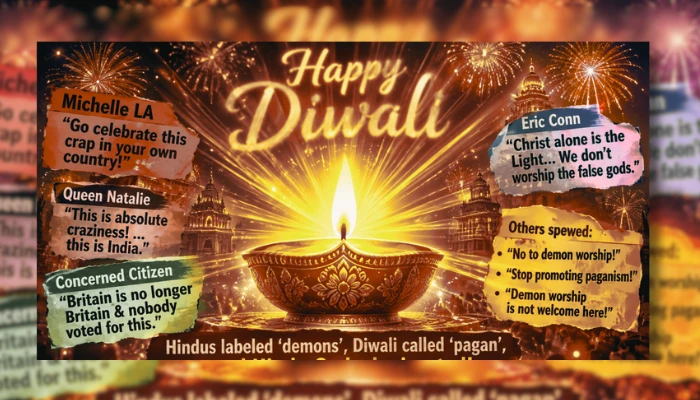
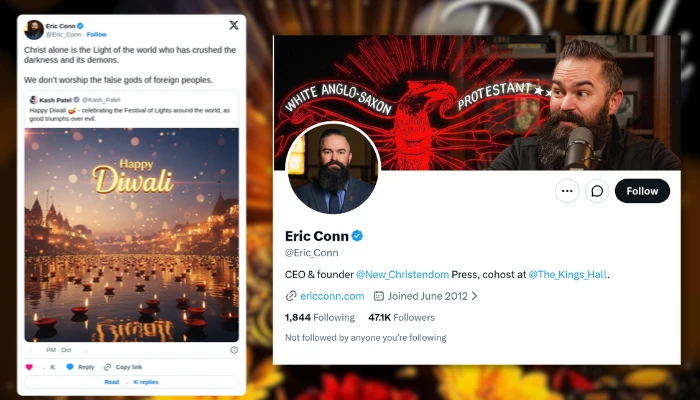
Diwali celebrations and Hindu religious practices were targeted by social media influencers and public figures in the United Kingdom and the United States, who made anti-Hindu remarks and expressed exclusionary sentiments. Several social media influencers shared derogatory and abusive comments criticising Diwali celebrations, while branding Hindu Gods as “false gods”. They asserted that Christ alone was the true God. They also questioned the presence and celebration of Indian religious and cultural traditions in Britain and America. As reported by The Organiser, the incident first came to light after influencer Michelle LA shared a video showing Diwali celebrations and expressed her disapproval through an exclusionary remark. On 21 October 2025, she wrote, “Go celebrate this crap in your own country!”, directly suggesting that Diwali celebrations did not belong in the country where they were taking place. Another influencer, Queen Natalie, criticised Diwali celebrations in East Ham, London, where Indians had organised a fireworks display in the street. Reacting to the celebrations, she expressed disapproval and described the event as “absolute craziness”, writing, “This is absolute craziness! The Indians are having a full-on fireworks display in the street in East Ham, London to celebrate Diwali,” before adding, “this is India.” Her remarks singled out the Indian community for celebrating Diwali in a public space in London. Another X user, Bruce,e wrote, “Diwali in Toronto. This is outrageous. The Indian Invaders could not disrespect Canada more than they already do. They have to go back.” Similarly, an influencer identified as Concerned Citizen criticised Diwali fireworks and celebrations across London and other parts of the United Kingdom. In a social media post, the individual contrasted Diwali celebrations with the traditional Guy Fawkes Night fireworks displays held on 5 November, claiming that Britain once had “civilised, well organised, safe family run Firework Displays”. The post further stated, “Now during the week of Diwali-Fireworks & Music blaze all night long across Cities & trash lined streets everywhere. Britain is no longer Britain & nobody voted for this.” The remarks portrayed Diwali celebrations as incompatible with British identity and framed the presence of Indian religious and cultural traditions as an unwanted change to the country. The hostility also extended to Hindu religious beliefs in the United States. The Hinduphobia Tracker team investigated the X account of Eric Conn (@eric_conn) and found that he co-hosted The King's Hall Podcast (@The_Kings_Hall), which had approximately 16,500 followers, and was the CEO and founder of New Christendom Press. Conn's own X account had approximately 47,700 followers. On 20 October 2025, he quote-tweeted a Diwali greeting shared by Kash Patel. Rejecting the Hindu religious significance of the festival, Conn wrote, “Christ alone is the Light of the world who has crushed the darkness and its demons. We don’t worship the false gods of foreign peoples.” His remarks dismissed Hindu deities as “false gods” and portrayed Hindu religious worship as foreign and opposed to Christianity. Likewise, several supporters of the MAGA (Make America Great Again) movement targeted Kash Patel with racist and anti-Hindu remarks. One user wrote, “Reject this false religion’s Diwali nonsense.” Another commented, “Not the brightest idea to promote foreign gods in the Christian nation of America.” A third user described Diwali as “a hellish celebration.” The organiser reported a total of 19 cases of anti-Diwali hate speech. Apart from the incidents covered above in the present report, the Hinduphobia Tracker had previously documented all 15 incidents in which US- and Canada-based social media users expressed extreme hatred in response to Diwali greetings posted on X, directing hateful and derogatory comments at Hindus and the festival. For instance, in Irving, Texas, a group of masked men publicly displayed banners insulting Hindu deities Vishnu and Ganesh, crossing out their images and labelling them as “foreign demons.” The banners carried slogans such as “Don’t India my Texas,” “Deport H-1B Scammers,” “Reject Foreign Demons,” and “Jesus Christ is Our Lord.” Photographs of the men displaying these banners were posted on X on 25 October 2025 by an account named ‘Take Action Texas’. The account also added a highly offensive caption referring to the Hindu festival of Diwali as “garbage”. The post stated: “In response to all the recent ‘Diwali’ garbage, we hit a couple of different spots in Irving, a city that has been ravaged by H-1B scams and massive demographic shifts due to labour imports coming from India.” In another incident, Hindu public figures in the United States, including Federal Bureau of Investigation Director Kash Patel and Director of National Intelligence Tulsi Gabbard, were targeted with anti-Hindu remarks and religious slurs after sharing Diwali greetings on 20 October 2025. Several users responded by denigrating Hinduism, calling Hindu Gods and Goddesses “demons”, dismissing Diwali as “paganism” and asserting that Christianity was the only religion that should be recognised in America. Some users also shared derogatory imagery depicting Hindu deities falling before Christ, while others told Hindus to take their “demon worship” back to India. In a separate incident, Christian podcaster Joshua Haymes repeatedly criticised Diwali through online posts, explicitly describing the festival as a “false religion” and its celebrations as “demonic”. Similarly derogatory remarks were made by Bradley Pierce, a Christian conservative, constitutional attorney, President of the Foundation to Abolish Abortion, and Vice President of Heritage Defence. He quote-tweeted a post by the official X handle of the Texas Governor's Office, ‘Governor Abbott Press Office’, which had extended Diwali greetings and shared photographs of the Governor celebrating the festival with Indian-American Hindus. Responding to the post, Pierce wrote: “Celebrating the worship of false gods (Hindu gods) provokes the righteous judgment of Christ upon our land.” In yet another incident, a Canadian Christian influencer named Nate, who used the username ‘@celticashes’ on X, made derogatory remarks targeting Diwali and Hindus. He described himself as a “Christian nationalist” on his X profile, which had approximately 14,900 followers. On 23 October 2025, he posted a video showing Hindus bursting firecrackers in Canada, with firecracker waste scattered across the road. Alongside the video, he published a post denigrating both Hindus and the Diwali festival. He wrote: “Just like that, we’ve let braindead f*cking Indians turn our beautiful Western countries into total shitholes with their retarded Diwali garbage that has zero to do with us.” In another incident, an American Christian influencer named ‘Feels Guy’, who had 39,600 followers on X, made a derogatory comment targeting Diwali. On 21 October 2025, he made a vile remark comparing the Hindu festival to a sexually transmitted disease (STD). He wrote: “What the hell is Diwali? Sounds like an STD.” The tweet went viral and garnered nearly 20,700 views. Similarly, a Christian woman named Bree Solstad, who had 68,300 followers on X, made a derogatory remark targeting the entire Hindu community by describing Hindus as demon worshippers. She also portrayed Diwali as a festival involving the worship of false gods and demons. Her remarks came in response to a Diwali greeting Kash Patel shared through his official X handle. Solstad quote-tweeted Patel's message and wrote: “My politics is whatever gets pagan demon false god worshippers (Hindus) out of all leadership roles in our country. Diwali involves the worship of false gods and invites the presence and blessing of these demon gods. Lights are ceremonially lit to invoke the goddess of wealth.” Additionally, Joel Webbon made abusive remarks on X (formerly Twitter), targeting Hindu deities in response to a Diwali greeting Kash Patel shared. Webbon quote-tweeted Patel's message and wrote: “Go back home (to India) and worship your sand demons. Get out of my country.” His remarks sparked widespread outrage among Indian Hindus, who condemned the offensive comments targeting their revered festival and deities. Another derogatory and abusive attack targeting Hindu deities and Diwali was made by Jayda Fransen, a Christian politician from London, United Kingdom, and founder of a political group called ‘The Christian Nationalist Party’. On 20 October 2025, Fransen made abusive remarks against Hindu deities, including Lord Rama and Goddess Kali, describing them as “demonic”. The incident began after an X account named ‘Reform UK’, operating under the handle ‘@reformparty_UK’, posted Diwali greetings for Hindus. In response, Fransen quote-tweeted the post, sharing videos of Lord Rama and Goddess Kali and writing: “This is demonic, and it has no place in the United Kingdom. Christ is King.”
Case Images
Why it is Hate Crime ?
This case is being added to the tracker under the primary category: Hate Speech against Hindus. The subcategory selected is: Anti-Hindu slurs, mocking faith. Anti-Hindu slurs and the deliberate mocking of the Hindu faith owing to religious animosity involve the use of derogatory terms, stereotypes, or offensive references to religious practices, symbols, or figures. One of the common anti-Hindu slurs used against Hindus is “cow-worshipper” and “cow piss drinker”. The intention of using these terms is to demean and mock Hindus as a group and their religious beliefs, since Hindus consider the cow holy. Additionally, some symbols and the slurs attached to them have a historical context that exacerbates the insult, hate, stereotyping, dehumanization,n and oppression against Hindus. Cow worship has been used for centuries to denigrate Hindus, insult their faith,th and oppress Hindus specifically as a religious group. There has been overwhelming documentation about how cow slaughter has been used to persecute Hindus,dus with cow meat being thrown in temples and places of worship. There has also been overwhelming documentation that cow meat (beef) has been force-fed to Hindus to either forcefully convert them to Islam or denigrate their faith. Apart from cow worship, the Swastika – which holds deep religious significance for Hindus – has also been misinterpreted and distorted and used as a slur against Hindus. Similarly, the worship of the Shivling has been used by supremacist ideologies and religions to denigrate Hindus owing to religious animosity. Such slurs and denigration stem from inherent animosity and hate towards Hindus and their faith; therefore, it is categorised as hate speech targeted at Hindus specifically owing to their religious identity. The other category is: Attack not resulting in death. Within this, the subcategory is: Attacked for Hindu identity. In several cases, Hindus are attacked merely for their Hindu identity without any perceived provocation. A classic example of this category of religiously motivated hate crime is a murder in 2016. 7 ISIS terrorists were convicted for shooting a school principal in Kanpur because they got ‘triggered’ seeing the Kalava on his wrist and the tilak that he had put. In this case, the Hindu victim had offered no provocation except for his Hindu religious identity. The motivation for the murder was purely religious, driven by religious supremacy. Such cases where Hindus are targeted merely for their religious identity would be documented as a hate crime under this category. This incident was a manifestation of Hinduphobia because Hindu religious celebrations and the public expression of Hindu faith were subjected to ridicule, religious denigration, and exclusionary rhetoric. The hostility reflected an attitude in which Hindu religious and cultural traditions were treated as foreign, inferior, and unwelcome in Western societies. The objections went beyond criticism of particular celebrations and extended to questioning the legitimacy of Hindu religious practices and the place of Hindu communities in public life. Diwali is a major Hindu festival celebrating the triumph of good over evil, light over darkness and knowledge over ignorance. Its observances include prayers to Hindu deities, religious rituals, the lighting of diy, and the sharing of festive offerings. For Hindus, Diwali is an expression of faith, devotion, cultural identity,y and religious heritage. Dismissing the festival as “crap” and portraying its celebrations as an unwanted intrusion amounted to denigrating a sacred Hindu observance. The religious significance of the festival was disregarded, while Hindus celebrating it publicly were treated as people whose traditions did not belong. The exclusionary nature of this hostility was particularly evident in the suggestion that Hindus should celebrate Diwali in their “own country”. The United States and the United Kingdom are democratic nations whose founding principles recognise the right of people belonging to different ethnicities and religious communities to practise and profess their faith. Both countries have also been largely occupied by European settlers, which displaced and marginalised indigenous populations and their traditions. Their societies have benefited enormously from the contributions of people from Asia, including highly skilled professionals from India. Yet, the same Indian community whose talent, expertise and services are readily welcomed and relied upon is subjected to contempt when it publicly celebrates its religious and cultural traditions. Telling Hindus that their festivals are unwelcome and that they should return to their country, while readily accepting their contributions in other spheres of life, exposes a glaring double standard. Hindus cannot be considered welcome when their skills and services are needed but treated as outsiders when they seek to practise and celebrate their faith. Such selective acceptance of a community, while rejecting its religious and cultural identity, reflects xenophobic prejudice and religious intolerance. The portrayal of Diwali celebrations as incompatible with British identity also reflects an exclusionary understanding of national belonging. The presence of Hindu religious and cultural traditions does not diminish the identity or heritage of another country. Nor does the celebration of a festival by an immigrant or minority community make that country any less British. Suggesting that Britain had lost its identity because Diwali celebrations were taking place effectively treated the visibility of Indian and Hindu traditions as a threat to the country's cultural character. It disregarded the right of Hindu communities to preserve and express their religious heritage without being made to feel like outsiders. Moreover, the hostility also extended beyond the festival to the religious beliefs underlying it. Hinduism is a deeply rooted religious tradition with its own philosophical foundations, scriptures, deities, spiritual practices, and traditions of worship. Hindu Gods and Goddesses hold profound religious significance for devotees. Describing them as “false gods” and associating them with darkness and demons was a direct denigration of Hindu religious beliefs. Such language reduced an established faith to something illegitimate and inferior while attacking the dignity of its followers. The assertion that Christ alone represented the light of the world, followed by the dismissal of Hindu deities as “false gods of foreign peoples”, reflected an assertion of religious superiority. The Christian belief in the supremacy of Jesus Christ is a matter of personal religious conviction. However, adherence to one's own faith does not justify insulting the deities of another religion or portraying its followers as people who worship false or demonic beings. The freedom to profess Christianity does not come at the expense of the religious dignity and freedom of Hindus to worship their own deities and celebrate their festivals. Moreover, Kash Patel was also individually targeted because he is a Hindu who publicly celebrated his religious festival. His peaceful celebration of Diwali invited hateful comments, including demands that he return to India. This exposed the conditional nature of the acceptance extended to Hindus and the failure of genuine religious coexistence. Despite being a prominent public figure in the United States, Patel was treated as a foreigner because he openly expressed his Hindu faith. The hostility reflected an attitude that regarded Hindu religious identity as inferior and unwelcome in American public life. The description of Hindu religious traditions as belonging to “foreign peoples” was particularly exclusionary. It portrayed Hinduism as an alien belief system rather than recognising it as a religion practised by communities across the world, including generations of Hindus living in Western countries. Hindu religious identity does not become less legitimate outside India, nor does the Indian origin of a religious tradition make its public expression inappropriate elsewhere. Such rhetoric effectively sought to draw a boundary around who could legitimately participate in the religious and cultural life of these societies. Notably, the Hinduphobia Tracker had previously documented another incident involving hostility towards Hindu public figures for sharing Diwali greetings in the United States. That incident similarly involved Hindu deities being branded as “demons”, Diwali being dismissed as “pagani, sm” and Hindu religious expression being portrayed as unwelcome in American society. The recurrence of such hostility demonstrated how the public celebration of Hindu festivals and the expression of Hindu religious identity were met with denigration and exclusionary rhetoric. Overall, the incident exposed a pattern of anti-Hindu hostility in which a sacred Hindu festival was ridiculed, Hindu deities were denigrated, and Hindu religious and cultural traditions were portrayed as foreign and unwelcome. The hostility sought to undermine the legitimacy of Hindu religious expression and question the place of Hindu communities in Western societies. Such religious denigration and exclusion of Hindus for practising and celebrating their faith formed the basis for including this incident in the Hinduphobia Tracker. Disclaimer: The Hinduphobia Tracker records the date of an incident based on when it occurred, not when it was reported in the media or gained traction on social media. In this instance, the incident began on 20 October 2025, when Kash Patel posted Diwali greetings. This incident includes five(5) perpetrator accounts, corresponding to the four anti-Hindu comments highlighted in this entry. Therefore, the perpetrator count has been restricted to the four accounts specifically documented by the Hinduphobia Tracker. Although the hateful comments targeted the Hindu community as a whole, the victim count has been recorded as one, since Kash Patel was individually targeted in this incident. The religious identity of all five perpetrators has been recorded as ‘Christian’ because most of the documented accounts explicitly stated that Christ was the only one to be worshipped in America, indicating their Christian religious affiliation. Although the social media accounts involved in the incident were based in both the United Kingdom and the United States, the incident location was recorded as the United States, as a larger number of the documented accounts were based there.
Victim Details
Total Victim
1
Deceased
0
Gender
- Male 1
- Female 0
- Third Gender 0
- Unknown 0
Caste
- SC/ST 0
- OBC 0
- General 1
- Unknown 0
Age Group
- Minor 0
- Adult 1
- Senior Citizen 0
- Unknown 0


Case Status
Unknown


Perpetrators Details
Perpetrators
Christian Extremists
Perpetrators Range
From 2 To 5
Perpetrators Gender
both
 Sources



