Diwali greetings trigger Hinduphobic backlash in US: Hindu public figures bombarded with racist, anti-Hindu abuse while Hindu gods branded demons
 United States
 19 October, 2025
Case Summary
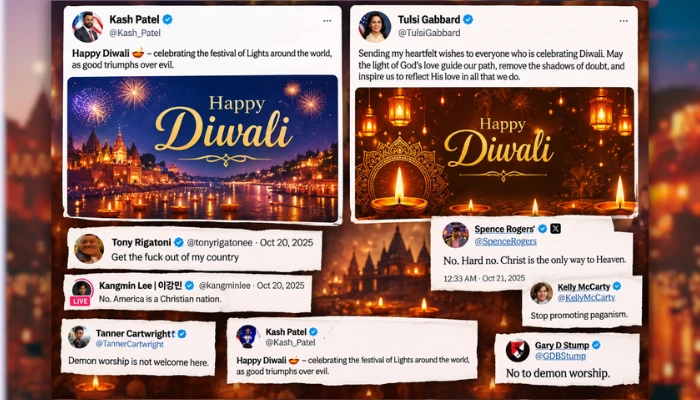
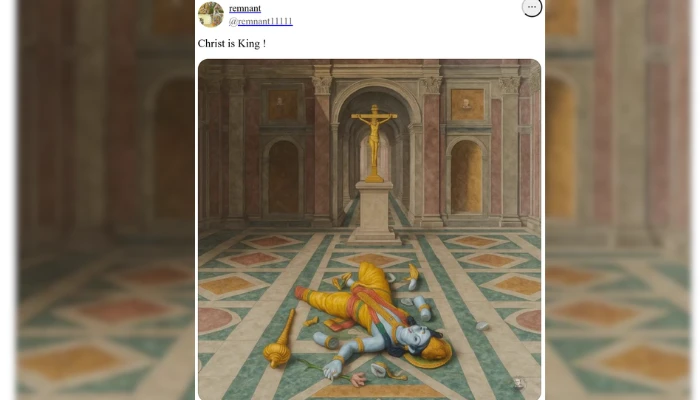
Hindu public figures in the United States, including Federal Bureau of Investigation Director Kash Patel and Director of National Intelligence Tulsi Gabbard, were targeted with anti-Hindu remarks and religious slurs on social media after sharing greetings wishing people a “Happy Diwali” on 20 October 2025. Several users responded to their greetings by denigrating Hinduism, calling Hindu Gods and Goddesses “demons”, dismissing Diwali as “paganism” and asserting that Christianity was the only religion that should be recognised in America. Some users also shared derogatory imagery depicting Hindu deities falling before Christ, while others told Hindus to take their “demon worship” back to India. The incident came to light after Patel and Gabbard shared Diwali greetings on their respective X accounts. Patel posted, “Happy Diwali - celebrating the Festival of Lights around the world, as good triumphs over evil,” accompanied by a festive image. Gabbard also extended her heartfelt wishes to everyone celebrating Diwali, expressing hope that the light of God's love would guide their path, remove the shadows of doubt, and inspire people to reflect His love. Their posts attracted several derogatory responses targeting the Hindu festival and its religious significance. The team at the Hinduphobia Tracker investigated both posts and found several derogatory comments targeting Hinduism, Hindu religious beliefs,s and the celebration of Diwali. Replying to Gabbard's Diwali greeting, one X user, Gary D Stump (@LordFlash_Woof), dismissed Hindu worship as demon worship, commenting, “No to demon worship.” Another user, Kelly McCarty (@KellyLMcCarty), denigrated the festival by dismissing it as paganism, writing, “Stop promoting paganism.” Spence Rogers (@SpenceRogers) rejected the recognition of Hindu religious traditions and asserted Christian religious supremacy, stating, “No. Hard no. Christ is the only way to Heaven.” Another user, Ni,ck, vilified Hindu religious practices as demon worship and questioned their place in America, telling Gabbard to take her “demon worship back to India.” The hostility also extended to Hindu Gods and Goddesses. Some users shared derogatory imagery portraying Hindu deities falling before Christ, presenting them as inferior to the Christian religious figure. Others explicitly described Hindu deities as “demons”. According to a report by The Organiser, Karl Bennett directly vilified Indian deities and equated them with demons, writing, “Indian Gods are demons, Don't compare them to Christ.” Another user, Jonathan Hoenisch, quoted Gabbard's Diwali greeting and condemned the celebration of Hindu deities while asserting that America belonged exclusively to Christians, writing, “The Living God is not pleased with the celebration of pagan gods. America is a Christian country. I invite @TulsiGabbard to get out of here with pretending that all religions are just as valid.” The remarks directly denigrated Hindu deities and rejected the recognition of Hindu religious celebrations in America. One X user, displaying the name Remnant (@remnant1111), shared a distorted and derogatory depiction of Lord Krishna, showing His idol broken, with its arms cut off, and lying on the floor before Christ. The imagery portrayed Lord Krishna in a damaged state, placing Him beneath Christ in a visual representation of religious subordination. The hostility was similarly directed at Kash Patel. Replying to his Diwali greeting, X user Tony Rigatoni (@tonyrigatonee) used an abusive and exclusionary remark to question Patel's right to belong in America, writing, “Get the fuck out of my country.” Another user, Phoebe (@phoebeLars6906), mocked the religious identity of people celebrating Diwali and sarcastically referenced evangelical Christianity, commenting, “I bet you are an evangelical Christian who has never read the Bible.” Tanner Cartwright also rejected the celebration of Diwali through a religiously exclusionary remark, stating, “Demon worship is not welcome here.” The users repeatedly characterised Hindu religious practices as demonic, denigrated Hindu Gods and Goddesses, and dismissed the celebration of Diwali as the promotion of paganism. The demand that Hindu religious practices be taken back to India, coupled with statements that America was exclusively a Christian country, sought to portray the public expression of Hindu faith as something that did not belong in American society.
Case Images
Why it is Hate Crime ?
This case is being added to the tracker under the primary category: Hate Speech against Hindus. The subcategory selected is: Anti-Hindu slurs, mocking faith. Anti-Hindu slurs and the deliberate mocking of the Hindu faith owing to religious animosity involve the use of derogatory terms, stereotypes, or offensive references to religious practices, symbols, or figures. One of the common anti-Hindu slurs used against Hindus is “cow-worshipper” and “cow piss drinker”. The intention of using these terms is to demean and mock Hindus as a group and their religious beliefs, since Hindus consider the cow holy. Additionally, some symbols and the slurs attached to them have a historical context that exacerbates the insult, hate, stereotyping, dehumanization,n and oppression against Hindus. Cow worship has been used for centuries to denigrate Hindus, insult their faith,th and oppress Hindus specifically as a religious group. There has been overwhelming documentation about how cow slaughter has been used to persecute Hindus,dus with cow meat being thrown in temples and places of worship. There has also been overwhelming documentation that cow meat (beef) has been force-fed to Hindus to either forcefully convert them to Islam or denigrate their faith. Apart from cow worship, the Swastika – which holds deep religious significance for Hindus – has also been misinterpreted and distorted and used as a slur against Hindus. Similarly, the worship of the Shivling has been used by supremacist ideologies and religions to denigrate Hindus owing to religious animosity. Such slurs and denigration stem from inherent animosity and hate towards Hindus and their faith; therefore, it is categorised as hate speech targeted at Hindus specifically owing to their religious identity. The other primary category selected is: Attack on Hindu religious representations. Within it, the sub-category selected is: Iconoclastic representation of Hindu Gods/Goddesses. An icon is a symbol of someone or something that is revered, or a religious representation of a spiritual ideal. Iconography is of vital significance in the Hindu milieu. It helps connect people’s spiritual beliefs with the real world. Iconography within the Hindu faith takes several shapes and forms. Murtis are most significant to Hindus, and they perform daily rituals, prayers, and offerings before them. Besides the murtis, there are several other symbols which have deep significance in the Hindu faith – the Om and Swastika, for example. Any iconoclastic representation of these symbols, images,s and murtis is an affront to the religious beliefs and faith of the Hindu community itself since the symbols and icons are deeply religious in nature. In this sub-category of crime, we would record hate crimes and iconoclastic representations, in words, art, or any other form of representation of symbols that hold religious significance for the Hindu community. Since these symbols, icons, and murtis are central to the Hindu faith, any iconoclastic representation of these symbols is born out of animosity towards the faith itself, manifesting through these symbols; therefore, these representations would be considered religiously motivated hate crimes. The other category is: Attack not resulting in death. Within this, the subcategory is: Attacked for Hindu identity. In several cases, Hindus are attacked merely for their Hindu identity without any perceived provocation. A classic example of this category of religiously motivated hate crime is a murder in 2016. 7 ISIS terrorists were convicted for shooting a school principal in Kanpur because they got ‘triggered’ seeing the Kalava on his wrist and the tilak that he had put. In this case, the Hindu victim had offered no provocation except for his Hindu religious identity. The motivation for the murder was purely religious, driven by religious supremacy. Such cases where Hindus are targeted merely for their religious identity would be documented as a hate crime under this category. This incident was a blatant manifestation of Hinduphobia because Hindu public figures Kash Patel and Tulsi Gabbard were subjected to religious hostility and personal attacks for publicly celebrating Diwali. Their greetings triggered a barrage of comments that branded Hindu deities as “demons”, denounced Diwali as “paganism” and demanded that Hindu religious practices be taken back to India. The hostility went beyond verbal contempt for Hindu beliefs. Users also shared derogatory imagery depicting Hindu deities as inferior to Christ, including an image of a broken idol of Lord Krishna lying on the floor before Christ. The incident thus exposed hostility not only towards Hindu religious observances but also towards the Hindu deities themselves and those who openly expressed their faith. Diwali is a major Hindu festival celebrating the triumph of good over evil, light over darkness and knowledge over ignorance. Its observances include prayers to Hindu deities, religious rituals, the lighting of diyas and the sharing of festive offerings. For Hindus, it is an expression of faith, devotion and religious heritage. Dismissing it as “paganism” and associating its celebration with “demon worship” was an outright vilification of a sacred Hindu observance, deliberately portraying Hindu religious practices as evil. Similarly, describing Hindu Gods and Goddesses as “demons” was a direct attack on the deities Hindus revere and the religious beliefs associated with them. Further, the derogatory depiction of Lord Krishna was particularly significant. Lord Krishna is one of the most revered deities in Hinduism, worshipped as an incarnation of Lord Vishnu and regarded as the embodiment of divine love, wisdom, and righteousness. Portraying His idol broken and lying on the floor before Christ was not merely a comparison between two religious figures. The deliberate use of a broken Hindu idol, placed in a position of humiliation before Christ, visually represented the degradation of a Hindu deity and conveyed a message of religious subordination. It presented a revered Hindu God as defeated and inferior, turning an image of religious devotion into an instrument of ridicule and contempt. Such imagery directly attacked the dignity of Hindu religious beliefs and the sentiments of devotees who worship Lord Krishna. Furthermore, the language used in the comments was equally steeped in religious bigotry. Gary D. Stump's remark, “No to demon worship”, Kelly McCarty's dismissal of Diwali as “paganism,” and Spence Rogers' assertion that “Christ is the only way to Heaven” collectively portrayed Hindu worship as illegitimate and inferior to Christianity. Karl Bennett's statement that “Indian Gods are demons” went further by explicitly vilifying Hindu deities. These were not simply expressions of personal religious conviction. They involved the denigration of another faith, its deities, and its sacred observances. Reducing Hinduism to demon worship sought to strip Hindu religious practices of their legitimacy and portray Hindus as followers of evil. Further, the declaration that “America is a Christian country” and the demand that Gabbard leave for suggesting that all religions were equally valid exposed an assertion of religious superiority. The statement treated Christianity as the only faith entitled to recognition in American public life while rejecting the legitimacy of Hindu religious expression. The personal belief that one's religion is supreme does not justify humiliating other faiths or denying their followers the freedom to practise and profess their beliefs. By demanding that Gabbard leave, the user moved beyond expressing religious conviction and into explicitly excluding a Hindu public figure for recognising and celebrating Diwali. The Christian faith, by its theological foundations, places strong emphasis on worshipping Jesus Christ as the one true Lord and rejecting other gods. However, the personal belief in the supremacy of one's faith does not justify denigrating other religions, denying their legitimacy, or treating their followers as unwelcome. By insisting that only Christ should be worshipped in America, the speaker moved beyond expressing personal religious conviction and into rejecting the religious freedom of others, including Hindus, to practise and profess their faith. The remarks directed at both Patel and Gabbard also carried an exclusionary and xenophobic undertone. Telling Gabbard to take her “demon worship back to India” and telling Patel to “get the fuck out of my country” portrayed Hindu religious identity as incompatible with American belonging. These comments effectively suggested that Hindu Americans had no place publicly expressing their faith in the United States. The hostility was particularly revealing because Patel and Gabbard were targeted simply for extending Diwali greetings, an ordinary expression of religious recognition and celebration. Overall, the incident exposed a pattern of anti-Hindu hostility in which Hindu Gods and Goddesses were demonised, a revered idol of Lord Krishna was depicted in a broken and humiliating state, and a major Hindu festival was denigrated as paganism and demon worship. Hindu public figures were subjected to personal abuse and told that their religious beliefs did not belong in America. Such religious denigration, imagery intended to humiliate Hindu deities, and the exclusion of Hindus for publicly expressing their faith formed the basis for including this incident in the Hinduphobia Tracker. Disclaimer: The Hinduphobia Tracker records the date of an incident based on when it occurred, not when it was reported in the media or gained traction on social media. In this instance, the incident began on 20 October 2025, when Kash Patel posted Diwali greetings. This incident includes ten(10) perpetrator accounts, corresponding to the ten anti-Hindu comments highlighted in this entry. Although hundreds of additional anti-Hindu comments were posted, the perpetrator count has been restricted to the ten accounts specifically documented by the Hinduphobia Tracker. Although the hateful comments targeted the Hindu community as a whole, the victim count has been recorded as two, since Kash Patel and Tulsi Gabbard were the two individuals primarily targeted in this incident. The religious identity of all ten perpetrators has been recorded as ‘Christian’ because most of the documented accounts explicitly stated that Christ was the only one to be worshipped in America, indicating their Christian religious affiliation.
Victim Details
Total Victim
2
Deceased
0
Gender
- Male 1
- Female 1
- Third Gender 0
- Unknown 0
Caste
- SC/ST 0
- OBC 0
- General 2
- Unknown 0
Age Group
- Minor 0
- Adult 2
- Senior Citizen 0
- Unknown 0


Case Status
Unknown


Perpetrators Details
Perpetrators
Christian Extremists
Perpetrators Range
From 10 to 100
Perpetrators Gender
both
 Sources



