Attack on Hindu sentiments: Christian politician makes abusive remark targeting Hindu deities and Diwali celebrations
 United Kingdom
  19 October, 2025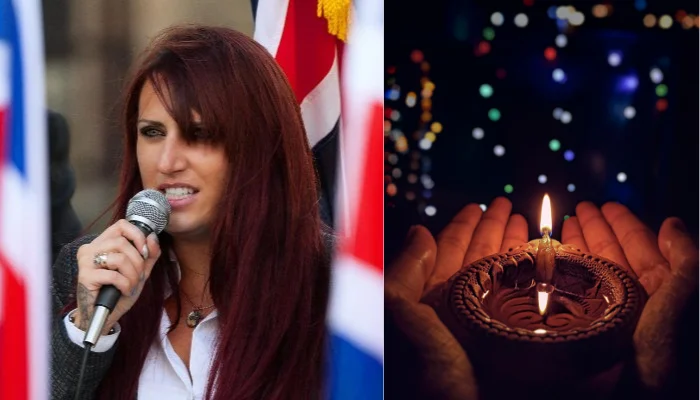
Case Summary
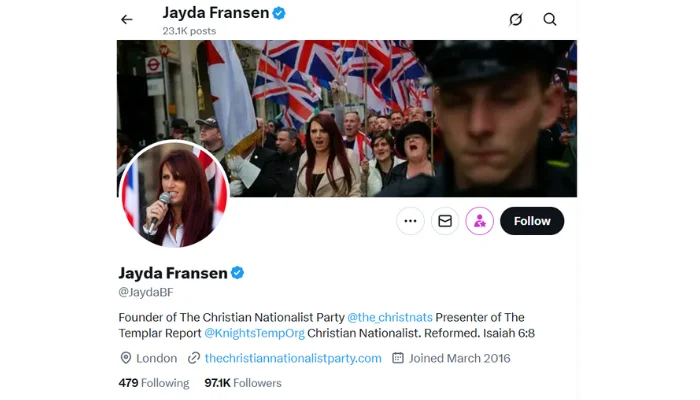
A derogatory and abusive remark insulting Hindu deities and Diwali, a revered Hindu festival, was made by a Christian politician from London, United Kingdom, named Jayda Fransen. Diwali, also known as Deepavali, holds profound importance for Hindus as it symbolises the victory of light over darkness, good over evil, and knowledge over ignorance. It commemorates the return of Lord Rama to Ayodhya after defeating the demon king Ravana, representing the triumph of righteousness (dharma) and virtue. Diwali also celebrates the divine feminine energy through Goddess Lakshmi, symbolising wealth, prosperity, and good fortune, and through Goddess Kali, who signifies the destruction of evil forces. The festival unites Hindu families and communities in prayer, celebration, and renewal, encouraging spiritual cleansing, positive beginnings, and harmony. The accused, Jayda Fransen, founder of a political group called “The Christian Nationalist Party”, made abusive remarks against Hindu deities like Lord Rama and Goddess Kali on 20th October 2025, describing them as ‘demonic.’ The incident began after a page on X (formerly Twitter) named ‘Reform UK’, operating under the handle ‘@reformparty_UK’, posted a Diwali greeting for Hindus. In response, Fransen quote-tweeted the post, sharing videos of Lord Rama and Goddess Kali and wrote: “This is demonic and it has no place in the United Kingdom. Christ is King.” This resulted in massive outrage among Indian Hindus, who expressed anger and condemnation over such disparaging remarks against a revered Hindu festival and Hindu deities.
Case Images
Why it is Hate Crime ?
This case has been added to the tracker under the primary category- Hate Speech against Hindus. The subcategory selected is- Anti-Hindu slurs, mocking faith. Anti-Hindu slurs and the deliberate mocking of the Hindu faith owing to religious animosity involve the usage of derogatory terms, stereotypes, or offensive references to religious practices, symbols, or figures. One of the common anti-Hindu slurs used against Hindus is “cow-worshipper” and “cow piss drinker”. The intention of using this term is to demean and mock Hindus as a group and their religious beliefs since Hindus consider the cow holy. Additionally, some symbols and the slurs attached to them have a historical context that exacerbates the insult, hate, stereotyping, dehumanisation and oppression against Hindus. Cow worship has been used for centuries to denigrate Hindus, insult their faith and oppress Hindus specifically as a religious group. There has been overwhelming documentation about how cow slaughter has been used to persecute Hindus with cow meat being thrown in temples and places of worship. There has also been overwhelming documentation where cow meat (beef) has been force-fed to Hindus to either forcefully convert them to Islam or denigrate their faith. Apart from cow worship, the Swastika – which holds deep religious significance for the Hindus – has also been misinterpreted and distorted to use as a slur against Hindus. Similarly, the worship of the Shivling has been used by supremacist ideologies and religions to denigrate Hindus owing to religious animosity. Such slurs and denigration stem out of inherent animosity and hate towards Hindus and their faith, therefore, it is categorised as hate speech targeted at Hindus specifically owing to their religious identity. This case is a clear instance of religiously motivated hate speech against Hindus. The accused Christian woman first denigrated a revered Hindu festival, Diwali. It is also referred to as the 'Festival of Lights' and holds profound religious significance for the Hindu community. To abuse and denigrate such a sacred festival constitutes a direct affront to Hindu religious identity and sentiments, establishing this as religiously motivated hate speech. The accused not only disparaged Diwali but also abused Hindu deities such as Lord Rama and Goddess Kali by labelling them ''demonic''. Lord Rama is one of Hinduism's most revered deities, embodying dharma (duty/righteousness), moral integrity, and the ideal king who vanquished evil. Goddess Kali signifies the divine feminine energy of destruction of evil and protection of devotees, embodying fierce power to defeat darkness and evil forces. Hindu deities are regarded as sacred manifestations of the divine; any attack or abuse towards them deeply wounds Hindu religious sentiments. Therefore, such vilification constitutes religiously motivated hate speech against the Hindu community and their faith. Furthermore, the accused stated that Hinduism, the festival of Diwali, and Hindu deities have no place in the United Kingdom. To declare that a particular religious community has no place in a geographical region exemplifies religious supremacy and exclusion. This statement reveals an intent to impose a Christian supremacist vision that marginalises and rejects the Hindu community. Rooted in exclusion and hatred, this clearly qualifies as religiously motivated hate speech. It is also crucial to highlight that terms like "demonic" have historically been deployed by Christian evangelists and proselytisers to deride Hinduism and other polytheistic faiths. This language conveys doctrinal animosity and seeks to delegitimise Hindu religious traditions. The use of such terminology in this context exemplifies a clear pattern of anti-Hindu sentiment, further confirming this as a religiously motivated hate speech. Given the deliberate disparagement of a sacred Hindu festival, the targeted abuse of highly revered deities, the promotion of exclusionary religious supremacy, and the use of historically charged derogatory language, this case has been added to the Hate Crime database of the Hinduphobia Tracker.


Case Status
Unknown


Perpetrators Details
Perpetrators
Christian Extremists
Perpetrators Range
One Person
Perpetrators Gender
female
 Sources




