Hindu woman abducted, forcibly converted to Islam and coerced to marry a married Muslim man in Pakistan's Punjab
 Punjab, Pakistan
  23 August, 2026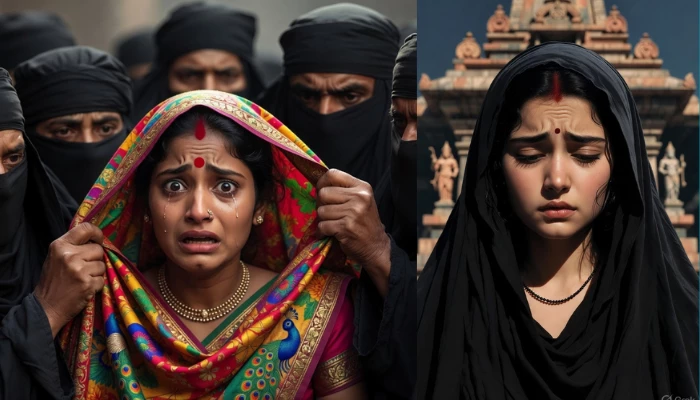
Case Summary
In Sindh, Pakistan, a 21-year-old Hindu woman was kidnapped from her hometown, taken to Punjab, pressured to convert to Islam and forcibly married to a Muslim man named Nazeer Hussain, who was already married. As per media reports, the woman was identified as Shirimati Reeta, a resident of Rana Rajput Colony in Khipro Tehsil of Sanghar district. She went missing from her hometown last week, prompting her brother Ravi Shankar to approach the authorities. An FIR was registered in Sanghar under Section 365-B of the Pakistan Penal Code on the complaint of her brother, Ravi Shankar. According to the complaint, CCTV footage from the family’s residence showed unidentified men abducting and taking Reeta away on August 24, 2026. The family also complained that mobile phones and other valuables were taken during the incident. The complaint further stated that Reeta was subsequently taken to Gujranwala in Pakistan’s Punjab province, around 80 kilometres from Lahore, and she was pressured to convert to Islam. Thereafter, she was forcibly married to a Muslim man named Nazeer Hussain, who was already married. Punjab Police later recovered Reeta and produced her before a judicial magistrate on August 31, 2026. Though the investigating officer, SI Muhammad Abdullah of Eminabad Police Station, sought permission to send Reeta to Darul Aman, a government-run shelter, on the grounds that she was unwilling to return to her parents, her lawyers, Asad Jamal and Kheta Ram, opposed the request. They told the court that Reeta wanted to return home with her brother. The magistrate subsequently directed Reeta to record her statement under oath, during which Reeta stated that she wanted to return to her parents’ home of her own free will. Following her statement, the magistrate allowed her to leave with her brother. The court placed responsibility for her safe custody and transportation back to her family home in Sanghar on her brother. At the time of writing, there were no details available about the culprits who abducted Reeta, nor was there any news if Nazeer Hussain was prosecuted or arrested. The incident once again brought attention to longstanding concerns surrounding forced conversions, abductions and marriages involving women and girls from religious minority communities, particularly Hindus in Pakistan. Rights groups had for years raised concerns about cases involving Hindu and other minority women, particularly those belonging to economically disadvantaged families. Such cases frequently involved abduction, pressure to change religion and marriage without the consent of the woman or her family. The Human Rights Commission of Pakistan had previously cited estimates suggesting that hundreds of minority girls were subjected to coercion, abduction or pressure to convert and marry every year, with Hindu girls identified by rights groups as a significant proportion of reported cases. The Hinduphobia Tracker had previously documented numerous cases where Hindu women were abducted, raped and forcibly converted to Islam by Muslim perpetrators and then coerced to marry the perpetrators. For instance, in March 2026, in Dhilyar, Khipro, Sindh province, Pakistan, a Hindu woman and her minor daughter were abducted at gunpoint, sexually abused and forcibly converted to Islam by armed Muslim men. The victims were Pari, aged around 35 years, and her daughter Sapna, aged approximately 10 years. Further, in another horrendous incident in June 2026 in Samaro, Sindh, Pakistan, a married Hindu woman, identified as Kanno Kolhi, was abducted at gunpoint from her home by a Muslim man and his accomplices. She was then held hostage at an Islamic shrine, where she was raped, forcibly converted to Islam, and made to undergo a nikah (Islamic marriage). On the day of the incident, the victim was sleeping alone at her house when the accused, identified as Ghulam Rasool Chandio and several other individuals, forcibly entered her residence and abducted her. Following the abduction, the victim was taken to an Islamic religious shrine near Samaro, where she was forcibly converted to Islam and forced into marriage against her will. During her approximately one-month-long captivity, she was repeatedly sexually assaulted. In another gut-wrenching instance in August 2026 in Mirpurkhas, Sindh, Pakistan, a 19-year-old Hindu woman was abducted, subjected to repeated rape, physically assaulted and tortured by being hung upside down, forcibly converted to Islam and married to a 33-year-old Muslim man. The victim was identified as Hina Meghwar, whose name was forcibly changed to Zainab Sheikh, and she was married to a Muslim man named Jamil Khaskheli. She was also made to give false testimony that she had converted and married of her own free will. Her conversion was carried out by Pir Muhammad Ayub Jan Sirhindi, an Islamic Sufi cleric in Pakistan whose dargah had been directly involved in several instances of forced conversions involving Hindu women and minor Hindu girls following their abduction. Time and again, such cases highlighted the persecution faced by Hindu minorities in Pakistan, marked by systemic discrimination, violence, and forced conversions. Hindu women were often abducted, forcibly converted to Islam, and married off to Muslim men with little to no legal recourse. Temples were frequently vandalised or destroyed, and Hindu communities were subjected to social and economic marginalisation. Blasphemy laws were disproportionately used against Hindus, leading to false accusations and severe punishments. Many Hindu families were forced to flee their homes due to religious intolerance, living in constant fear of attacks. This sustained persecution highlighted the dire conditions for Hindus in Pakistan, where their religious identity made them targets of oppression.
Why it is Hate Crime ?
The primary category selected in this case is: Predatory Proselytisation. The subcategory selected is: Harassment, threats, coercion for conversion. Harassment covers a wide range of behaviours of an offensive nature. It is commonly understood as behaviour that demeans, humiliates, and intimidates a person, including threats and coercion. Harassment and threats, in this case, find their root on discriminatory grounds which has the effect of nullifying a person’s rights or infringing upon his freedom to exercise his right specifically owing to the victim’s religious identity. Verbal and physical threats and psychological or physical harassment are often used against Hindu victims because they choose to practice their professed religion. Religious harassment also includes forced and involuntary conversions by harassment, threats or coercion. Coercion includes intimidatory tactics like force-feeding a Hindu victim beef to convert to another religion, forceful circumcision etc. In several cases documented, non-Hindu perpetrators or those who harbour specific animosity towards Hinduism, harass victims simply based on their religious identity. Such cases often also include harassment to ensure the Hindu victim abandons his/her professed religion and adopts the religion of the perpetrator. Such cases where Hindu victims are harassed to convert to the perpetrator’s religion are rooted in animosity towards the victim’s religious identity and are therefore documented as religiously motivated hate crimes. This case was added to the Hinduphobia tracker as a religiously motivated hate crime because the hostility directed against the victim demonstrated that her Hindu identity was central to the offence. She was targeted as a Hindu woman, and this was reflected in what followed her abduction: pressured to abandon Hinduism and convert to Islam. The religious nature of the offence was further established by the fact that conversion was made part of the coercive process. The purpose was not simply to control the victim but to compel a change in the religion she professed. Such conduct directly interfered with her freedom of conscience and religion. When coercion is used to make a Hindu abandon her faith and adopt the religion of the perpetrators, the harassment acquires a distinctly religious character. The forced marriage further reinforced this religious dimension. Marriage in this context was not an isolated personal act but followed the attempt to impose a different religious identity upon the victim. In such cases, the sequence of first coercing the woman to convert and then marrying her to a man of the new faith, Muslim man, serves to consolidate the conversion and prevent her from resisting or returning to her original religious and social environment. The marriage creates an additional layer of control over the victim after her religious identity has already been targeted. It isolates her from her family, community and religious roots, leaving little scope for her to return to the life and identity she had before the coercion. The sequence therefore showed an effort not merely to obtain a conversion but to make the imposed religious identity permanent and remove the victim from the social and religious environment to which she originally belonged. The circumstances also demonstrated how religious coercion operated through the isolation of a Hindu victim from her family and community. By taking her away from her hometown and placing her in an unfamiliar environment, the perpetrators deprived her of the support system through which she could resist the pressure being imposed upon her. This made the religious coercion more effective and further undermined her ability to exercise her freedom of religion independently. The case also reflected the particular vulnerability of Hindu women and girls in Pakistan to religious coercion. The repeated occurrence of abduction, conversion and marriage involving Hindu victims demonstrated that such conduct cannot always be viewed as an ordinary criminal dispute when the victim's religious identity is directly followed by an attempt to change that identity. The present case fit this wider pattern because the coercion was specifically directed towards replacing the victim's Hindu faith. The fact that the victim ultimately exercised her own choice before the magistrate was also significant. It further highlighted the distinction between genuine religious choice and a decision made under coercive circumstances. In numerous such cases, victims who are abducted or converted against their will are subsequently sent to government-run facilities, where their isolation from their families and communities further weaken their ability to resist the coercion imposed upon them. The same pattern was visible in this case. The investigating officer sought permission to send Reeta to Darul Aman, claiming that she was unwilling to return to her parents, which was directly refuted by Reeta herself when she told the magistrate that she wanted to return home with her brother. Such practices are carried to further break the victim's resistance and create conditions in which she is expected to surrender completely to the circumstances imposed upon her. Overall, since this case meets the parameters of a religiously driven hate crime, it is added to the hate crime database of the Hinduphobia Tracker. Disclaimer: The Hinduphobia Tracker records incidents based on when an event occurred or when the victim's ordeal began rather than when the media reported it. The media sources mentioned that the victim was abducted on 24 August 2026. Therefore, for documentation purposes, we have recorded the date based on when the incident occurred rather than when it was reported. In this case, though there were more than one perpetrator involved, the media reports identified only one Muslim perpetrator by name, Nazeer Hussain. Therefore, the perpetrator count was recorded as one. This is a conservative estimate recorded for documentation purposes only.
Victim Details
Total Victim
1
Deceased
0
Gender
- Male 0
- Female 1
- Third Gender 0
- Unknown 0
Caste
- SC/ST 0
- OBC 0
- General 0
- Unknown 1
Age Group
- Minor 0
- Adult 1
- Senior Citizen 0
- Unknown 0


Case Status
Case sub-judice


Perpetrators Details
Perpetrators
Muslim Extremists
Perpetrators Range
One Person
Perpetrators Gender
male
 Sources




