Hindu woman abducted, raped, tortured and forced into Islamic conversion and marriage in Pakistan; made to falsely testify that conversion was voluntary
 Mirpur Khas, Sindh, Pakistan
  22 August, 2026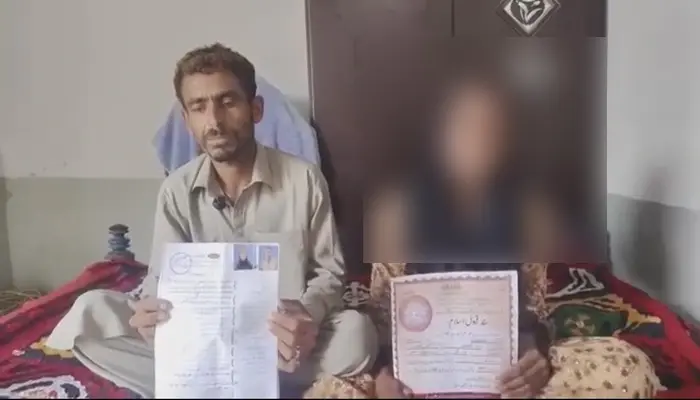
Case Summary
In Mirpurkhas, Sindh, Pakistan, a 19-year-old Hindu woman was abducted, subjected to repeated rape, physically assaulted and tortured by being hung upside down, forcibly converted to Islam and married to a 33-year-old Muslim man. The victim was identified as Hina Meghwar, whose name was forcibly changed to Zainab Sheikh, and she was married to a Muslim man named Jamil Khaskheli. She was also made to give false testimony that she had converted and married of her own free will. Her conversion was carried out by Pir Muhammad Ayub Jan Sirhindi, an Islamic Sufi cleric in Pakistan whose dargah had been directly involved in several instances of forced conversions involving Hindu women and minor Hindu girls following their abduction. Nikhil Chandwani highlighted the case on his Instagram account. He is a Hindu rights activist who has been involved in rescuing, resettling and rehabilitating persecuted Hindu families from Pakistan. He has helped to rescue nearly 10,000 persecuted Hindu families from Sindh. Chandwani revealed that Hina was forcibly abducted from her home in the Samaro area and repeatedly raped for several days. She was also physically assaulted and tortured, including being hung upside down. Following this, she was pressured to convert to Islam and marry Jamil Khaskheli. Subsequently, the victim was also forced to testify that she had converted to Islam and entered into the marriage of her own free will. In a video that later surfaced, the victim appeared visibly scared and was accompanied by Jamil Khaskheli when she claimed that she had converted to Islam and married him voluntarily. Using the name Zainab Sheikh, she also claimed that she had received threats from her uncle, Bario, and her father, Dongar Meghwar. She asked the court and the authorities to provide protection to both herself and Jamil Khaskheli. Chandwani also revealed that Hina was taken to Pir Muhammad Ayub Jan Sirhindi, who, at the time of writing this report, is associated with the Pir Sarhandi dargah in Pakistan's Umerkot region. He stated that Hindu girls and women were taken to such religious institutions after their abduction and subsequently converted to Islam, and that even the Pakistani state administration supported such dargahs, enabling the continued forced conversion of Hindus in Pakistan. Notably, the Pir Sarhandi dargah has remained in the media spotlight for several years for its direct involvement in cases concerning the abduction, coercion and forced conversion of Hindu girls and women. Hindu families repeatedly raised concerns over a recurring pattern in which Hindu girls disappeared, sometimes after being lured or abducted, and were subsequently taken to the dargah, where they were forcibly converted to Islam and married to Muslim men. The shrine's madrasa, Gulzar-i-Khalil, had also been directly involved in the rapid processing of such conversions and marriages, with ceremonies carried out swiftly, often before Hindu families had an opportunity to intervene or verify the age and consent of the girls involved. Pir Muhammad Ayub Jan Sirhindi had also stated that he had overseen thousands of such forced conversions, most of which involved Hindu girls. This case highlights the persecution faced by the Hindu minorities in Pakistan, marked by systemic discrimination, violence, and forced conversions. Hindu women, particularly young girls, are often abducted, forcibly converted to Islam, and married off to Muslim men with little to no legal recourse. Temples are frequently vandalised or destroyed, and Hindu communities are subjected to social and economic marginalisation. Blasphemy laws are disproportionately used against Hindus, leading to false accusations and severe punishments. Many Hindu families are forced to flee their homes due to religious intolerance, living in constant fear of attacks. This sustained persecution highlights the dire conditions for Hindus in Pakistan, where their religious identity makes them targets of oppression.
Why it is Hate Crime ?
The primary category selected in this case is: Predatory Proselytisation. The subcategory selected is: Harassment, threats, coercion for conversion. Harassment covers a wide range of behaviours of an offensive nature. It is commonly understood as behaviour that demeans, humiliates, and intimidates a person, including threats and coercion. Harassment and threats, in this case, find their root on discriminatory grounds which has the effect of nullifying a person’s rights or infringing upon his freedom to exercise his right specifically owing to the victim’s religious identity. Verbal and physical threats and psychological or physical harassment are often used against Hindu victims because they choose to practice their professed religion. Religious harassment also includes forced and involuntary conversions by harassment, threats or coercion. Coercion includes intimidatory tactics like force-feeding a Hindu victim beef to convert to another religion, forceful circumcision etc. In several cases documented, non-Hindu perpetrators or those who harbour specific animosity towards Hinduism, harass victims simply based on their religious identity. Such cases often also include harassment to ensure the Hindu victim abandons his/her professed religion and adopts the religion of the perpetrator. Such cases where Hindu victims are harassed to convert to the perpetrator’s religion are rooted in animosity towards the victim’s religious identity and are therefore documented as religiously motivated hate crimes. This case was a clear example of a religiously motivated hate crime because a Hindu woman was abducted, subjected to repeated rape, forcibly converted to Islam and then married to a Muslim man. Following this, she was made to give false testimony stating that she had converted and married of her own free will. The overall nature of the case, along with the involvement of Islamic clerics such as Pir Muhammad Ayub Jan Sirhindi, who had been associated with the forced conversion of numerous Hindu girls and women, further demonstrated the religious dimension of the crime. The circumstances showcased that the victim's Hindu identity was central to the violence and coercion inflicted upon her. Firstly, the fact that this incident occurred in Pakistan starkly illustrates the exploitation of vulnerable Hindu minorities through coercion and force. Such incidents are not isolated cases; rather, they are part of a persistent and troubling pattern in Pakistan, where Hindu minorities, particularly young Hindu girls, are frequently targeted for kidnappings, forced religious conversions, and marriages to Muslim men. This ongoing trend showcases the systemic discrimination and violence faced by the Hindu community in Pakistan. The Hindu minority has been subjected to various forms of harassment, marginalisation, and abuse since the country’s inception. In this case, the abduction of the Hindu woman demonstrated the religious dimension of the offence from the outset. Her abduction was not carried out for an ordinary criminal motive such as financial gain, property-related disputes or any other material purpose. She was specifically targeted as a Hindu woman, forcibly taken away from her family and subsequently subjected to religious coercion. The fact that her abduction was followed by her forced conversion to Islam and marriage to a Muslim man established a clear connection between the initial abduction and the subsequent religious persecution she endured. The abduction therefore formed the first stage of a religiously motivated offence directed at depriving a Hindu woman of her religious identity, autonomy and right to remain within her faith and community. The fact that Hina was subjected to repeated rape further demonstrated how sexual violence was used as a tool of religious coercion in the course of the offence. She was raped repeatedly for several days before being pressured into converting to Islam and marrying a Muslim man. The prolonged sexual violence inflicted severe physical and psychological trauma upon her and was used to break her spirit, undermine her resistance and place her in an increasingly vulnerable and submissive state. In this context, the repeated rape was not merely an act of sexual gratification but formed part of the coercive process used to weaken the victim before imposing an Islamic identity and marriage upon her. The deliberate use of sustained sexual violence against a Hindu woman to break her resistance and facilitate her forced conversion demonstrated a clear instance of religiously driven sexual violence and persecution. The forced conversion to Islam and subsequent nikah represented a direct violation of the victim's religious autonomy, fundamental rights, and freedom to retain and practise her Hindu faith. A religious conversion could only be considered voluntary when a person made such a decision with their own full and informed consent and out of a genuine, personal conviction towards the faith they chose to embrace. In this case, however, the circumstances were coercive from the very beginning, as the victim was first abducted and subjected to repeated sexual violence before being forcibly converted to Islam. Her conversion therefore cannot be considered voluntary in any sense, as she was deprived of the ability to make a free and informed decision regarding her religious identity. She was compelled to abandon the faith into which she had been born, effectively treating her Hindu beliefs and identity as something that could be forcibly discarded and replaced. The change of her name from Hina Meghwar to Zainab Sheikh further demonstrated the attempt to erase every visible sign of her Hindu identity and impose a new religious identity upon her. The subsequent nikah with Jamil Khaskheli was not an independent or voluntary act but served to establish control over the victim and institutionalise the forced conversion imposed upon her. Taken together, these acts demonstrated deep-seated religious hostility towards the Hindu community and a deliberate instance of stripping a Hindu woman of her faith identity. The involvement of Pir Muhammad Ayub Jan Sirhindi further demonstrated that the incident formed part of a wider pattern rather than being an isolated case of voluntary conversion. Sirhindi and his dargah have repeatedly been associated with the forced conversion of multiple Hindu girls and women, demonstrating the existence of an established network through which vulnerable members of the Hindu community were targeted and subjected to religious coercion. His involvement in the present case therefore strengthened the religious dimension of the offence and indicated a coordinated effort to target Hindu women, strip them of their Hindu identity and facilitate their marriages to Muslim men. Such a recurring pattern reflected a religiously driven form of persecution aimed at weakening and ultimately eroding the Hindu minority in Pakistan through the forced conversion of its members, particularly vulnerable women and girls, and demonstrated deep-seated hostility towards the Hindu community. The fact that the victim was subsequently made to give false testimony stating that she had converted to Islam and married of her own free will further demonstrated the vulnerability of Hindu girls and women in Pakistan. Such coercion has been seen in multiple cases involving Hindu women and girls who are abducted, forcibly converted to Islam and subsequently brought before courts or authorities to provide statements portraying their conversion and marriage as voluntary. In several such instances, Pakistani courts and administrative authorities have previously effectively institutionalised the coercive process by accepting such statements despite the circumstances surrounding the victims' abduction and conversion, and cases have also emerged in which forcibly converted Hindu girls were handed back to the Muslim men who had abducted them. The use of coerced testimony to create an appearance of voluntary conversion therefore served to conceal the preceding abuse and deny the victim meaningful access to protection or justice. In the present case, the fact that the victim was made to portray a forcibly imposed conversion and marriage as an act of her own free will demonstrated the depth of the religious hostility directed towards her and highlighted the precarious position of Hindu women and girls within Pakistan's institutional and social framework. Overall, since this case meets the parameters of a religiously driven hate crime, it is added to the hate crime database of the Hinduphobia Tracker. Disclaimer: The Hinduphobia Tracker records incidents based on when an event occurred or when the victim's ordeal began. It is important to clarify that none of the media sources covering this case has specified the exact date when the incident occurred. Therefore, for documentation purposes, we have recorded the date based on when the incident was first reported in the media, 23rd August 2026. In this case, two identifiable perpetrators were involved: the Muslim man to whom the victim was married, Jamil Khaskheli, and the Islamic cleric, Pir Muhammad Ayub Jan Sirhindi. Therefore, the perpetrator count has been recorded as two. This is a conservative estimate recorded for documentation purposes only.
Victim Details
Total Victim
1
Deceased
0
Gender
- Male 0
- Female 1
- Third Gender 0
- Unknown 0
Caste
- SC/ST 1
- OBC 0
- General 0
- Unknown 0
Age Group
- Minor 0
- Adult 1
- Senior Citizen 0
- Unknown 0


Case Status
Unknown


Perpetrators Details
Perpetrators
Muslim Extremists
Perpetrators Range
From 2 To 5
Perpetrators Gender
male
 Sources




