Hindu event falsely portrayed as violent by leftist media; downplays hate-driven murder of a Hindu man as 'minor dispute'
 India
India  12 April, 2026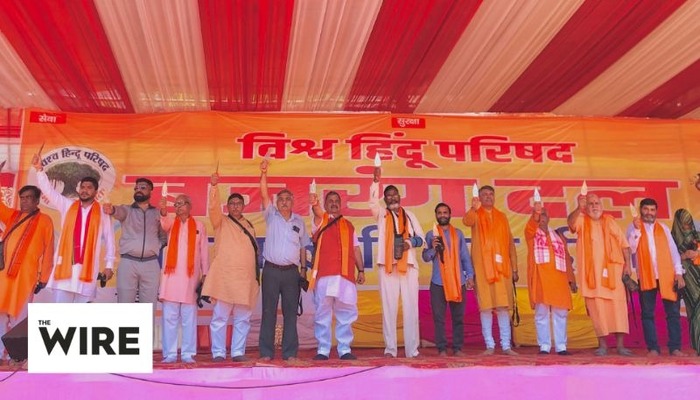
Case Summary
A clear pattern of anti-Hindu prejudice was promoted in the opinion piece titled "दिल्ली: तरुण हत्या के बाद तनावग्रस्त उत्तम नगर में हुए उग्र भाषण, विहिप ने 1,700 त्रिशूल बांटे" (Delhi: Fiery speeches in tense Uttam Nagar after Tarun's murder; VHP distributes 1,700 tridents) authored by Ankit Raj and published in The Wire on 13 April 2026. It presented a misleading narrative surrounding the Trishul Diksha event organised by a Hindu organisation, portraying Hindus as violent, thus reflecting an anti-Hindu bias through selective framing, omission of critical facts, and inversion of victimhood. The article was written in the aftermath of the killing of a Hindu youth, Tarun Kumar, during Holi celebrations in Uttam Nagar, where the Hindu man was beaten to death by a group of Muslim men after a child accidentally spilt coloured water on a Muslim woman during Holi celebrations. Despite the gravity of the incident and the fact that a Hindu man lost his life, the article systematically downplayed the communal nature of the crime by reducing it to a “minor conflict,” while diluting the targeted nature of the violence and obscuring the identity of the perpetrators. While the killing triggered local outrage and demands for justice from the victim’s family and sections of the Hindu community, reportage by the media outlet The Wire drew criticism for its framing of both the murder and subsequent developments. In its ground report dated 13 April 2026, covering a “Trishul Deeksha” programme organised by the Vishwa Hindu Parishad (a Hindu organisation) at Ayyappa Park in Uttam Nagar, the media outlet described the killing of the Hindu youth as arising from a “minor dispute” that escalated into communal tension, thereby reducing the severity of the mob violence in which a Hindu man lost his life. The report placed significant emphasis on the consequences faced by the accused Muslim family, including vandalism of their home, demolition action by municipal authorities, and their subsequent departure from the locality. At the same time, comparatively limited attention was given to the victim and his family, who lost their only son. The demands for justice raised by his family, who were present at the event and publicly called for strict punishment of the perpetrators. The same report scrutinised the VHP’s distribution of approximately 1,700 tridents as part of its “Trishul Deeksha” programme, falsely portraying the event as a form of mobilisation in a communally sensitive area. It claimed that minors were among those receiving tridents and characterised speeches delivered at the event as “fiery” and aggressive in tone, falsely portraying that Muslim communities were indirectly referenced during addresses by speakers. The author attempted to portray that the event was organised in the context of the murder of Tarun Kumar, while completely ignoring the fact that the Delhi Vishwa Hindu Parishad (VHP) was not holding a Trishul distribution event for the first time. The report further claimed that the symbolic distribution of tridents, described by organisers as representing “culture, service, and security,” carried more complex implications on the ground, thereby falsely framing the event as potentially contributing to heightened tensions. Additionally, the report noted that over 30,000 tridents were planned to be distributed across Delhi in similar programmes, drawing misleading attention and alarm to the scale of the initiative. Furthermore, the killing of the Hindu youth, Tarun Kumar, was contextualised as a localised dispute while the response of Hindu organisations was examined through a lens of escalation and mobilisation. The portrayal of administrative actions, such as demolition of the accused’s property (which was legal as the property was enroached), was framed in terms of hardship faced by the accused family, contributing to an inversion of victimhood in public discourse. The presence of Tarun Kumar’s family members at the event, their participation in the ceremony, and their calls for justice were reported but interpreted within the broader framing of emotional mobilisation rather than as expressions of grievance following a fatal assault. This pattern of coverage was viewed alongside earlier commentary by the same publication, including opinion pieces that had characterised the Uttam Nagar incident as a quarrel between families or a reflection of fragile social relations, thereby downplaying its communal dimension. In contrast, symbolic or organisational responses from Hindu groups, such as the Trishul Deeksha programme, were subjected to heightened scrutiny and interpreted as indicative of rising majoritarian assertion.
Why it is Hate Crime ?
This case has been added to the tracker under the primary category of - Hate speech against Hindus. The sub-category selected here is- Anti-Hindu subversion and prejudice. The tertiary category selected under it is: Anti-Hindu Fake news or Downplaying Hate speech is defined as any speech, gesture, conduct, writing, or display that is prejudicial against a specific individual and/or group of people, which leads to or may lead to violence, prejudicial action or hate against that individual and/or group. Media plays a specific and overarching role in perpetuating prejudicial attitudes towards a community owing to unfair, untrue coverage and/or misrepresentation/misinterpretation, selective coverage and/or omission of facts of/about issues affecting a specific religious group. This type of bias can dehumanise the victim group, making it easier for others to justify harmful actions against them, which aligns with the objectives of hate speech laws aimed at preventing such harm. It is often observed that the media takes a prejudicial stand against the Hindu community, driven by their need to shield the aggressor community, which happens to be a numeric minority; however, that is the one perpetrating violence against Hindus. For example, the media is often quick to contextualise religiously motivated crimes against Hindus, omit or misrepresent facts that point towards religiously motivated hate crimes, justify and/or downplay religiously motivated hate crimes, or simply present fake news to stereotype Hindus. Such media bias leads to the denial of persecution and is often used to dehumanise Hindus, leading to justification for violence against them. For example, the media covered several fake allegations of Hindus targeting Muslims and forcing them to chant Jai Shree Ram. Most of these cases were proved false and fabricated after police investigation. These fake news reports were subsequently never retracted or clarified. Such fake news led to the justification of violence and dehumanisation of Hindus based on the argument that since Hindus targeted Muslims and forced them to chant Jai Shree Ram, the dehumanisation of Hindus and violence against them was par for the course and merely a retaliation. Such media bias leads to prejudicial portrayals of Hindus and offers a justification for violence against them and, therefore, is considered hate speech under this category. This case was added to the tracker as it involved the systematic downplaying of the killing of a Hindu man and the selective framing of a subsequent Hindu religious event, the Trishul Deeksha event, in a manner that cast suspicion on Hindu responses while diluting the gravity of the original crime. In its report on the “Trishul Deeksha” programme organised by the Vishwa Hindu Parishad in Uttam Nagar, The Wire reduced the brutal killing of Tarun Kumar to a “minor dispute,” thereby minimising the seriousness of a fatal act of Muslim mob violence in which a Hindu youth lost his life. This characterisation stripped the incident of its severity and communal context, presenting it as a routine altercation rather than a disproportionate act of violence, which had already generated fear and outrage among the local Hindu community. This mischaracterisation amounted to a clear minimisation of the crime, stripping it of its communal nature and obscuring the fact that a Hindu individual was killed by a Muslim mob over a minor issue. Such dilution of facts was not neutral reporting but a conscious attempt to reframe a violent act in a way that diminishes the gravity of the offence against a Hindu victim The report further demonstrated bias by shifting the focus away from the victim and towards the consequences faced by the accused Muslim family, including the demolition of their property, which was done legally by the municipal corporation, and their departure from the locality. By foregrounding these aspects while giving comparatively limited attention to the victim’s family and their demand for justice, the narrative created an imbalance that inverted victimhood. The suffering and grievances of the Hindu victim’s family were present but were not treated as the central concern, while the reportage placed greater emphasis on portraying the accused side as impacted, thereby reshaping public perception of who the primary victim was. At the same time, the article subjected the Hindu response to heightened scrutiny by portraying the Trishul Deeksha event as a form of mobilisation in a communally sensitive environment. The distribution of tridents, described by organisers as symbolic of “culture, service, and security,” was framed as having deeper and potentially troubling implications, and the presence of minors and the tone of speeches were highlighted to reinforce this perception. The routine Hindu event was portrayed with violent rhetoric. This selective emphasis created a narrative in which expressions of Hindu solidarity and calls for justice were interpreted as escalatory or aggressive, rather than as a reaction to the killing of a member of their community. Additionally, the language used in the report reflected differential standards in describing actors and events. Speeches delivered at the event were characterised as “fiery” and aggressive, while references to the circumstances of the murder and the role of the accused were comparatively muted. This asymmetry in tone contributed to a portrayal where Hindu mobilisation appeared inherently suspect, whereas the actions leading to the death of the Hindu victim were softened through neutral or minimising language. Such framing influenced how readers interpreted both the crime and the response to it. The cumulative effect of these elements demonstrated a pattern of selective omission, narrative distortion, and inversion of victimhood. By reducing a mob lynching of a Hindu youth as a minor dispute, shifting focus towards the accused, and casting Hindu responses in a negative light, the report contributed to a narrative that diminished the seriousness of violence against a Hindu individual. This approach went beyond neutral reporting and reflected a consistent bias in the representation of the incident, where the centrality of the Hindu victim was undermined and the broader context of the violence was diluted. Moreover, this pattern was not isolated. The Wire has, in multiple instances, framed incidents involving harm to Hindus in a manner that softens the role of the perpetrators. By shifting narratives and omitting key facts, such reporting shields wrongdoing and redirects scrutiny. This creates a consistent bias in representation. For instance, on 21st December, The Wire published a report quoting the Bangladeshi government’s official response to the Ministry of External Affairs’ reply in the Lok Sabha. The ministry stated that there were 2,200 incidents of violence against Hindus and other minorities in Bangladesh in 2024, whereas The Wire downplayed and claimed that there were only 138 incidents of violence between January and November 2024. In another instance on 16th October, 2024, The Wire framed the brutal murder of 22-year-old Hindu youth Ram Gopal Mishra in Bahraich, Uttar Pradesh, as an act of "self-defence" by Muslim assailants. Mishra was brutally killed after he replaced a green flag with a saffron one at Abdul Hamid’s home following a dispute during the Durga Visarjan procession. The Wire's video report titled “Who is behind the communal riots in Bahraich?” was published on October 16, where journalist Sharat Pradhan suggested that the BJP and RSS incited communal tension, linking it to the upcoming by-elections. In yet another instance, on 16 May, 2025, in Bhopal, several Hindu girls were religiously profiled, lured, and raped by a group of Muslim men. The perpetrators filmed their horrific acts and even attempted to sell them on pornographic websites. The Wire objected to the publication of the details about the Muslim perpetrators and their stated religious motivations for committing the crime. Huneza Khan authored an article in The Wire about the Bhopal incident, claiming that the Bhopal rape case had been subjected to a media trial. She argued that the reporting of these horrific stories about the victims was causing communal hatred against Muslims. Therefore, this case was categorised under Hate speech against Hindus, specifically under Anti-Hindu subversion and prejudice, with a tertiary classification of Anti-Hindu fake news, downplaying, or misrepresentation. The framing adopted in the coverage contributed to the normalisation of narratives that minimise or obscure violence against Hindus while disproportionately scrutinising their responses, thereby shaping public discourse in a manner prejudicial to the community.


Case Status
Unknown


Perpetrators Details
Perpetrators
Others
Perpetrators Range
One Person
Perpetrators Gender
male
 Sources




