Hindu youth’s killing trivialised: Leftist media portal portrays mob lynching as ‘family quarrel’, distorts facts to portray Hindus as aggressors
 India
India  17 March, 2026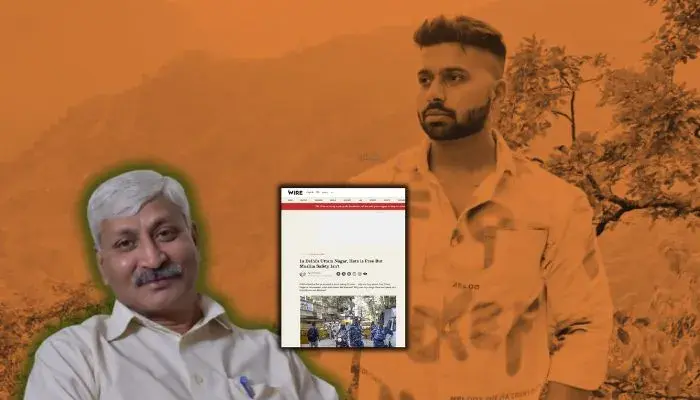
Case Summary
A clear pattern of anti-Hindu prejudice was promoted in the opinion piece titled "In Delhi's Uttam Nagar, Hate is Free, But Muslim Safety Isn't" authored by Apoorvanand and published in The Wire on 18 March 2026. It presented a misleading narrative surrounding the Uttam Nagar violence that reflected an anti-Hindu bias through selective framing, omission of critical facts, and inversion of victimhood. The article was written in the aftermath of the killing of a Hindu youth, Tarun Kumar, during Holi celebrations in Uttam Nagar, where the Hindu man was beaten to death after a child accidentally spilt coloured water on a Muslim woman during Holi celebrations. Despite the gravity of the incident and the fact that a Hindu man lost his life, the article systematically downplayed the communal nature of the crime by reducing it to a “quarrel between two families,” thereby diluting the targeted nature of the violence and obscuring the identity of the perpetrators. The narrative consistently shifted focus away from the Hindu victim who lost his life at the hands of a Muslim mob and instead foregrounded the fears and insecurities of the Muslim community, portraying them as the primary victims in the aftermath of the incident. It emphasised slogans raised during protests and framed Hindu outrage as an expression of majoritarian aggression, while failing to contextualise this reaction as a response to the killing of the Hindu man. Furthermore, the article talked about historical events such as the 1984 anti-Sikh riots and the Hashimpura massacre to construct a broader false narrative of systemic Hindu and state violence against minorities, especially the Muslim minority. The article drew parallels with events such as the 1984 anti-Sikh riots, where it claimed that Hindus, enraged after the assassination of Indira Gandhi, were allowed by police to loot and kill Sikhs, and the Hashimpura massacre, where it claimed that security forces themselves killed Muslims, using these examples to argue that Muslims in India have historically experienced police complicity during episodes of violence, thereby extending this framework to interpret the situation in Uttam Nagar. The article also questioned police conduct by suggesting complicity with Hindu groups, while simultaneously acknowledging that law enforcement had prevented further violence. This contradictory positioning served to cast suspicion on institutional actions when they appeared to align with Hindu grievances, thereby reinforcing a narrative of systemic bias in favour of Hindus even in a context where a Hindu had been killed. Additionally, the piece talked about administrative actions such as demolition drives affecting properties linked to the accused, framing these measures as targeted against Muslims without adequately addressing the legal or procedural basis cited by authorities.
Why it is Hate Crime ?
This case has been added to the tracker under the primary category of - Hate speech against Hindus. The sub-category selected here is- Anti-Hindu subversion and prejudice. The tertiary category selected under it is: Anti-Hindu Fake news or Downplaying Hate speech is defined as any speech, gesture, conduct, writing, or display that is prejudicial against a specific individual and/or group of people, which leads to or may lead to violence, prejudicial action or hate against that individual and/or group. Media plays a specific and overarching role in perpetuating prejudicial attitudes towards a community owing to unfair, untrue coverage and/or misrepresentation/misinterpretation, selective coverage and/or omission of facts of/about issues affecting a specific religious group. This type of bias can dehumanise the victim group, making it easier for others to justify harmful actions against them, which aligns with the objectives of hate speech laws aimed at preventing such harm. It is often observed that the media takes a prejudicial stand against the Hindu community, driven by their need to shield the aggressor community, which happens to be a numeric minority; however, that is the one perpetrating violence against Hindus. For example, the media is often quick to contextualise religiously motivated crimes against Hindus, omit or misrepresent facts that point towards religiously motivated hate crimes, justify and/or downplay religiously motivated hate crimes, or simply present fake news to stereotype Hindus. Such media bias leads to the denial of persecution and is often used to dehumanise Hindus, leading to justification for violence against them. For example, the media covered several fake allegations of Hindus targeting Muslims and forcing them to chant Jai Shree Ram. Most of these cases were proved false and fabricated after police investigation. These fake news reports were subsequently never retracted or clarified. Such fake news led to the justification of violence and dehumanisation of Hindus based on the argument that since Hindus targeted Muslims and forced them to chant Jai Shree Ram, the dehumanisation of Hindus and violence against them was par for the course and merely a retaliation. Such media bias leads to prejudicial portrayals of Hindus and offers a justification for violence against them and, therefore, is considered hate speech under this category. This case qualifies as a hate-driven incident because the opinion piece titled "In Delhi's Uttam Nagar, Hate is Free But Muslim Safety Isn't" authored by Apoorvanand and published in The Wire, did not merely present an alternative viewpoint but systematically constructed a narrative that erased Hindu victimhood, downplayed the killing of a Hindu man, and recast the incident that portrayed Hindus as aggressors while amplifying Muslim victimhood. At the core of the incident was the brutal killing of a Hindu youth, Tarun Kumar, in Uttam Nagar during Holi celebrations, after a child accidentally spilt water on a Muslim woman. However, instead of acknowledging the targeted and disproportionate nature of the violence over a minor issue, the article deliberately reduced the incident to a “quarrel between two families.” This mischaracterisation amounted to a clear minimisation of the crime, stripping it of its communal nature and obscuring the fact that a Hindu individual was killed by a Muslim mob over a minor issue. Such dilution of facts was not neutral reporting but a conscious attempt to reframe a violent act in a way that diminishes the gravity of the offence against a Hindu victim. The article further demonstrated bias by shifting the narrative focus almost entirely away from the deceased Hindu victim and towards the perceived insecurity of the Muslim community. While the death of Tarun Kumar was treated as a peripheral detail, extensive emphasis was placed on protest slogans and the emotional state of Muslims in the locality. This selective amplification created a distorted moral framework in which the reaction of Hindus to the killing was portrayed as the primary concern, while the killing itself was relegated to the background. By framing Hindu outrage as inherently threatening and unjustified, the article effectively denied Hindus the legitimacy of expressing grief and anger over the killing of the Hindu man. Similarly, in an attempt to portray the Muslim victimhood, the author talked about unrelated historical events such as the 1984 anti-Sikh riots and the Hashimpura massacre. These events were presented in a manner that generalised Hindu culpability and suggested a pattern of state-supported violence against minorities. However, drawing such parallels in the context of Uttam Nagar, where a Hindu individual had been killed, amounted to a deliberate deflection from the facts of the case. Instead of addressing the immediate crime, the article embedded the incident within a broader narrative that portrayed Hindus as historical aggressors and Muslims as perpetual victims. This rhetorical strategy not only misrepresented the present case but also contributed to the normalisation of narratives that diminish or erase violence against Hindus. Additionally, even the historical events cited in the article were framed in a misleading manner to attribute collective blame to Hindus and reinforce a narrative of inherent Hindu aggression. The reference to the 1984 anti-Sikh riots was presented as an instance of “Hindus” attacking Sikhs, whereas historical records and inquiry reports have clearly established that the violence was orchestrated by political actors, particularly leaders and workers linked to the Indian National Congress, rather than Hindus. Similarly, the Hashimpura massacre was carried out by members of the Provincial Armed Constabulary, making it a case of state excess and custodial violence, not an act of communal aggression by Hindus as a community. By selectively framing these incidents as examples of Hindu-led violence, the article distorted their historical context and reassigned institutional or political culpability onto an entire religious group. This misrepresentation served to reinforce a preconceived narrative of Hindu aggression while erasing the specific actors and circumstances responsible for those events, thereby further embedding bias into the interpretation of the Uttam Nagar case. The article also adopted a contradictory stance on law enforcement. On one hand, it acknowledged that the police had prevented further violence and maintained control over the situation. On the other hand, it insinuated that the police were complicit with Hindu groups and selectively allowed expressions of hostility. This dual framing served to undermine institutional credibility when it acted in a manner that aligned with Hindu grievances, thereby reinforcing a perception that even lawful and preventive actions by authorities were suspect if they did not conform to the article’s narrative. Such insinuations, made without substantiated evidence, contributed to a broader attempt to portray state institutions as biased in favour of Hindus, even in a situation where a Hindu had been killed. Additionally, the article’s portrayal of administrative actions, such as demolition drives targeting properties linked to the accused, further reflected selective framing. These actions were presented as being directed against Muslims, without adequately engaging with the legal basis cited by authorities, including instances of illegal encroachments. By presenting these measures solely through the lens of communal targeting, the article reinforced a narrative of victimhood while disregarding the procedural context in which such actions were undertaken. Taken together, these elements demonstrate that the author did not simply express an opinion but engaged in a pattern of selective omission, distortion, and narrative inversion that consistently demonised Hindus. The minimisation of a Hindu victim’s killing, the amplification of Muslim victimhood, the use of unrelated and false historical analogies to generalise Hindu aggression, and the casting of suspicion on state institutions collectively point to a deliberate attempt to shape public perception in a manner that is prejudicial to Hindus. Such conduct goes beyond the boundaries of fair commentary or journalistic interpretation. It reflects a deeper ideological bias that seeks to reinterpret incidents involving Hindu victims in a way that diminishes their suffering and redirects attention elsewhere. By systematically erasing the centrality of the Hindu victim and reframing the discourse to portray Hindus as aggressors even in the aftermath of their own victimisation, the article contributed to the normalisation of anti-Hindu narratives. Therefore, the spread of this fabricated narrative clearly falls under hate speech. It was an instance of hate-driven narrative construction, where selective reporting, contextual distortion, and rhetorical framing were employed to undermine the reality of violence against a Hindu individual and portray Muslim victimhood. Since the article was motivated by anti-Hindu bias, this case has been added to the tracker.


Case Status
Unknown


Perpetrators Details
Perpetrators
Others
Perpetrators Range
One Person
Perpetrators Gender
male
 Sources




