Bhopal's rape case of Hindu girls by Muslim men downplayed by 'The Wire', religious profiling of the victims whitewashed
 Delhi, Delhi, India
  15 May, 2025
Case Summary
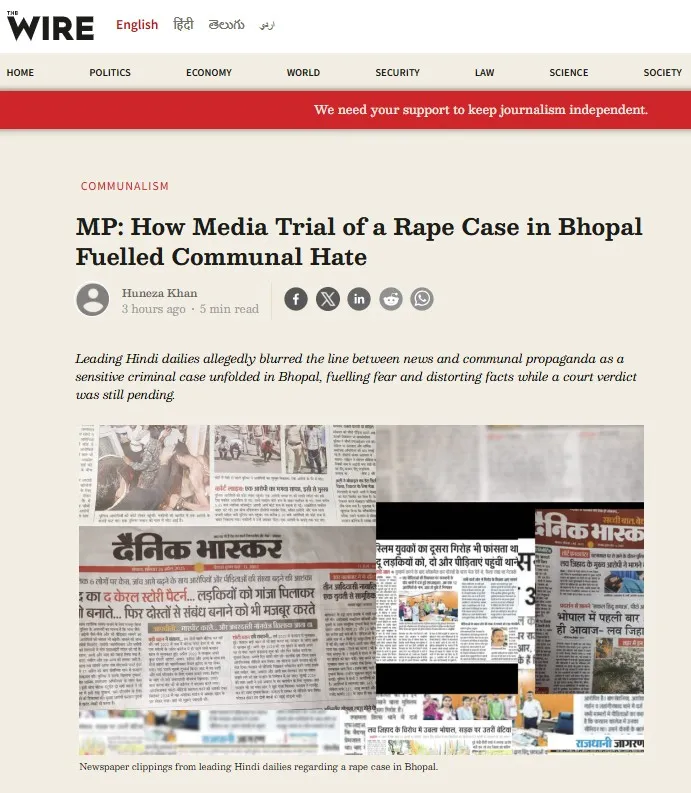
Several Hindu girls were religiously profiled, lured, and raped by a group of Muslim men in Bhopal. The perpetrators filmed their horrific acts and even attempted to sell them on pornographic websites. During police interrogation, one of the accused, Farhan, stated that these acts were committed for ‘Sawaab’, meaning a meritorious deed. The media reported the incident as it occurred, which led to criticism from the leftist Islamist propaganda news portal, The Wire. The Wire objected to the publication of the details about the Muslim perpetrators and their stated religious motivations for committing the crime. On 16th May 2025, Huneza Khan authored an article in The Wire about the Bhopal incident, claiming that the Bhopal rape case had been subjected to a media trial. She argued that the reporting of these horrific stories about the victims was causing communal hatred against Muslims. In the Bhopal case, Muslim men raped Hindu girls after drugging them with marijuana, filmed the assaults, and even burned them with cigarettes. When the mainstream media reported these details without restraint, The Wire expressed concern, downplaying the religious profiling or targeting of Hindu women in this case, referring to it as a crime against ‘college girls’ rather than specifically against Hindu girls. Contrary to The Wire’s narrative, the gang’s leader, Farhan, told police during an interrogation that he had no remorse for trapping and raping Hindu girls, threatening them, and considered these acts a ‘sawaab’ (virtuous) deed as per Islam. Farhan also stated that he aimed to ruin the lives of Hindu girls, viewed his actions as a form of 'Jihad', and was proud of his role. The gang members, including Farhan, Abrar, Nabeel, Saad, and Ali, would record videos of each other raping Hindu girls. Some arranged rooms for the assaults, while others supplied marijuana. If any Hindu girl refused, they would threaten to sell her video online. The girls were targeted at various places like dance academies, colleges, offices, and other locations. However, in the eyes of The Wire, the exposure of these facts is an act of ‘communal hate’ and Islamophobia. The Wire argued that such reporting raises questions about media ethics, insisting that the crimes were not religiously motivated but were a result of ‘patriarchy’. This is a glaring approach of whitewashing and downplaying the religious targeting and abuse of Hindu women by Muslim men indoctrinated by the Islamist ideology.
Case Images
Why it is Hate Crime ?
This case has been added to the hate tracker under the prime category- Hate speech against Hindus and within this, the sub-category selected is- Anti Hindu subversion and prejudice. Under this, one tertiary category namely, 'Anti-Hindu fake news or downplaying', has also been selected. Hate speech is defined as any speech, gesture, conduct, writing, or display that is prejudicial against a specific individual and/or group of people, which is leading to or may lead to violence, prejudicial action or hate against that individual and/or group. Media plays a specific and overarching reach in perpetuating prejudicial attitudes towards a community owing to unfair, untrue coverage and/or misrepresentation/misinterpretation, selective coverage and/or omission of facts of/pertaining to issues affecting a specific religious group. This type of bias can dehumanise the victim group, making it easier for others to justify harmful actions against them, which aligns with the objectives of hate speech laws aimed at preventing such harm. It is often observed that the media takes a prejudicial stand against the Hindu community driven by their need to shield the aggressor community which happens to be a numeric minority, however, is the one perpetrating violence against Hindus. For example, the media is often quick to contextualise religiously motivated crimes against Hindus, omit or misrepresent facts that point towards religiously motivated hate crimes, justify and/or downplay religiously motivated hate crimes or simply present fake news to stereotype Hindus. Such media bias leads to the denial of persecution and is often used to dehumanise Hindus, leading to justification for violence against them. For example, the media covered several fake allegations of Hindus targeting Muslims and forcing them to chant Jai Shree Ram. Most of these cases were proved false and fabricated after police investigation. These fake news reports were subsequently never retracted or clarified. Such fake news led to the justification of violence and dehumanisation of Hindus based on the argument that since Hindus targeted Muslims and forced them to chant Jai Shree Ram, the dehumanisation of Hindus and violence against them was par for the course and merely a retaliation. Such media bias leads to prejudicial portrayal of Hindus and offers a justification for violence against them and therefore, is considered hate speech under this category. This case has been added to the tracker as this instance of downplaying and whitewashing of the crimes rooted in religious animosity against Hindu women by Muslim men is a misappropriation of facts and outright Hinduphobic. Despite police statements and confessions from the accused that explicitly mention targeting Hindu girls as an act of religious merit or “sawaab,” The Wire frames the incident as a generic crime of rape and sexual assault against “college girls” and attributes the motive to 'patriarchy' rather than religious animosity held towards the victim and her Hindu identrity. By refusing to acknowledge the religious and ideological motivations of the perpetrators, The Wire deliberately erases the targeted nature of the violence on the Hindu community. This sort of reporting minimises the suffering of the Hindu victims by refusing to recognise that they were attacked specifically because of their Hindu identity. Such crimes are committed by Muslim men due to religious animosity towards the Hindu community, which even the main perpetrator, Farhan, highlighted by calling it an act of 'Sawaab' and 'Jihad'. Such denial not only delegitimises the lived experiences of the Hindu victims and their families but also prevents a broader societal understanding of the patterns of hate crimes against Hindus, especially Hindu women. Secondly, by shifting the narrative away from religiously motivated sexual violence and focusing solely on generic social issues like patriarchy, The Wire implicitly suggests that the religious targeting of Hindus is either unimportant or non-existent. This further leads to a culture of silence and impunity around anti-Hindu hate crimes and therefore contributes to Hinduphobia. Furthermore, The Wire’s stance discourages honest reporting and public discourse about the crime and religiously motivated violence. This not only shows their standard of journalism but also their malicious motives to silence the public discourse on crimes committed against Hindus by Muslims. By labelling the exposure of these facts as “communal hatred”, The Wire not only undermines the credibility of victims but also stigmatises those who seek justice and recognition for hate crimes against Hindus. This pattern of denial and deflection is a hallmark of anti-Hindu hatred and bias, and therefore, this case is being added to the tracker under the category of the Hate Crime database.


Case Status
Unknown


Perpetrators Details
Perpetrators
Others
Perpetrators Range
One Person
Perpetrators Gender
female
 Sources




