Sacred Hindu site defiled as Muslim youths hold non‑veg iftar party on boat in the Ganges, throwing bones near temple ghat in Varanasi
 Varanasi, Uttar Pradesh, India
  15 March, 2026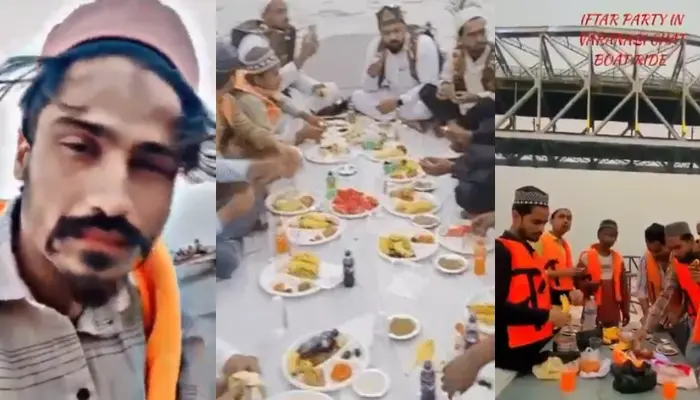
Case Summary
In Varanasi, Uttar Pradesh, the Hindu sacred sites of the Bindu Madhav temple and the ghats of Kashi were defiled when Muslim youths held a non‑vegetarian iftar party on a boat in the Ganga River near the temple and ghats. The accused ate chicken biriyani and threw chicken bones into the Ganga, defiling the sanctity of the river that is held sacred by Hindus. This incident occurred on 16 March 2026. The accused organised the iftar on a boat on the Ganga near the sacred Bindu Madhav temple and the ghats of Varanasi, as the vessel travelled from Assi Ghat to Namo Ghat, areas home to several other Hindu temples. The Muslim men on board first offered namaz and then broke their fast by eating dates, fruits and chicken biryani from a pot. After the meal, the bones were thrown into the holy waters of the Ganga. Clips of the accused eating non‑vegetarian food and holding the iftar near the sacred ghats on the boat went viral on social media, triggering widespread outrage among Hindu users. Rajat Jaiswal, Metropolitan President of the BJP Yuva Morcha, filed a complaint at the Kotwali police station. He said the Muslim men had consumed chicken biryani near the Bindu Madhav temple and ghats and thrown its bones into the Ganga. He stated, “Mother Ganga is a major centre of faith for followers of Sanatan Dharma. Millions of devotees from India and abroad come daily to drink the waters of Mother Ganga. Eating chicken biryani during iftar while sitting on a boat in the Ganges and then throwing the remains into the river is condemnable. Along with the complaint, a video of the incident has also been provided to the police as evidence.” Jaiswal added that the act hurt the sentiments of Hindu followers, arguing that such actions deliberately fostered an “Islamic supremacist” mindset among Muslim youth. He also demanded action against the boatman and the revocation of his licence. Within eight hours, the police arrested 14 Muslim men in connection with the incident. Syed Mohammad Yasin, joint secretary of Anjuman Intazamia Masjid, Varanasi, called the accused “ignorant” people. He stressed that iftar is a purely religious activity, not a trip or a picnic, and that Maghrib prayer is mandatory immediately afterwards. He questioned what these youths had been taught by their families and said they had given Hindu right‑wing groups an opportunity to defame Islam, adding that “no amount of condemnation of this act is enough.” He urged Islamic scholars to publicly comment on the episode, noting that BJP workers benefit politically from such incidents. Assistant Commissioner of Police (Kotwali) Vijay Pratap Singh said a complaint had been received from Rajat Jaiswal of the BJP Yuva Morcha. “Based on the complaint, a case was registered. Two teams were formed, and raids were conducted to apprehend the accused. So far, 14 people have been arrested, and further action is being taken.”
Why it is Hate Crime ?
This case is being added to the tracker under the primary category- Attack on Hindu religious representations. The subcategory selected is- Desecration of religious symbols. Icons and symbols or a religious representation of a spiritual ideal are widely revered in Hinduism. Iconography is of vital significance in the Hindu milieu. It helps connect people’s spiritual beliefs with the real world. Iconography within the Hindu faith takes several shapes and forms. Murtis are of most significance to Hindus, to which daily rituals, prayers and offerings are done. Besides the murtis, there are several other symbols which have deep significance in the Hindu faith – the Om and Swastika for example. Since these Hindu religious symbols hold paramount importance in Hinduism, any desecration of symbols, icons, murtis, religious representations and manifestations, is driven by animosity towards the faith itself which manifests itself through these murtis, icons and symbols. Therefore, any desecration of these Hindu religious symbols and representations is considered religiously motivated hate crimes under this category. The other subcategory selected is- Defiling religious customs. Sanatan Dharma is not a religion of one book, which is to say that while it has religious scriptures that form the central tenets of the faith, there are several traditions followed through thousands of years, mostly passed from generation to generation orally. There are several such customs and traditions that are followed by various Hindus and Hindu sects. Defiling of these traditions and customs is a breach of an individual or group’s religious practices. Such practices can range from dietary restrictions like not eating non-vegetarian food for a certain period of the year, not eating non-vegetarian food at all, not eating beef since the cow is considered holy in Hinduism, the sanctity of religious customs followed in the house (like many ISCKON devotees), etc. Any malicious action leading to the breach of such traditions or defilement of these traditions owing to animosity towards the faith or for the sake of activism stems not only from the lack of faith in the religion itself but also from disregard for the faith of the devotees who follow the customs/traditions and implicit bias against the faith, the tradition itself. Since these specific traditions are central to the faith of the devotees of that specific sect of Hindus, any non-compliance with these traditional rules would be considered a religiously motivated hate crime. This case is a clear instance of a religiously motivated hate crime, as the Muslim perpetrators desecrated the sacred Bindu Madhav Temple, the ghats of Kashi and the Ganga River. They did so by organising a chicken biryani iftar party on a boat in the sacred Ganga River near these sites, amounting to desecration of Hindu sacred places. Varanasi stands as Hinduism’s holiest city, known as Kashi, the ancient city of light and the eternal abode of Lord Shiva, where the deity resides as Vishwanath and oversees the universe from his lingam. Situated on the crescent‑shaped bend of the Ganga River, it has been a continuous centre of Hindu pilgrimage, learning and spirituality for over 3,000 years. Hindus believe that dying in Varanasi grants instant moksha, liberation from the cycle of samsara, as the soul merges directly with Shiva, free from karma. The city hosts over 80 ghats, thousands of temples, including the Kashi Vishwanath temple, and sites like the Dashashwamedh Ghat for grand Ganga Aarti rituals. Similarly, the Bindu Madhav temple holds profound significance in Hinduism as a temple dedicated to Lord Krishna and Vishnu, revered for its association with divine pastimes and worship of the preserver deity. Hindu temples in general serve as abodes of deities, maintained through strict purity rituals that prohibit non‑vegetarian items, meat or impurities within their premises or vicinity to preserve spiritual sanctity. Even the ghats in Varanasi, stretching along the Ganga River from Assi Ghat to Namo Ghat, function as sacred steps for ritual bathing, cremations and pilgrimages, hosting numerous temples and symbolising the transition between life and moksha. The Ganga River itself is revered as the divine mother Ganga, embodying purity that cleanses sins, with devotees immersing in its waters for spiritual purification. These three, the sacred city of Varanasi, the Bindu Madhav temple, the ghats and the Ganga River, represent the core sacred religious symbols of Hindus, each embedded in a living ecosystem of faith, ritual and identity. Henceforth, the defiling of Varanasi’s sanctity by staging a non‑vegetarian iftar near the Bindu Madhav temple and the ghats, the desecration of the temple by associating it with the consumption of meat and the introduction of impure elements in its vicinity, the desecration of the ghats by turning spaces of ritual bathing, cremation and pilgrimage into a backdrop for an alien religious observance, and the defiling of the Ganga River by throwing chicken bones into its waters collectively constitute a clear instance of religiously motivated hate crime, because they deliberately target and violate the most sacred symbols and practices of Hindu faith, treating them not as sites of reverence but as arenas for humiliation and subordination. Introducing iftar, an exclusively Islamic religious practice, near Hindu temples, the ghats of Kashi and on the Ganga River constitutes forced religious dominance and the imposition of Islamic themes onto Hindu sacred sites. Such intrusion transforms spaces reserved for Hindu rituals into venues for alien religious observance, undermining the exclusivity of Hindu worship and sanctity. This act showcases further desecration of Hindu sacred sites, ghats and the Ganga River by challenging their inviolable religious character. It is important to note that, when one watches the videos of the perpetrators eating chicken biryani during iftar near the sacred sites, they are not merely recording the act but performing it for the camera in a visibly mocking tone. They look directly into the lens as they consume non‑vegetarian food beside a Hindu temple and ghat, treating the desecration of a sacred Hindu site as a spectacle to be flaunted rather than a transgression to be concealed. Their demeanour suggests open pride and gloat, as if they are consciously showcasing their religious animosity towards Hinduism and presenting the violation of Hindu sanctity as something “bold” or “brave”. By deliberately uploading this footage to social media, they sought to maximise the humiliation and hurt felt by Hindus, broadcasting the act of desecration to a wide audience and inviting admiration or approval within their own community. This calculated, performative display of contempt for Hindu symbols and sacred spaces, combined with the intent to provoke and intensify emotional injury, makes this a clear case of a religiously motivated hate crime. After eating the chicken biryani, the perpetrators threw the bones into the sacred Ganga River. This act amounts to religious defilement and directly hurts Hindu sentiments, as the Ganga River is held as the purest celestial river descended from the heavens through Lord Shiva’s matted locks to absorb the sins of the earth, with scriptures like the Ganga Stotra describing its waters as amrit (nectar) that purifies 100 generations of ancestors upon immersion. Devotees collect its water in vessels for home worship, perform tarpan (ancestral rites), and cremate bodies on its banks to ensure the soul’s salvation, with even a single drop believed to wash away lifetimes of sins. Introducing meat bones, deemed impure and tamasic in Hindu dietary and ritual codes, pollutes this sanctity, violates prohibitions against non‑vegetarian waste in rivers tied to Hindu cosmology and inflicts profound emotional hurt on Hindus who view such desecration as an attack on their deepest faith and living heritage. All these instances, including proximity to the Ganga River, temples and ghats of Kashi; eating meat in that area where temples and ghats are located; and throwing meat pieces and bones into the Ganga River, showcase clear desecration and defilement of Hindu symbols and sacred sites, making it a clear case of a religiously motivated hate crime. Therefore, this case is being added to the hate crime database of the Hinduphobia Tracker.


Case Status
Arrested


Perpetrators Details
Perpetrators
Muslim Extremists
Perpetrators Range
From 10 to 100
Perpetrators Gender
male
 Sources




