Hindu religious symbol 'Vel' disrespected publically by the Deputy chief Minister in an election event in Tamil Nadu
 Ramanathapuram, Tamil Nadu, India
  6 April, 2026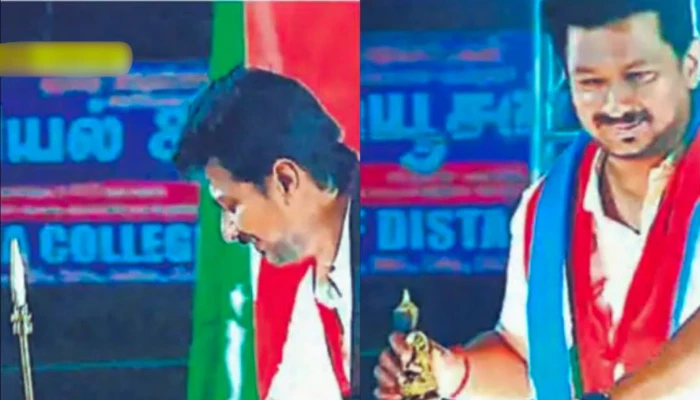
Case Summary
In Ramanathapuram, Tamil Nadu, Hindu Vel, a divine javelin or spear associated with Lord Murugan, was demeaned and disrespected by the ruling Dravida Munnetra Kazhagam (DMK) Deputy Minister, Udhayanidhi Stalin, in an election campaign event. He declined to accept a vel offered by a party functionary while accepting a Buddha statue presented shortly thereafter. The incident took place during a public meeting held in the palace area of Ramanathapuram, where Udhayanidhi Stalin had arrived to canvass for votes. After he concluded his address, party office-bearers and functionaries came forward to present him with gifts on stage. As per the report, one party functionary first presented him with a Vel (spear). Udhayanidhi briefly received the vel but immediately returned it to the same functionary. Moments later, another functionary presented him with a Buddha statue, which he accepted. The contrasting responses at the same event drew the attention of those present and elicited visible surprise among the attendees. This incident was not recorded in isolation. The Hinduphobia Tracker had previously documented instances in which Udhayanidhi Stalin and several political figures associated with the DMK and allied Dravidian parties have disrespected Hindu symbols, customs, and places of worship. In a speech delivered by Udhayanidhi Stalin, Deputy Chief Minister of Tamil Nadu, on 2 September 2023, the DMK leader had called for 'eradication' of Sanatan Dharma (Hinduism) and compared it with mosquitoes and diseases. Similarly, on 2 April, 2025, DMK leader A Raja, known for his history of Hinduphobic remarks, instructed party members to remove Hindu religious symbols while donning the party’s signature dhoti. In a widely circulated video, Raja underscored the need to differentiate DMK members from “Sanghis” by shedding visible markers of Hindu identity. He stated, “If you wear a ‘pottu’ (bindi/tilak/religious mark) and a Sanghi does the same, it becomes difficult to tell the difference when both clap. That’s why I say, pray to God if you wish. If your parents apply holy ash on your forehead, keep it. But once you wear the DMK dhoti, remove it.” Likewise, in Madurai on 22 December 2025, members of the Hindu community were subjected to abusive remarks and threats, and the revered Hindu symbol, the Vel, the sacred weapon of Lord Kartikeya/Murugan, was insulted by Dravidian politicians associated with the Viduthalai Chiruthaigal Katchi (VCK). The symbol was used in the course of political messaging and speeches directed against Hindu groups, which was recorded by the tracker as an incident involving disrespect towards a sacred Hindu representation. Similarly, in March 2025, at a book launch event for Dravidian Stock’s translation of Kalaignar’s Thirukkural, Dr Ezhilan mocked the Bhagavad Gita and the Upanishads. He questioned the placement of the Gita within the Mahabharata, ridiculed the idea of Lord Krishna advising Arjuna amid a battlefield, and compared the text unfavourably with other war literature. In the same speech, he claimed the Gita had been inserted to influence and kill people, used the phrase “Vachu Seiran”, and alleged that the text and the Upanishads were crafted to counter Buddhist influence. He also claimed the tradition contained mantras for destruction, diseases, urination, and constipation. Further, on January 18, 2026, Hinduphobia recorded how a sitting Tamil Nadu legislator, Dr Ezhilan Naganathan, referred to Brahmins as “mosquitoes” and suggested their annihilation during a social media exchange. In a recent event, Hindu customs were desecrated and defiled by the ruling Dravida Munnetra Kazhagam (DMK) minister. The DMK General Secretary and Water Resources Minister Duraimurugan went viral on social media after he was seen wiping off vibhuti from his forehead immediately after it was applied by a temple priest during a temple visit. Following the circulation of the footage, the incident drew public criticism and sparked reactions from various quarters ahead of the 2026 Tamil Nadu Assembly elections.
Why it is Hate Crime ?
The primary category selected for the case is- Attack on Hindu religious representations. The subcategory selected is- Desecration of a Hindu religious symbol. Icons and symbols, or a religious representation of a spiritual ideal, are widely revered in Hinduism. Iconography is of vital significance in the Hindu milieu. It helps connect people’s spiritual beliefs with the real world. Iconography within the Hindu faith takes several shapes and forms. Murtis are of most significance to Hindus, to which daily rituals, prayers and offerings are done. Besides the murtis, there are several other symbols which have deep significance in the Hindu faith – the Om and Swastika, for example. Since these Hindu religious symbols hold paramount importance in Hinduism, any desecration of symbols, icons, murtis, religious representations and manifestations, is driven by animosity towards the faith itself, which manifests itself through these murtis, icons and symbols. Therefore, any desecration of these Hindu religious symbols and representations is considered a religiously motivated hate crime under this category. This case was included under the selected category because the vel is not an ordinary object but a sacred Hindu religious symbol deeply revered by devotees of Lord Murugan. In Hindu tradition, especially in Tamil Nadu, the vel symbolised divine protection, courage, and the triumph of dharma over evil. It held immense spiritual and cultural significance for Hindus and was closely associated with worship, devotion, and religious identity. What made this incident serious was the stark bias exhibited by the DMK leader. The vel was returned in full public view, while another religious symbol was accepted and retained straight afterwards. This contrast in physical response carried an implied message of rejection. Public gestures often communicate meaning as strongly as words, and here the act itself conveyed visible reluctance and disregard towards a Hindu religious symbol. The implied insult lay in the manner of treatment, which distinguished the vel from the other symbol and made the disrespect evident without anything needing to be said. When such conduct came from a public figure, its impact extended beyond the stage itself. Public personalities influenced social attitudes, and their actions often carried symbolic meaning. By openly returning the vel, the gesture had the effect of making Hindus feel belittled for their religious practices and sacred symbols. It sent a message that a symbol central to the Hindu faith was being treated with less regard in comparison to another religious representation. The significance of the vel in Tamil Hindu tradition made this act particularly hurtful. It is inseparably linked with Lord Murugan and forms an important part of temple worship, festivals, and religious devotion across the region. A public refusal to retain such a symbol therefore directly affected the sentiments of Hindu devotees and reflected disregard towards a sacred manifestation of their faith. The incident involving Udhayanidhi Stalin’s refusal to accept the Vel, a sacred symbol associated with Lord Murugan, is not an isolated act but rather part of a broader, consistent pattern in the rhetoric and conduct of leaders within the DMK and its ideological ecosystem. Over the years, several party figures have made statements and gestures that reflect a deep-seated hostility towards Hindu beliefs, symbols, and practices. Udhayanidhi himself has previously called for the “eradication” of Sanatan Dharma, comparing it to diseases, while other leaders like A Raja have openly encouraged party members to shed visible markers of Hindu identity to distinguish themselves politically. Instances of mocking Hindu scriptures such as the Bhagavad Gita and Upanishads, derogatory remarks against specific Hindu communities, and the repeated desecration or rejection of sacred symbols like the Vel further reinforce this pattern. Even symbolic acts, such as wiping off vibhuti immediately after a temple ritual, signal a deliberate distancing from and rejection of Hindu traditions. Taken together, these actions and statements indicate that the disrespect shown towards the Vel is not incidental but reflective of an entrenched ideological stance within sections of the DMK that views Hindu identity and its expressions with disdain and seeks to undermine their legitimacy in public life. Taken together, the deliberate rejection of a sacred Hindu symbol in a public setting, coupled with the continuing history of anti-Hindu remarks, established clear hostility towards Hindu religious identity. For this reason, the case was rightly recorded as a hate incident involving the desecration and public disparagement of a Hindu religious symbol. Disclaimer: The Hinduphobia Tracker records incident dates based on when the victim's ordeal began, rather than when the media reported it. In this case, the report does not mention when the act was committed; therefore, the date when the report was published has been recorded as the indicative incident date for documentation purposes.


Case Status
Unknown


Perpetrators Details
Perpetrators
State and Establishment
Perpetrators Range
One Person
Perpetrators Gender
male
 Sources




